Meaning
Pre-defined tables of phase and amplitude states guide the beam steering vectors of wireless transceiver systems. Systematic codebook evaluation verifies that these pre-calculated states cover the required spatial directions with sufficient gain and minimal side lobes. The process determines how effectively an integrated radio transceiver switches through its pre-programmed phase configurations to maintain an optimal communication link during movement.
Beam Selectivity
Antenna arrays steer beams by applying specific phase progressions across individual radiating elements. If the increments between neighboring codebook entries are too coarse, blind spots can occur where the antenna gain drops abruptly.
Testing Benchmark
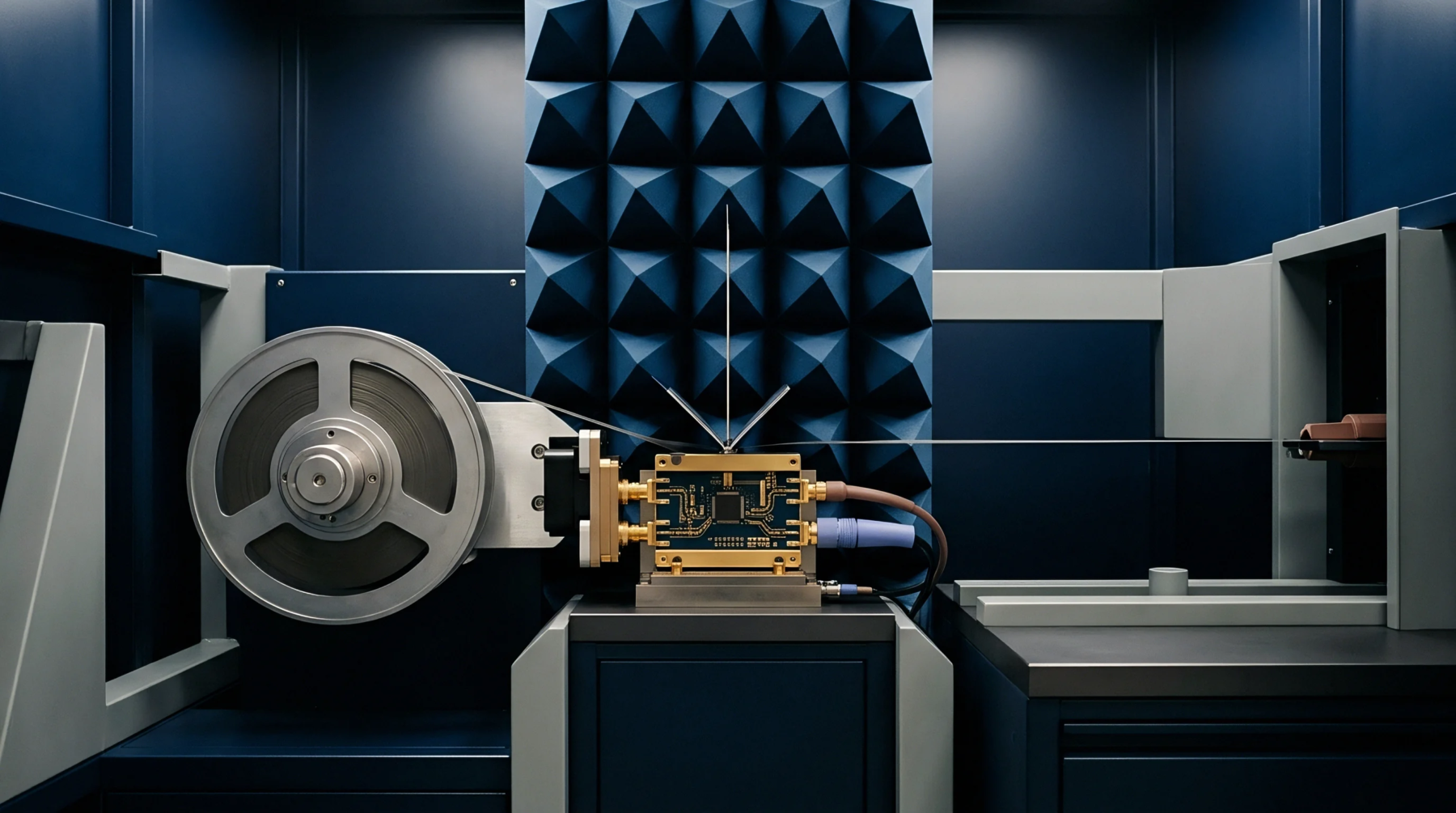
Measurement campaigns for these predefined tables use automated OTA chambers to scan the antenna pattern at each codebook index. The test system records the three-dimensional radiation pattern across the operating frequency band. These measurements generate a spherical matrix of equivalent isotropically radiated power values.
This spatial dataset is then compared with the expected numerical simulation during the product validation phase.
Module Integration
Host software drivers use the validated matrix indices to dynamically adjust the RF front-end settings based on received signal strength indicators. If a module cannot process the required switching speeds, latency will increase and degrade real-time traffic performance. Hardware integrators must balance the memory size of the lookup table against the switching speed of the phase shifters to ensure stable operation.