Managing Laboratory Chamber Testing for Chinese Radio Regulatory Compliance
Radio type approval in China demands accredited domestic chamber testing, strict sample hardware modification, and exact power spectral mask compliance.
Specialized radio frequency operation commands a wireless transceiver to emit an unmodulated or continuously modulated carrier at a single designated channel without engaging dynamic frequency hopping or carrier sensing mechanisms. Employed during regulatory compliance testing and manufacturing calibration, fixed frequency transmit forces the radio hardware to bypass regular media access control protocols and transmit uninterrupted at a specified power level. This unvarying transmission mode enables external measurement equipment to evaluate spectral purity, power amplifier linearity, harmonic suppression, and phase noise characteristics under repeatable conditions.
The method applies to factory verification lines and anechoic chamber testing. It ceases to apply during standard operational networking, where dynamic frequency agility, channel hopping, and regulatory medium-sharing algorithms must govern the air interface.
Initiating continuous transmission at an isolated channel exposes the integrated radio frequency front-end to maximum thermal and electrical dissipation. The local oscillator or frequency synthesizer locks onto the target carrier frequency, driving the internal power amplifier into continuous conduction rather than pulsed time-division bursts. This sustained signal output enables engineers to evaluate carrier frequency tolerance, phase noise spectral masks, and power amplifier saturation characteristics.
By maintaining uninterrupted signal generation, the transceiver establishes an unyielding target for spectrum analyzers and power meters during precision measurement cycles. Thermal equilibrium settles within minutes, showing whether transceiver cooling designs prevent frequency drift or unexpected thermal throttling during sustained transmission.
Production lines leverage static single-frequency emissions to execute high-speed parametric tuning of radio frequency matching networks and internal power settings. Rather than spending valuable seconds negotiating base-station handshakes, automated test equipment directly commands the unit under test via serial diagnostic interfaces to emit on low, mid, and high factory channels. High-speed automated power meters capture the absolute transmitted power across each individual channel, recording the precise attenuation offsets needed to achieve target output figures.
The test computer calculates correction factors for gain non-linearities and writes the calibration values directly into the permanent flash memory of the device. This rapid open-loop routine slashes per-unit calibration time from several minutes down to a few seconds per board.
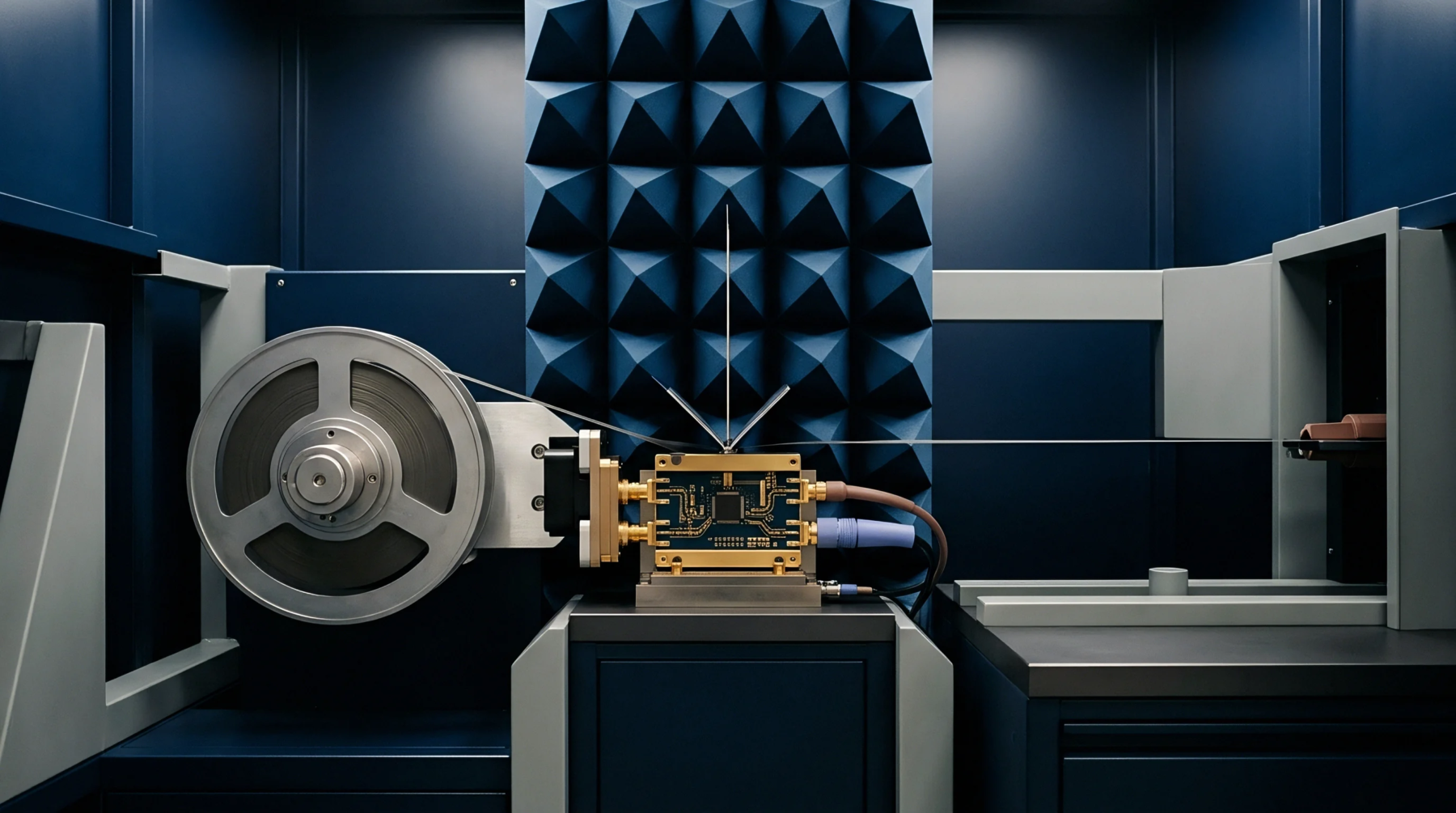
Formal type approval testing under regulatory standards demands unvarying radio output states to capture worst-case electromagnetic emission profiles. Accredited certification laboratories configure the unit for fixed frequency transmit across its operating band edges to ensure compliance with strict out-of-band emission boundaries. The testing officer measures fundamental radiated power, adjacent channel power ratios, and harmonic emissions up to several times the operating frequency inside an anechoic enclosure.
Test reports detail exact frequency offsets, spectrum analyzer bandwidth settings, detector modes, and measured emission amplitudes against legal maximum thresholds. Final regulatory certification documents log the command scripts and interface sequences used to engage the test mode, ensuring third-party audit repeatability.
Radio type approval in China demands accredited domestic chamber testing, strict sample hardware modification, and exact power spectral mask compliance.
Expertise is a utility, not a secret. sentiention™ publishes its working knowledge as open reference: intelligence layer covering the materials it sources, the markets it enters, and the reference that serves both.