ATE Fixture Design Escrow File Formats and Asset Transfer Procedures
Verify uncompiled native CAD, wiring schedules, and containerized test sequences in escrow to ensure seamless physical fixture transfer and line re-qualification.
Industrial automation systems utilize compressed gas conversion to generate mechanical force through linear or rotary motion mechanisms. Pneumatic actuation drives the mechanical movements inside production testing fixtures, pick-and-place component placement arms, and automated enclosure pressing machines. The physical domain operates on differential air pressure applied against internal pistons, diaphragms, or sliding vanes, translating fluid energy into physical displacement.
The mechanism ceases to apply in purely electromechanical, piezoelectric, or hydraulic drive systems that do not rely on a regulated factory air supply.
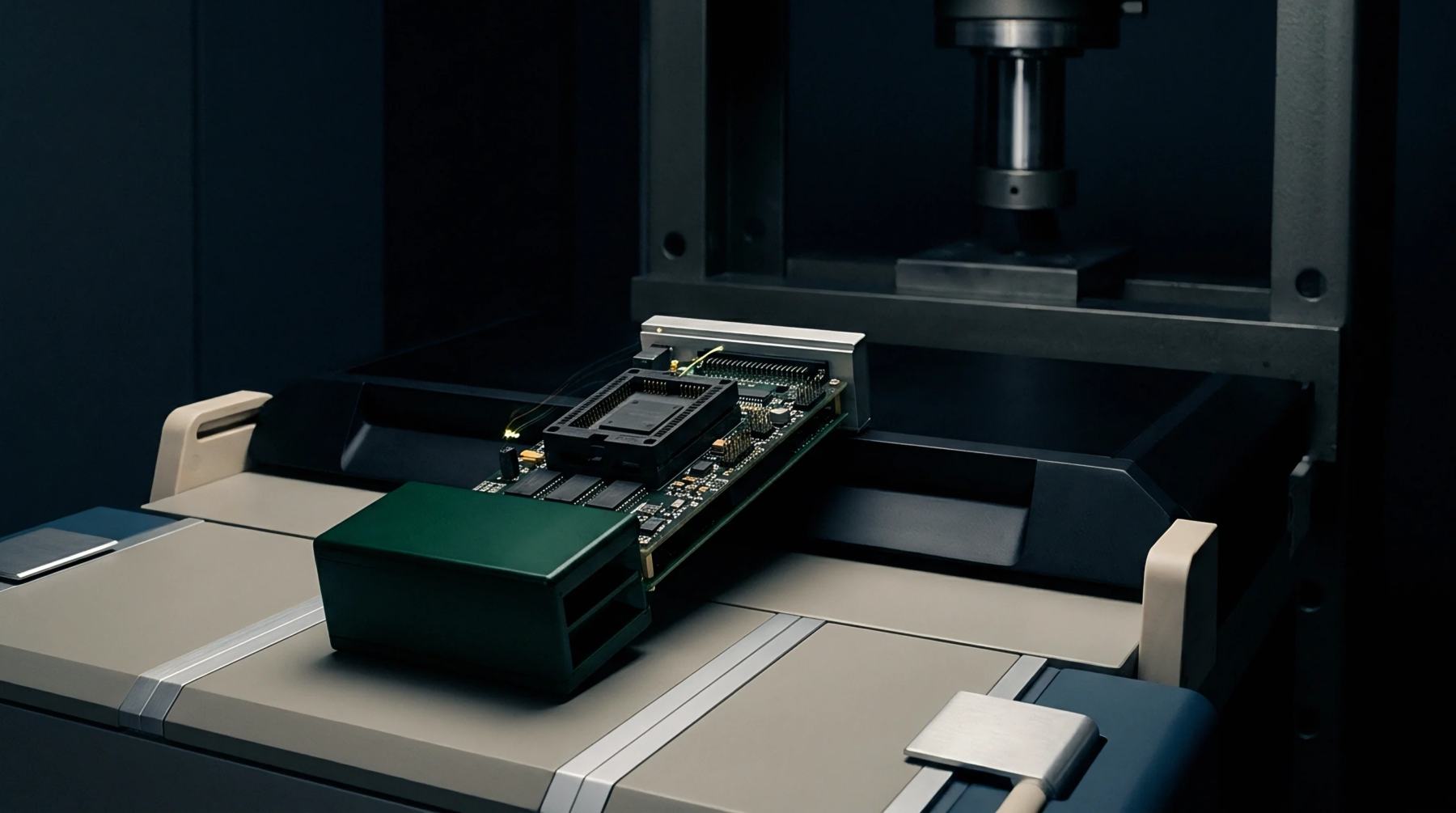
Automated manufacturing fixtures for assembled circuit boards depend on controlled downward travel to mate spring-loaded test probes with miniature target pads. Pneumatic actuation delivers uniform clamping pressure across custom bed-of-nails fixtures, overcoming the combined upward spring resistance of several hundred pogo pins simultaneously. Regulated pneumatic cylinders depress mechanical push-rods evenly, seating the device under test into alignment nests without inducing localized mechanical stress.
Excessive or uneven mechanical displacement can crack surface mount multi-layer ceramic capacitors, sever ball grid array solder joints, or fracture trace layers inside printed circuit boards. Dual-hand safety start buttons and position-sensing magnetic reed switches confirm full physical closure before test instrumentation connects to device circuits.
Stable force generation requires precise control over supply line pressure, air filtration, and flow exhaust rates. Systems driven by pneumatic actuation incorporate filter-regulator-lubricator units to strip moisture, oil mists, and particulates from compressed air before gas enters valve manifolds. Regulating proportional air pressure allows operators to tune insertion forces for delicate sub-miniature radio frequency connectors, preventing mechanical deformation of gold-plated center pins.
Speed control valves restrict exhaust airflow, damping cylinder stroke velocity to minimize mechanical impact shocks as tooling reaches end-of-stroke limits. When factory line pressure drops below calibrated operational limits, digital pressure switches halt testing routines immediately to avoid partial pin contact and false failure reports.
Industrial communication buses route control signals from programmable logic controllers to solenoid-driven air distribution manifolds. Integrating pneumatic actuation with automated test software requires interlocking electrical feedback signals with test step execution. A fixture control sequence fires a direct current solenoid to advance a cylinder, delays until reed switches confirm mechanical limit engagement, and then initiates electrical communication routines across universal serial bus or cellular antenna ports.
Exhaust silencers dampen acoustic discharge noise, maintaining factory floor noise thresholds during rapid cycling. Precise mechanical displacement guarantees repeatable contact impedance during high-throughput end-of-line verification.
Verify uncompiled native CAD, wiring schedules, and containerized test sequences in escrow to ensure seamless physical fixture transfer and line re-qualification.
Expertise is a utility, not a secret. sentiention™ publishes its working knowledge as open reference: intelligence layer covering the materials it sources, the markets it enters, and the reference that serves both.