Meaning
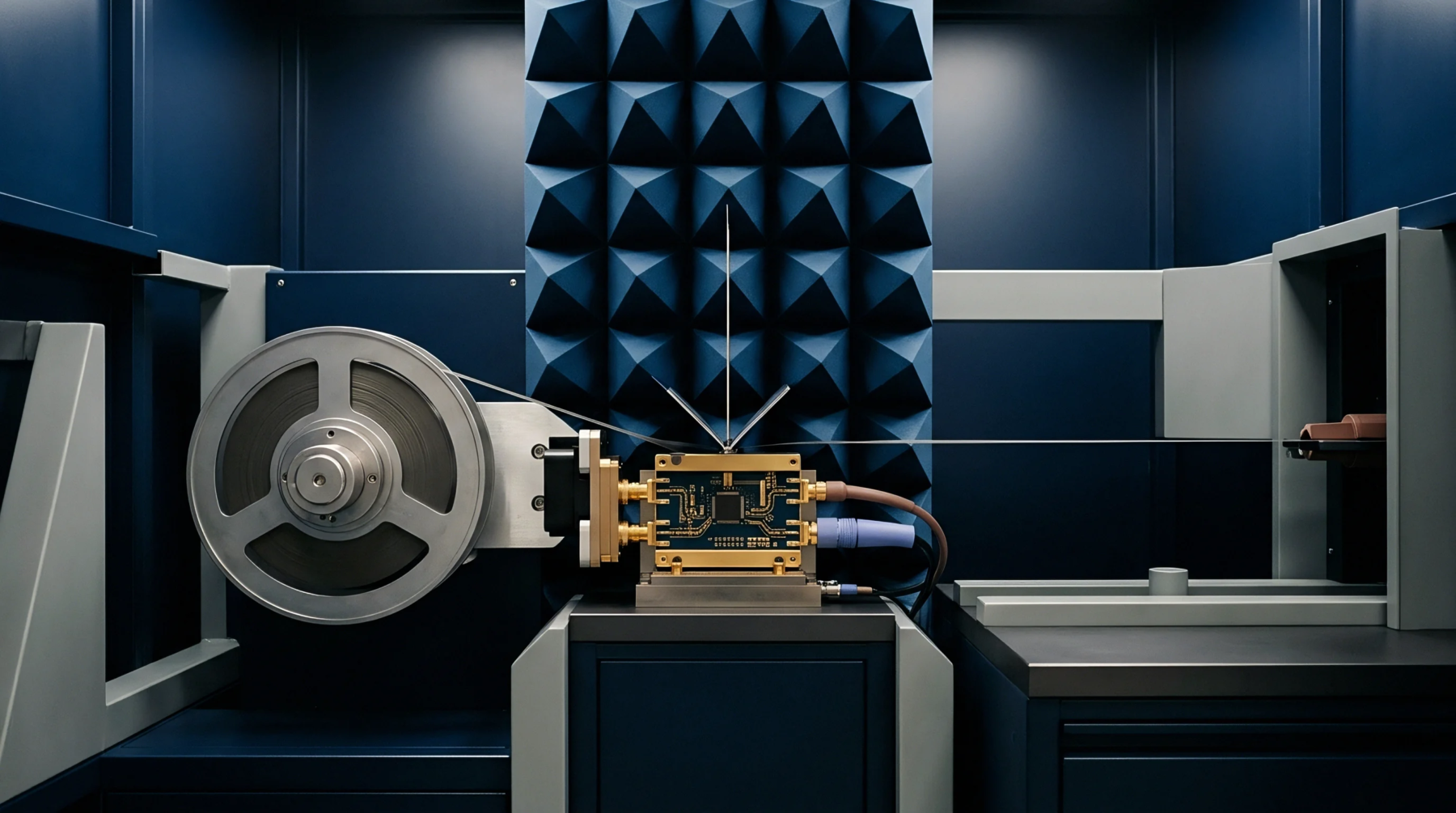
A shielded enclosure lined with wedge-shaped radio frequency absorbers provides an environment free from electromagnetic reflections for testing wireless devices. This anechoic room simulates free space by absorbing incident waves across designated frequency bands. Test engineers place antennas inside this chamber to isolate device performance from external interference and multipath distortion.
Shielding Architecture
Metal panels welded continuously around the perimeter form a Faraday cage that blocks ambient radio frequency signals from entering the measurement volume. Copper or galvanized steel sheets create a low-resistance barrier that attenuates high-frequency radiation by up to one hundred decibels. Joints between panels undergo stringent sealing to prevent electromagnetic leakage during active transmissions.
Absorption Physics
Pyramidal foam elements containing carbon and ferrite materials attenuate incoming waves by converting electromagnetic energy into thermal dissipation. Foam geometry creates a gradual impedance transition between air and the lossy medium, minimizing surface backscatter. Shorter wedges absorb higher gigahertz frequencies, while longer configurations damp lower megahertz signals effectively.
Test Execution
Operators mount the device under test on a non-reflective turntable positioned in the quiet zone of the chamber. Automated positioning systems rotate the assembly while stationary receiver antennas measure radiation patterns across spherical coordinates. Calibration scans precede every test sequence to establish baseline ambient levels before certification measurements commence.