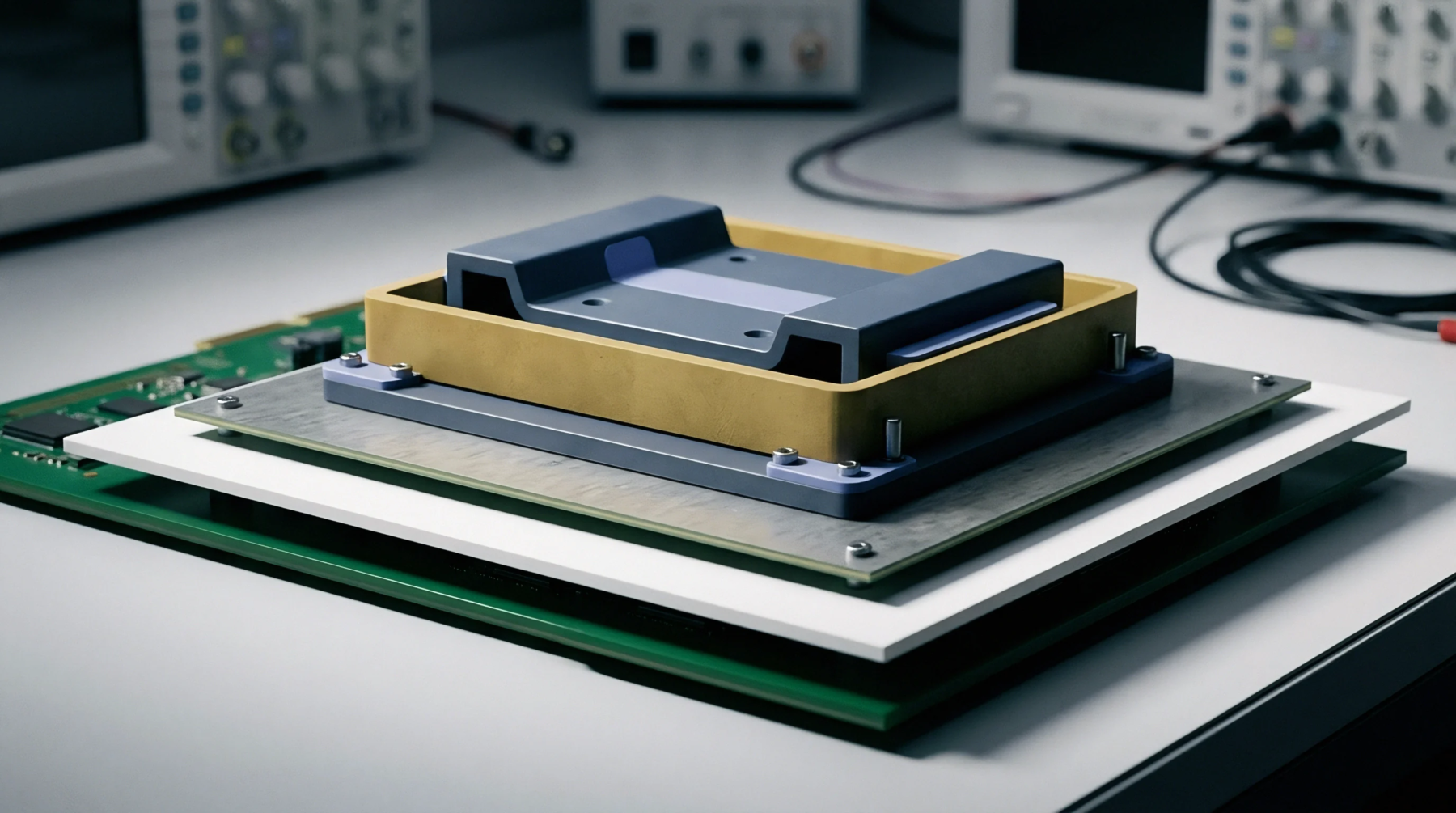
Mould and Test Jig Ownership When Production Moves
Asset ownership requires unbundled NRE contracts, native CAD databases, containerized firmware build tools, and explicit bailment agreements waiving factory liens.
Firmware containerization acts as an architectural encapsulation method where low-level machine instructions and hardware abstraction layers reside within isolated software environments to ensure execution parity across disparate embedded processing architectures. By wrapping binary blobs and their immediate dependencies into protected segments, firmware containerization prevents unauthorized memory access between discrete control modules within a multi-tenanted SoC or system-on-chip environment. Logic isolation occurs at the bootloader level where each virtualized partition demands specific cryptographic signatures before initialization.
Access control policies reside inside the secure storage area to prevent cross-process data leakage during runtime execution. Memory regions remain locked to specific virtual containers while hardware peripherals are arbitrated through a centralized hypervisor layer to stop resource contention. Systems relying on this architecture allow for independent updates to specific device drivers without requiring a full image reflashing cycle.
Boundary conditions occur when the hardware lacks a memory management unit or possesses restricted hardware acceleration support for virtualization tasks.
Heat dissipation across dense integration boards fluctuates when multiple containers initiate high-frequency processing simultaneously. Practitioners measure thermal throttling points during the initial validation of the board power profile to see if the silicon remains within safe operating junctions. These thermal constraints dictate the maximum number of concurrent processes allowed within the firmware containerization framework before system stability degrades.
Sensors embedded on the PCB trigger frequency scaling if the logic density causes local hot spots near the processor core. Designers must calculate the total power consumption by summing the individual container overhead with the baseline hardware activity to prevent thermal shutdown scenarios.
Communication pathways between discrete firmware segments rely on shared memory buffers that require strictly defined protocols for data exchange. Developers verify these interface junctions through a hardware abstraction layer that acts as the primary translator between the containerized logic and the physical pins. Integration teams confirm this mechanical and logical fit during the early prototyping stage by monitoring signal latency between separate process threads.
Errors often propagate when the container boundary ignores interrupt latency requirements or fails to respect the hardware timing signals.
Production units undergo testing to confirm that the firmware containerization holds firm during the transition from the development environment to the finished device assembly. Engineers perform a boundary scan to verify that memory protection units prevent container escape attempts that compromise the system root of trust. This validation process happens after the supplier provides the initial binaries but before the buyer approves the final assembly for distribution.
Testing focuses on the verification of individual partition integrity and the speed of inter-process communication under heavy load conditions. Each container must provide a response within the millisecond window allotted by the system scheduler to maintain operational timing. Final verification ensures that the hardware security modules properly gate all attempts by external sources to overwrite containerized logic or modify the associated hardware abstraction mapping.
Firmware containerization provides the necessary segregation to maintain long-term stability in complex connected devices.
Asset ownership requires unbundled NRE contracts, native CAD databases, containerized firmware build tools, and explicit bailment agreements waiving factory liens.
Expertise is a utility, not a secret. sentiention™ publishes its working knowledge as open reference: intelligence layer covering the materials it sources, the markets it enters, and the reference that serves both.