Meaning
Radio frequency integrated circuits operating above twenty-four gigahertz convert high-frequency electromagnetic signals directly into baseband or intermediate frequencies within compact system architectures. Operating within the millimeter spectrum, mmwave transceivers encompass the active silicon, local oscillators, upconverters, downconverters, and beamforming phase shifters required for high-bandwidth wireless communications. These devices govern fifth-generation cellular backhaul, fixed wireless access, automotive radar, and high-throughput point-to-point links.
They stop applying to sub-six-gigahertz wireless architectures where fractional bandwidths are lower and discrete, separated component topologies remain economically and technically viable.
Semiconductor Integration
Path loss increases dramatically at millimeter-wave frequencies, demanding active beamforming arrays to focus RF energy into directional beams. Modern mmwave transceivers integrate dozens of power amplifiers, low-noise amplifiers, and digitally controlled phase shifters onto a single silicon-germanium or complementary metal-oxide-semiconductor die. These integrated circuits handle complex modulation schemes like 64-QAM and 256-QAM across channel bandwidths reaching several hundred megahertz.
The extreme frequencies make traditional wire-bonding unfeasible due to parasitic inductance, compelling the use of flip-chip packaging and ball grid array interconnects that connect directly to antenna-in-package substrates.
Thermal Enclosure
Dissipating thermal energy represents a critical design challenge when deploying high-density millimeter-wave silicon. Because the efficiency of silicon-based millimeter-wave power amplifiers remains low, mmwave transceivers convert a large percentage of DC input power into heat within a very small footprint. If that thermal load is not transferred away from the package, junction temperatures rise rapidly, degrading phase accuracy, reducing output power, and accelerating semiconductor wear.
Mechanical enclosures must incorporate thermal interface materials directly against the transceiver package back-side, routing heat toward external aluminum chassis structures without distorting the sensitive antenna arrays co-located on the same printed circuit board.
System Interfacing
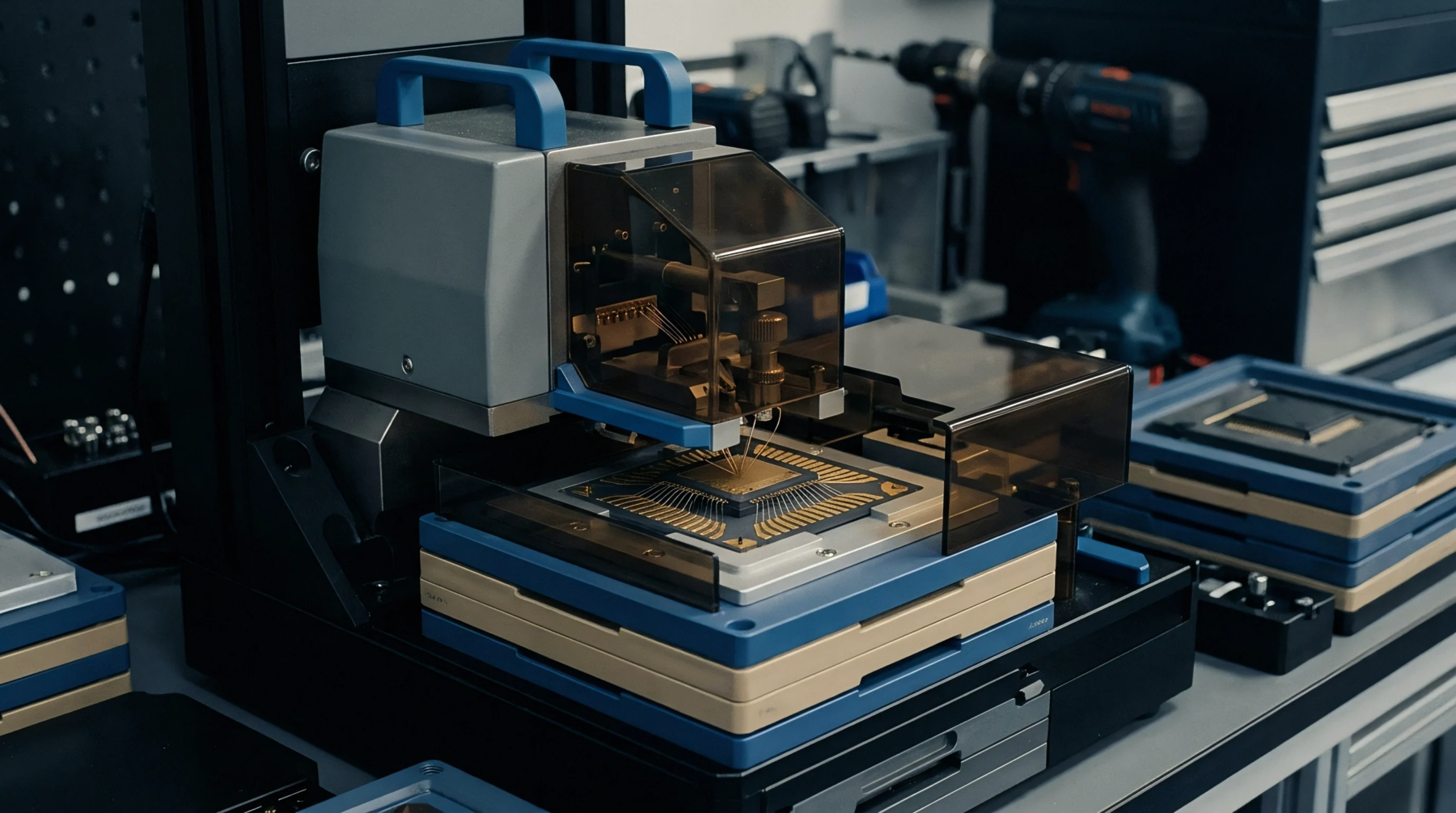
Validating high-frequency transceiver assemblies requires specialized test benches utilizing automated probe stations, downconverting spectrum analyzers, and calibrated anechoic chambers. Hardware validation teams evaluate performance metrics including error vector magnitude, beam-steering settling times, and equivalent isotropically radiated power across the full angular sweep. Handover documentation for these systems details phase calibration tables and temperature compensation coefficients that baseband algorithms apply during active communication links.
Stable transceiver operation ensures that millimeter-wave radio links maintain low latency and sustained data throughput across complex, non-line-of-sight urban environments.