Meaning
Electromagnetic interaction between adjacent elements in a multi-antenna array alters the excitation currents and voltages of individual radiators. The phenomenon of mutual coupling skew refers to the resulting asymmetric distortion of the steered beam and the deviation of the main beam from its target angle. This effect arises because the impedance of each antenna element changes dynamically as a function of the steering phase.
Coupling Mechanism
When individual elements in a phased array are placed close together, the radiation from one element induces currents in its neighbors. This mutual energy transfer is stronger when the array has a tight element spacing, which is common in compact millimeter-wave modules.
Distortion Metric
Engineers quantify this steering error by measuring the difference between the intended steering angle and the actual radiated peak power direction. This deviation increases at wide scan angles where the phase difference between elements is largest. A skewed beam leads to poor beamforming efficiency and increases the power directed into unwanted sidelobes.
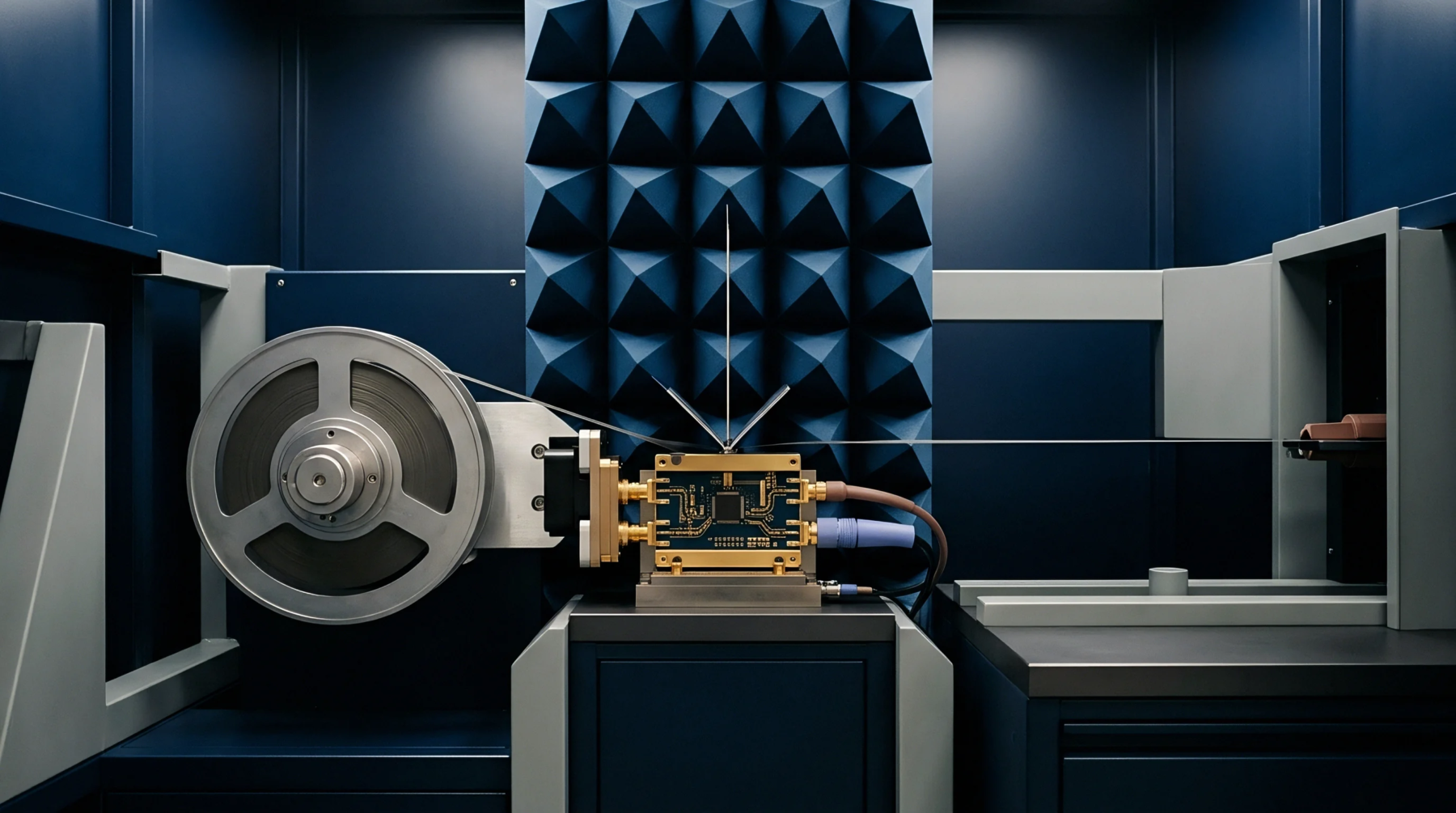
Measurement platforms use multi-axis goniometers to record the three-dimensional radiation pattern and identify these angular deviations.
Mitigating Design
Antenna designers use physical isolating structures, such as electromagnetic bandgap elements or decoupling walls, to reduce the energy transfer between elements. If physical isolation is insufficient, the system must use digital compensation algorithms within the beamforming codebook. These algorithms adjust the phase and amplitude coefficients applied to each element to counteract the predicted coupling effects.