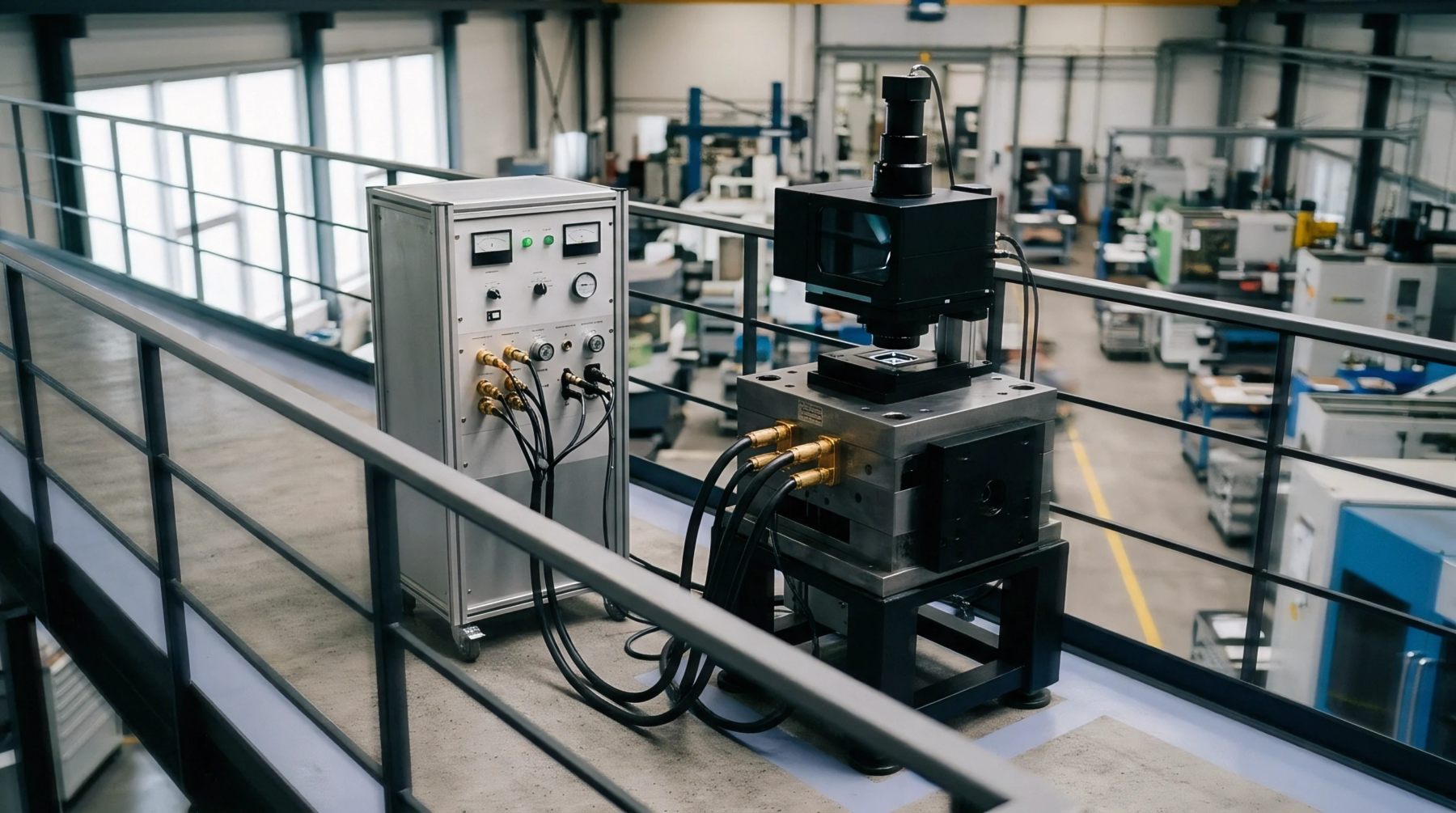
Dielectric Measurement Methods for Automotive Radar Enclosures
Characterizing automotive radar enclosures demands resonant cavity screening for raw resins and quasi-optical free-space sweeps for painted multilayer fascias.
Millimetre-wave radio frequency allocation spans the band from 76 GHz to 81 GHz designated internationally for vehicular radar sensors and industrial range measurement. Operation at 77 GHz permits small antenna apertures while providing wide sweep bandwidths required for high range resolution in object detection. The wavelength in free space sits slightly below four millimetres, confining effective propagation to line-of-sight paths subject to atmospheric oxygen absorption and heavy scattering by precipitation.
The allocation stops at 81 GHz where regional spectrum assignments yield to radio astronomy and fixed point-to-point links.
Signal distribution between the monolithic microwave integrated circuit and the radiating patch array demands low-loss substrates such as hydrocarbon ceramics or liquid crystal polymers. Waveguide structures routed through standard FR-4 circuit boards suffer severe dielectric dissipation exceeding one decibel per millimetre at 77 GHz, which degrades radar link margins and increases receiver noise figure. Microstrip transitions at these frequencies rely on tight etched copper tolerances within plus or minus five micrometres to prevent phase velocity mismatch.
Solder balls in ball grid array packages introduce parasitics that act as low-pass filters unless compensated by coplanar ground structures. Mold compound over the package must maintain uniform thickness because permittivity drift shifts antenna beam directivity away from design boresight.
Protective plastic enclosures placed over front-end antennas alter radiation patterns through dielectric reflection and phase retardation. The plastic wall must match a half-wave thickness calculated from the resin dielectric constant at 77 GHz to minimize return loss back into the transmitter. Polycarbonate and polybutylene terephthalate formulations require uniform wall density to avoid internal voids that scatter power.
Tooling split lines or wall taper placed in front of patch arrays distort radar phase centers and degrade angular accuracy in direction-finding algorithms. Paint coatings containing metallic flake create local attenuation that attenuates target echoes and raises false alarm counts. Moisture absorption by the radome resin shifts real permittivity upward, detuning the matched transmission window under humid operating cycles.
Frequency-modulated continuous-wave radar architectures depend on precise ramp linearity to resolve target distance without spreading spectral energy across adjacent frequency bins. Synthesizer phase noise and voltage-controlled oscillator non-linearities across a four gigahertz chirp sweep induce range sidelobes that mask small radar cross-section targets situated beside strong reflectors. Production calibration maps frequency error versus tuning voltage to generate correction factors stored in factory non-volatile memory.
Transmitter phase stability during temperature ramp tests determines qualification under automotive safety integrity targets. The production test sequence captures intermediate-frequency spectra in an anechoic chamber to confirm phase noise meets mask limits across the full operational sweep.
Characterizing automotive radar enclosures demands resonant cavity screening for raw resins and quasi-optical free-space sweeps for painted multilayer fascias.
Expertise is a utility, not a secret. sentiention™ publishes its working knowledge as open reference: intelligence layer covering the materials it sources, the markets it enters, and the reference that serves both.