Sub-GHz Quartz Drift Basics under Ambient Temperature Variations
Thermal quartz drift reduces sub-GHz receiver sensitivity by misaligning narrow channel filters unless compensation matches environmental swings.

Resonance
Piezoelectric quartz blanks utilized in sub-GHz radio frequency circuits exhibit physical dimensional changes across temperature variations. These physical shifts alter the mechanical vibration frequency of the crystal lattice, forcing the fundamental oscillator frequency to drift from its nominal room-temperature calibration. In sub-gigahertz wireless architectures operating across 433 MHz, 868 MHz, and 915 MHz Industrial, Scientific, and Medical bands, reference clock accuracy governs the RF carrier center frequency, local oscillator tuning, and internal digital modem timing.
Understanding the thermal drift mechanics of passive quartz crystals requires isolating initial manufacturing tolerance, thermal curvature characteristics, and long-term crystal lattice aging.

AT Cut Quartz Crystal Temperature Mechanics
Mechanical slicing of synthetic quartz along specific crystallographic angles governs frequency stability across ambient operational ranges. AT-cut quartz crystals dominate sub-GHz reference clock implementations due to cost efficiency and predictable thermal performance. The frequency-temperature response of an AT-cut crystal follows a cubic parabolic equation centered around a turnover point near 25 degrees Celsius.
Equations governing this mechanical behavior express frequency deviation in parts per million relative to the nominal frequency.
Mathematically, the thermal frequency drift follows a standard parabolic approximation across industrial operating temperature bands spanning minus 40 degrees Celsius to plus 85 degrees Celsius:
Frequency Drift Formula ~ Δf / f0 = A · (T – T0)³ + B · (T – T0)² + C · (T – T0) + Δf_initial / f0
For standard AT-cut crystals, the parabolic quadratic coefficient B dominates the ambient drift curve, typically measuring minus 0.035 parts per million per degree Celsius squared. The linear coefficient C and cubic coefficient A remain minimal near room temperature but alter the curve at extreme sub-zero or high-temperature outdoor thresholds. Cold shifts peak frequency.
Thermal drift accelerates.
Initial calibration tolerance at 25 degrees Celsius typically introduces a fixed offset of plus or minus 10 to 20 parts per million. Soldering reflow thermal stress shifts this baseline by an additional plus or minus 3 to 5 parts per million due to mechanical strain on the crystal enclosure leads. Annual aging effects add roughly plus or minus 1 to 3 parts per million per year as trace contaminants inside the hermetically sealed crystal can interact with the quartz electrode plating.
At minus 40 degrees Celsius, an uncompensated 868 MHz quartz crystal exhibits up to 100 parts per million deviation, generating an 86.8 kilohertz frequency shift that exceeds standard 125 kilohertz channel filters.
When an uncompensated quartz crystal experiences outdoor ambient temperature changes, the total frequency error accumulates rapidly at the operating band endpoints. At 915 MHz, a total error budget of 50 parts per million translates into an absolute frequency offset of 45.75 kilohertz. If both the transmitter node and receiver gateway rely on uncompensated crystals facing opposite thermal extremes, total system offset doubles to nearly 91.5 kilohertz.
Margin collapses quickly.
| Operating Frequency | Initial Tolerance (25°C) | Drift at -40°C (ppm) | Drift at +85°C (ppm) | Max Single-End Offset (kHz) | Max Node-to-Gateway Offset (kHz) |
|---|---|---|---|---|---|
| 433.92 MHz | ±10 ppm | -85 ppm | -65 ppm | 41.22 kHz | 82.44 kHz |
| 868.30 MHz | ±10 ppm | -85 ppm | -65 ppm | 82.48 kHz | |
| 915.00 MHz | ±10 ppm | -85 ppm | -65 ppm | 86.92 kHz | 173.85 kHz |
Component vendors routinely claim that standard passive crystals deliver reliable performance across standard industrial temperature ranges when embedded in sealed outdoor metering enclosures. Sourcing agents hear claims that board layout parasitic capacitance adjustments eliminate thermal frequency errors without active compensation hardware. Field measurements reveal that circuit capacitance trimming corrects only the initial 25 degree Celsius room-temperature offset, leaving thermal parabolic drift unaddressed during freeze and thaw ambient cycles.
Mismatch
Carrier frequency shifts between transmitting nodes and receiving base stations compress the available link margin inside RF transceivers. When a transmitter radiates power at a frequency shifted by thermal drift, the receiver local oscillator must capture that carrier within its internal intermediate frequency filter passband. If the thermal drift pushes the radiated carrier outside the receiver channel filter bandwidth, incoming signal energy experiences severe attenuation, degrading receiver sensitivity and elevating packet error rates.
How Does Frequency Offset Degrade Sub-GHz Receiver Sensitivity?
Signal power entering a sub-GHz radio front end faces attenuation when carrier energy falls outside the passband of internal intermediate frequency stage filters. In 2-FSK and 2-GFSK modulation schemes typical of sub-GHz systems, signal detection relies on measuring frequency deviation relative to the center channel frequency. Total channel bandwidth necessary for unattenuated reception follows Carson’s Rule adjusted for mutual frequency offset between transmitter and receiver reference oscillators.
Channel Bandwidth Equation with Drift ~ BW_channel ≥ Bit_Rate + 2 · Frequency_Deviation + 2 · Total_Frequency_Offset
When thermal variation creates a frequency offset that consumes the safety margin built into the receiver channel filter bandwidth, the receiver channel filter attenuates signal sidebands. This filtering action reduces the signal-to-noise ratio entering the digital demodulator stage. Frequency error shifts IF filters.
A 3 dB drop in received signal power halves the effective communication range in free space propagation scenarios, while a 10 dB attenuation degrades outdoor coverage distances by up to seventy percent under log-distance path loss conditions.
The operational degradation modes triggered by uncompensated thermal quartz drift encompass specific hardware failure points in sub-GHz radio links:
- Preamble Detection Failure occurs when the receiver modem fails to detect incoming synchronization bits because signal power lands in the stopband of the intermediate frequency channel filter.
- Demodulation Distortion arises when Frequency Shift Keying tone frequencies drift asymmetrical to the receiver channel center, skewing bit decision thresholds inside the digital baseband slicer.
- Phase Locked Loop Slip happens when local oscillator tracking loops fail to achieve frequency lock during the initial burst transmission frame due to excessive carrier frequency offset.
- Adjacent Channel Attenuation occurs when high receiver filter bandwidth settings introduced to accommodate crystal drift accept elevated thermal noise floor power, degrading baseline receiver sensitivity by several decibels.
Designing receiver passbands without accounting for bidirectional thermal frequency drift causes silent packet loss at geographic temperature extremes.
To demonstrate the relationship between quartz drift, channel bandwidth selection, and receiver sensitivity degradation, consider a sub-GHz radio operating at 868 MHz with a 50 kbps data rate and a 25 kHz frequency deviation. Under ideal conditions, Carson’s Rule indicates a minimum required signal bandwidth of 100 kHz. Widening the receiver channel filter bandwidth to 200 kHz accommodates reference quartz thermal drift, but increases total integrated noise power entering the receiver front end, permanently lowering baseline sensitivity.
| Data Rate / Deviation | Receiver IF Bandwidth | Carrier Offset (kHz) | Signal Power Loss | Effective Sensitivity (dBm) | Link Margin Deficit |
|---|---|---|---|---|---|
| 50 kbps / ±25 kHz | 100 kHz | 0 kHz | 0.0 dB | -110.0 dBm | 0.0 dB |
| 50 kbps / ±25 kHz | 100 kHz | 20 kHz | 1.8 dB | -108.2 dBm | 1.8 dB |
| 50 kbps / ±25 kHz | 100 kHz | 40 kHz | 6.5 dB | -103.5 dBm | 6.5 dB |
| 50 kbps / ±25 kHz | 200 kHz (Widen) | 40 kHz | 3.0 dB (Noise) | -107.0 dBm | 3.0 dB |
| 50 kbps / ±25 kHz | 100 kHz | 60 kHz | 18.2 dB | -91.8 dBm | 18.2 dB |
Failure to match receiver channel filter bandwidth parameters against thermal quartz drift characteristics leads directly to intermittent packet drops during seasonal ambient temperature drops, generating field service calls and operational downtime for outdoor sensor deployments.

Channelization
Spectrum allocations enforced by international telecommunications authorities define rigid boundary masks for sub-gigahertz ISM operation. Operating sub-GHz equipment in European markets under ETSI EN 300 220 specifications or North American markets under FCC Part 15 subparts requires strict adherence to channel center frequencies and occupied bandwidth limits. When thermal drift forces carrier emission outside permitted spectral masks, non-compliant transmissions cause adjacent channel interference and violate regional radio equipment regulations.
Regulatory Band Restrictions and Narrowband Constraints
European regulatory frameworks managed by ETSI specify narrow channel allocations in the 868 MHz band, including dedicated 12.5 kHz and 25 kHz channel grids for high-duty-cycle industrial telemetry. In a 12.5 kHz channel allocation, total permitted frequency error across temperature extremes must remain under 1.5 kHz to prevent spectral spillover into adjacent channels. A standard passive quartz crystal exhibiting 50 parts per million drift at 868 MHz drifts by 43.4 kilohertz, completely exceeding the 12.5 kHz channel boundaries.
Channel spacing shrinks.
North American FCC Part 15 regulations permit wider bandwidth digital modulation schemes across the 902 MHz to 928 MHz ISM band, but mandate frequency stability under section 15.215 to keep occupied bandwidth within assigned band edges during environmental variations. System integrators calculating RF channel plans for outdoor deployments evaluate thermal frequency margins using a sequential analytical methodology.
- Determine maximum and minimum operational ambient temperatures expected within the field enclosure, accounting for solar heating loading.
- Calculate total prospective quartz frequency deviation across the temperature span using crystal vendor parabolic coefficients and manufacturing tolerance limits.
- Multiply maximum parts per million error by the operating RF carrier frequency to isolate absolute center frequency drift in kilohertz.
- Add worst-case transmitter drift to worst-case receiver drift to establish maximum total system carrier offset.
- Compare calculated total carrier offset against regional regulatory channel boundary masks and receiver filter passband constraints.
- Select appropriate oscillator hardware tiers or enable receiver digital frequency tracking mechanisms to guarantee regulatory compliance margin.
ETSI EN 300 220 clause 7.2 imposes maximum transmitter frequency error limits that disqualify uncalibrated passive crystals in 25 kilohertz sub-GHz allocations.
Sub-GHz systems utilizing ultra-narrowband modulations, such as 100 bps or 1 kbps telemetry links, face severe constraints under ambient temperature swings. At a bit rate of 1 kbps, receiver filter bandwidths are configured down to 2.4 kHz to minimize thermal noise power and achieve maximum receiver sensitivity near minus 130 dBm. An uncompensated quartz drift of 20 kilohertz shifts the signal far beyond the receiver passband, breaking connectivity entirely.
Crystal tolerance sets yield.
Regulatory compliance contracts for commercial radio modules mandate that certified equipment preserve channel center alignment within published tolerances across all declared operational environmental conditions, compelling modular suppliers to document thermal frequency stability in certification submission files.
Compensation
Transceiver design practices mitigate oscillator frequency deviations through embedded hardware algorithms or stabilized reference source topologies. Selecting appropriate frequency stabilization methods balances baseline bill of materials cost against operational current consumption during active frame processing. System architects choose between passive crystals paired with Automatic Frequency Control baseband loops, or hardware Temperature Compensated Crystal Oscillators that preserve frequency accuracy at the component level.
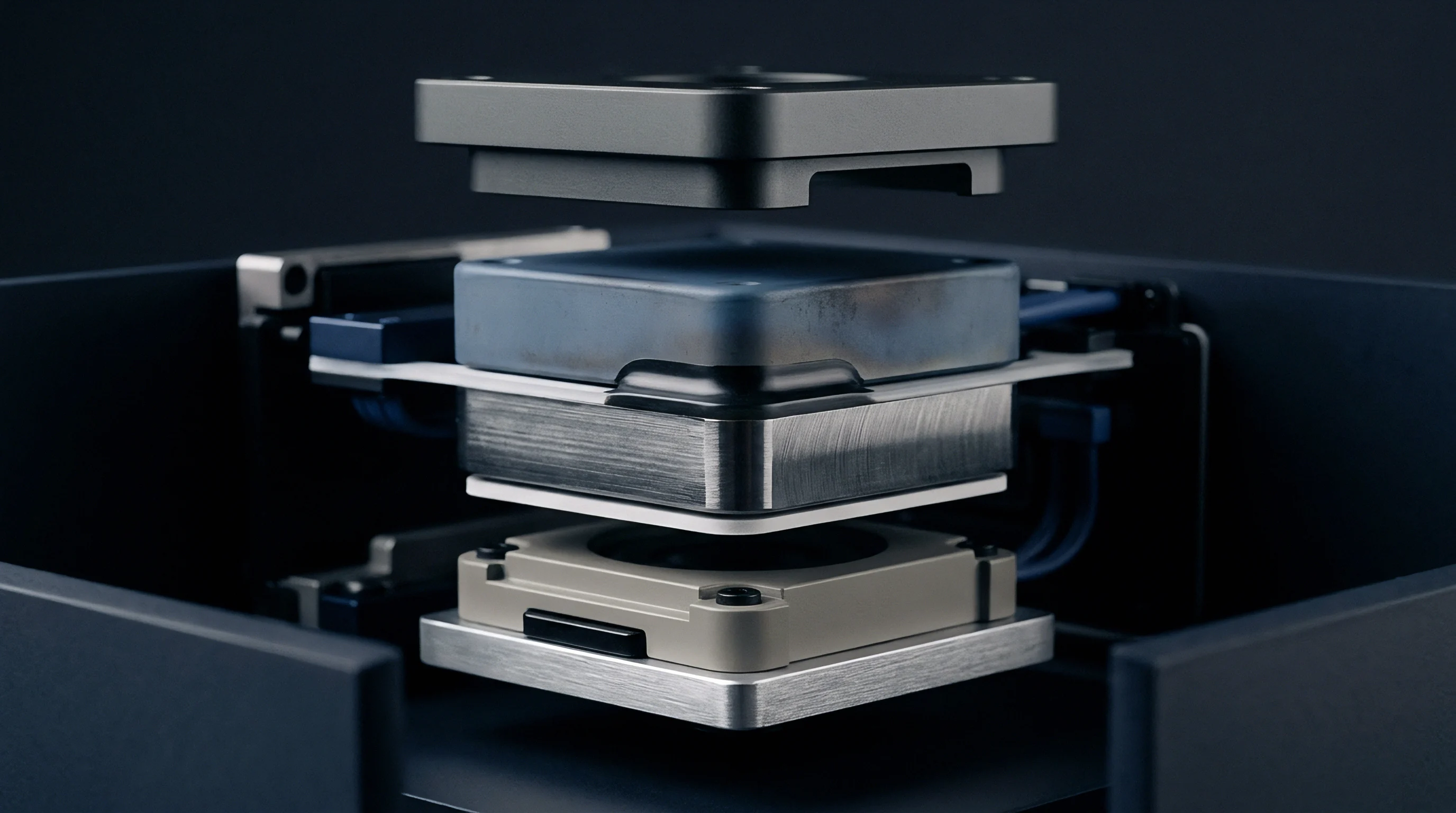
Automatic Frequency Control Mechanics and TCXO Hardware Architectures
Sub-GHz transceiver chipsets feature integrated Automatic Frequency Control circuits that detect carrier frequency errors during preamble reception and tune receiver local oscillator frequencies to match incoming signals. The AFC circuit operates by calculating the carrier frequency delta across preamble symbol transitions and adjusting internal digital synthesizer feedback dividers. Preamble bits consume energy.
Automatic Frequency Control systems operate under specific physical constraints. The maximum capture range of an AFC loop typically equals half of the receiver intermediate frequency filter bandwidth. If thermal drift shifts the carrier frequency beyond this capture window, the AFC loop fails to acquire frequency lock, resulting in total frame rejection.
Extending preamble length provides the digital baseband modem adequate time to acquire lock, but extends transmitter airtime, elevating node energy expenditure.
Replacing passive crystals with active TCXO components eliminates frequency tracking preamble extensions by maintaining ultra-flat frequency stability across ambient temperature variations. A typical TCXO integrates an internal analog temperature sensor and varactor diode network that applies compensating voltage shifts to the quartz crystal internal bias circuit, constraining frequency drift to within plus or minus 0.5 to 2.5 parts per million over minus 40 degrees Celsius to plus 85 degrees Celsius.
| Reference Hardware | Thermal Stability (-40 to +85°C) | Required Preamble Length | Sleep Current Penalty | Active RX Energy per Frame | Component Unit Cost |
|---|---|---|---|---|---|
| Standard Passive XTAL | ±50 ppm (±43.4 kHz) | 64 bits (AFC active) | 0 nA | 42.5 µJ | $0.12 |
| High-Precision XTAL | ±25 ppm (±21.7 kHz) | 32 bits (AFC active) | 0 nA | 28.1 µJ | $0.28 |
| Integrated TCXO | ±1.5 ppm (±1.3 kHz) | 8 bits (Standard) | 1.5 to 2.5 µA | 14.2 µJ | $0.85 |
| TCXO with Power Switch | ±1.5 ppm (±1.3 kHz) | 8 bits (Standard) | 50 nA (Switched) | 15.8 µJ | $0.95 |
Evaluating hardware architectures for outdoor sub-GHz deployments requires verifying key operational selection parameters during component qualification RFQs:
- Frequency Stability Rating specifies maximum allowable drift in parts per million across the entire operating ambient temperature range.
- Startup Settling Time measures the duration required for reference clocks to stabilize oscillation within valid carrier frequency tolerances following power-up events.
- Supply Voltage Sensitivity defines frequency pulling effects caused by supply voltage drops during battery discharge cycles.
- Phase Noise Limits evaluate local oscillator purity under thermal stress to maintain adjacent channel selectivity performance.
Automated frequency correction circuits restore sensitivity only when the incoming signal preamble provides sufficient duration for digital lock loops.
Widening receiver channel filter bandwidths to offset thermal quartz drift increases receiver integrated noise power, degrading baseline sensitivity and reducing outdoor operational coverage distance.
Valuation
Bill of materials calculations for wireless node designs weigh raw oscillator unit prices against total energy expenditure over field lifespans. Standard passive quartz crystals offer baseline unit pricing near twelve cents in high-volume production, representing an attractive choice for cost-sensitive hardware projects. Incorporating passive crystals in outdoor equipment introduces indirect costs associated with extended preambles, retransmissions caused by frame corruption, and potential field failures at low ambient temperatures.

Total Cost of Ownership and Energy Accounting
Battery-powered sub-GHz nodes operating on primary lithium thionyl chloride cells rely on microampere-level sleep currents to achieve ten-year operational lifespans. Standard TCXOs consume continuous bias current between 1.5 and 2.5 milliamperes during active operation, and require dedicated high-side power switches to disconnect supply voltage during sleep intervals. Power consumption rises.
Retransmissions drain batteries. Frequency errors accumulate.
Consider a battery-powered outdoor utility meter transmitting 50-byte payloads four times per hour at a data rate of 10 kbps using an 868 MHz transceiver. Utilizing a passive crystal with active AFC requires extending the message preamble from 8 bits to 64 bits to guarantee receiver lock under worst-case thermal drift. Transmission airtime increases from 40 milliseconds to 45.6 milliseconds per frame.
Across a ten-year operating lifetime, the additional airtime consumes 812 milliampere-hours of extra battery capacity solely to accommodate reference frequency drift compensation.
When nodes fail to connect due to extreme thermal drift, unacknowledged message retransmissions multiply total active airtime by factors of three to five, depleting battery reserves in months rather than years. Field service calls to replace prematurely depleted outdoor sensor batteries incur labor expenses that exceed the initial module bill of materials cost by orders of magnitude.
Selecting passive quartz crystals with tightly specified thermal parabolic coefficients or integrating power-switched TCXO circuits balances initial manufacturing cost against total field lifecycle reliability, ensuring that sub-GHz node implementations maintain required link margins and regulatory compliance across all operating ambient temperature ranges.