Parametric Indemnity Allocation Frameworks for Unnotified Subsystem Register Drift in Cellular Submodule Supply Chains
Enforce parametric indemnity clauses tied to dock-level register hash verification and dynamic current benchmarking to prevent silent cellular module failures.


Drift

Subsystem Register Behavior under Supply Variations
Cellular submodules communicate with baseband host microcontrollers over serial peripheral interfaces or asynchronous transceivers. Configuration profiles, phase-locked loop trimming parameters, power amplifier bias tables, and autonomous low-power sleep wake timers sit in non-volatile flash or programmable read-only memory blocks mapped directly to internal hardware registers. Across foundry silicon lots, normal wafer variations yield slight physical discrepancies in gate oxide thickness and effective channel lengths.
Once firmware initialization routines run, those physical variations show up as altered power-on default values or shifted thermal lookup coefficients.
Subsystem register drift occurs when silent firmware revisions, microcode patches, or raw die revisions move operational registers away from qualified customer baselines. An unannounced bump from firmware version A01 to A02, for instance, might alter the internal low-noise amplifier bias current register ~ designated in reference architectures as an internal radio frequency analog front-end control word. That change shifts receiver front-end linearity under dense multi-carrier conditions, yet the module throws no system-level initialization error code whatsoever.
A shift of two least significant bits in an unlisted analog bias register increases submodule current draw by 18 milliamperes during continuous LTE Cat-1 listening cycles.
Module vendors introduce these microcode tweaks to prop up wafer yields across looser silicon tolerances at fabrication plants. Outwardly, nothing appears wrong: the module still answers standard AT commands, attaches to the carrier network, and clears basic diagnostic queries. Deeper in the radio subsystem, however, thermal drift tables and receiver gain stepping curves stray from the parameters validated during initial product engineering design qualification.

Parametric Manifestations in Field Cellular Deployments
These hidden register shifts eventually surface as physical degradation in the field. A tweak to an autonomous extended discontinuous reception (eDRX) timer register, for example, reshapes the internal sleep stabilization sequence, holding the baseband in a high-current wake state for hundreds of milliseconds longer per scheduled paging window. In battery-powered deployments, that extra draw drains cells rapidly, turning a projected ten-year operating life into thirty-six months without ever logging a software panic or hardware defect warning.
Radio transmission parameters prove just as fragile. Altering the power amplifier ramping coefficient register modifies RF output transitions across 3GPP Band 8 (880–915 MHz uplink) or Band 20 (832–862 MHz uplink). The resulting spectral regrowth violates adjacent channel leakage ratio ceilings, leading base stations to reject link establishment or force maximum power down-stepping.
In fringe coverage areas, link margins fall by 4 dB to 6 dB, driving dropped packets, excessive uplink retransmissions, and elevated thermal loading across the entire device enclosure.
Such discrepancies reflect internal housekeeping intended to optimize silicon yield margins across variable manufacturing batches.


Fault

Failure Mode Classification for Baseband Silicon Shifts
Pinpointing the root cause requires separating application software defects from silent register drifts inside the sealed module packaging. When baseband silicon shifts alter internal timing control loops or analog trimming tables, failure modes display distinct mechanical and electrical profiles that elude ordinary automated production test scripts.
| Subsystem Category | Register Target | Physical Drift Mechanism | Observable Field Metric | Diagnostic Access Level |
|---|---|---|---|---|
| Analog Baseband | LNA Bias Trimming | Altered current reference scaling | Receiver sensitivity degraded by 3.8 dBm | Proprietary engineering test commands |
| Power Management | DC-DC Converter Switching Frequency | Altered clock divider integer in firmware | Spurious emissions at 2.1 MHz baseband harmonics | Oscilloscope probe on power rail inductor |
| Protocol Timer | eDRX Sleep Entry Latency | Extended high-speed bus holding state | Quiescent current elevated from 12 uA to 1.4 mA | Precision inline current shunt analyzer |
| RF Front-End | PA Ramp Profile Lookup Table | Modified digital pre-distortion coefficient | ACLR violation by 4.2 dB on carrier edge | Conducted spectrum analyzer via U.FL port |
Tracking these failure modes requires methodical isolation, but access is deliberately constrained. Cellular module vendors lock baseband debug registers behind proprietary manufacturing firmware overlays. Standard user-facing AT commands obscure underlying physical register mappings, isolating the system integrator from internal silicon diagnostics during incoming quality control procedures.

Diagnostic Inaccessibility and Sourcing Friction
Incoming shipments routinely clear standard go-no-go carrier attachment checks in production test fixtures. Once installed in harsh thermal environments, such as unconditioned utility metering enclosures or automotive chassis bays, temperature compensation registers drift along uncharacterized trajectories. At ambient temperatures above 60 degrees Celsius, transmit power drops below class specifications, triggering connection timeouts and excessive network polling loops.
Commercial frictions escalate when original equipment manufacturers attribute premature field battery exhaustion to the submodule vendor, while vendors maintain that operational battery consumption depends on application-level payload sizes, cellular carrier cell congestion, and local signal propagation conditions. Resolving these counter-arguments demands objective bench-level register extraction routines using specialized hardware debug access tools to capture unnotified register contents directly from physical test pads beneath the submodule shield can.
Without cryptographic verification hashes for baseline register configurations in the initial delivery specification dossier, disputes remain unresolvable.


Bench

Verification Protocols and Dynamic Current Benchmarking
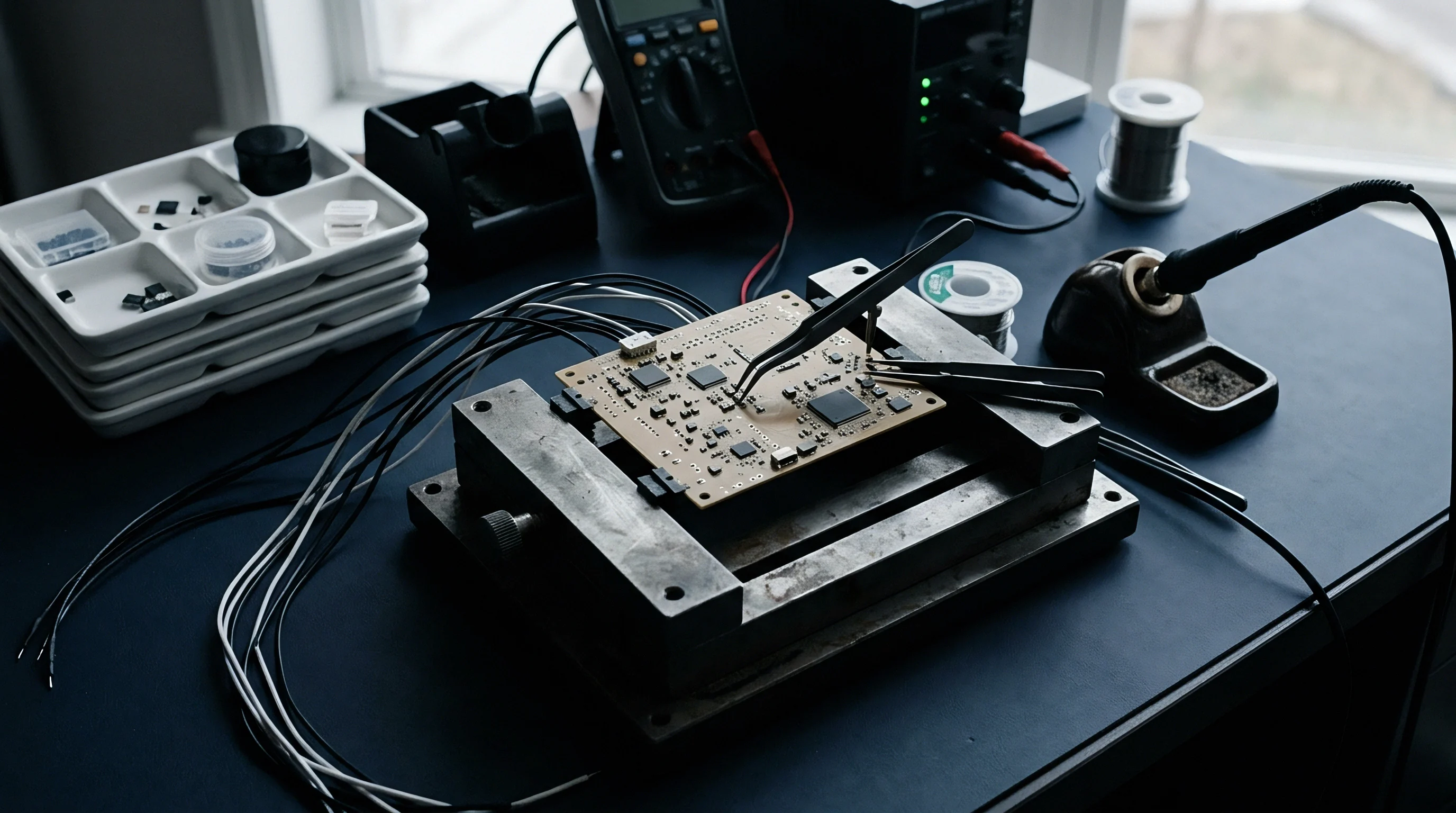
Catching unnotified register alterations requires empirical test setups that capture analog, RF, and power signatures under controlled laboratory conditions. The primary test bench couples a high-speed dynamic current waveform analyzer with a calibrated radio communication tester operating inside an RF-shielded isolation chamber. Technicians isolate the cellular submodule from the host microcomputer board, powering the radio module directly from a low-noise programmable linear power supply equipped with microampere-resolution current sampling.
The measurement procedure steps the module through a scripted operational sequence designed to expose register alterations across distinct functional blocks:
- Baseline Power-Down Current Verification holds the module in hard reset via the hardware reset line, measuring quiescent gate leakage across all internal power domains to isolate physical silicon fabrication variations from microcode differences.
- Cold Boot Current Profile Capture monitors the initial 800 milliseconds following power-on-reset with a 100 kHz sampling digitizer, recording transient inrush current peaks and stepped transitions that signify baseband bootloader register initialization routines.
- Conducted RF Sensitivity Evaluation measures packet error rates across carrier frequencies using 3GPP TS 51.010 test loops, confirming whether receiver front-end low-noise amplifier gain settings match certified baseline sensitivity floors down to -108 dBm on target bands.
- Extended Sleep Profiling records current decay rates during transitions from active radio resource control connected states down to power saving mode (PSM), evaluating whether autonomous sleep timers hold within pre-certified boundaries below 4 microamperes.
Evaluating current draw curves reveals subtle changes to baseband microcode. A submodule whose power management unit register switches converter pulse-width modulation frequencies produces distinctive high-frequency ripple on the main DC power line. This electrical signature indicates altered register settings even when no engineering change notification accompanied the delivered production batch.
Signal Degradation Mechanics across Sub-GHz Frequencies
RF performance verification centers on conducted power and modulation analysis. In sub-GHz bands like LTE Band 20 or NB-IoT Band 8, matching networks operate with tighter fractional bandwidths than higher-frequency radios. An unnotified change in internal RF switch driver registers alters the capacitance presented to internal antenna matching elements by mere fractions of a picofarad.
The resulting impedance mismatch creates measurable degradation in the conducted transmitter performance profile.
Technicians measure the link parameters using an automated RF test script. The signal analyzer captures the error vector magnitude (EVM) across all resource blocks during full-power transmission at 23 dBm. If an internal power amplifier bias register shifts from class-AB bias targets toward lower-current operating modes to reduce factory current testing failures, the measured EVM deteriorates from 3.5 percent up to 8.2 percent.
The radio still transmits, yet uplink transmission in weak signal conditions suffers catastrophic packet loss due to phase distortions and inter-symbol interference.
Under section 4.2 of standard supply master agreements, unnotified firmware or hardware modifications violating signed parameter sheets void vendor lot acceptance certifications.
This degradation imposes compounding costs on the system integrator. To maintain communication links, the module baseband retransmits packets repeatedly, expanding radio airtime from 120 milliseconds to over 2,400 milliseconds per hourly reporting event. The link margin degradation directly consumes device operating life, establishing a clear physical causal chain from the silent register drift to tangible product failure in the field.
The verification bench produces unambiguous electrical waveforms, yet converting these physical deviations into enforceable commercial remedies requires structured legal and financial mechanisms.


Ledger

Parametric Indemnity Mechanics in Supply Contracts
Traditional warranty clauses fail to protect buyers against unnotified register drift. Typical component warranties cover clear defects in materials and workmanship, requiring the buyer to prove a unit is physically inoperative before claiming replacement or repair. A cellular submodule with drifted register tables functions mechanically and communicates across cellular carrier networks, thereby passing simple pass-or-fail warranty checks.
Securing financial protection demands parametric indemnity structures tied directly to measurable physical thresholds recorded on incoming inspection benches.
Parametric frameworks establish contractual payment triggers based on objective physical performance metrics rather than complex subjective damage evaluations. The supply agreement incorporates an enforceable parametric addendum defining strict tolerances around verified operational baselines, including active current limits, sleep currents, transmit spectral masks, and register memory hash values. When incoming lot sampling reveals register-induced shifts beyond contractual tolerances, defined liquidated indemnities trigger automatically without protracted negotiations over ultimate commercial blame.
Buyers integrate these mechanisms into procurement schedules using a multi-tiered financial formula that prices operational risk directly into batch settlement payments:
- Quiescent Current Escalation Penalties apply liquidated per-unit deductions from the final batch invoice whenever random sample testing demonstrates sleep draw exceeding baseline specifications by more than fifteen percent across three consecutive production reels.
- Sensitivity Margin Offsets mandate financial credits to cover field antenna upgrades or battery capacity expansions when receiver sensitivity falls by two decibels or more below the agreed baseline design qualification dossier.
- Firmware Hash Deviation Assessments trigger immediate lot rejection rights combined with full reimbursement of incoming inspection and lab qualification costs whenever baseband register checksums fail to match the cryptographically locked production baseline.
- Direct Recall Escrow Drawdowns fund warranty and dispatch logistics directly from an irrevocable supplier letter of credit if register drift degrades field packet completion rates below ninety-nine percent within the first twenty-four months of deployment.
A structured indemnity table removes subjective debate between commercial procurement teams and component factory representatives. By establishing transparent tiers of financial recovery linked directly to bench measurement parameters, the buyer transforms complex RF drift mechanics into predictable financial offsets.
| Parametric Deviation Category | Contractual Tolerance Floor | Measured Bench Threshold | Allocation of Remediation Expense | Contractual Commercial Action |
|---|---|---|---|---|
| Sleep State Current (PSM) | 3.5 uA +/- 10% | Exceeds 5.0 uA sustained | 100% Vendor coverage of battery reserve expansion | Direct invoice debit per shipped unit |
| Adjacent Channel Power (ACLR) | -38.0 dBc maximum | Worse than -35.5 dBc | Vendor covers secondary RF qualification fees | Hold shipment pending baseline restoration |
| Register Image MD5 Checksum | Identical to Type Approval | Any bit sequence mismatch | Vendor covers full lot re-screening and audit lab labor | Immediate lot rejection and freight chargeback |
| RRC Connected Current | 140 mA at 23 dBm | Exceeds 165 mA at 23 dBm | Pro-rated battery replacement indemnity schedule | Mandatory engineering change order review |
Implementing these financial allocation tables requires clear definitions of testing methods, statistical confidence levels, and designated neutral testing facilities within the master supply agreement.

Do Supply Chains Support Pure Automated Parametric Claims?
Adopting fully automated parametric payouts encounters substantial resistance from submodule manufacturers and international contract manufacturers. Tier-one cellular module vendors frequently refuse unilateral invoice debit clauses, insisting that field failure rates must be established through formal return material authorization (RMA) procedures conducted inside their own factory failure analysis laboratories. These evaluations can extend over twelve to sixteen weeks, during which production lines stall or unverified modules continue flowing into assembly operations.
To navigate this resistance, procurement agreements establish hybrid parametric frameworks. Under this commercial architecture, independent accredited testing laboratories receive blind random samples from each delivered manufacturing lot. If the testing laboratory confirms that specified electrical or radio parameters violate contractual register-stability limits, the associated indemnity triggers immediately, holding disputed funds in an escrow structure until formal root-cause analysis concludes.
Tying escrow release directly to verifiable physical laboratory data insulates the procurement desk from open-ended commercial exposures. The buyer preserves critical assembly line continuity while maintaining the financial leverage needed to enforce engineering discipline throughout the global supply chain.
Unchecked parametric drift ultimately compounds into massive warranty liabilities that threaten the operating solvency of connected product programs.


Crate

Incoming Inspection and Hash Audit at the Dock
Enforcing parametric indemnity terms requires rigorous quality gates at the physical point of delivery. Receiving departments must implement incoming inspection routines that verify the internal configuration of cellular modules before shipping reels are released to automated surface-mount placement lines. Inspecting packaged modules on tape and reel presents distinct physical challenges, as high-speed automated testing is required without damaging delicate moisture-sensitive packaging or breaking vacuum seals on long-term inventory reels.
Inspection protocols employ randomized sampling conforming to ANSI/ASQ Z1.4 sampling procedures, pulling a defined quantity of submodules from each received shipping carton. Technicians mount these sample units into zero-insertion-force pogo-pin test fixtures connected to automated diagnostic controllers. The fixture applies power, issues secure engineering test strings via the primary UART interface, and queries internal register banks to read register contents across analog, digital, and baseband subsystems.
The core of this incoming audit is the verification of the subsystem register image hash. By querying internal non-volatile memory via documented diagnostic hooks, the fixture retrieves memory pages containing calibration values, default operational parameters, and firmware baseband configurations. The automated test system computes a cryptographic hash, such as an SHA-256 digest, across this extracted memory map and validates the calculated digest against the authorized reference hash recorded in the engineering approval file.
Any variance in the extracted hash flags the entire production lot for containment. The receiving engineering team immediately issues an electronic quality hold, isolating the affected pallet within a secure storage cage to prevent unverified components from entering surface-mount pick-and-place lines. The automated containment report, complete with raw memory dumps and comparison logs against golden baseline units, transmits directly to the module supplier as formal documentary evidence of an unnotified product revision.

Statistical Confidence and Lot Rejection Mechanics
Statistically defending a lot rejection requires robust sample sizes capable of withstanding scrutiny during commercial contract disputes. Testing three units from a delivery of ten thousand provides insufficient statistical weight to justify withholding contract payments or enforcing liquidated damages. Sourcing desks implement clear statistical plans based on acceptable quality limit standards, typically requiring a general inspection level II with an AQL threshold of 0.4 for major parametric non-conformances.
Under this statistical regime, a shipment lot of 10,000 submodules requires an initial random sample of 315 units. If the diagnostic test discovers more than three units exhibiting unnotified register drift or hash deviations, the entire production lot faces contractual rejection. The supplier then faces two contractual alternatives: authorize a complete factory recall and immediate replacement at their own expense, or fund a 100-percent screening audit conducted by an independent certified test house to sort conforming units from drifted silicon.
Executing incoming dock-level screening demands dedicated bench equipment and skilled operator time, representing an ongoing operational expenditure for the purchasing organization. These operational overhead costs are formally incorporated into the parametric indemnity calculation, shifting the financial burden of verification quality control directly onto suppliers who distribute undocumented engineering alterations through global supply channels.
Documented inspection processes convert ambiguous silicon variations into actionable commercial rejections right at the factory door, protecting downstream manufacturing integrity.