Managing Laboratory Chamber Testing for Chinese Radio Regulatory Compliance
Radio type approval in China demands accredited domestic chamber testing, strict sample hardware modification, and exact power spectral mask compliance.
Testing bodies operating under national telecommunication metrology authorities evaluate wireless terminal hardware against radio frequency, electromagnetic compatibility, and network access mandates. Within this regulatory framework, CTTL functions as the China Telecommunication Technology Labs, an accredited testing institution under the China Academy of Information and Communications Technology. The laboratory executes conformance evaluations required for regulatory market entry, operator network acceptance, and third-party quality certifications for connected cellular modules, tracking units, and intelligent hardware.
Its formal assessments verify transmitter spectral purity, receiver sensitivity, specific absorption rate, and protocol interoperability against national standardization criteria. Regulatory scope ends where non-telecommunication consumer goods lack radio transceivers, network interfaces, or electromagnetic emission characteristics.
National laboratory recognition systems maintain qualification hierarchies to guarantee the cross-border validity of verified test data. The lab operates under approvals granted by the China National Accreditation Service for Conformity Assessment and holds designation from the Ministry of Industry and Information Technology as an authorized testing facility for State Radio Regulation of China certification. Bilateral mutual recognition arrangements allow its measurement dockets to substantiate compliance declarations across overseas regulatory regimes, including technical assessments submitted to telecommunications bodies in North America and Europe.
Engineering teams submit cellular tracking devices or smart gateway units directly to these testing chambers to satisfy regulatory mandates prior to mass deployment across public networks. Operational validity requires maintaining calibrated instrumentation traceable to national primary metrology standards.
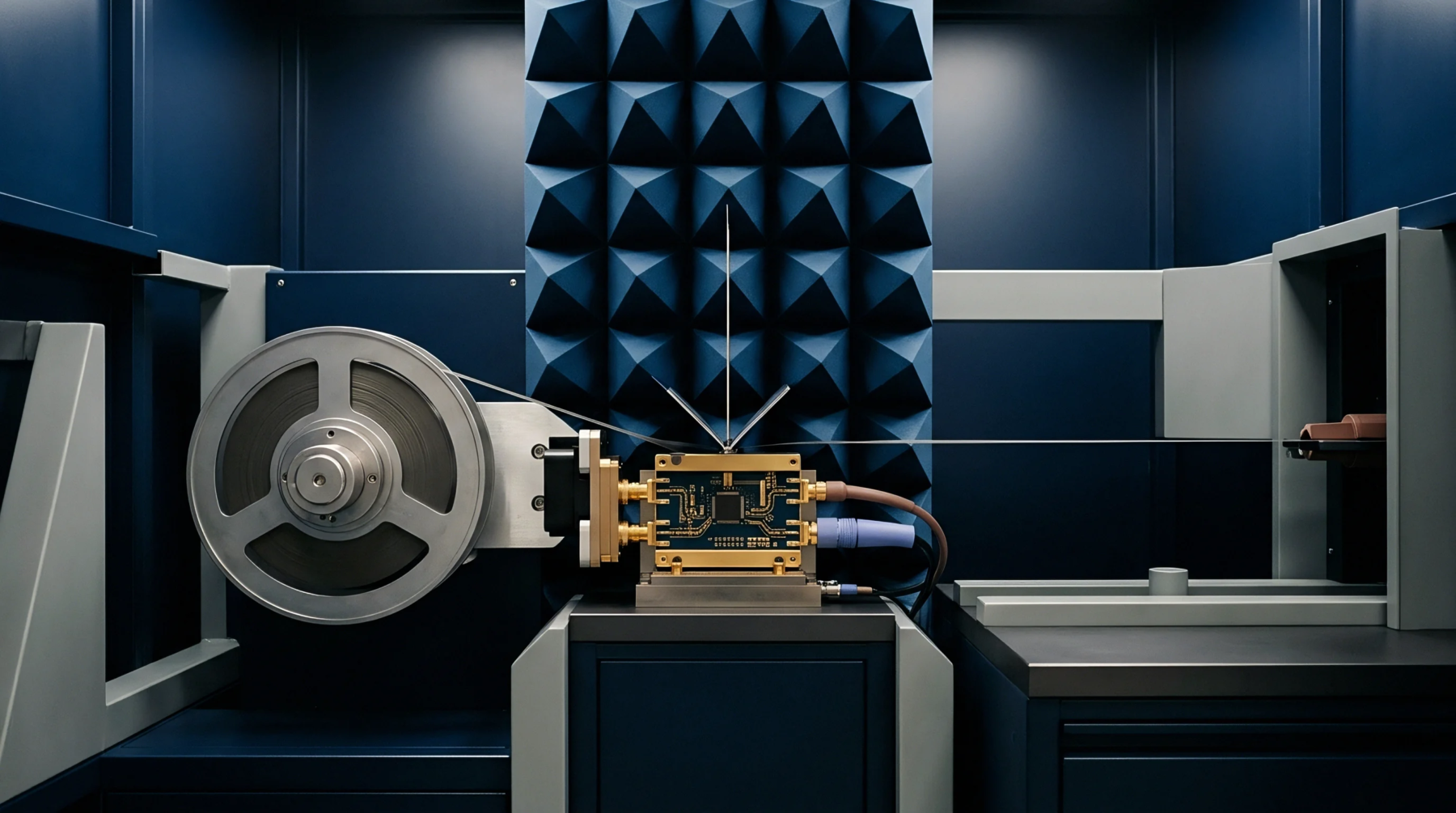
Hardware submissions face physical and radiated testing protocols that scrutinize the boundary where cellular transceiver modules interact with integrated antenna structures. Measurement campaigns evaluate whether an engineering layout exhibits internal parasitic coupling, excessive out-of-band spurious emissions, or antenna mismatch losses that degrade carrier performance. Technicians seat the unit inside anechoic chambers to measure total radiated power and total isotropic sensitivity across operating frequency bands.
Such evaluation verifies that the integration layer of an internet of things enclosure preserves the standalone performance figures established by the component transceiver vendor. Failure within these automated test routines requires layout alterations to trace routing, filtering networks, or ground return geometries.
Delivery of the completed test dossier concludes the commercial engagement between the manufacturing entity and the testing institution. This output comprises the formal test report detailing conducted radio frequency power profiles, occupied bandwidth traces, adjacent channel leakage ratios, and electrostatic discharge immunity performance across all operational states. Device vendors submit this comprehensive documentation packet to administrative agencies to secure type approval licenses or operator supply-chain qualifications.
Carrier approval committees examine every clause within the data set to confirm that a connected product will not degrade cellular infrastructure stability or violate radio spectrum allocations. Commercial mass distribution remains legally prohibited until the authoritative test certificate is signed, sealed, and entered into the state compliance repository.
Radio type approval in China demands accredited domestic chamber testing, strict sample hardware modification, and exact power spectral mask compliance.
Expertise is a utility, not a secret. sentiention™ publishes its working knowledge as open reference: intelligence layer covering the materials it sources, the markets it enters, and the reference that serves both.