Meaning
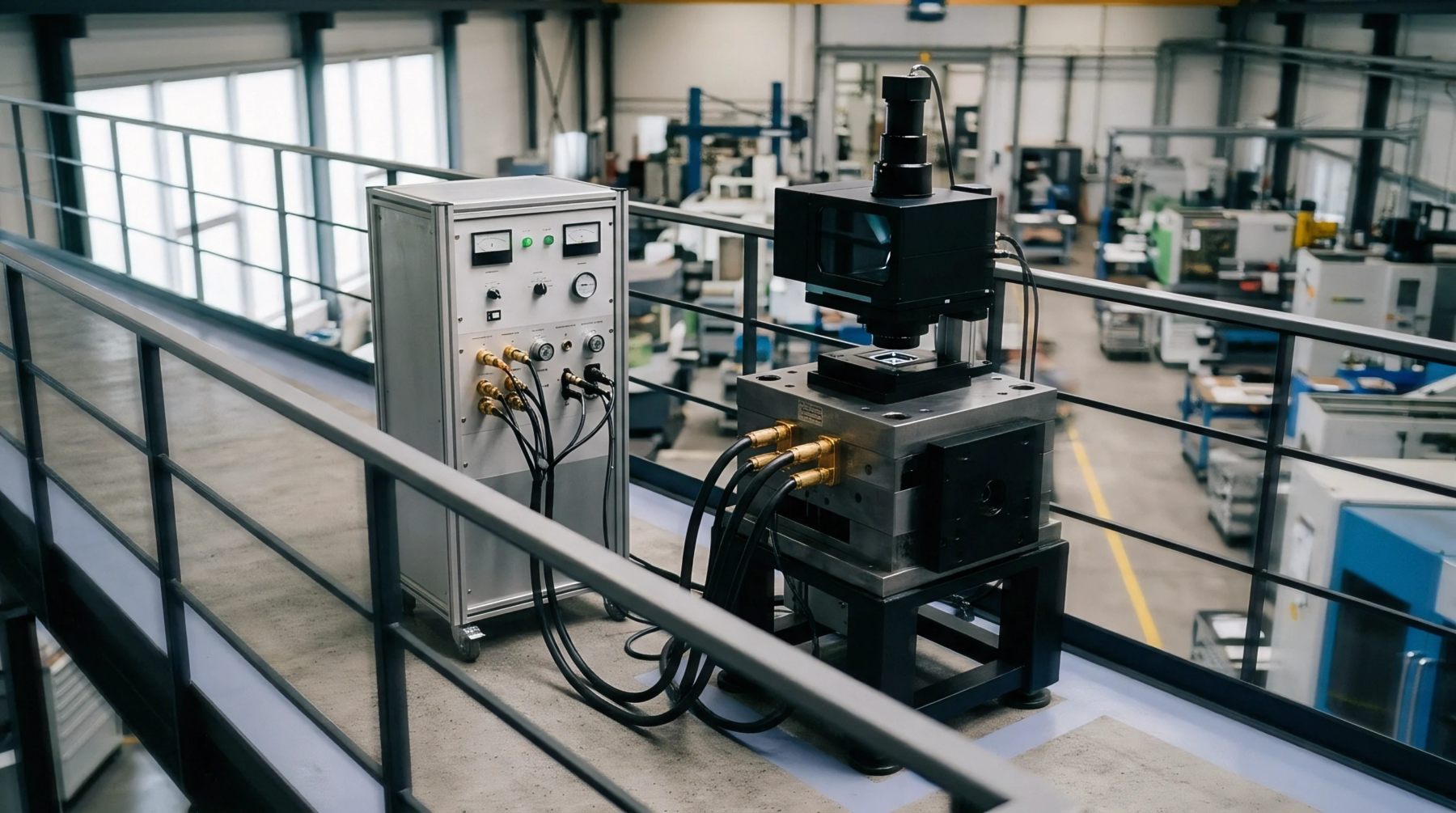
Resonant electromagnetic cavities bounded by parallel reflecting surfaces store standing wave energy at discrete periodic frequency intervals. In high-frequency material characterization, the fabry-perot resonator evaluates low-loss substrate sheets and radome polymers by measuring quality factor degradation and resonant displacement across millimeter-wave frequencies. The open geometry accommodates planar samples without requiring conductive metal coatings or destructive sample cutting.
The apparatus stops providing valid measurements when sample surfaces exhibit significant surface curvature or when insertion losses damp cavity resonance below detection thresholds.
Transmission Peak
Multiple wave reflections between opposing mirrors create sharp transmission fringes at frequencies where mirror separation equals an integer multiple of half-wavelengths. Resonance peak sharpness relates directly to mirror reflectivity and internal cavity losses. Open resonator structures achieve unloaded quality factors exceeding one hundred thousand, providing extreme sensitivity to minute dielectric absorption.
Measuring transmission peak width determines total resonator losses before sample insertion.
Substrate Perturbation
Inserting a flat dielectric sheet between the mirrors shifts resonant peak frequencies downward and reduces the loaded quality factor. The frequency shift relates directly to the real relative permittivity and physical thickness of the sample sheet. Concurrently, transmission peak broadening reveals the material dielectric loss tangent.
Operating the fabry-perot resonator across multiple longitudinal modes provides broadband dielectric characterization within a single test fixture.
Loss Derivation
Data reduction procedures apply electromagnetic boundary conditions across sample interfaces to extract constitutive parameters from observed resonance shifts. Analytical equations isolate sample attenuation by subtracting known diffraction losses and mirror conductor losses from total measured cavity dissipation. Calibrated micrometer drives establish mirror spacing to micrometer accuracy, eliminating dimensional ambiguity in permittivity calculations.
Material verification records output these derived values to qualify low-loss laminates for millimeter-wave circuit production.