Meaning
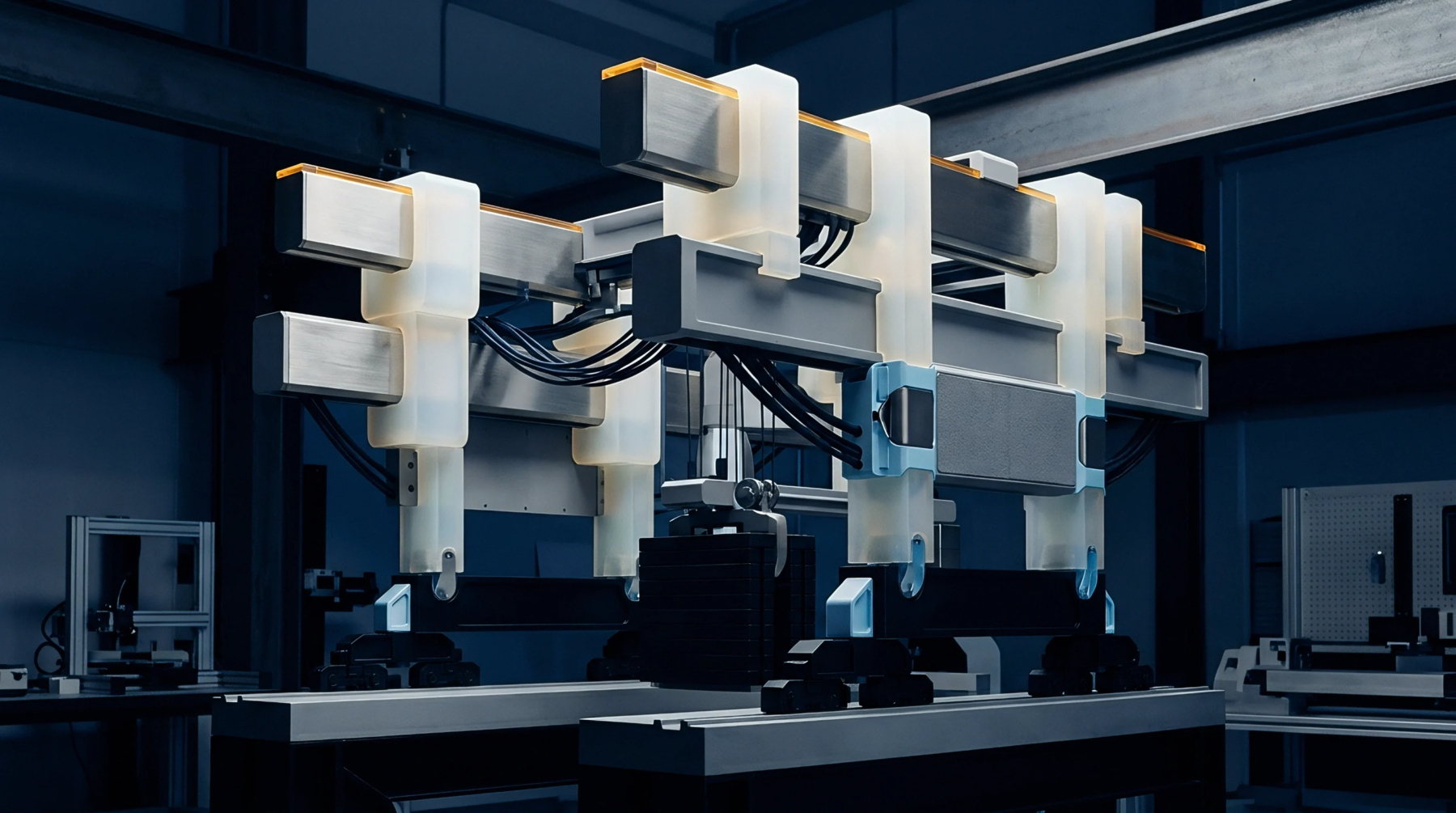
Precise spatial coordination across multiple motion axes defines multi-axis stage synchronization, ensuring that linear and rotational actuators maintain exact temporal and positional alignment during complex trajectory execution. Motion controllers apply this method to eliminate tracking errors between independent positioning mechanisms, preventing mechanical binding and micro-fractures in delicate components during automated assembly. The technique governs high-speed laser micromachining and semiconductor wafer inspection where trajectory deviation ruins the workpiece.
Boundaries lie where motion control shifts from coordinated vector interpolation to independent point-to-point positioning, since uncoordinated axes lack the shared clock and feedback loops required for synchronized execution.
Mechanical Coupling
Thermal expansion mismatch across disparate alloy mountings disrupts multi-axis stage synchronization during extended thermal cycles. Actuators absorb differing heat loads from internal drive coils and external ambient sources, altering baseline dimensions and inducing mechanical preloads across the assembly joints. Engineers offset this dimensional drift by anchoring optical linear encoders directly to the granite metrology frame rather than the drive housing, isolating feedback loops from structural distortion.
System integrators verify these thermal stability budgets using interferometric calibration tests before issuing the final machine acceptance protocol.
Interface Protocol
Real-time communication jitter degrades multi-axis stage synchronization by introducing phase delays into the command stream received by individual motor drives. High-speed serial buses replace traditional analog command lines to eliminate signal degradation across long cable runs inside crowded machinery enclosures. Controller hardware parses position setpoints through deterministic ethernet profiles, ensuring that update packets arrive at every axis driver within a sub-microsecond window.
Buyer qualification testing requires an oscilloscope verification of the clock synchronization signal at the innermost connector pin before the subassembly joins the main production line.
Vector Verification
Acceptance testing for multi-axis stage synchronization relies on circular contouring tests defined in international machine tool standards. Laser interferometers measure radial deviation while the stage executes a diagonal vector path, exposing dynamic contouring errors caused by servo loop latency. Technicians record acceleration profiles during the factory acceptance test to confirm that jerk limits remain below the threshold that excites structural resonance in the payload platform.
Compliance with these kinematic limits validates the supplier assembly rating before the equipment ships to the final integration site.