Evaluating Tariff Headings for Multi Component Integrated Circuits under Note Nine
Classification under heading 8542 demands mold-encapsulated leadframe or silicon substrates without printed wiring, securing zero percent ITA tariff treatment.


Rule
Legal classification of integrated circuits under the Harmonized Tariff Schedule relies on strict architectural boundaries established by Note 9 to Chapter 85. Importers seeking zero-percent duty treatment under the Information Technology Agreement frequently route multi-component packaging through heading 8542. Border inspection authorities reject these claims when physical assembly methods cross into module or system-level construction.
Heading 8542 covers monolithic integrated circuits, hybrid integrated circuits, multichip integrated circuits, and multi-component integrated circuits. The tariff legal text imposes explicit structural constraints on each category, leaving no room for functional equivalence arguments when material construction strays from the code text.
Multi-component integrated circuits enter heading 8542 only when all internal components form an indivisible combination on a single synthetic substrate, leadframe, or silicon carrier. Note 9(b) defines these assemblies as combinations of one or more monolithic, hybrid, or multi-chip integrated circuits combined with discrete active or passive components. Acceptable passive elements include silicon-based inductors, thin-film capacitors, discrete resistors, or microelectromechanical systems sensors.
Packaging must completely encapsulate these elements through molding, transfer encapsulation, or seal rings. The physical boundary of the package determines regulatory classification regardless of whether the final device performs a radio frequency function, signal processing, or power management.
The substrate defines the heading.
Organic printed circuit boards using flame-retardant epoxy laminates or bismaleimide-triazine resin immediately disqualify an assembly from heading 8542. Customs authorities classify assemblies built on multi-layer organic laminates with etched copper trace interconnects as printed circuit board assemblies or functional modules under heading 8517 or heading 8543. Heading 8542 demands semiconductor-grade leadframes, silicon interposers, ceramic substrates, or glass carriers.
Interconnects must rely on wire bonding, flip-chip micro-bumps, or direct silicon vias. The inclusion of surface-mount components soldered onto a traditional fiberglass board forces the shipment into higher tariff brackets with active customs audit exposure.
- Organic Substrate Utilization triggers immediate reclassification to heading 8517 or 8543 because etched copper wiring on resin matrices constitutes a printed wiring board structure under tariff legal notes.
- Unencapsulated Component Layouts fail the indivisible package test under Note 9(b) when discrete active parts remain exposed or accessible outside a unified mold compound.
- Discrete Active Devices exceeding simple silicon diodes or transistors create legal classification conflicts if their primary operational function transforms the package into an independent apparatus.
- External Interconnect Pins lacking direct leadframe integration indicate a sub-assembly board structure rather than a unified component package.
Customs officers evaluate the physical housing during destructive teardown audits. A package containing discrete passive chips soldered alongside an integrated circuit die may qualify under Note 9 provided those components mount directly onto a leadframe or silicon carrier without an intermediate organic board layer. The presence of passive components alone does not disqualify a product.
Disqualification occurs when component layout, internal wiring methods, or substrate materials mirror standard surface-mount printed circuit construction. Misinterpreting this distinction leads directly to reclassification penalties during post-clearance audits.
The physical substrate material governs Chapter 85 classification decisions irrespective of overall device processing capability.
Package suppliers frequently claim that using standard organic laminates saves substrate cost without altering the logical operation of the silicon.

Stack
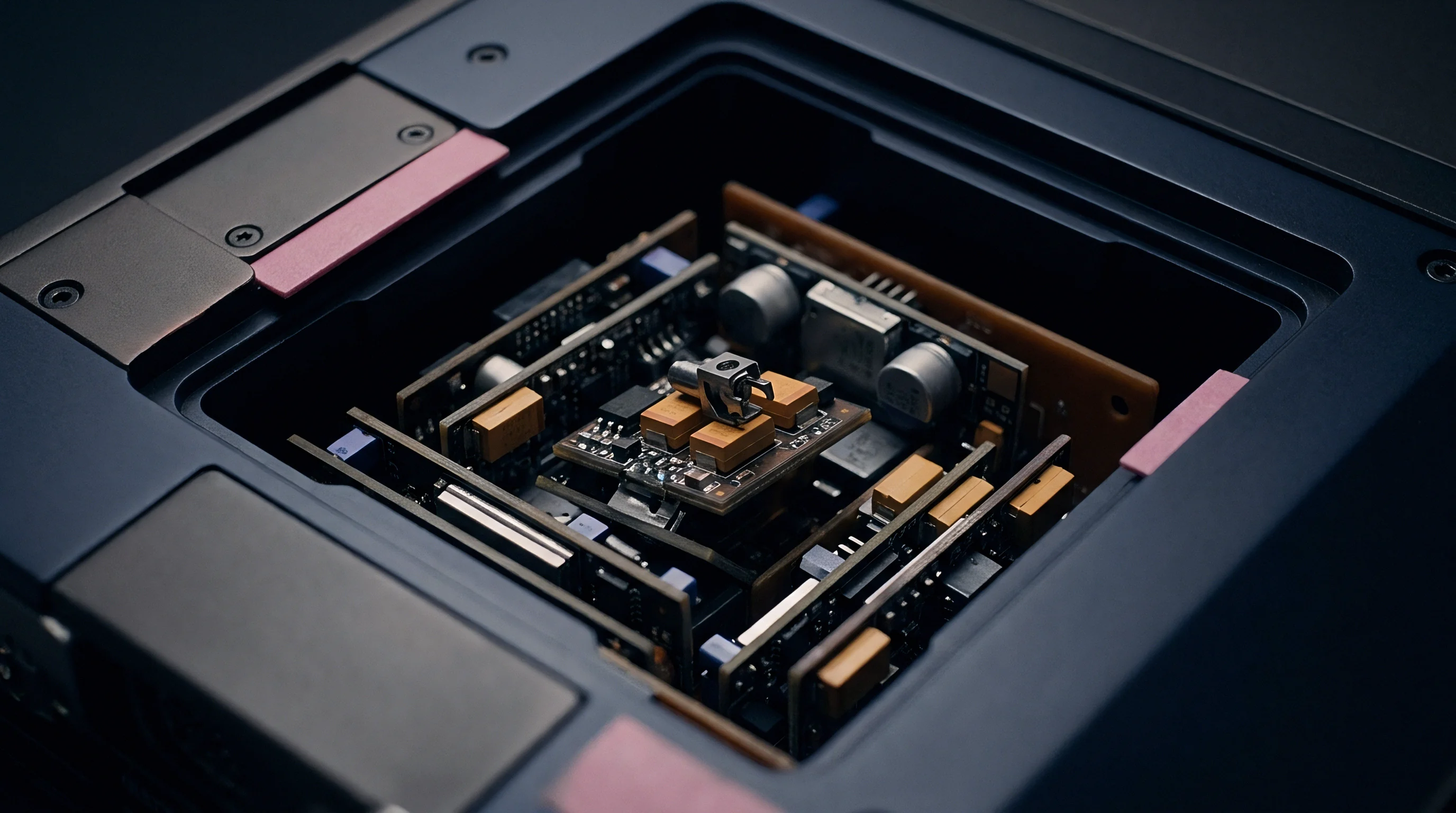
Micro-architectural assembly determines tariff eligibility at the microscopic layer. Physical cross-sections reveal whether internal structures comply with Note 9 requirements or represent board-level assembly methods. Monolithic integrated circuits house all active elements within a single semiconductor substrate.
Hybrid integrated circuits combine thick-film or thin-film passive elements with active dies on an insulating substrate. Multi-chip integrated circuits package two or more connected monolithic dies within a single housing. Multi-component integrated circuits go further by incorporating discrete active or passive components alongside monolithic silicon, but they demand rigorous structural unity to retain heading 8542 status.
Encapsulation holds the package together.

Physical Component Integration Boundaries
Component layout within a multi-component packaging design must avoid standard surface-mount assembly paradigms. Inductors, capacitors, and resistors within the package must connect via wire bonds, flip-chip solder bumps, or direct physical deposition. Solder paste reflow on standard printed circuit traces violates the packaging requirement under customs precedents.
Microelectromechanical components such as silicon accelerometers, gyroscopes, or acoustic resonators qualify as passive or active components under Note 9, provided they sit directly on the primary leadframe or silicon interposer. Internal space within the transfer mold compound must be entirely filled, forming a solid, non-dismountable block.
Silicon carriers pass Note Nine.
Customs laboratories use high-resolution X-ray microtomography to map internal layout geometries before executing destructive cross-sectioning. Inspections search for organic substrates, surface-mount solder joints on fiberglass layers, and unencapsulated air cavities. Package integrity relies on thermal expansion matching between the mold compound, leadframe alloy, and silicon dies.
The table below delineates the structural parameters separating compliant semiconductor packaging under heading 8542 from non-compliant sub-assemblies.
| Package Classification | Substrate Carrier Material | Interconnect Technology | Encapsulation Type | Target HS Heading | Typical Duty Range |
|---|---|---|---|---|---|
| Monolithic IC | Single Crystal Silicon | Diffused Doped Channels | Transfer Mold Resin | 8542.31 / 8542.39 | 0.0% (ITA Covered) |
| Multi-Chip IC (MCM) | Silicon / Ceramic / Leadframe | Wire Bond / Micro-Bump | Solid Resin Block | 8542.31 / 8542.39 | 0.0% (ITA Covered) |
| Multi-Component IC (MCO) | Leadframe / Silicon Interposer | Wire Bond / Through-Silicon Via | Full Epoxy Molding | 8542.31 / 8542.39 | 0.0% (ITA Covered) |
| Hybrid IC | Alumina Ceramic / Glass | Thick-Film / Thin-Film Deposition | Hermetic / Molded Resin | 8542.31 / 8542.39 | 0.0% (ITA Covered) |
| Printed Circuit Assembly | FR-4 / BT Resin Organic Laminate | Reflow Solder Traces | Open / Conformal Coat | 8517.62 / 8543.70 | 2.6% – 6.0% (Non-ITA) |

Substrate Architecture and Organic Laminate Exclusions
Copper traces on FR-4 fail.
When an internal substrate incorporates woven glass fibers impregnated with epoxy resin, customs laboratories issue negative classification findings for heading 8542. The legal commentary to Note 9 explicitly contrasts semiconductor packaging with printed wiring structures. Silicon interposers utilizing redistribution layers achieve high routing density while maintaining pure inorganic composition.
Ceramic substrates composed of high-purity alumina or aluminum nitride provide high thermal conductivity and mechanical strength, meeting Note 9 criteria provided thick-film or thin-film processing creates the wiring path. Copper leadframes produced via chemical etching or precision stamping remain the baseline standard for multi-component integrated circuit qualification.
- Mount the intact component package in epoxy resin matrix for stabilization during mechanical cutting procedures.
- Execute precision cross-sectional grinding along the central axis using diamond-slurry abrasive wheels.
- Examine substrate cross-section under field-emission scanning electron microscopy to identify resin matrix glass weave patterns.
- Perform energy-dispersive X-ray spectroscopy across conductive traces to map copper-tin intermetallic layers indicative of reflow soldering.
- Verify full encapsulation integrity by checking for uniform mold compound penetration around all passive silicon elements.
Destructive analysis provides definitive evidence for customs disputes. Importers presenting unverified supplier datasheets face high vulnerability during post-importation duty assessments. Physical laboratory reports demonstrating pure leadframe construction, wire-bonded silicon passives, and full epoxy transfer molding establish defendable tariff positions.
Physical cross-section microscopy overrides technical drawing documentation during customs verification audits.
Substrates built with organic resin bases always force reclassification regardless of component size or package encapsulation.


Silicon
System-in-Package RF architectures present complex classification scenarios when high-frequency frontend circuits enter global supply chains. Designers routinely package power amplifiers, low-noise amplifiers, switches, bandpass filters, and matching passives into ultra-compact housings. Regulatory agencies treat these devices as radio modules when tested for spurious emissions and occupied bandwidth.
Customs agencies evaluate the same physical unit purely through the lens of Note 9 structural rules. A package certified as an intentional radiator under radio equipment rules retains heading 8542 eligibility only if its internal physical construction avoids organic substrate boards.

When Does an RF Package Exceed Note Nine?
Radio frequency System-in-Package modules frequently integrate embedded planar antennas or ceramic patch elements. The inclusion of an antenna within the package triggers intensive customs scrutiny. Tariff classification rules isolate whether the antenna functions as a passive ceramic chip component integrated onto a leadframe or represents a printed copper trace on an organic substrate.
Printed PCB trace antennas instantly disqualify the package from heading 8542, pushing the product into heading 8517 as a radio communication apparatus module. Integrated ceramic chip antennas wire-bonded to a silicon carrier allow the package to retain multi-component integrated circuit status under Note 9.
Chamber reports do not bind customs.
Radio equipment compliance test reports issued under ETSI EN 300 328 or FCC Part 15 subpart C measure radiated field strength, occupied bandwidth, and out-of-band emissions. These reports document functional RF capabilities, including maximum equivalent isotropically radiated power and modulation schemes. Customs classification officers disregard radiated field strength data when evaluating tariff headings.
An RF front-end module exhibiting high output power and integrated filtering remains heading 8542 compliant if built on a leadframe with wire-bonded silicon passives. The operational function of transmitting radio signals does not displace Note 9 qualification if physical construction meets multi-component integrated circuit rules.
Radio equipment grants certified under FCC Part 15 show operational transmission capability but carry zero legal weight in establishing Harmonized Tariff Schedule headings.

Discrepancies between Radio Grants and Customs Declarations
Supply chain managers frequently encounter friction when import declarations cite heading 8542 while accompanying radio approval grants refer to the product as an integrated transceiver module. Customs audit teams cross-reference import records against public regulatory databases. When a grant lists a device as a complete radio module carrying its own shielding box and organic laminate board, customs authorities initiate immediate reclassification proceedings.
Importers align technical nomenclature across all filings to avoid triggering mandatory physical teardowns.
Customs officers perform X-ray audits.
Antenna integration determines the final classification split. If an RF System-in-Package requires an external antenna connected via an external package pin, Note 9 status remains intact provided internal packaging rules are met. If the package contains a integrated antenna structure etched onto an internal organic board, the product falls under heading 8517.62 as a device for the reception, conversion, and transmission of voice, images, or other data.
This shift raises basic tariff rates from zero percent up to three percent or higher depending on national tariff schedules and preferential trade arrangements.
Purchase specifications must state that all high-frequency multi-component packages strictly utilize leadframe or silicon interposer carriers with encapsulated chip antennas to preserve zero-tariff heading 8542 customs treatment.

Proof
Establishing tariff compliance demands objective documentary evidence prior to commercial shipment arrivals. Advance Tariff Rulings, known as Binding Tariff Information within European Union member states and 19 CFR Part 177 administrative rulings in the United States, provide legal certainty before customs clearance. Securing a binding ruling requires submitting comprehensive engineering dossiers that reveal internal construction without compromising trade secrets.
Importers relying solely on commercial invoices describing items as electronic integrated circuits risk severe delays when customs laboratories perform unannounced audits.

Constructing the Technical Teardown Dossier
A complete technical dossier submitted for customs advance ruling must go beyond basic datasheets. Documentation requires detailed material bills, component layout diagrams, substrate composition reports, and cross-sectional micrographs. The dossier must explicitly confirm the manufacturing methodology of every internal component, proving that passive elements consist of thin-film or thick-film structures on silicon or ceramic.
Providing clear evidence of transfer mold encapsulation directly addresses Note 9 indivisibility requirements.
Laboratory reports establish physical proof.
- Substrate Material Certification provided by the package foundry confirming high-purity copper leadframe, alumina ceramic, or monocrystalline silicon substrate construction without resin laminates.
- Internal Layer Schematics showing wire bond diagrams, flip-chip bump arrays, and direct silicon via paths connecting internal dies without printed wiring boards.
- Passive Component Material Analysis verifying that discrete capacitors and inductors utilize silicon-based thin-film deposition or ceramic chip construction.
- Encapsulation Compound Data Sheet detailing the chemical makeup of thermosetting epoxy molding compounds used to form the unified package housing.

Navigating National Customs Laboratory Protocols
National customs laboratories utilize specialized testing methods to verify Note 9 compliance. Laboratories execute chemical de-encapsulation using hot nitric acid or plasma etching to dissolve epoxy mold resins without destroying internal metal interconnects. Once exposed, technicians examine the layout under scanning electron microscopes to detect forbidden organic substrate bases, cold-solder joints on FR-4 traces, or unencapsulated discrete modules.
Passing laboratory analysis establishes an unassailable legal record that protects historical imports from retroactively applied duty assessments.
Under Customs and Border Protection administrative guidelines, technical dossiers lacking internal cross-sectional micrographs face automatic rejection without substantive Note 9 review.
Binding rulings issue specific legal coverage limited strictly to the exact physical architecture evaluated by the customs laboratory. Any subsequent modification to the package substrate, die layout, or passive supplier invalidates the advance ruling. Importers maintain active change notifications with packaging foundries to ensure minor component adjustments do not breach Note 9 boundaries and expose future shipments to border detention.
What specific margin of structural deviation triggers an automatic invalidation of an existing Binding Tariff Information ruling when a foundry transitions from wire-bonded silicon passives to embedded surface-mount capacitors?


Exposure
Misclassifying component packages incurs substantial financial penalties during post-clearance duty audits. Importing products under heading 8542 when physical construction demands classification under heading 8517 or 8543 creates accrued duty liabilities compounded by interest and administrative fines. The Information Technology Agreement guarantees zero percent tariff duty on genuine 8542 integrated circuits across participating nations.
Reclassification to non-ITA headings exposes shipments to standard tariff schedules, trade remedy tariffs, and national security duties ranging from two percent to over twenty-five percent of custom value.
Duty rates jump immediately.

Financial Consequences of Tariff Reclassification
Customs authorities hold legal power to re-examine import entries retroactively, typically spanning three to five years depending on national jurisdiction. When an audit determines an importer incorrectly declared organic substrate System-in-Package modules under heading 8542, customs issues a demand for unpaid back duties. Fines for negligent misclassification can match or exceed the primary duty differential.
Importers operating on narrow gross margins face severe cash flow disruption when multi-year import volumes receive retroactive duty assessments.

Worked Landed Cost Comparison across Import Headings
Evaluating financial exposure requires modeling landed cost across alternative tariff headings. Consider a commercial procurement of 100,000 wireless System-in-Package units valued at $12.50 per unit, representing a total shipment customs value of $1,250,000. The table below illustrates the duty liability spread depending on physical packaging construction and resulting tariff classification.
| Declared Tariff Heading | Physical Substrate Basis | Applicable Tariff Rate | Primary Duty Liability | Trade Remedy Surcharge (if applicable) | Total Financial Exposure per Batch |
|---|---|---|---|---|---|
| 8542.39.00 (MCO Compliant) | Leadframe / Silicon Carrier | 0.0% (ITA Covered) | $0 | 0.0% | $0 |
| 8517.62.00 (Radio Module) | BT Resin / Organic Board | 3.3% Standard Rate | $41,250 | 7.5% – 25.0% | $135,000 – $353,750 |
| 8543.70.99 (Electrical Function) | FR-4 Multi-Layer Laminate | 2.6% Standard Rate | $32,500 | 7.5% – 25.0% | $126,250 – $345,000 |
| 9031.80.80 (Measuring / Sensing) | FR-4 with MEMS Sensors | 1.7% Standard Rate | $21,250 | 7.5% – 25.0% | $115,000 – $333,750 |
In the scenario above, declaring heading 8542 without satisfying Note 9 physical packaging constraints creates a primary duty vulnerability of $41,250 per batch under standard radio module headings. If the origin country incurs trade remedy tariffs, exposure jumps dramatically. Over a three-year import campaign comprising twenty shipments, total duty exposure exceeds several million dollars, turning a profitable product program into a significant liability.

Contractual Protections for Component Sourcing
Procurement teams protect operating margins by embedding mandatory physical construction parameters into supplier master service agreements. Technical specifications must define substrate chemistry, interconnect methodologies, and packaging architectures required to legally maintain Note 9 qualification.
- Substrate Material Guarantees forcing vendors to deliver certified inorganic leadframe or silicon carrier construction for all heading 8542 purchase orders.
- Indemnification for Reclassification Fines requiring suppliers to reimburse duty differentials, accrued interest, and customs penalties resulting from undisclosed organic substrate substitutions.
- Mandatory Advance Change Notifications establishing a strict sixty-day window before foundries alter packaging mold compounds, die interconnect structures, or internal passive substrate types.
- Audit Access Rights granting customer-appointed engineering teams authority to execute destructive teardown inspections on production batch samples.
Unplanned reclassification during border entry holds shipments in bonded customs warehouses while duty disputes play out. Storage fees accumulate daily while customer delivery dates pass unmet. Importers maintaining robust technical dossiers, advance tariff rulings, and explicit supplier substrate contracts eliminate border detention risks, protect landing costs, and preserve zero-percent duty advantages guaranteed by Note 9 multi-component integrated circuit rules.
Procuring micro-assemblies without contractual substrate guarantees exposes the importer to immediate border detention, retroactive multi-year duty assessments, and severe cash penalties upon customs audit discovery.