Meaning
Increases in the background electrical noise power within a communication channel degrade receiver sensitivity and reduce the effective signal-to-noise ratio. Noise floor elevation describes this thermal, environmental or system-generated degradation, where spurious energy masks low-level radio frequency signals and shrinks network coverage cells. The theoretical baseline noise limit across a matched load is defined by thermal noise at minus one hundred and seventy-four decibels milliwatt per hertz at room temperature, but practical systems operate above this threshold due to active component noise figures.
External electromagnetic interference, co-located radio harmonics, passive intermodulation and board-level digital switching noise elevate this baseline. Detecting low-power sensor broadcasts or maintaining high-order modulation schemes requires preserving the lowest achievable background noise level.
Interference Mechanisms
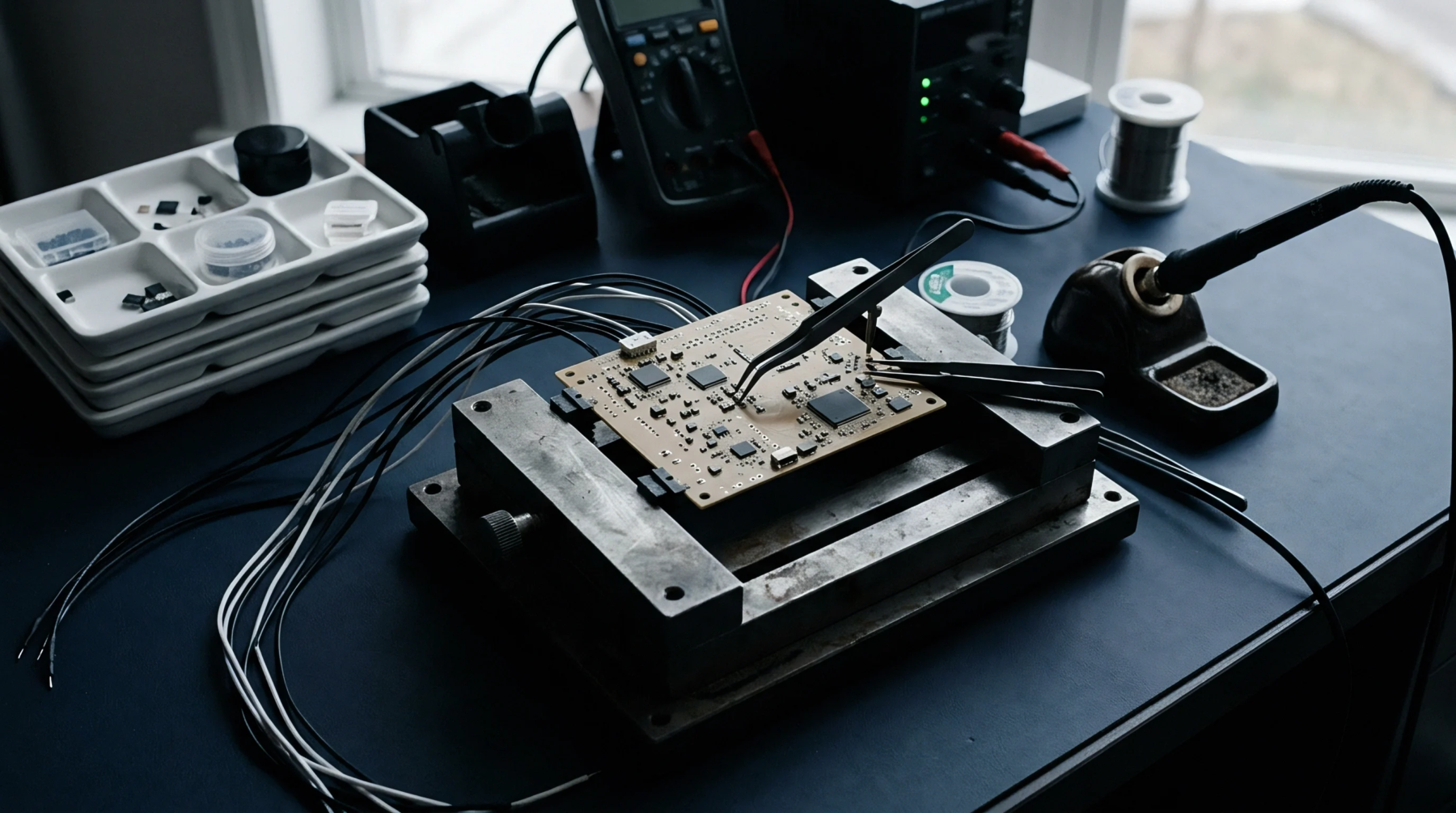
Multiple physical sources inject unwanted broadband and narrowband noise energy into sensitive receiver front-ends. Passive intermodulation distortion generated by high-power transmitter carriers mixing across nonlinear mechanical contacts creates high-energy spurious spikes that fall directly into co-located uplink receiver channels. Switching power supplies, high-speed microcontroller buses and unshielded clock traces radiate broadband electromagnetic fields that couple into sensitive receiver traces through capacitive or inductive crosstalk.
Co-site transmitter bleed through poor filtering saturates low-noise amplifiers, driving active stages into non-linear operation and raising the overall noise floor across broad receiver bands. External environmental noise generated by industrial motors, automotive ignitions and consumer electronics adds continuous atmospheric interference.
Link Impact
Rising noise power degrades wireless link margin and forces base stations to adjust their communications parameters dynamically. When background noise climbs, low-power IoT transceivers operating near sensitivity limits suffer sudden packet loss and decreased operational range. Modern wireless protocols counter elevated noise levels by lowering modulation complexity, switching from high-order quadrature amplitude modulation down to robust phase-shift keying schemes.
This adaptive fallback decreases channel data throughput and increases channel occupancy times. In remote sensor deployments, extended packet transmission durations exhaust non-rechargeable battery reserves prematurely. Mobile terminals adjust by increasing their own transmit power to overcome uplink noise, generating higher local thermal dissipation and battery consumption.
System Boundary
The noise elevation concept applies exclusively to the background noise power density against which intentional communications signals are resolved. It does not measure structural physical hardware damage, mechanical fatigue or static electrical path resistance. Quantifying noise floor elevation requires calibrated spectrum analyzers, noise figure meters or base station receiver status registers under controlled thermal states.
Shielding enclosures, bandpass channel filters, differential trace routing and low-noise amplifier selection determine a receiver design’s noise rejection capability. Once total noise power equals received signal power, data extraction becomes impossible without advanced spread spectrum coding processing gains. System handover acceptance defines permissible uplink noise thresholds before field networks require mechanical connector maintenance or RF filtering retrofits.