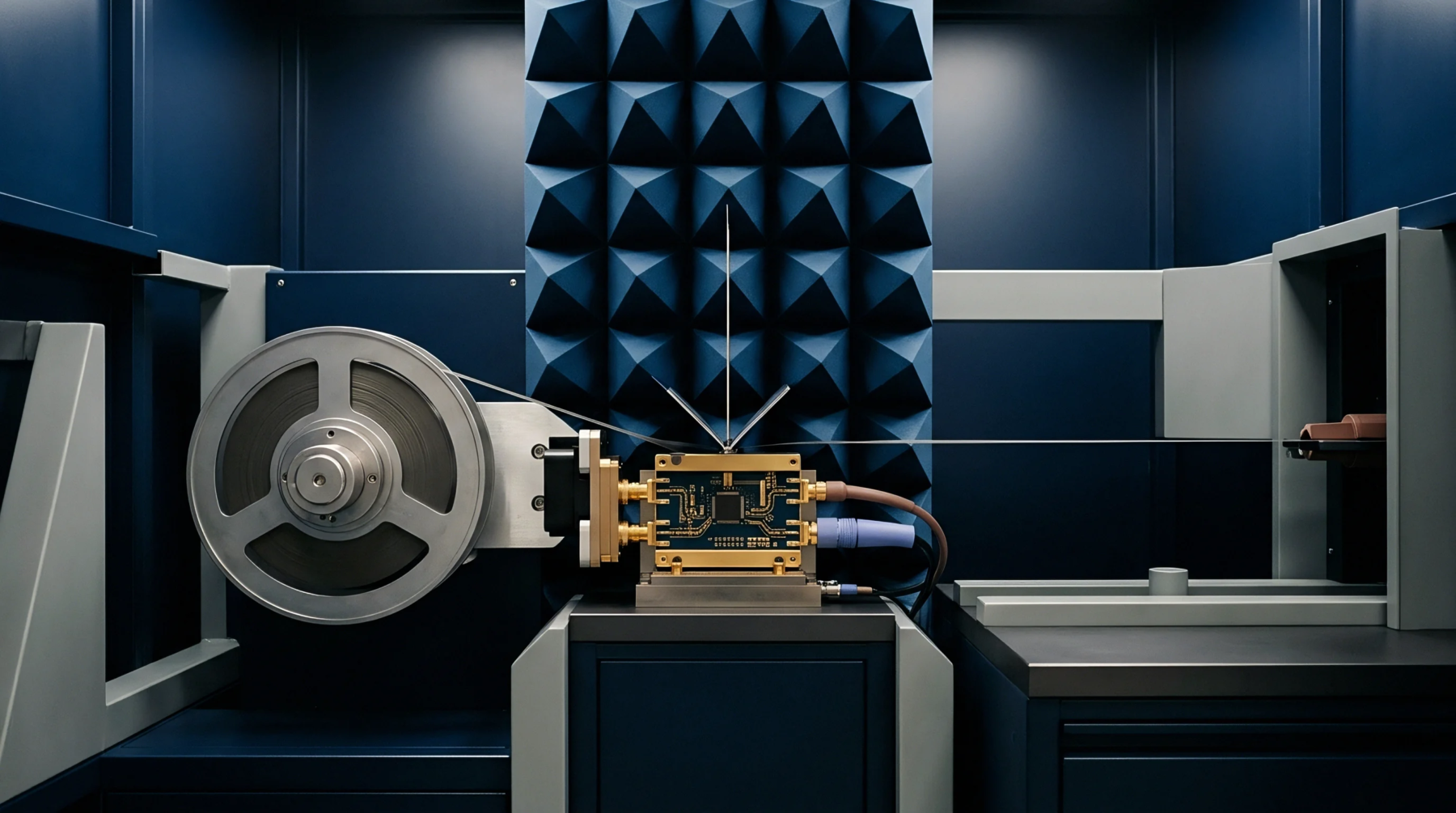
Managing Laboratory Chamber Testing for Chinese Radio Regulatory Compliance
Radio type approval in China demands accredited domestic chamber testing, strict sample hardware modification, and exact power spectral mask compliance.
Administrative spectrum regulations issued by national communications ministries establish strict operational parameters, certification rules, and interference limits for wireless transmission equipment operating within domestic borders. Promulgated by the Ministry of Industry and Information Technology, Radio Management Directive 2021 No. 129 establishes updated technical requirements for radio frequency equipment operating in the 2.4 GHz and 5.1 GHz bands within the People’s Republic of China. This statutory framework mandates specific spectrum sharing mechanisms, limits on equivalent isotropically radiated power, and strict boundaries on out-of-band emissions for Wi-Fi and Bluetooth devices.
The directive applies to all wireless devices manufactured, imported, or deployed for commercial use within the jurisdiction. It ceases to apply to military spectrum allocations, non-transmitting consumer goods, or terminal equipment operating entirely on foreign spectrum plans outside domestic borders.
Spectrum efficiency mandates within the regulation demand higher performance from medium-sharing mechanisms embedded inside local area wireless hardware. Wireless devices operating within the designated frequency bands must incorporate polite spectrum access mechanisms, including listen-before-talk protocols and dynamic frequency selection to prevent co-channel interference with radar installations. The regulation establishes strict ceilings on maximum transmitted power, limiting total radiated energy across diverse operating channel bandwidths.
Spectral masks outside authorized frequency boundaries were tightened under these provisions, demanding higher selectivity from radio front-end filters and power amplifier architectures. Products failing to maintain transmission parameters within these narrower envelopes cannot obtain legal State Radio Regulation of China certification.
Meeting these enhanced regulatory rules drives significant engineering adjustments across integrated radio frequency front-ends, antennas, and firmware stacks. Embedded system developers must verify that system power tables stored in the hardware calibration memory actively restrict output levels to meet the lowered emission ceilings. Component engineers frequently implement higher-order ceramic filters or bulk acoustic wave filters between the radio transceiver and antenna structure to suppress newly restricted out-of-band harmonics.
Firmware layers must enforce localized regulatory domain profiles, preventing the user interface or third-party software applications from overriding designated channel allocations and operational power caps. Mechanical enclosures containing integrated antennas must undergo rigorous radiated testing to confirm that structural parasitics do not amplify restricted spurious emissions.
Legal access to commercial distribution requires submitting production-grade hardware to accredited testing laboratories for formal type examination. Accredited metrology engineers evaluate test units across conducted and radiated setups, measuring spectral power density, occupied bandwidth, spurious emissions during transmission, and idle-state receiver radiation. Test results are assembled into an official conformity docket, which is subsequently uploaded to the State Radio Regulatory Commission portal for administrative assessment.
The resulting radio transmission equipment type approval certificate verifies that the product satisfies every technical boundary enforced by the statute. Commercial deployment within the targeted national territory remains illegal without this formal clearance certificate and the associated physical regulatory label affixed to the device.
Radio type approval in China demands accredited domestic chamber testing, strict sample hardware modification, and exact power spectral mask compliance.
Expertise is a utility, not a secret. sentiention™ publishes its working knowledge as open reference: intelligence layer covering the materials it sources, the markets it enters, and the reference that serves both.