Autonomous Firmware Backoff Logic for Cross Border Cellular IoT Roaming
Autonomous firmware backoff algorithms convert continuous cellular roaming search loops into stateful sleep cycles, preserving battery life during network denial.


Rejection
Cross-border tracking units frequently encounter foreign base stations that return explicit refusal codes during initial attach attempts. When a cellular IoT device operating on LTE-M or NB-IoT enters another country, the primary Public Land Mobile Network identifier broadcast by local towers does not match the home network credentials on the SIM card. The device sends an attach request over the radio interface, and the visited network infrastructure ~ after evaluating roaming agreements ~ returns a Non-Access Stratum registration rejection carrying a specific 3GPP cause code.
These Non-Access Stratum refusal responses enforce precise network operational boundaries, but unhandled roaming rejections carry steep battery penalties. When an unmanaged cellular module receives cause code 11 (unallowed PLMN), cause code 12 (unallowed location area), or cause code 13 (forbidden roaming within a zone), default firmware implementations repeatedly re-attempt registration on the same frequency channel. The modem loops through full-power RF transmission cycles every few seconds, consuming peak currents between 250 mA and 450 mA while attempting to negotiate access with a network that has barred its credentials.
| 3GPP Cause Code | Standard Definition | Network Context | Immediate Firmware Action | Mandated Blacklist Duration |
|---|---|---|---|---|
| Cause 11 | PLMN Not Allowed | No commercial roaming agreement between home operator and visited network. | Append PLMN ID to temporary forbidden list; cease attach retries on current carrier. | 24 hours or until full power cycle. |
| Cause 12 | Location Area Not Allowed | Regional roaming restriction within national boundaries. | Store Location Area Identification; trigger cell re-selection on alternative channels. | 12 to 24 hours depending on mobility profile. |
| Cause 13 | Roaming Not Allowed In Location Area | Geofenced carrier subscription restriction. | Inhibit autonomous attach attempts; switch SIM profile or restrict radio to home bands. | Indefinite until host application overrides. |
| Cause 15 | No Suitable Cells In Location Area | Capacity saturation or dynamic coverage restriction on current cell tower. | Execute immediate neighbor cell measurement scan; delay retry by minimum 300 seconds. | Dynamic backoff scaling from 5 to 60 minutes. |
Standard modem firmware offloads network search behavior to internal timers defined in 3GPP TS 23.122 specifications, but default configurations frequently fail in cross-border deployments. Timer T3245 controls the forbidden PLMN list clearance interval, holding barred carrier IDs in memory for 12 to 24 hours before allowing another registration attempt. If a device crosses a border with only one roaming partner, and that partner temporarily issues cause code 15 due to transient tower congestion, standard modem logic blacklists that single carrier for a full day.
The asset remains isolated while the hardware burns power scanning unsupported spectrum.
Standard commercial roaming agreements mandate that terminal equipment must honor 3GPP cause code 11 rejections by placing the reporting network ID on a persistent forbidden list for a minimum of 86400 seconds.
Firmware architects override standard modem behavior by building an external state machine into the host microcontroller application. The host processor monitors AT command responses across the UART interface, parsing execution strings like +CEREG or +CGAREG error outputs. When it detects a persistent refusal code, the host intercepts the modem execution loop to issue explicit radio management commands, overriding default timers, forcing the baseband processor into deep sleep, and managing carrier preference registers directly.
Contractual terms between terminal equipment vendors and cellular operators enforce strict compliance rules on retry frequency. Under GSMA TS.34 guidelines for IoT device efficiency, any device that transmits more than 30 attach requests within one hour to a network returning cause code 11 or 13 incurs immediate automatic service suspension at the Home Location Register.
Grid
RF spectrum allocation across global territories forces cellular radios to sweep through disparate frequency assignments when primary tower access fails. A modem executing a full-band search scans every E-UTRA Absolute Radio Frequency Channel Number supported by its hardware front end. In North America, LTE-M operation centers on bands 2, 4, 12, 13, 66, and 71, whereas European networks deploy coverage across bands 3, 8, and 20.
When an asset crosses an international boundary, the modem’s low-noise amplifier and power amplifier must retune across several hundred megahertz while processing synchronization signals from visible base stations.
Radio frequency sweeps demand substantial current. During active channel scanning, the radio receiver correlator runs continuously, drawing between 40 mA and 90 mA depending on baseband silicon architecture. If the device fails to locate a usable home or roaming signal, the modem ramps transmit power to maximum levels, delivering up to +23 dBm into the antenna feedline to transmit random access preambles.
Antenna detuning further compounds energy losses: a vehicle-mounted tracker crossing a border can experience 6 dB to 10 dB of detuning from body proximity or environmental degradation, forcing the radio system to run at full RF output power for extended intervals.
- Channel Raster Scanning Overheads force the baseband receiver to spend up to 100 milliseconds per channel evaluating Primary Synchronization Signals across wide frequency spans.
- Power Amplifier Duty Cycle Saturation occurs when continuous preamble transmissions at maximum output power heat the RF front-end substrate, degrading amplifier efficiency.
- Paging Channel Correlation Failure arises when degraded downlink path loss prevents the modem from decoding system information blocks despite detecting cell energy.
- Out-Of-Band Intermodulation Distortion degrades receiver sensitivity when strong adjacent non-roaming carrier signals overload the low-noise amplifier stage.
Energy budgets degrade exponentially during unthrottled search routines. Consider a 3.8 V system powered by a 2400 mAh primary lithium thionyl chloride battery cell. In standard Power Saving Mode with eDRX enabled, the quiescent system current remains at 3.5 microamps.
A single unthrottled roaming search loop lasting 180 seconds at an average current draw of 120 mA consumes 6.0 milliamp-hours of capacity. Executing this search cycle every five minutes during an extended cross-border transit exhausts 72 milliamp-hours per hour, depleting the entire primary battery capacity within 33 hours of continuous border searching.
| Operation Mode | Average Current Draw (3.8V) | Duration Per Cycle | Energy Spent Per Event | Calculated Battery Impact (2400mAh Cell) |
|---|---|---|---|---|
| Single Channel Raster Read | 45 mA | 80 ms | 0.001 mAh | Negligible baseline operation. |
| Full Regional Band Scan (6 Bands) | 85 mA | 42 seconds | 0.991 mAh | 0.04 percent of total cell capacity. |
| Global Spectrum Sweep (21 Bands) | 110 mA | 195 seconds | 5.958 mAh | 0.25 percent of total cell capacity. |
| Attach Retry with Max RF Tx (+23dBm) | 310 mA | 12 seconds | 1.033 mAh | 0.04 percent per individual attempt. |
| Unthrottled Roaming Search Loop (1 Hr) | 140 mA (equivalent) | 3600 seconds | 140.000 mAh | 5.83 percent lost per hour of search. |
Base stations enforce hard connection limits, and firmware developers who ignore physical spectrum constraints subject their devices to severe battery depletion. When an asset spends hours in transit through coverage gaps between border checkpoints, unmanaged channel scanning can turn a ten-year operational lifetime specification into a dead battery before the shipment reaches its final distribution point.
At an average current draw of 110 mA during a 195-second global spectrum sweep, a single failed cross-border roaming search cycle consumes 5.958 milliamp-hours from the battery system.


Backoff
Autonomous recovery state machines prevent runaway radio active time by inserting algorithmic delays between registration retries. Rather than relying on simple linear timers that execute scans at fixed intervals, firmware engineers deploy adaptive backoff algorithms that scale retry delays based on historical rejection counts, current battery voltage, and motion sensor inputs. When a registration attempt fails on a foreign network, the firmware increments an internal failure counter and calculates the next permitted radio wake-up time using scaling formulas.
Truncated Binary Exponential Backoff provides a proven framework for managing radio retry intervals. The firmware calculates delay time using the equation Tdelay = min(Tmax, Tbase × 2n + jitter), where n represents the consecutive failure count, Tbase serves as the initial backoff interval, and Tmax caps the maximum permitted sleep duration. Adding pseudorandom jitter prevents synchronous network flooding when multiple tracking units experience border coverage drops simultaneously on the same transport vessel.

Will Custom PLMN Search Timers Bypass Standard Roaming Restrictions?
Modifying internal modem search parameters through direct AT commands alters how baseband processors interact with standard network infrastructure. Standard 3GPP search routines prioritize home networks by executing Higher Priority PLMN background scans at fixed multiples of 6 minutes, controlled by SIM elementary file parameters. Overriding these timers with commands such as AT+NVW or proprietary vendor extensions allows host firmware to disable continuous background scans entirely while roaming on an approved secondary carrier, preserving battery life without dropping the connection.
Fibonacci backoff schedules offer an alternative scaling trajectory that expands sleep intervals less aggressively than exponential logic during initial failure cycles, while escalating to long sleep windows rapidly after persistent rejection. Integrating accelerometer movement data into the backoff logic halts network search routines entirely while the asset remains stationary inside a shielded metallic shipping container or border holding warehouse, resuming cell search operations only when movement thresholds indicate physical transport progression.
| Retry Count (n) | Linear Delay (Base=60s) | Exponential Delay (Tbase=30s, Tmax=86400s) | Fibonacci Delay (Base=30s) | Cumulative Energy Lost (10 Retries) |
|---|---|---|---|---|
| 1 | 60 seconds | 30 seconds | 30 seconds | 0.099 mAh |
| 3 | 180 seconds | 240 seconds | 90 seconds | 0.297 mAh |
| 5 | 300 seconds | 960 seconds | 240 seconds | 0.495 mAh |
| 8 | 480 seconds | 7,680 seconds | 630 seconds | 0.792 mAh |
| 10 | 600 seconds | 30,720 seconds | 1,650 seconds | 0.990 mAh |
Designing an autonomous backoff engine demands clear execution pathways for state transitions. The decision flow defines specific system behavior based on radio conditions and power availability.
- Signal Detection Validation checks for minimum Reference Signal Received Power levels above -115 dBm before initiating any registration sequence.
- Rejection Cause Classification reads the returned Non-Access Stratum cause code to distinguish temporary network congestion from permanent carrier barring.
- Sleep Schedule Calculation computes the target backoff window using current battery health parameters and historical failure counts.
- Subsystem Power Isolation places the modem into complete hardware power-down via direct FET switches or deep PSM sleep before starting the backoff timer.
- Motion Interrupt Evaluation monitors background accelerometer signals to trigger premature backoff interrupts if the device undergoes significant displacement.
Exponential backoff schedules incorporating pseudorandom jitter prevent simultaneous signal attach spikes across multi-asset shipping deployments while extending battery operational lifetimes.
As a rule of thumb, an autonomous backoff algorithm should transition the radio module into complete hardware power-off or deep Power Saving Mode whenever calculated retry delays exceed 300 seconds, maintaining host micro-controller current draw below 10 microamps during the sleep window.

Profiles
Multi-identity SIM architectures and eUICC applets introduce secondary recovery layers when the underlying modem remains stuck in refusal loops. Modern cross-border IoT deployments use SIM cards carrying multiple International Mobile Subscriber Identities or eUICC capabilities capable of switching bootstrap profiles over the air. When primary roaming credentials fail on a foreign border, host firmware interacts with the SIM card through standard ISO 7816 interface commands or custom SIM applet interfaces to trigger profile rotation.
Applet-driven identity switching requires strict coordination with baseband backoff state machines. Executing an IMSI switch while the cellular modem actively attempts an attach sequence disrupts baseband state memory, frequently locking the SIM interface until a hard hardware reset occurs. Firmware orchestrates profile rotation by driving the modem into offline radio state using AT+CFUN=4, issuing the profile selection command via AT+CSIM or AT+CRSM, and waiting for the SIM card to complete internal file updating before applying power back to the RF circuitry.
Profile switching procedures follow a strict, deterministic execution path to protect SIM file integrity during cross-border transit:
- Force cellular modem into minimum functionality state via AT+CFUN=0 command.
- Verify total release of all active network sessions and baseband volatile memory handles.
- Issue ISO 7816 logical channel command to target SIM applet selector handle.
- Transmit profile selection payload containing secondary IMSI credentials and fallback PLMN preferences.
- Wait for successful APDU execution return code 90 00 from the SIM secure element.
- Apply full power cycle to SIM interface power rails to force elementary file re-read.
- Re-enable modem radio functionality via AT+CFUN=1 and initiate manual attach to selected operator ID.
Switching profiles consumes significant energy and network overhead. Over-the-air profile updates demand high signal quality to download fresh SIM credentials via Remote SIM Provisioning platforms. If a device loses primary connectivity in a remote border region, localized profile rotation relies entirely on pre-stored credentials embedded in the SIM profile container during manufacturing.
Multi-IMSI profile switching state machines require a mandatory 15-second radio stabilization delay between network detach and profile switching commands to prevent SIM file system locking.
Visited carrier networks frequently reject rapid identity changes originating from the same IMEI hardware address within short time windows, citing security anti-spoofing flags inside the visited core network.
Bench
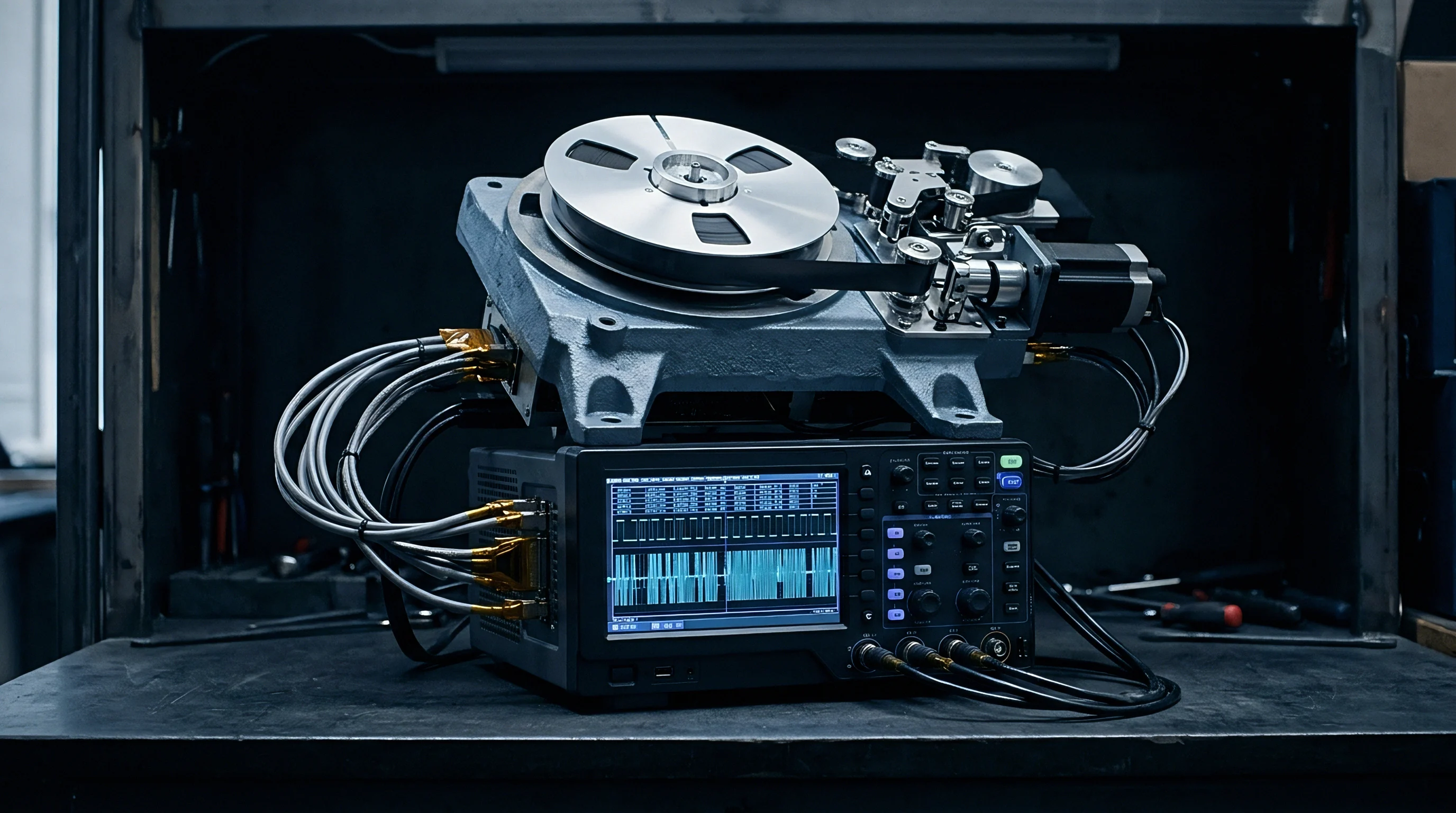
Verifying autonomous retry logic demands hardware-in-the-loop simulation capable of replicating cross-border network denials and variable signal degradation. A complete verification bench integrates a multi-channel radio communication tester, a programmable DC power supply capable of microamp resolution, an RF shielding enclosure, and an automated host controller running continuous test scripts. The communication tester emulates base station signaling, transmitting configured Country Codes and Network Codes while injecting controllable Non-Access Stratum rejection cause codes into the device under test.
Consider a practical verification scenario evaluating a cellular asset tracker crossing the border between France and Spain. The test script configures the cell emulator to broadcast Mobile Country Code 208 and Mobile Network Code 10 (French network) on channel 1300 (Band 3). The device attaches successfully, establishing an active packet data protocol context.
The script then ramps down French signal power to -125 dBm while bringing up a secondary cell broadcasting MCC 214 and MNC 07 (Spanish network) on Band 20 with an enforced rejection parameter set to cause code 11 (PLMN Not Allowed).
Test equipment monitors current draw across high-speed sampling channels during this simulated transition. Upon receiving cause code 11 from the Spanish cell emulator, an unoptimized firmware implementation continuously loops AT+COPS searches, generating 220 mA current bursts every 15 seconds. Total energy consumed over a 2-hour simulated border delay reaches 352 mAh, representing a heavy draw on primary battery capacity.
The optimized firmware implementation carrying autonomous backoff logic detects cause code 11, appends 214-07 to its temporary internal blacklist, issues AT+CFUN=0, and enters deep sleep mode with an average current draw of 8.2 microamps. The initial failed attach attempt and subsequent backoff execution consume just 1.42 mAh over the same 2-hour window.
Automated regression suites test edge-case conditions by injecting transient network anomalies. The test bench simulates carrier radio link failure by suddenly removing RF signal during active attach negotiations, evaluating whether host firmware recovers without entering an unrecoverable baseband latch-up state. The system logs UART debug communications, power consumption traces, and SIM card command responses, outputting compliance reports against GSMA TS.34 IoT device requirements.
Firmware verification passes only when the asset tracker maintains power consumption below 0.05 mAh per hour during sustained 24-hour network denial scenarios across all supported RF band profiles.