Determining Radiated Emission Changes from Radio Module Firmware Updates
Firmware register and power table modifications alter radiated emissions, requiring pre-scan verification and permissive change filings before release.
Radiated and conducted electromagnetic emission screening performed ahead of formal regulatory evaluation establishes whether an electronic assembly operates within statutory field-strength boundaries. A compliance pre-scan identifies unintended radio frequency energy generated by trace geometry, switching regulators, internal oscillator clocks and mechanical seams before submitting hardware to an accredited test facility. The operation measures peak emissions across defined frequency bands to uncover marginal performance against statutory limits set by authorities such as the Federal Communications Commission or the European Union.
Engineering teams rely on these sweeps to prevent costly formal re-testing cycles. The scope covers initial unshielded board layouts through fully enclosed prototypes with attached peripheral cabling, ending when formal certification testing begins under prescribed chamber conditions.
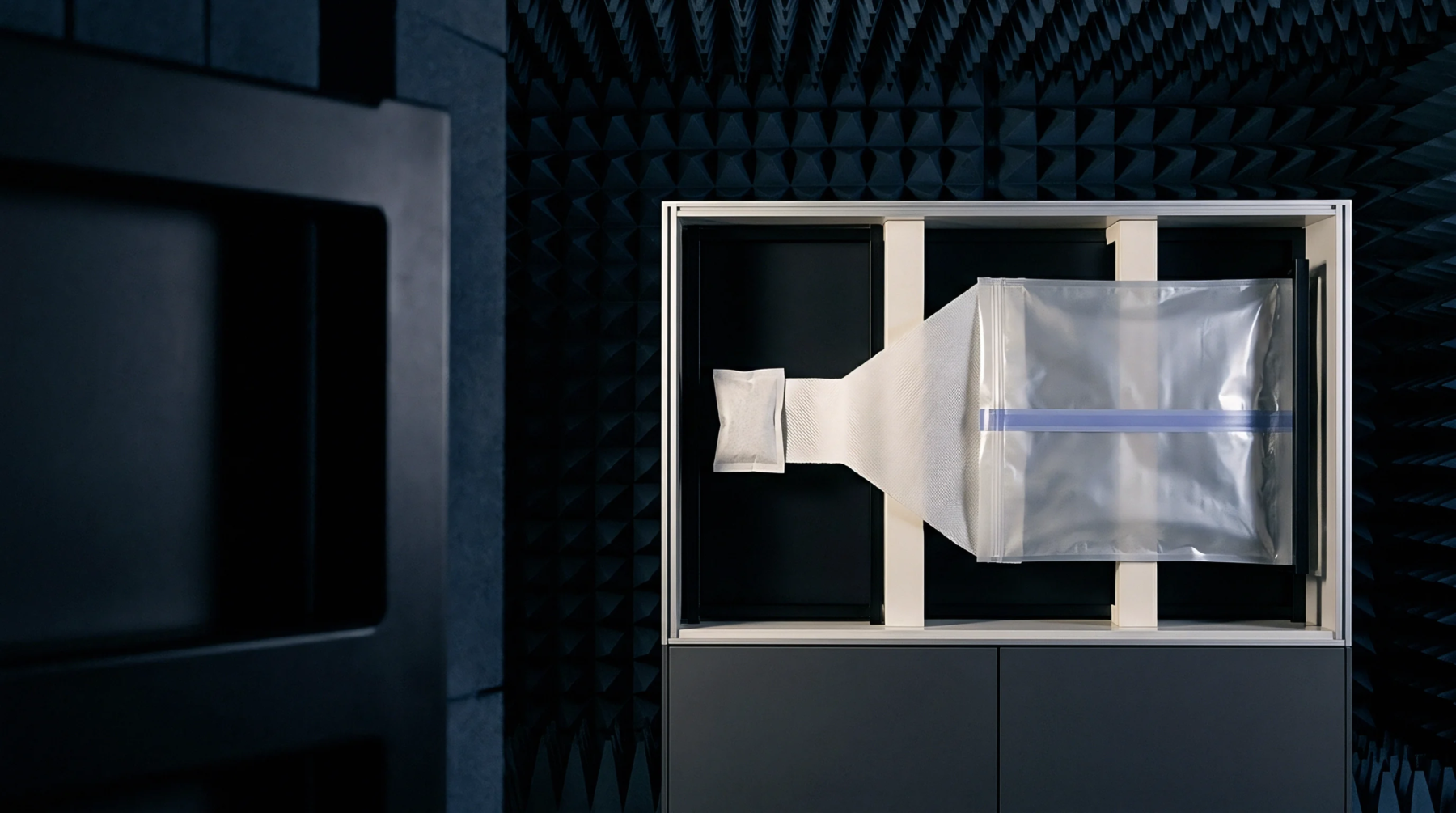
Anechoic and semi-anechoic environments isolate the device under test from ambient electromagnetic signals present in industrial environments. Absorber-lined enclosures eliminate boundary reflections, permitting calibrated antennas to capture emissions across horizontal and vertical polarizations at shortened distances of one to three meters. Turntables rotate the complete assembly across a three-hundred-and-sixty-degree profile while spectrum analyzers record spectral peaks using fast Fourier transform acquisition modes.
Near-field magnetic and electric probes localize specific printed circuit board traces, decoupling loops, or enclosure joints responsible for radiating energy above the reference threshold. Measurements taken in non-calibrated spaces require careful ambient signal subtraction to isolate actual device activity from cellular, broadcast, and industrial interference.
Spectral findings from exploratory scans trigger layout, firmware, and mechanical enclosure revisions to suppress excessive peak energy. High-frequency radiation from clock lines or power converter loops prompts the insertion of surface-mount ferrite beads, common-mode chokes, or additional bypass capacitance. Ground plane discontinuities beneath high-speed signals demand trace re-routing to shorten current return paths and reduce loop inductance.
Enclosure seams, connector apertures, and display bezels often receive conductive gaskets, beryllium copper fingerstock, or internal metal shielding cans to suppress enclosure leakage. Spread-spectrum clocking registers are configured inside system firmware to broaden energy peaks, distributing concentrated radio energy across a broader band below statutory limits.
Formal qualification submission requires an internal engineering report compiling pre-scan spectral charts against regulatory baseline masks. Tabulated margins record the difference between measured radiated energy peaks and relevant class boundaries across each critical harmonic. Grounding diagrams, shield clip torque specifications, and bill-of-materials revisions tie specific hardware configurations to the measured spectral profiles.
Delivery of this document releases hardware prototypes for formal accredited laboratory qualification. Radiated margin values recorded in the compliance pre-scan define the readiness threshold for final regulatory certification.
Firmware register and power table modifications alter radiated emissions, requiring pre-scan verification and permissive change filings before release.
Expertise is a utility, not a secret. sentiention™ publishes its working knowledge as open reference: intelligence layer covering the materials it sources, the markets it enters, and the reference that serves both.