Calculating Thermal Expansion Load Changes in Bolted Assemblies
Thermal expansion alters bolt tension by the product of joint stiffness, differential growth, and clamped length, causing yield or cold-soak preload loss.
Grip
Clamp length determines the basic spring rate of a mechanical enclosure. When temperatures swing between a minus forty degrees Celsius storage depot and eighty-five degrees under full operating load, mixed metals expand at noticeably different rates. That delta either stretches the fastener or slackens the joint.
Steel bolts threaded into cast aluminum chassis are a standard failure point in outdoor electronics: aluminum expands at roughly twice the rate of carbon steel, driving sharp tension spikes into the shank at peak operating temperatures.
A bolted joint works as two opposed springs: the fastener under tension, the clamped flange under compression. Thermal swings disrupt that balance through the difference in expansion coefficients. A joint that holds its torque on the bench can drop significant preload in fewer than ten thermal cycles if the original design calculations ignore differential growth.

Mechanical Vulnerabilities in Thermal Environments
Temperature swings produce distinct structural failures in mixed-metal joints.
- Flange plastic deformation occurs when elevated temperatures drive thermal load beyond the compressive yield strength of the mating boss, crushing the casting beneath the fastener head.
- Thread shear failure develops in tapped aluminum bosses because the female threads lose shear strength rapidly as temperatures exceed one hundred degrees Celsius.
- Cold-soak joint separation takes place during low-temperature excursions when the clamped material contracts faster than the fastener, dropping residual clamp force to zero and unseating environmental elastomer seals.
- Fastener fatigue fracture accelerates under cyclic thermal service when fluctuating tensile loads combine with bending moments induced by uneven flange expansion.
If the clamped casting yields at peak temperature, its clamped thickness drops permanently. Once the assembly cools, the bolt contracts against a thinner joint stack, losing its initial preload.
Water leaking past unseated silicone or ethylene propylene diene monomer seals shorts internal radio-frequency circuits long before the hardware itself shears. Working out these load shifts before tooling release preserves both enclosure sealing and field life.

Dilation
Free parts expand in proportion to temperature based on their linear expansion coefficients. Once bolted into an enclosure, that expansion is mechanically constrained and converts into stress. Calculating what happens starts with finding the free thermal expansion of each part along the clamp axis, then solving for the forces required to keep the stack geometry intact.
Thermal growth in constrained stacks converts thermal strain directly into fastener stress.
Fastener alloys differ substantially in thermal expansion from standard enclosure castings. Carbon steel runs around eleven to twelve parts per million per Kelvin, while austenitic stainless steel sits between sixteen and eighteen parts per million per Kelvin. Cast aluminum alloys like A380 or ADC12 expand at twenty-one to twenty-three parts per million per Kelvin, creating a pronounced mismatch against steel bolts.
| Material Designation | Elastic Modulus (GPa) | Expansion Coefficient (ppm/K) | Yield Strength (MPa) |
|---|---|---|---|
| ISO 898-1 Class 8.8 Carbon Steel | 205 | 11.5 | 640 |
| ISO 898-1 Class 10.9 Alloy Steel | 210 | 11.2 | 940 |
| A2-70 Stainless Steel (AISI 304) | 193 | 16.5 | 450 |
| ADC12 Die-Cast Aluminum | 96 | 21.0 | 150 |
| 6061-T6 Extruded Aluminum | 69 | 23.5 | 275 |
| C11000 Electrolytic Copper | 117 | 16.8 | 220 |
The gap between expansion rates sets the thermal interference. Along the clamped length, differential expansion equals that length multiplied by the temperature delta and the coefficient difference. When the clamped metal expands faster than the fastener, heat pulls the bolt tighter, raising axial tension.
Is Differential Thermal Growth Capable of Crushing Flanges?
Under-head compressive stresses regularly exceed the plastic limit of aluminum housings at peak operating temperatures. An M6 Class 8.8 bolt bearing directly on an aluminum boss without a wide, hardened washer can generate contact stress above two hundred megapascals at eighty-five degrees Celsius. The bolt stretches while the aluminum yields under the head, permanently compressing the boss; when the joint returns to ambient temperature, preload drops toward zero.
High-expansion clamped components will press against stiff fasteners until the softer mating face yields.

Stiffness
The spring rates of the bolt and the clamped flange determine how thermal interference splits between fastener tension and joint compression. Bolt compliance accounts for the unthreaded shank, the engaged and free thread lengths, and deflections at the head and nut. Clamped member compliance is typically calculated using the conical pressure envelope from VDI 2230, where load spreads through the flange within a double frustum.
A thirty-millimeter clamp length in an aluminum boss generates a four-kilonewton load spike for every sixty-degree temperature increase when secured by an M6 steel bolt.
Fastener elasticity is the cross-sectional area times the elastic modulus, divided by active length. Flange stiffness requires integrating the pressure cone angle, typically between twenty-five and thirty-three degrees depending on geometry and surface friction. Together, these two stiffnesses establish the joint stiffness factor, which sets how much differential expansion the bolt absorbs relative to the flange.
The joint stiffness factor links thermal expansion straight to load change. When the flange expands faster than the bolt, the induced thermal force equals differential expansion multiplied by the combined spring rate. That combined rate is bolt stiffness times member stiffness, divided by their sum.
Stepwise Thermal Load Calculation Procedure
Calculating thermal force shifts requires a systematic order of analysis.
- Establish baseline assembly preload by calculating torque-tension conversion based on thread pitch and verified friction coefficients across fastener contact surfaces.
- Determine individual component spring rates using elastic moduli and effective cross-sectional areas across the full grip length.
- Compute the joint compliance ratio to define the proportion of thermal strain distributed into bolt tension versus flange compression.
- Calculate differential thermal expansion across the complete temperature range using material-specific expansion coefficients and maximum thermal gradients.
- Evaluate total resultant bolt load at peak temperature against fastener yield limits and bearing surface compressive allowances.
If the calculated thermal force pushes a fastener beyond ninety percent of its yield strength, the joint enters plastic deformation, degrading fatigue life and loosening once temperatures drop.
Overestimating member stiffness leads to an overconfident estimate of remaining clamp load, resulting in field seal failures that consume entire warranty budgets in one operating season.

Relaxation
Surface asperities flatten under sustained clamp pressure. Thermal cycles accelerate this embedment because higher temperatures lower the compressive yield point of microscopic peaks on machined faces. Torquing flattens threads and bearing surfaces to some extent during assembly, but the initial thermal peak flattens them further under elevated contact stresses.
Relaxation losses in mixed-metal assemblies routinely claim twenty percent of initial preload during the initial thermal excursion before joint equilibrium stabilizes.
Fasteners also undergo stress relaxation: under prolonged tension, metal reorganizes microscopically, converting elastic stretch into permanent set. In die-cast aluminum alloys, creep starts as low as eighty degrees Celsius under concentrated loads, steadily easing the compressive counter-force exerted by the housing wall.
Will Joint Relaxation Accelerate Bolt Yielding?
Thermal excursions frequently push combined mechanical and thermal stresses beyond the proportional limit of the joint. A bolt torqued to eighty percent of proof load at room temperature can easily exceed yield when differential expansion adds tensile force. The bolt stretches permanently, and once back at room temperature, it is longer than the relaxed stack it was meant to clamp, leaving negligible preload.
| Operating Temperature (°C) | Temperature Delta (K) | Thermal Load Change (kN) | Total Bolt Load (kN) | Preload Remaining After 20°C Return (kN) |
|---|---|---|---|---|
| -40 | -60 | -3.8 | 5.2 | 9.0 |
| 20 | 0 | 0.0 | 9.0 | 9.0 |
| 60 | +40 | +2.5 | 11.5 | 8.6 |
| 85 | +65 | +4.1 | 13.1 | 7.2 |
| 105 | +85 | +5.4 | 14.4 | 5.8 |
| 125 | +105 | +6.7 | 15.7 (Yield Exceeded) | 2.1 |
With repeated thermal cycles, the combined effect of embedment, creep, and localized yielding progressively degrades baseline clamping force, producing joint chatter and fretting corrosion across mounting interfaces.
Critical Verification Scope for Joint Integrity
Engineering sign-off packages require specific validation files to confirm thermal joint stability.
- Joint compliance calculations documenting individual spring rates, assumed stress cone angles, and verified material properties at operating temperature limits.
- Torque-angle tightening specifications establishing validated assembly scatter bands and target preload margins calibrated against production friction conditions.
- Thermal cycle test reports demonstrating residual preload measurement via ultrasonic bolt elongation gages after minimum one hundred full temperature cycles.
- Interface pressure mapping scans confirming that elastomer compression gaskets maintain minimum sealing pressure across the entire perimeter at low-temperature dwell limits.
Standard thread lockers prevent rotation, but chemical adhesives cannot halt the axial preload loss caused by material yielding.
Margin
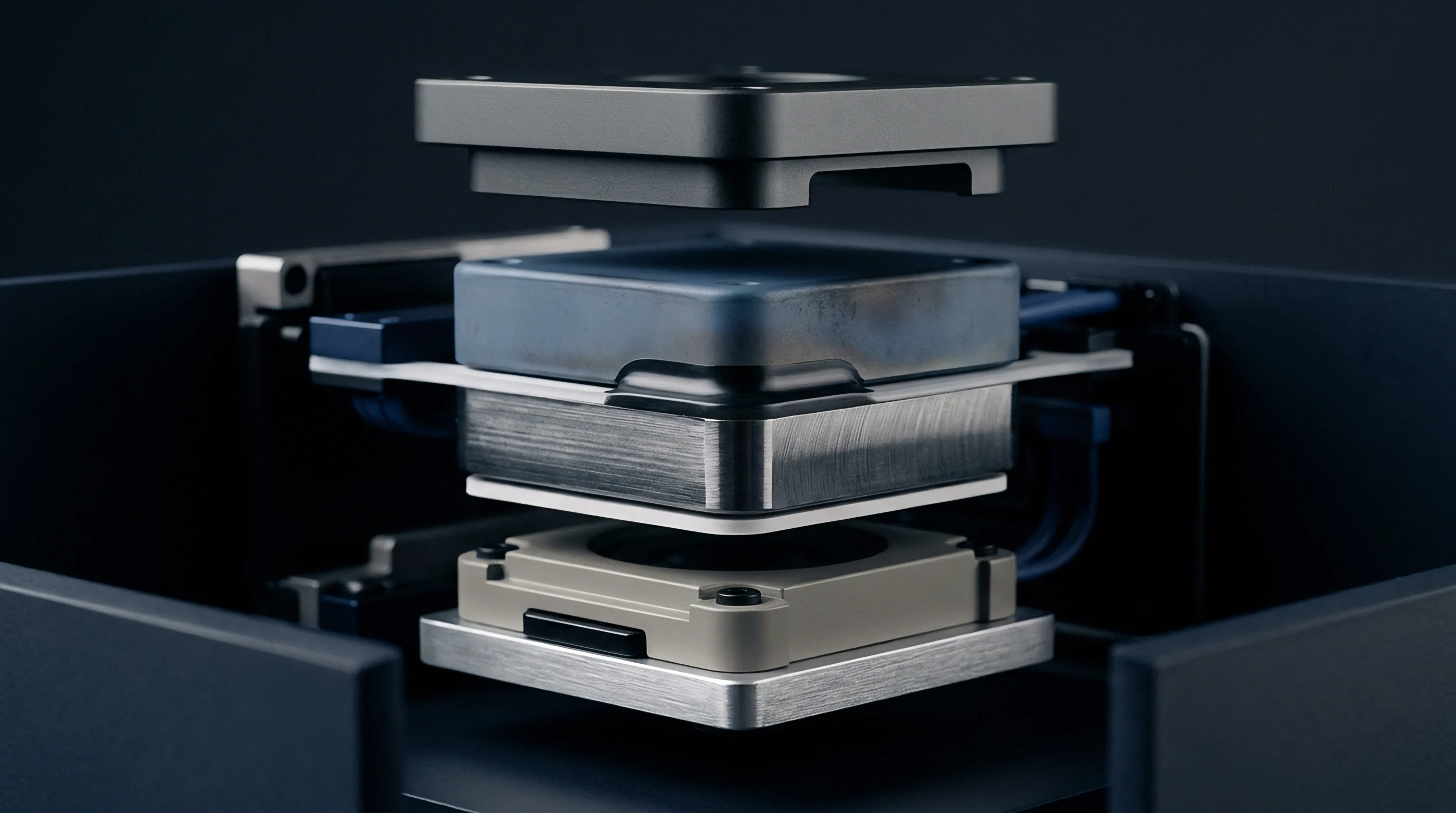
Improving joint reliability starts with making the fastener more elastically compliant relative to the clamped flange. Increasing clamp length with thick collar spacers or deep counterbores lowers the fastener spring rate; a more compliant bolt absorbs thermal expansion with far lower tension spikes. Long, slender shanks tolerate thermal growth much better than short, stiff studs.
Closing the expansion gap is an alternative. Specifying austenitic stainless steel hardware in aluminum enclosures cuts differential expansion by more than half compared to carbon steel. If high-strength steel remains necessary for structural capacity, Belleville disc springs or conical washers add elasticity back into the stack, preserving clamp force through cold soak and subsequent relaxation.
Standard procurement contracts enforcing VDI 2230 compliance hold the module integrator liable for warranty replacements if thermal relaxation causes joint separation before five thousand operating hours elapse.
Assembly control sets the initial safety margin against thermal yield. Standard torque tools yield preload scatter around plus or minus thirty percent due to friction variation. Switching to torque-angle or yield-point control narrows that window to plus or minus ten percent.
That reduced spread lets designers specify a lower nominal room-temperature preload, preserving room for thermal expansion at maximum temperature without opening the joint at cold extremes.
Section 5.3 of VDI 2230 Part 1 sets this design boundary, requiring that maximum thermal force be checked against the lowest yield limit across the entire operating temperature range.