International Contract Enforceability of Liquidated Damages in Electronics Assembly
Cross-border liquidated damages require explicit downtime calculations based on unabsorbed overhead to survive judicial penalty reviews in assembly contracts.
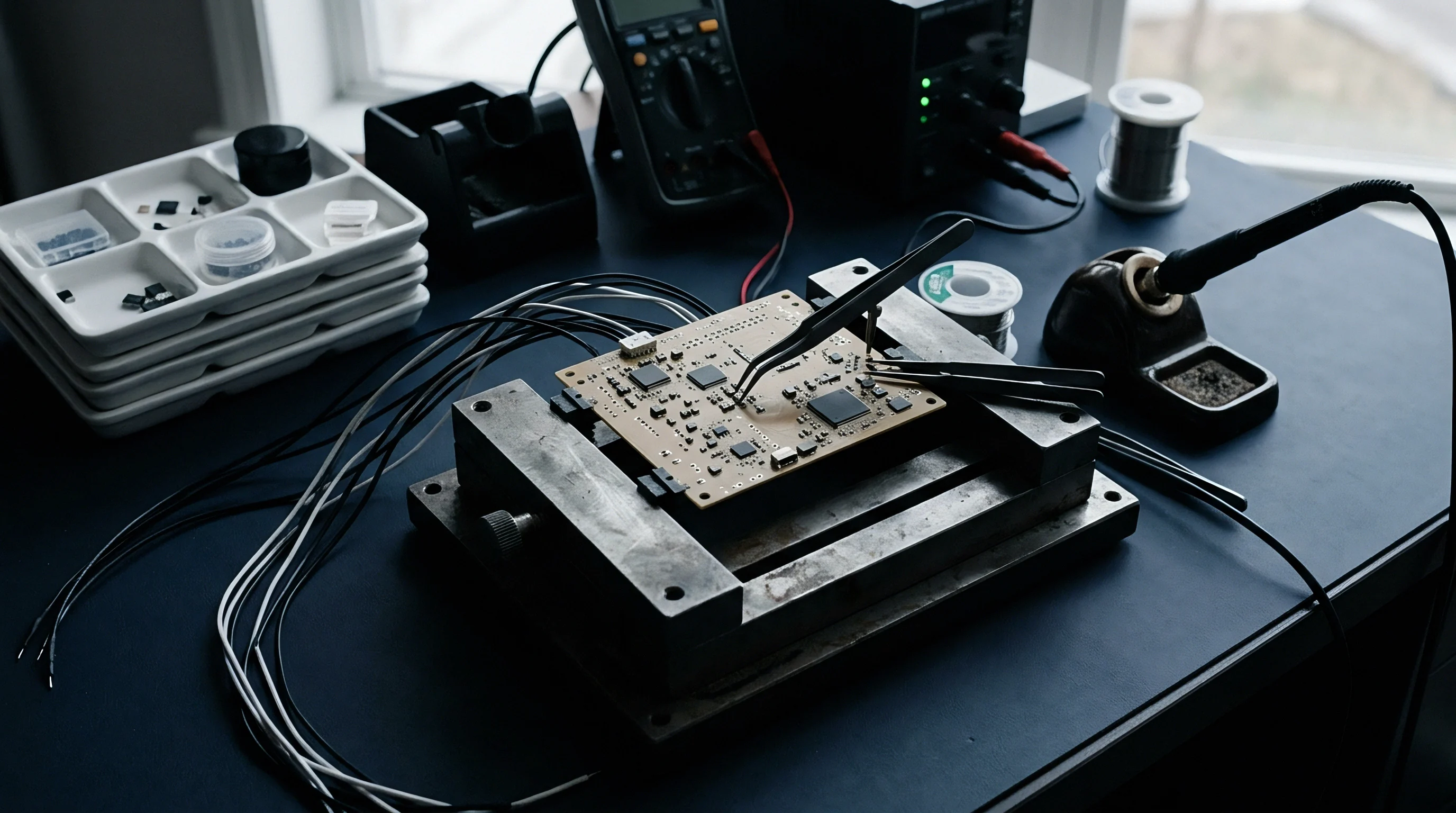

Bench
Continuous high-density placement processes register lost capacity directly through hourly throughput tallies. At thirty thousand components per hour, a surface-mount line stalled by a jammed feeder, a miscalibrated pick-and-place nozzle, or a missing bill-of-materials item burns capital in real time. Liquidated damages clauses translate these physical line stoppages into predictable, pre-agreed figures.
If a contract manufacturer misses scheduled handovers, the buyer carries unabsorbed overhead, delays downstream box-build operations, and risks missing contracted shipping windows. Working out that exposure before signing sets a defensible formula for converting assembly delays into financial recovery.
Because factory shifts run continuously, calculating liquidated damages requires tracking how a stoppage ripples through the entire plant. Direct technical labor, automated optical inspection systems, and surface-mount lines keep accruing depreciation and overhead while bare boards sit idle in buffer magazines. That drag carries directly into downstream operations: programming bays, functional circuit test benches, and environmental stress screening chambers all sit idle waiting for board assemblies.

Surface Mount Line Stoppage Operational Metrics
Surface-mount production schedules rely on explicit measures of downtime cost. During an unscheduled stoppage, line expenses accumulate across several distinct hardware and labor categories:
- Placement Equipment Amortization Placement machinery depreciates across planned shift hours regardless of actual board throughput.
- Direct Technical Labor Dedicated line operators, process engineers, and quality control inspectors cannot simply be reassigned on short notice during unscheduled downtime.
- Facility Overhead Absorption Climate control systems for moisture-sensitive components draw continuous power whether the placement head is moving or dark.
- Downstream Station Starvation Downstream optical inspection and selective soldering cells sit idle, compounding delivery slippage into final box-build operations.
Without clear contractual rates for daily delay compensation, proving actual damages in litigation quickly becomes prohibitive. Agreeing on daily figures tied to unabsorbed overhead eliminates contentious, document-heavy discovery if a dispute reaches court.

Quantifying Financial Downtime before Contract Signing
Buyers weigh reserved line capacity against baseline operational costs. A standard automated surface-mount line running two twelve-hour shifts incurs between twelve hundred and twenty-five hundred dollars in daily fixed overhead, materials excluded. If the manufacturer falls behind by fifteen business days, unabsorbed line costs coupled with air freight expedites for downstream assemblies accumulate rapidly.
SMT line capacity reserved at fifteen hundred dollars per day per line generates thirty thousand dollars in unabsorbed fixed overhead across a twenty-day assembly delay.
Tying pre-estimated delay figures directly to factory overhead provides an enforceable legal footing. Delivery penalties set arbitrarily tend to collapse under judicial review. Grounding daily rates in documented operating costs anchors the remedy in accounting fact, whereas setting an unadjusted rate higher than three times the actual daily operating cost invites legal challenges that can leave the buyer with no enforceable delay remedy at all.


Calculus
Both common and civil law courts test agreed delay damages against whether the stipulated sum genuinely forecasted injury. Cross-border electronics manufacturing agreements run into sharply divergent legal doctrines on delay compensation. An unenforceable provision leaves the buyer exposed to uncompensated delays and saddled with the heavy burden of proving actual losses after the fact.
Enforceability turns on how the provision is structured. English common law asks whether the stipulated sum protects a legitimate commercial interest without imposing an extravagant or unconscionable burden on the supplier. Civil law jurisdictions take a different approach, weighing the agreed sum against the losses actually suffered and reserving the power to adjust the recovery amount accordingly.

Pre-Estimated Losses versus Unenforceable Penalties
Recovering delay costs requires terms that correspond to calculated operational impact. Most agreements set daily delay assessments either as a percentage of the purchase order or as a fixed per-diem fee. These rates generally run from 0.1 percent to 0.5 percent of total contract value per business day of unexcused delay, subject to an aggregate cap between five and ten percent.
Spelling out the underlying arithmetic in a contract schedule demonstrates that the figures reflect calculated plant costs rather than punitive pressure. Tying the per-diem rate to unabsorbed line overhead, tooling re-setup, and test bench recalibration provides the evidentiary foundation needed to withstand judicial scrutiny.

Jurisdictional Variations in Delay Damages Evaluation
Enforcement standards diverge sharply between English commercial courts and Chinese civil tribunals. English judges look at whether the clause protects a legitimate business interest and whether the remedy is proportionate. Chinese courts applying the People’s Republic of China Civil Code assess stipulated damages against proven actual loss, with statutory authority to reduce the award if the contract rate exceeds actual losses by more than thirty percent.
| Jurisdiction | Primary Governing Standard | Penalty Rule Threshold | Judicial Power to Adjust | Typical Cap Range |
|---|---|---|---|---|
| England & Wales | Legitimate Interest & Proportionality | Extravagant or unconscionable penalty | Enforces or strikes down entirely | 5% to 10% contract value |
| PRC (China) | Civil Code Article 585 | Exceeds actual loss by over 30% | Reduces or increases sum to actual loss | 5% to 15% contract value |
| Singapore (SIAC) | Genuine Pre-estimate of Loss | In terrorem punishment motive | Enforces valid pre-estimate strictly | 5% to 10% contract value |
| United States (UCC) | UCC Section 2-718(1) | Unreasonable size in light of actual loss | Voids clause if deemed unreasonable | 5% to 10% contract value |
Liquidated damages language needs to mirror the legal tests of the chosen dispute forum. Sourcing contracts governed by Chinese law require clauses framed around demonstrable loss pre-estimations to prevent judges from reducing awards under Article 585 during enforcement.
Delay disputes frequently center on whether delivery slips stemmed from component shortages at buyer-assigned vendors or internal line reallocations by the contract manufacturer.


Tribunal
Courts applying the PRC Civil Code measure contractual delay provisions against actual, documented injury. Securing an arbitral award or judgment against an offshore assembler offers no real recovery if the courts where the plant’s assets reside decline to enforce it. The cross-border architecture of the contract dictates whether delay recovery is realized or remains an uncollectable paper victory.
The choice between local court litigation and international arbitration determines how easily an award can be collected from an overseas manufacturing partner. When the supplier holds no domestic assets, contract terms must anticipate enforcement mechanisms under the New York Convention on the Recognition and Enforcement of Foreign Arbitral Awards.

Can Chinese Courts Enforce Liquidated Damages Clauses?
Chinese courts recognize and enforce foreign arbitral awards under the New York Convention, subject to statutory grounds for refusal and domestic public policy reviews. Collecting an award against a mainland assembly contractor means presenting the case to an intermediate people’s court, where judges confirm the award aligns with public interest and does not breach statutory recovery thresholds under civil law.
Pursuing claims directly in Chinese courts involves strict evidentiary burdens regarding actual damage. Civil procedure rules call for exhaustive primary documentation: stamped factory logs, certified shift sheets, and notarized material transfer receipts. Recovering delay damages requires assembling a thoroughly authenticated paper trail to substantiate every dollar claimed.

Arbitration Forums and Reciprocal Enforcement Rules
Cross-border manufacturing contracts often seat disputes in regional arbitration centers to safeguard enforcement. Selecting institutions like the Singapore International Arbitration Centre or the Hong Kong International Arbitration Centre ensures procedural neutrality alongside established enforcement routes against suppliers across mainland China, Southeast Asia, and Europe.
Enforcement procedures follow a structured sequence when executing cross-border delay claims against default assembly suppliers:
- Submitting verified surface-mount run logs and formal delay notices to the designated arbitration panel.
- Obtaining an arbitral award that specifies damages owed for unexcused line downtime.
- Filing for enforcement with the intermediate court where the manufacturer holds physical assets or operating accounts.
- Converting foreign-currency awards into local currency orders to enable bank account freezes or judicial invoice attachments.
A contract clause governing international assembly delay damages modifies liability limits directly:
Contractual liquidated damages set at 0.2 percent per day of delay shall constitute the sole monetary remedy for schedule default, without waiving the buyer’s right to terminate the assembly agreement upon reaching the ten percent contract cap.
Pairing liquidated damages caps with unambiguous termination rights preserves buyer leverage when delivery slips mount. Once penalties hit the contract ceiling, the buyer can cancel open purchase orders, retrieve proprietary tooling, and shift active production to a secondary supplier without surrendering the damages that have already accrued.


Defects
Untangling contractor delays from buyer-side component shortfalls requires an ongoing audit of production logs. Board assembly concentrates risk from multiple operational streams; determining who pays for a slip requires separating plant-level execution errors from engineering change orders, broader supply chain breakdowns, and genuine force majeure events.
Delay penalties apply strictly to unexcused downtime attributable directly to the manufacturer. Defining precise operational boundaries in the manufacturing services agreement shields legitimate claims from being blurred by external supply disruptions, keeping liquidated damages enforceable if a formal dispute arises.

Causation Analysis for Electronics Assembly Delays
Modern circuit boards integrate hundreds of active and passive components, each representing a potential single point of failure for the line schedule. When a line halts, factories routinely blame missing consigned parts or incomplete engineering release files. Proving factory fault requires auditing receiving logs and machine setup timestamps against actual inventory arrivals.
Automated warehouse records establish whether parts arrived within the agreed lead-time windows. If a buyer delivers consigned microcontrollers three days behind schedule, but the assembler leaves placement feeders unconfigured for ten days after receipt, responsibility for the final seven days of idle time rests with the plant.

Excusable Stoppages and Force Majeure Exclusions
Supply chain halts and engineering changes necessarily adjust the timeline of default. Manufacturing agreements use excusable delay provisions to pause liquidated damage accruals during qualifying events, defining which disruptions grant schedule relief and detailing the notice steps needed to substantiate them.
Evaluating excusable delay claims requires executing a systematic assessment of line stoppage causation:
- Engineering Change Order Notice Revisions to placement files or schematic revisions issued by the buyer grant schedule relief proportional to documented line reset time.
- Buyer Consigned Material Delay Delayed arrival of buyer-procured integrated circuits pauses damage accrual until incoming lots clear receiving inspection.
- Factory Equipment Breakdown SMT feeder jams, reflow oven heater failures, and automated optical inspection faults count as unexcused operational downtime.
- Force Majeure Verification Regional electrical power outages and natural disasters excuse delivery delays only when substantiated by official governmental utility notices.
Excusable delay claims require written notice within forty-eight hours of occurrence alongside verified surface-mount placement machine error logs.
Provisions granting blanket delivery extensions without machine-level logs invite abuse. Requiring raw machine error logs prevents a factory from disguising internal scheduling conflicts or line reallocations as component supply issues.
Overturning a factory claim that component solderability defects rather than operator line errors caused an unexcused ten-day production stall requires meeting exacting evidentiary thresholds in incoming inspection and line error logging.

Remedy
Financial recovery relies on clear deduction mechanisms in the manufacturing agreement. A legal right to liquidated damages provides little practical value if collection requires another round of litigation. Contractual set-off terms allow buyers to subtract accrued delay penalties directly from pending assembly invoices, recovering funds immediately rather than awaiting a voluntary refund.
Direct set-off mechanisms shift the financial burden back to the manufacturer. When delivery slips, the buyer deducts the accrued liquidated damages from open surface-mount service fees, test charges, or final shipment invoices, defending project cash flow and gross margins.

Contractual Offset Mechanics against Assembly Invoices
Executing an invoice offset requires clear contractual authorization to deduct delay penalties from open accounts payable balances. Under standard commercial terms lacking set-off rights, withholding funds unilaterally exposes buyers to breach-of-contract counterclaims. A detailed deduction mechanism establishes clear ground rules for calculating net payment obligations.
Under these clauses, liquidated damages accrue automatically once milestone dates lapse. The buyer tallies the delay days, applies the contractual per-diem rate, and issues a formal reconciliation statement with the adjusted remittance. This setup flips the litigation posture: a supplier disputing the deduction must file suit to recover the withheld fees.

Worked Delay Compensation Model for Turnkey Production
Consider a turnkey contract for twenty thousand industrial control modules scheduled over a ten-week production run. At one hundred dollars per module, total contract value is two million dollars. The contract sets liquidated damages at 0.2 percent of total contract value per business day of unexcused delay, subject to an aggregate cap of eight percent.
| Production Event Metric | Operational Parameters | Financial Calculation | Cumulative Ledger Impact |
|---|---|---|---|
| Contract Value & Scope | 20,000 modules @ $100/unit | Base Value: $2,000,000 | Total committed capital |
| Agreed Daily Delay Rate | 0.2% per business day | $4,000 / business day | Daily delay accrual rate |
| Contractual Penalty Cap | 8.0% of total contract value | Maximum Limit: $160,000 | Maximum recovery ceiling |
| Actual Unexcused Delay | 15 business days late | 15 days × $4,000/day | $60,000 gross delay claim |
| Excusable ECO Delay Adjustment | 3 business days buyer ECO | 3 days × $4,000/day | ($12,000) deductible credit |
| Net Enforceable Offset | 12 net default days | 12 days × $4,000/day | $48,000 net invoice offset |
This breakdown shows how delay accounting plays out in practice. A gross claim of sixty thousand dollars drops by twelve thousand dollars to credit three days of buyer-initiated engineering change re-tooling. The resulting forty-eight thousand dollar net offset is deducted straight from the final production invoice, trimming total payout from two million dollars to one million nine hundred fifty-two thousand dollars.
Coupling direct invoice deductions with verified factory stoppage logs secures immediate cost recovery while keeping long-term manufacturing relationships intact.