Classification Mechanics for Embedded Radio Module Customs Filings
Radio module customs entry hinges on technical self-sufficiency under HTS 8517.62 versus component IC rules under 8542.31 to avoid import delays.


Heading
Customs authorities classify imported electronic assemblies under international tariff schedules that categorize radio hardware by function. The Harmonized System maintained by the World Customs Organization forms the basis for national schedules, such as the Harmonized Tariff Schedule of the United States and the European Union’s Combined Nomenclature. Embedded radio modules can present classification challenges, as small wireless assemblies sit in a gray zone between bare integrated circuits and full telecommunications apparatus.
Finding the correct ten-digit tariff code determines the base ad valorem duty, potential trade remedy duties, and entry prerequisites set by partner government agencies.
When evaluating unpopulated printed circuit assemblies against active radio boards, customs authorities routinely reject component classifications for items that process RF signals. Legal classification starts with the General Rules for the Interpretation of the Harmonized System. Rule 1 specifies that classification is determined by the terms of the headings and relative section or chapter notes.
Heading 8517 covers telephone sets, smartphones, and other apparatus for transmitting or receiving voice, images, or data, including network communication equipment. Subheading 8517.62 covers machines for receiving, converting, and transmitting or regenerating voice, images, or data, which encompasses Wi-Fi, Bluetooth, cellular LPWAN, and Zigbee modules. Importers often look for lower duty rates under Heading 8542 for integrated circuits or Heading 8543 for electrical goods with individual functions not specified elsewhere in Chapter 85.

Legal Framework Governing Micro-Radio Classification
Trade compliance relies on the World Customs Organization’s standardized nomenclature to categorize tech imports. Section XVI, Note 2 of the Harmonized System provides the core mechanism for classifying electronic parts and subassemblies: parts that are goods included in any heading of Chapter 84 or 85 must be classified in their respective headings. A fully assembled radio module with a circuit board, baseband processor, RF front-end IC, surface acoustic wave filter, and impedance matching network is treated as an independent machine under Heading 8517 rather than a basic component under Heading 8542.
The precise classification rule applied directly dictates the applicable duty rate for an imported assembly.
General Rule of Interpretation 3(b) governs composite goods made of different components. Tariff specialists apply it when an imported board combines memory, microcontroller processing logic, and wireless transceivers. Classification under Rule 3(b) hinges on identifying which component gives the assembly its essential character.
In an embedded radio module, high-frequency wireless transmission provides that essential character. A microcontroller board paired with a 2.4 GHz transceiving circuit therefore falls under Subheading 8517.62, as RF transmission defines its main function within a host product.

Subheading Boundaries across 8517, 8542, and 8543
Distinguishing complete communication apparatus from monolithic integrated circuits directly affects duty rates in major markets. Subheading 8542.31 applies strictly to monolithic ICs, multichip ICs, or system-in-package units built on a single semiconductor substrate. Once multiple discrete components sit on a fiberglass or ceramic circuit board substrate alongside passive surface-mount devices, the assembly loses Heading 8542 status unless it meets the statutory definition of a multi-component integrated circuit (MCO).
Under Note 9(b) to Chapter 85, MCOs are defined as combinations of integrated circuits with discrete passive elements ~ produced by thin- or thick-film technology, or mounted on a single printed circuit board structure ~ that operate as an integrated circuit package.
Assigned tariff codes dictate both the customs clearance process and administrative entry requirements.
Subheading 8543.70 serves as a residual category for electrical goods with individual functions not covered elsewhere in Chapter 85. Importers frequently try entering hardware under 8543.70.99 to secure zero-duty treatment or bypass trade tariffs aimed at telecommunications gear. However, administrative rulings from US Customs and Border Protection and European customs authorities routinely overturn 8543 declarations for wireless modules.
Because Heading 8517 explicitly covers apparatus for transmitting or receiving data in a wireless network, RF transceivers, Bluetooth controllers, and cellular modems are excluded from Heading 8543.
An ad valorem duty rate of 0 percent applies under subheading 8542.31.00 when an unshielded semiconductor substrate lacks independent radio frequency filtering circuits.
Customs rulings set clear boundaries for board-level imports based on their populated elements. Discrete capacitors, inductors, quartz crystal oscillators, or printed trace antennas shift an assembly out of Chapter 8542. An unshielded radio module mounted on an FR-4 board with exposed surface-mount pads enters under Subheading 8517.62.00, receiving standard telecommunications treatment even if it relies on host power and external commands to operate.
| Tariff Subheading | Hardware Description | Ad Valorem Duty (US) | Ad Valorem Duty (EU) | PGA Clearance Flag | Technical Classification Basis |
|---|---|---|---|---|---|
| 8542.31.00 | Monolithic Radio Transceiver SoC (Bare Die/Package) | 0.0% | 0.0% | FCC Exemption / Verification | Single semiconductor substrate; silicon level integration only. |
| 8517.62.00 | Surface-Mount Wi-Fi 6E / BLE Module with Shielding | 0.0% | 0.0% | FCC ID Verification Required | Complete RF assembly on PCBA substrate with data processing. |
| 8517.62.00 | Cellular LPWAN (LTE-M/NB-IoT) Module with SIM Socket | 0.0% | 0.0% | FCC ID & PTCRB Verification | Standalone wide area network transmission machine. |
| 8526.91.00 | UWB Positioning Module / Radionavigation Unit | 0.0% | 0.0% | FCC ID Verification Required | Primary function defined as radio position determination. |
| 8543.70.99 | Industrial Remote Control PCBA Assembly | 2.6% | 3.7% | FCC Part 15 / CE RED DoC | Residual electrical apparatus lacking 8517 network integration. |
Importers need to check commercial supply agreements to ensure product descriptions match legal tariff classifications rather than internal marketing terms. Section 304 of the Tariff Act of 1930 requires importers to mark the country of origin legibly on outer shipping cartons, shifting liability to the seller if missing.


Circuit
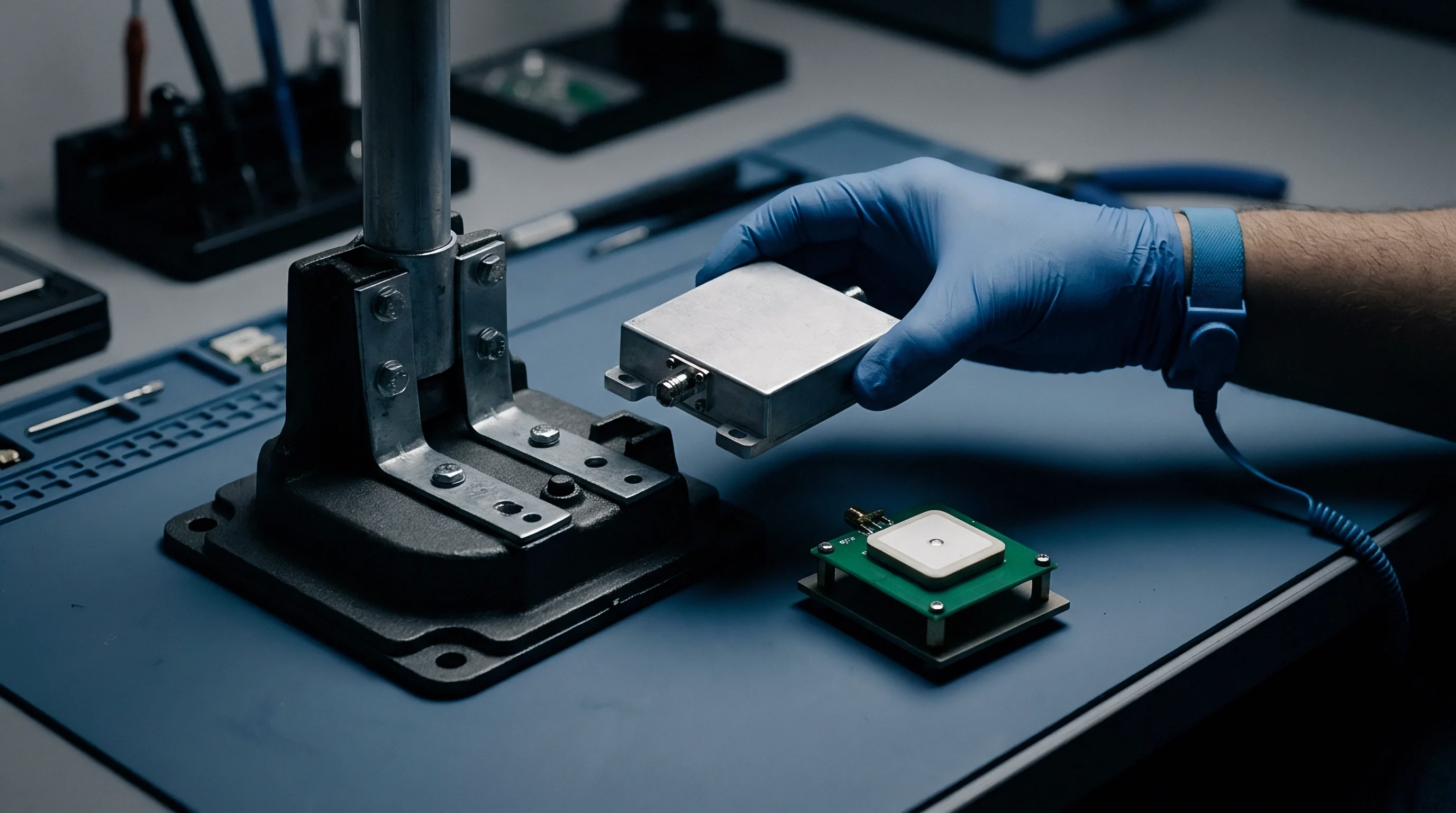
Printed wiring boards are designed with physical boundaries that directly affect their classification during customs inspections. Officers at container freight stations and air cargo hubs review hardware samples to check declared HTS codes against tariff guidelines. Features like EMI shielding cans, integrated trace antennas, micro-coaxial RF connectors, and onboard power regulation act as physical proof of independent functionality.
A bare silicon die bonded to a leadframe falls under semiconductor rules, while a multi-layer FR-4 substrate populated with passives and a shield is classified as a complete radio apparatus.
The inclusion of a Faraday shield directly alters how customs authorities legally classify a board assembly.
Customs laboratories analyze imported subassemblies with X-ray fluorescence, optical microscopy, and circuit inspection to resolve classification disputes. If an importer declares a shipment under Subheading 8542.31 as integrated circuits, lab analysts check the substrate for discrete surface-mount components. Finding inductors, decoupling capacitors, temperature-compensated crystal oscillators (TCXO), or surface acoustic wave (SAW) filters alongside the transceiver chip prompts a formal report reclassifying the shipment under Subheading 8517.62.00.
Under international tariff precedents, discrete components on a shared substrate disqualify the assembly from Chapter 8542 semiconductor treatment.

Physical Assembly Criteria Defining Standalone Apparatus
Structural components mounted on a substrate signal operational independence to examining customs specialists. A metallic Faraday shield over the RF front-end is a key demarcation point, providing the electromagnetic isolation required for modular transmitter approval under FCC rules (47 CFR § 15.212). Customs views RF shielding as evidence that the module was built as a self-contained radio device meant to operate across different host environments without altering its emission profile.
Exposed solder pads often indicate component-level status rather than a finished apparatus.
Onboard firmware execution helps define whether an assembly functions as an independent machine.
Board architecture also affects classification when onboard processing is present. An embedded module with a dedicated ARM Cortex-M core, pre-flashed Bluetooth Low Energy stack software, and non-volatile flash memory holds all the execution logic needed to establish, maintain, and drop wireless links. That internal processing capability meets the customs definition of a machine capable of receiving, converting, and transmitting data.
Even if the module relies on external DC power and host commands to operate, its core functional capability resides within its physical hardware envelope.

Impact of Antenna Integration and Shielding Enclosures
Metal RF shielding paired with onboard radiating elements can quickly shift product designations during an audit. Antenna layout serves as another physical check. Embedded modules generally use one of three antenna setups: an integrated ceramic chip antenna, an etched meandered inverted-F trace antenna (MIFA) along the PCB edge, or a miniature U.FL/IPEX coaxial connector for an external antenna.
Each setup shows that the full path for high-frequency energy propagation exists on the board itself.
Fully configured radio modules possess the physical structure to transmit data independently.
With an onboard trace antenna, an assembly is physically complete as a wireless radiator. Customs rulings classify trace-antenna modules as finished radio apparatus under Subheading 8517.62.00. If an unshielded board has only bare RF output pads that depend on external matching components and antenna routing on a host motherboard, the board is sometimes presented as an incomplete subassembly.
Under General Rule of Interpretation 2(a), an incomplete article that has the essential character of the complete item is classified under the heading of the finished product. Because the board contains the main transceiver IC, inspectors apply GRI 2(a) to keep it under Heading 8517.
Solder pads on an unshielded surface-mount board lead customs inspectors toward integrated circuit status rather than finished radio apparatus.
Design decisions made at the schematic stage directly constrain tariff options. The following parameters show whether a PCBA assembly triggers complete apparatus classification:
- Faraday Shielding Enclosure indicates compliance with standalone modular transmitter requirements and confirms independent equipment status under telecommunications tariff headings.
- Etched PCB Antenna Geometry supplies physical proof of complete radio frequency radiation capability without requiring additional external radiating elements.
- Dedicated Crystal Oscillator establishes onboard clock signal generation for RF carrier synthesis, eliminating reliance on host clock distribution networks.
- Pre-Flashed Protocol Stack demonstrates stored program execution capability for managing wireless transport protocols independently of host system software.
Unshielded modules facing reclassification are frequently framed as lacking independent commercial utility, or as remaining integrated circuits rather than radio transmitters when manufactured without metal shielding.


Gate
Processing at ports of entry links tariff collection directly to regulatory approvals from telecommunications agencies. In the US, Customs and Border Protection enforces rules for the Federal Communications Commission. Across EU member states, national customs authorities enforce the Radio Equipment Directive (2014/53/EU) through market surveillance bodies.
When an entry declaration for embedded radio modules enters automated customs systems, the declared HTS code triggers Partner Government Agency (PGA) verification workflows that hold cargo until regulatory data matches official databases.
Administrative holds at the border can severely disrupt downstream production schedules.
Automated entry systems cross-check declared tariff lines against regulatory grant databases in real time. In the US Automated Commercial Environment (ACE), importing RF devices under HTS 8517.62.00 prompts a PGA message set. Filers must submit specific codes declaring compliance with 47 CFR Part 2 rules, providing either the FCC Equipment Authorization Grant number (FCC ID) or a valid exemption under 47 CFR § 2.1204 (such as small quantities for evaluation).
Any mismatch between the declared FCC ID and the FCC OET Grantee database results in entry rejection and a physical hold at the port.

Automated Import Clearing House Protocols for Radio Frequency Devices
Electronic filing systems pass product descriptors to spectrum agencies before freight is released. In Europe, import clearance runs through Import Control System 2 (ICS2) and national platforms linked to TARIC measure codes. Importing wireless gear under CN code 8517 62 00 requires proof of CE marking and an official EU Declaration of Conformity (DoC) showing compliance with Radio Equipment Directive Article 3.1(a) for health and safety, Article 3.1(b) for EMC, and Article 3.2 for spectrum use.
Shipments without a valid DoC are flagged and routed to red lanes for inspection or seizure.
Customs officers actively cross-reference submitted grant IDs against regulatory registration databases.
China Customs (GACC) enforces spectrum regulations by requiring State Radio Regulation of China (SRRC) Type Approval certificates for wireless modules imported under tariff position 8517.62. Importers submit SRRC codes into the single-window clearance platform. If the system flags an invalid code or unauthorized product description, entry processing stops automatically, requiring administrative review and physical sampling.

Is Modular Radio Grant Verification Required during Customs Inspection?
Border officers check equipment identifiers against federal databases before releasing goods. Inspectors verify that physical markings on the imported module match the exact regulatory ID string in the PGA submission. For modular approvals, the module itself must bear the FCC ID label, or include documentation explaining e-label access if an integrated display is used.
A mismatch between the FCC ID on the shield and the one on the commercial invoice creates a legal presumption of non-compliance.
Filing inaccurate customs documentation exposes importers to substantial financial penalties.
During automated entry reviews at US ports, customs hold notices are routinely triggered by mismatched FCC grant IDs. Customs processors issue Form CBP 28 (Request for Information) or Form CBP 29 (Notice of Action) requesting technical documentation, test reports, and integration instructions. Importers have 30 calendar days to provide proof of compliance.
Failing to respond results in a redelivery demand under CBP Form 4647, requiring the importer to return merchandise to customs custody or export it under supervision at their own expense.
Title 19 of the United States Code § 1592 imposes severe monetary penalties for negligent misclassification of imported radio frequency devices.
Clearing automated entry gates without supply chain delays requires a systematic verification process:
- Extract the exact ten-digit HTS code and verify if PGA flags (such as FCC, FDA, or RED compliance flags) are active for the target import territory.
- Obtain the official regulatory equipment authorization grant certificate directly from the radio module manufacturer prior to vessel loading.
- Verify that the physical regulatory identification label on the radio hardware matches the grant certificate string letter for letter.
- Construct the PGA electronic customs entry message set including the importer of record code, grantee code, equipment product code, and compliance declaration type.
- Submit entry documentation through an authorized customs broker at least 72 hours before vessel arrival to allow automated clearance processing.
Failing to align physical markings with electronic customs filings creates significant financial risk. Misdeclaring wireless apparatus as general electrical components leads to port detentions, demurrage fees, and forced re-exportation.


Tariff
Duties and fees on imported electronics depend on the declared Harmonized System code, country of origin, and trade measures. Calculating landed cost for embedded radio modules requires accounting for base ad valorem rates, harbor maintenance fees, merchandise processing fees, and retaliatory levies like US Section 301 tariffs on Chinese goods. While Most-Favored-Nation (MFN) duty rates for HTS 8517.62.00 are generally 0 percent under the Information Technology Agreement (ITA), trade remedies can impose duties that alter unit economics.
Monolithic integrated circuits typically enter trade channels under zero-duty provisions.
Determining origin for embedded radio modules gets complicated when supply chains span several countries. Under international trade law, non-preferential origin follows the rule of substantial transformation ~ where a manufacturing process creates a new article with a distinctive name, character, or use. A typical module supply chain might cross four jurisdictions: silicon wafer fabrication in Country A, IC packaging and testing in Country B, SMT assembly onto a circuit board in Country C, and firmware loading in Country D.
Origin Determination Mechanics for Multi-Country Supply Chains
Splitting manufacturing across territories forces detailed origin evaluations during customs audits. Customs agencies enforce strict origin rules on electronic assemblies. US Customs and Border Protection rulings consistently hold that surface-mount technology (SMT) assembly ~ soldering ICs, passives, crystals, and shielding onto a bare circuit board ~ constitutes a substantial transformation.
The location of SMT assembly therefore determines the legal country of origin, regardless of where individual chips were fabricated.
The importer of record carries the legal responsibility for accurate origin declarations.
Flashing firmware alone does not confer origin. If a populated board made in Country C goes to Country D simply to load a Bluetooth protocol stack or configuration settings, customs authorities rule that no substantial transformation took place in Country D. Origin remains Country C. Declaring Country D to bypass Section 301 tariffs on Chinese goods violates 19 U.S.C. § 1592, exposing importers to civil fraud investigations and treble damages.

Valuation and Customs Treatment of Bundled Firmware and Software
Software loaded into flash memory introduces valuation questions under customs rules. While the WTO Customs Valuation Agreement uses transaction value (the price paid for export) as the standard basis for valuation, WCO Technical Committee Decision 4.1 allows importers to exclude software costs from the dutiable value of electronic processing equipment under specific conditions.
Unbundling software licensing terms directly impacts dutiable value calculations.
Auditing multi-tier supply chain records shows that isolating software licensing fees from hardware invoice values yields a 4.2 percent landed cost reduction across 50,000 units. To exclude software royalty fees or license costs from an embedded module’s dutiable value, the fee must be separately itemized on the commercial invoice and backed by a distinct licensing agreement. If a supplier bills a bundled price of 12.00 USD per module (comprising 8.00 USD hardware and 4.00 USD software stack fee), the full 12.00 USD is subject to ad valorem duties.
Itemizing the invoice as 8.00 USD hardware and 4.00 USD software license allows duty to be assessed strictly on the 8.00 USD hardware portion, where local valuation rules permit software exclusions.

Landed Cost Arithmetic across Competing Entry Routes
To evaluate landed cost exposure across supply chain options, importers model total customs liabilities by combining base duties, trade tariffs, user fees, and regulatory clearance expenses.
Tariff classification disputes emerge when firmware additions alter the primary function of a host controller board.
| Import Parameter | Bare Transceiver IC (8542.31) | Unshielded Module PCBA (8517.62) | Certified Shielded Module (8517.62) | Finished Host Device (8517.62) |
|---|---|---|---|---|
| Hardware Invoice Unit Price | $2.10 USD | $4.50 USD | $6.80 USD | $45.00 USD |
| Base MFN Duty Rate | 0.0% | 0.0% | 0.0% | 0.0% |
| Section 301 Tariff Rate (China) | 25.0% | 25.0% | 25.0% | 7.5% / 25.0% |
| Merchandise Processing Fee (MPF) | 0.3464% | 0.3464% | 0.3464% | 0.3464% |
| Harbor Maintenance Fee (HMF) | 0.125% | 0.125% | 0.125% | 0.125% |
| PGA Filing & Brokerage Fee / Lot | $85.00 USD | $150.00 USD | $150.00 USD | $250.00 USD |
| Total Dutiable Base (10,000 Units) | $21,000.00 USD | $45,000.00 USD | $68,000.00 USD | $450,000.00 USD |
| Total Duty & Tariff Liability | $5,250.00 USD | $11,250.00 USD | $17,000.00 USD | $112,500.00 USD |
| Total Landed Cost per Unit | $2.635 USD | $5.641 USD | $8.517 USD | $56.462 USD |
Importers managing multi-country manufacturing flows use structured compliance checks to establish origin and tariff exposure:
- SMT Assembly Location Audit verifies the physical location of surface-mount soldering lines to establish primary substantial transformation.
- Silicon Wafer Origin Tracking maintains supply chain traceability records for semiconductor dies prior to encapsulation.
- Unbundled Invoice Structuring separates non-dutiable software licensing fees from physical hardware production costs on commercial documentation.
- Trade Preference Eligibility Check determines whether preferred country of origin rules (USMCA, EUR.1, RCEP) reduce duty rates below standard MFN levels.
Whether future revisions to the Harmonized System will establish dedicated subheadings for multi-protocol wireless system-on-chip devices remains undecided by the World Customs Organization.

Dossier
Maintaining audit-ready entry paperwork protects importers from retroactive duty reassessments, liquidated damages, and penalties. Customs authorities hold statutory audit windows extending three to five years after clearance. During a post-summary audit, auditors review the full import package to verify that declared tariff codes, origin declarations, valuations, and PGA filings match commercial records and physical product specifications.
Preparing customs entry declarations requires strict technical and legal accuracy.
Building a defensible compliance dossier means gathering technical, legal, and commercial documentation before volume production begins. The commercial invoice serves as the primary document. Customs rules require detailed product descriptions; vague terms like “electronic components” or “PCBA modules” trigger scrutiny and holds.
Invoices should read: “Embedded Bluetooth Low Energy Radio Module, Model RF-200, HTS Code 8517.62.0000, Shielded PCBA Assembly with Integrated Trace Antenna, FCC ID: 2ABC-RF200.”

Constructing Defensible Commercial Import Documentation
Alongside commercial invoices, importers should keep technical datasheets, bill of materials (BOM) files, schematics, and block diagrams in the compliance file. These records prove that imported hardware matches the claimed tariff heading. For a product declared under 8517.62 as a complete radio module, the schematic must show the full RF path, including baseband processor, matching circuit, and antenna connection.
Securing an official binding ruling establishes formal legal certainty prior to import.
For high-volume programs or borderline hardware designs, importers can seek binding tariff rulings from customs authorities. In the US, filers submit formal requests under 19 CFR Part 177 to CBP Regulations and Rulings. In the EU, importers apply for Binding Tariff Information (BTI) decisions through national authorities.
A binding ruling protects against retroactive reclassification penalties, provided the imported merchandise matches the specifications described in the request.

Binding Tariff Ruling Applications and Customs Dispute Defense
Preparing a binding ruling request requires thorough technical disclosures. Applicants submit physical samples, schematics, populated BOMs, layer stackup details, and operational descriptions showing how the module communicates with a host processor. Filing incomplete data risks an adverse ruling that locks the importer into a higher duty classification across all entry ports.
| Declared Tariff Heading | Hardware Configuration | Audit Exposure Level | Primary Audit Trigger | Financial Penalty Exposure |
|---|---|---|---|---|
| 8542.31.00 (IC) | Populated Shielded PCBA Board | High | Physical inspection finding discrete components on substrate. | Retroactive Section 301 duties + unpaid interest + 19 USC § 1592 penalties. |
| 8543.70.99 (Electrical) | Bluetooth / Wi-Fi Module | Medium | Automated cross-check showing 8517 network capability. | Duty differential reassessment + administrative entry re-filing fees. |
| 8517.62.00 (Radio) | Populated Shielded PCBA Board | Low | Routine statistical sample or missing FCC ID documentation. | Administrative correction under CBP Form 28 without penalty. |
| 8517.62.00 (Radio) | Unshielded Bare Transceiver PCBA | Medium | Customs lab asserting incomplete assembly status under GRI 2(a). | Potential duty re-calculation if host assembly rules apply. |
Importers building an audit-ready compliance file assemble key records before goods ship:
- Official Binding Tariff Ruling Certificate containing the formal classification determination issued by national customs headquarters.
- Complete Laboratory Test Report demonstrating compliance with RF emission standards and proving physical transceiver functionality.
- Itemized Commercial Invoice Breakdown separating physical hardware costs, NRE engineering fees, and non-dutiable software licenses.
- Manufacturer Certificate of Origin verifying the exact geographic location of surface-mount assembly operations.
Aligning technical descriptions on customs declarations directly with regulatory grant certificates prevents clearance delays.