Ground Conditions for Port Customs Enclosure Audits
Port customs enclosure audits require calibrated floor grounding, ambient noise suppression below 30 dBuV/m, and exact marking matches to clear holding.
Slab
Customs inspection bays in marine ports present complex electromagnetic and structural conditions for imported radio gear. Reinforced concrete staging floors contain dense structural rebar, buried utility conduits, and shifting moisture levels driven by coastal water tables. When customs officers unpack sealed shipping containers for physical inspection of industrial radio cabinets, the electrical baseline under the test bench directly affects measured electromagnetic emissions.
Floor composition dictates ground plane impedance during preliminary radiated pre-scans inside temporary port enclosures. A standard four-inch warehouse concrete floor with exposed steel reinforcement mesh creates parasitic capacitance against the chassis under test, shifting the resonant frequency of internal unshielded power traces and elevating low-frequency emissions between 30 MHz and 100 MHz.
Port customs inspection pads near salt air require daily electrical grounding baseline recalibration before any radiated RF verification starts.

Physical Staging Surfaces in Bonded Facilities
Staging environments at ports range from raw outdoor asphalt pads to semi-conditioned bonded warehouses with modular RF shielding walls. Dry outdoor asphalt has high electrical resistivity, exceeding 1,000 ohm-meters, leaving ungrounded metal chassis vulnerable to electrostatic discharge during handling. Indoor concrete pads treated with epoxy sealants reduce surface static, but they create an isolated floor plane that stops stray currents from dissipating safely into earth ground.
Audits at major trade gateways require verified low-impedance ground bonding before running any powered functional test. Inspectors attach spectrum analyzers to portable reference planes laid directly over the bay floor. If resistive variance between the reference plate and the underlying slab exceeds 5 ohms, high-frequency return currents travel back through test cable shields.
This unintended common-mode path can artificially raise radiated emission readings by up to 6 dB, triggering false failures against CISPR 32 Class A standards.
- Verify structural slab moisture content using a dual-depth pinless moisture meter to confirm values remain below four percent before placing RF test plates.
- Position a continuous 2-millimeter copper reference sheet measuring at least two meters by two meters directly over the concrete staging surface.
- Connect the reference sheet to the facility earth ground electrode using a braided copper strap with a length-to-width ratio under five to one.
- Measure the DC bond resistance between the reference sheet and the grounding terminal, ensuring the measured value does not exceed 0.02 ohms.
Ambient Field Measurement Thresholds
Heavy machinery in port customs zones introduces broad-band electromagnetic interference across sub-gigahertz frequencies. Container gantry cranes, electric yard tractors, and automated guided vehicles generate transient magnetic fields that penetrate unshielded temporary inspection structures. Ambient noise floors inside active port enclosures routinely reach 35 dBuV/m between 150 kHz and 30 MHz.
| Port Zone Type | Slab Surface Resistivity (ohm/sq) | Sub-Slab Moisture Range (%) | Ambient RF Noise Floor (0.1-30 MHz) | Ground Bond Impedance Limit at 10 MHz |
|---|---|---|---|---|
| > 10^9 (High Static Risk) | 6.5 – 12.0 | 42 dBuV/m | 12.5 ohms | |
| 10^6 – 10^8 | 4.0 – 7.5 | 36 dBuV/m | 4.2 ohms | |
| 10^4 – 10^6 | 2.5 – 4.5 | 28 dBuV/m | 0.8 ohms | |
| < 10^2 (Continuous Metallic) | 1.0 – 3.0 | 18 dBuV/m | 0.05 ohms |
Accredited port laboratories filter background noise by running ambient spectral sweeps before powering up the unit under test. When dockside cranes cycle heavy inductive loads, supply mains voltage can sag by up to eight percent, introducing phase jitter into unconditioned test power supplies. Qualified inspection bays use online double-conversion uninterruptible power systems to isolate sensitive spectrum analyzer receivers from grid instability.
Baseline calibration involves mapping enclosure floor impedance across multiple points before uncrating commercial shipments. Ground plane discontinuities near expansion joints alter local return paths for radiated RF fields. Technicians maintain at least a 1.5-meter offset from structural joints during pre-scans to keep measurement uncertainty within the 4.1 dB threshold specified by CISPR 16-4-2.
A port customs inspection setup operating over an uncalibrated floor plane relies on empirical correction factors rather than direct physical ground continuity.

Impedance
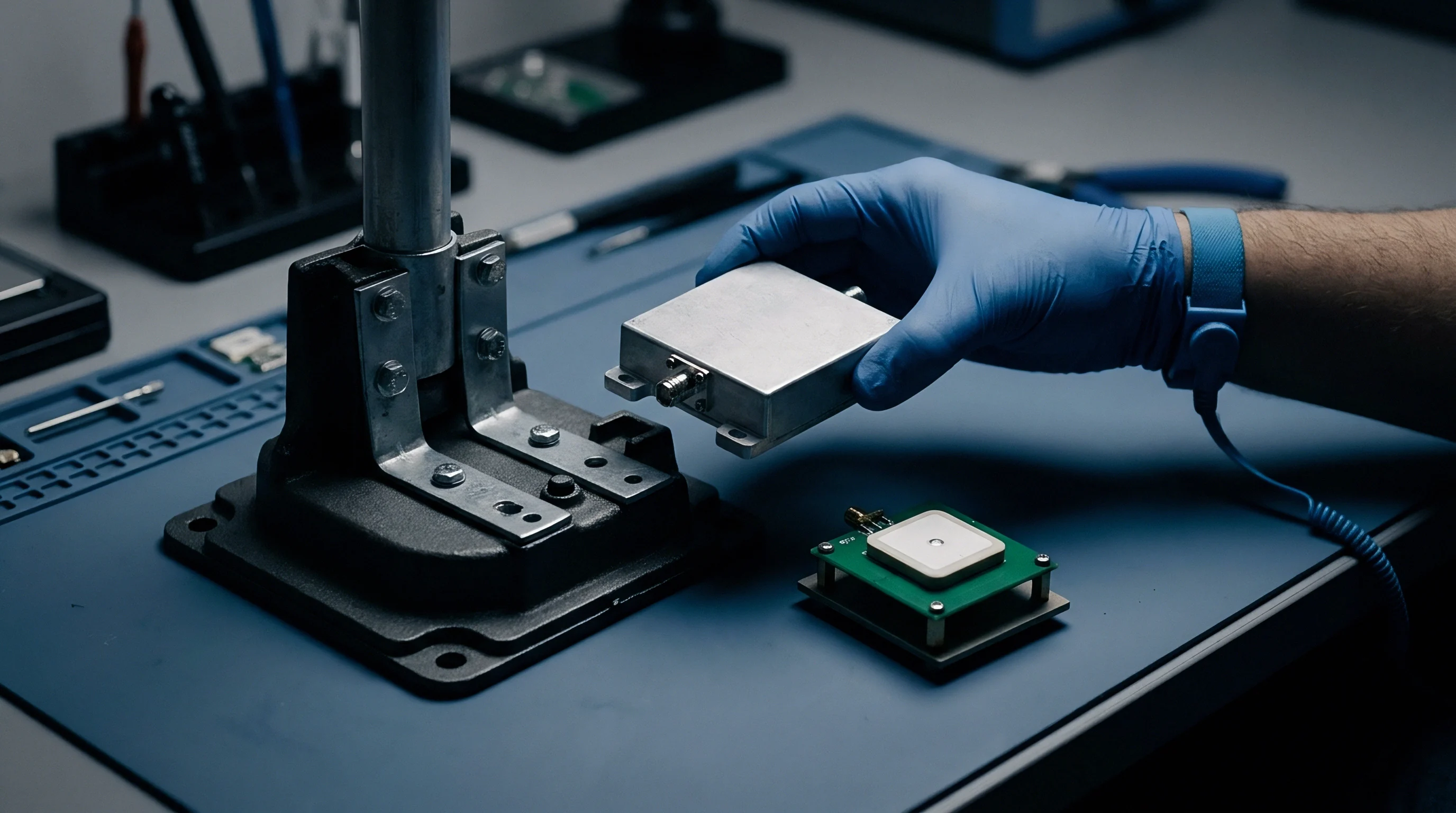
Electrical bonding between metal housings and local earth terminals determines whether an imported radio product passes a customs electromagnetic compatibility audit. Chassis housing radio modules must provide continuous low-impedance paths to dissipate common-mode currents generated by internal switching regulators and high-speed buses. Small structural breaks or anodized coatings turn the metallic frame into an effective patch antenna, turning conducted noise into radiated emissions.
At 2.4 GHz, a ground bonding strap DC resistance exceeding 0.05 ohms elevates chassis common-mode radiation above the 40 dBuV/m threshold defined in CISPR 32 Class B.

Chassis Bond Resistance Measurement Standard
Customs auditors check joint integrity using low-resistance ohmmeters capable of delivering a 10-ampere test current. A high test current punches through superficial oxidation, revealing the actual metallic contact area between chassis sub-assemblies. Standard multimeter checks using low milliampere currents yield misleading resistance values that mask potential bonding failures.
Galvanic incompatibility between dissimilar metals accelerates interface corrosion while equipment sits in humid port facilities. Pairing aluminum housing panels with stainless steel fasteners without nickel-plated washers produces galvanic potential differences exceeding 0.50 volts. Over a 14-day hold in marine air, oxidation forms an insulating barrier across the fastener interface, raising high-frequency ground impedance from 15 milliohms to over 3 ohms.
- Anodized coating insulation prevents electrical continuity across structural panel seams when assembly workers forget to specify masked grounding studs during manufacturing.
- Fastener torque relaxation reduces surface contact pressure under thermal cycling, allowing marine air to penetrate joint seams and form non-conductive oxide deposits.
- Painted gasket seating surfaces isolate conductive elastomeric environmental seals from the main enclosure frame, breaking the RF shielding perimeter.
- Missing internal tooth lock washers allow ground wire ring lugs to rotate freely on painted chassis posts, disconnecting the primary protective earth conductor.
Why Do Dockside Environmental Drift Factors Cause Test Failures?
Coastal holding zones subject electronic hardware to wide daily shifts in temperature and relative humidity. Thermal expansion opens microscopic gaps between enclosure panels, altering slot aperture dimensions that govern shielding effectiveness. A slot measuring 50 millimeters long allows significant RF leakage at frequencies above 3 GHz, matching the fundamental operating bands of Wi-Fi 6E and 5G NR transmitters.
High humidity causes surface moisture to condense on internal circuit board traces when inspectors move cold equipment from refrigerated shipping containers into warm audit bays. Water droplets shift the local dielectric constant, pulling RF impedance matching networks away from 50 ohms. This mismatch increases standing wave ratios on internal antenna feedlines, dumping reflected power into the ground plane and triggering failures during ETSI EN 301 489-17 spurious emission checks.
Conductive gaskets line enclosure perimeter grooves to maintain low contact impedance across panel joints under mechanical deflection. When shipping vibrations back out retention screws by a fraction of a millimeter, gasket compression falls below the 25 percent threshold needed for effective RF sealing. Port customs audits detect this degradation immediately during 1 GHz to 6 GHz radiated emission sweeps.
The standard testing protocol in ISO/IEC 17025 Clause 7.8.2 requires test reports to document exact grounding topology, invalidating clearance filings when audit setups deviate from baseline laboratory configurations.

Moisture
Moisture building up inside sealed shipping enclosures poses severe risks to electronics during extended port customs holds. Facilities in tropical marine zones frequently sustain outdoor relative humidity above 85 percent. When unpowered industrial radio enclosures sit in hold cycles, internal air spaces undergo cyclic condensation as ambient temperatures drop at night.
Condensation forms liquid water films across internal circuit boards and power distribution blocks. Water droplets bridging trace gaps down to 0.5 millimeters create high-resistance short circuits when inspectors apply power for functional testing. This moisture invalidates factory insulation resistance measurements and leads to dielectric breakdown during high-voltage safety checks under IEC 62368-1.
Adherence to IEC 60529 Section 13.4 mandates continuous seal contact stress exceeding 0.2 MPa to prevent moisture ingress during unpowered 72-hour customs holding cycles.

Dielectric Shift in Polycarbonate Housings
Non-metallic enclosures made of polycarbonate, ABS, or fiberglass composites absorb atmospheric water vapor over prolonged exposure. Polycarbonate absorbs up to 0.35 percent water by weight when exposed to 90 percent relative humidity for 96 hours. Absorbed water molecules alter the bulk dielectric constant of the plastic housing, shifting it from a nominal 2.9 up to 3.4 at 2.4 GHz.
This dielectric shift detunes internal microstrip patch antennas mounted flush against enclosure walls. The antenna center frequency shifts downward by 30 MHz to 50 MHz, pushing the main transmission lobe outside the approved operating band. As a result, the product fails ETSI EN 300 328 transmitter band-edge spectrum mask requirements during dockside testing.
Gasket Degradation in High Humidity Holding Zones
Elastomeric weather seals made of ethylene propylene diene monomer (EPDM) or silicone protect internal radio gear from moisture ingress. Exposure to airborne ocean salts and strong solar radiation degrades polymer cross-linking in unsealed outdoor storage areas. Surface micro-cracks can form along the gasket perimeter within 120 hours.
| Exposure Duration (Hours) | Relative Humidity (%) | Polycarbonate Moisture Absorption (% wt) | Dielectric Constant (Er) at 2.4 GHz | Antenna Center Frequency Shift (MHz) |
|---|---|---|---|---|
| 24 | 55 | 0.08 | 2.92 | – 4.2 |
| 48 | 70 | 0.15 | 3.05 | – 12.8 |
| 72 | 85 | 0.26 | 3.22 | – 28.5 |
| 120 | 95 | 0.38 | 3.45 | – 46.1 |
Gasket compression set increases rapidly under high ambient temperatures, permanently reducing the spring force against enclosure sealing surfaces while salt air corrodes metal contacts. Once seal contact pressure falls below 0.15 MPa, capillary action draws salt-laden moisture into the enclosure cavity during atmospheric pressure shifts caused by passing storm fronts.
Internal desiccant packs placed inside shipping enclosures reach moisture saturation within 48 hours if cable entry glands remain unsealed during transit. Factory-sealed units may contain internal drying agents intended for ocean transit, but customs officers break primary vapor barrier bags during initial container manifest inspections.


Discrepancy
Verifying imported radio systems against compliance dossiers frequently reveals physical and operational discrepancies at the port of entry. Host product manufacturers often integrate pre-approved modular transmitters into custom industrial enclosures without re-evaluating radiated spurious emissions under actual host ground conditions. Adding internal metal brackets, altering internal cable routing, or changing power supply topologies invalidates original modular grant conditions issued under FCC Part 15.247 or RED Article 3.2.
When host integration modifies the original modular antenna ground plane dimensions, the effective isotropic radiated power (EIRP) pattern changes significantly. An antenna certified on a 10-centimeter by 10-centimeter evaluation board can produce directional lobe peaking when installed inside a 40-centimeter metal host enclosure, exceeding maximum permitted field strength limits by up to 8 dB.
Unsealed cable entry glands transform outdoor radio cabinets into internal moisture reservoirs during high-humidity container dockage.
Host Alignment and Antenna Placement Drift
The physical positioning of internal radio modules relative to enclosure walls determines parasitic coupling profiles. If assembly operators are off by a few millimeters during factory construction, RF cabling shifts closer to switching power inductors. This spatial drift induces 100 kHz to 5 MHz switching noise directly onto the RF path, generating intermodulation products that fail FCC Class B unintended radiator checks during spot audits.
Mandatory host labeling rules dictate that host enclosures clearly display external FCC ID and ISED certification numbers, along with CE marking and UKCA identifiers matching submitted Declarations of Conformity. Discrepancies between printed housing labels and internal radio module markings trigger physical detention of the entire commercial shipment.
- Missing FCC ID marking on the external host housing requires immediate physical rework inside a bonded customs facility under official supervision.
- Discrepancies in model numbers between the customs entry summary (CBP Form 7501) and the host serial plate result in administrative hold flags.
- Unregistered antenna substitutions incorporating higher gain figures than authorized in the original modular grant violate host compliance laws.
- Omission of mandatory user manual compliance statements concerning RF exposure safety distances prevents final customs clearance authorization.

Worked Calculation of Retest and Demurrage Costs
Consider a commercial shipment of 500 outdoor cellular IoT gateway units arriving at a major container port. Customs authorities select a three percent sample lot (15 units) for physical and electromagnetic enclosure verification. Inspection reveals ground strap bonding failures on 4 of the 15 tested units, triggering an immediate hold on the remaining 485 units pending full qualification testing at an accredited port laboratory.
The financial impact accumulates across several operational cost categories during detention:
Assume an accredited laboratory re-testing fee of $4,200 per sample for complete CISPR 32 radiated emissions and IEC 61000-4-2 ESD immunity qualification. Testing 15 representative units from the held lot incurs $63,000 in direct evaluation charges. Port container demurrage fees add $350 per day per container after a 4-day grace period.
Resolving the audit hold takes 18 calendar days, generating 14 chargeable demurrage days per container across two 40-foot shipping containers, totaling $9,800.
Bonded warehouse storage fees for uncrating, staging, and securing the shipment accumulate at $180 per day, contributing $3,240 over the 18-day hold. On-site engineering labor to install corrective ground plane bonding straps across the entire 500-unit lot requires 40 technician hours at $125 per hour, adding $5,000 in direct remediation expenses. The total direct financial outlay to resolve the hold reaches $81,040, adding $162.08 in unplanned landed cost to every unit in the shipment.
Because retesting requires additional chamber time and modular grants limit host modifications, failing to verify enclosure ground continuity, elastomeric seals on cable entry glands, and host alignment before export leaves importers vulnerable to mandatory container return orders, cargo forfeiture, and severe civil penalties under cross-border trade enforcement statutes.

Clearance
Securing final customs release for radio equipment shipments requires complete alignment between physical enclosure characteristics, laboratory test reports, and official regulatory filings. Enforcement officers use standardized checklists to cross-reference imported hardware against public certification databases like the FCC Equipment Authorization System and the EU NANDO database. Discrepancies identified during physical teardowns block clearance regardless of commercial urgency.
Operational compliance demands that hardware documentation matches the exact structural configuration inside the shipping container. If a host housing incorporates metal chassis stiffeners or modified conductive gaskets not documented in the original technical construction file, inspectors treat the shipment as unapproved hardware, requiring formal corrective action filings.
Identifier Marking Alignment on External Metal Housings
Exterior rating plates mounted on radio enclosures must endure harsh marine transport without losing legibility. Chemically etched or laser-engraved stainless steel nameplates provide strong resistance to salt spray and solvent exposure. Thermal transfer adhesive labels frequently peel off or fade when exposed to container condensation, rendering mandatory regulatory identifiers unreadable during initial physical checks.
Electronic labeling offers an alternative for hosts equipped with integrated display panels. Regulatory frameworks like FCC E-Labeling rules allow digital display of certification marks, provided the user manual instructs customs inspectors how to access the software screen in three simple navigation steps without requiring special codes or access passwords.

Remediation Protocols for Seized Shipments
When port audits confirm non-compliant enclosure grounding or unauthorized RF modifications, importers must execute formal remediation plans approved by local customs authorities. Corrective work must occur entirely within designated bonded warehouses under direct official monitoring. Technicians retrofit external grounding straps, re-seat internal conductive gaskets, or apply secondary RF shielding foils to resolve radiated emission leaks.
Following physical remediation, an accredited testing body must conduct on-site verification testing to confirm that modified enclosures satisfy mandatory EMC limits. Upon successful completion of re-testing, the accredited body issues a supplemental test report appended to the original import entry dossier, allowing customs officers to release the held container for domestic market distribution.
What technical mechanisms will cross-border trade authorities implement when automated dockside RF scanners replace manual enclosure spot checks?