Harmonized Tariff Classification and Value Assist Mechanics for Radio Assemblies
Radio assembly classification turns on standalone RF transmission capability while dutiable valuation requires full reconciliation of offshore assists.

Heading
Customs valuation and tariff classification for populated radio frequency assemblies turn on the physical partition between baseband processing and radiated RF circuitry. Importers entering populated printed circuit boards bearing radio frequency transceivers under the Harmonized Tariff Schedule (HTS) face immediate scrutiny regarding whether the imported merchandise constitutes a finished machine, an incomplete machine retaining essential character, or a subassembly classified as a part. Under Section XVI of the tariff schedule, Note 2 governs the classification of parts, while General Rules of Interpretation (GRI) 1, 2(a), and 3 direct heading selection.
A transceiver board containing an antenna switch, power amplifier, mixer, and baseband microcontroller enters primary exposure under heading 8517 as apparatus for transmission or reception of voice, images, or other data, or under heading 8526 for radar, radio navigational aid, or radio remote control apparatus. Misidentifying the operative transmission protocol, whether cellular, IEEE 802.11 Wi-Fi, Bluetooth, or proprietary ultra-high frequency (UHF) links, drives systemic duty miscalculations that propagate across multi-year shipment volumes.
The customs analysis hinges on the presence or absence of discrete peripheral components and embedded firmware at the moment the assembly crosses the frontier. A populated transceiver module lacking a soldered antenna, host interface connector, or power regulator retains the essential character of a transmission apparatus under GRI 2(a) if the primary silicon performs modulation, frequency conversion, and transmission signal generation. Importers frequently attempt to classify bare or minimally populated surface-mount assemblies under heading 8473 as parts of automatic data processing machines, or heading 8529 as parts suitable for use solely or principally with the apparatus of headings 8525 to 8528.
This path collapses during customs audits when trade specialists evaluate the functional independence of the integrated circuits.
Classification under heading 8517.62 triggers when an assembly independently performs packet modulation and RF conversion prior to host attachment.
Appraising the transaction value under Title 19 of the United States Code (19 U.S.C. Section 1401a) or the World Trade Organization Customs Valuation Agreement introduces secondary exposure through value assists. Under these statutory provisions, an assist includes tools, dies, molds, and engineering, development, artwork, design work, and plans and sketches undertaken elsewhere than in the country of importation and supplied directly or indirectly, free of charge or at a reduced cost for use in connection with the production or the sale for export of the imported merchandise. Development assistance and design work conducted outside the importing jurisdiction add directly to the dutiable transaction value of the radio assembly.
Engineering teams frequently ship pre-programmed microcontrollers, surface acoustic wave (SAW) filters, radio-frequency integrated circuits (RFICs), or proprietary application-specific integrated circuits (ASICs) directly to overseas contract manufacturing facilities. Customs authorities classify these customer-furnished materials under 19 U.S.C. Section 1401a(h)(1)(A)(i) as materials, components, parts, and similar items incorporated in the imported merchandise. Production equipment, including custom radio-frequency test fixtures, calibrated golden units, shielded isolation boxes, and automated test firmware licenses provided to the overseas assembly plant represent assists under subsection (ii) or (iv).
The importer declares these costs upon entry. Failure to account for unbilled tooling or off-ledger software development performed overseas generates systemic undervaluation penalties that compound across production cycles.

Modular Boundaries and Functional Independence
Customs officials categorize radio circuit assemblies by dissecting the functional completeness of the populated printed circuit board assembly (PCBA). When a board contains a dedicated baseband processor, local oscillators, an RF transceiver, matching networks, and power distribution circuits, authorities consider the item an apparatus for the reception, conversion, and transmission or regeneration of voice, images, or other data under subheading 8517.62.00. The absence of a final enclosure or physical buttons does not prevent classification within 8517.62.00, provided the radio engine operates when supplied with nominal direct-current power and baseband data.
The jurisdictional boundary between an incomplete machine possessing essential character and a mere subassembly part rests on physical operationality. If an assembly requires a external master processor to initialize its internal registers and command basic clock generation via SPI or I2C serial buses, importers often argue for classification as a part under subheading 8517.70 or 8529.90. Customs rulings, including United States Customs and Border Protection (CBP) decisions under Headquarters Ruling Letter (HQ) H242887 and HQ H025812, consistently affirm that if an RF subassembly contains circuitry capable of standalone RF modulation and radiation upon peripheral connection, the essential character of the transmission apparatus is established.
Tariff specialists reject subassembly status for fully populated surface-mount transceiver modules, assigning duty rates tied to complete communications units.

Assists inside the Bill of Materials
Determining transaction value requires the identification of tangible and intangible inputs delivered to the contract manufacturer without an invoice offset. Customer-supplied electronic components, consigned semiconductor dies, printed circuit bare boards, and specialized RF shielding enclosures qualify as tangible assists under statutory definitions. Sourcing departments often maintain component-consignment agreements where the buyer procures custom RFICs directly from a wafer foundry and dropships them to an assembly house in another territory.
When the contract assembler bills only the board assembly labor, passives, and testing markup on their commercial invoice, the entry documentation understates customs value by the total cost of the consigned silicon.
Intangible assists present equivalent customs risk. Software algorithms developed to perform factory calibration of RF power outputs, balance internal quadrature mixers, or map in-situ phase noise profiles involve engineering development. If this development occurs outside the destination market and within a third country, the engineering expenditure constitutes an assist under 19 U.S.C. Section 1401a(h)(1)(A)(iv).
Conversely, design work executed within the destination territory by the importer’s domestic engineering staff is expressly excluded from assist treatment under US customs law. Importers must partition software engineering ledgers based on developer residency to defend transaction value calculations during field audits.
Test software transferred across internal networks is often treated on commercial books as carrying zero value because it remains proprietary code, whereas valuation rules require treating unbilled foreign test scripts as dutiable production assists.


Crate
Logistical and customs control of populated radio modules demands physical verification of internal layers, packaging, and marking before transport. Shipments moving under Harmonized System (HS) heading 8517 encounter documentation checks at international ports of entry where border agents inspect commercial invoices against bill of lading descriptions and printed circuit board physical markings. Discrepancies between printed silk-screen part numbers, customs declaration forms, and laboratory test reports halt shipments at the terminal.
Customs documentation must reconcile the hardware revision level listed on the commercial invoice with the exact physical revision visible under solder masks or laser-etched metal cans.
Regulatory marks on the transit packaging require alignment with local radio approval regimes. When an RF module travels as an intermediate assembly, shipping crates bearing finished product compliance logos invite immediate procedural delays. Customs officers cross-reference regulatory marks against national radio registration databases.
A crate showing FCC, CE, or regional approval marks without associated finished-device model numbers triggers secondary customs inspections. Port inspectors verify that modular certifications match the precise physical configuration packed within electrostatic discharge (ESD) shielding bags.
| Tariff Classification | Hardware Configuration Description | Regulatory Status at Border | Dutiable Valuation Basis |
|---|---|---|---|
| 8517.62.0050 | Populated PCBA with RFIC, baseband, crystal, power amp, without enclosure | Modular transmitter with grant | Transaction value plus consigned silicon assists |
| 8517.69.0000 | RF receiver front-end board, downconversion mixer, without transmitter | Unintentional radiator status | Invoice price plus tooling and test cage assists |
| 8517.70.0000 | Passive antenna array subassembly, ceramic patch with integrated coax | Passive component, no grant | Direct material and stamped tooling assists |
| 8526.91.0040 | GNSS receiver module, baseband correlation engine, patch antenna | Radio navigational receiver | Transaction value plus foreign firmware assists |
| 8542.31.0000 | System-in-Package RF module, overmolded substrate, passive integration | Electronic integrated circuit | Foundry cost plus packaging and mask-set assists |
Classification shifts depending on whether the radio module incorporates shielding cans and antenna structures directly onto the PCB substrate. System-in-Package (SiP) devices overmolded with conductive epoxy challenge the boundary between heading 8517 and heading 8542 as composite electronic integrated circuits. If an assembly incorporates discrete passive components, crystal oscillators, and shielded filters alongside monolithic silicon dies on a laminate interposer, customs administrations classify the unit under heading 8517 as a module rather than a monolithic integrated circuit under 8542.
This structural distinction governs eligibility for duty-free treatment under the Information Technology Agreement (ITA).

Physical Marking and Serialization Requirements
Customs officers verify the presence of product identifiers on circuit boards during border audits. Physical marking must match shipping documents down to the component revision level. Silk-screening or copper-etching of the unique identifier directly on the assembly substrate provides traceable evidence during physical customs examinations.
If an assembly carries a modular radio certification identifier, customs inspectors demand the corresponding equipment authorization grant to verify that the imported hardware configuration mirrors the approved circuit architecture.
Discrepancies arise when engineering revision numbers printed on PCB silk screens do not correspond to the revision numbers listed on commercial invoices. Manufacturing lines frequently update circuit trace layouts to resolve parasitic oscillations or replace obsolete surface-mount passive components. If the physical board shows revision C while entry documentation states revision B, customs agents issue document inquiries under administrative detention procedures.
Resolving these documentation errors requires technical production records linking the board redesign directly to commercial invoice line items.

Transit Integrity and Electrostatic Barrier Protocols
Populated radio boards cross borders inside sealed moisture barrier bags (MBBs) packed within conductive corrugated cartons. Opening ESD-safe packaging inside ungrounded customs inspection facilities risks damaging sensitive gallium arsenide (GaAs) or silicon-germanium (SiGe) low-noise amplifiers (LNAs) through electrostatic discharge. Importers minimize physical inspection hazards by providing clear outer-carton markings, serial number manifests, and external transparent inspection windows that allow barcode scanning without breaking electrostatic barriers.
Specialized shipping containers carrying unshielded radio subassemblies require documentation detailing proper environmental handling procedures. High humidity and static charges inside marine shipping containers degrade solderability on surface-mount pads and induce latent latch-up defects in high-frequency switching circuits. Proper shipping crates feature desiccants and humidity indicator cards (HICs) certified to J-STD-033 standards.
Customs inspectors must handle opened containers under controlled electrostatic discharge precautions to prevent latent field failures in radio hardware.
The forwarder holds the shipment if external box markings do not identify internal component serial ranges.

Tooling
Production equipment supplied to overseas contract manufacturing plants introduces tangible assist obligations under customs valuation statutes. In radio manufacturing, specialized tooling extends beyond traditional injection molds and stamping dies to include specialized RF instrumentation and production fixtures. If an importer purchases an RF shielded test fixture, a computer-controlled bed-of-nails automated test equipment (ATE) interface, or high-density surface-mount stencil foils and delivers them to an overseas assembler without charging fair market value, the acquisition cost represents an assist.
The total cost of this production equipment must be apportioned over the imported production volume.
Automated test fixtures designed specifically to verify radio board RF performance parameters represent dutiable assists under 19 U.S.C. Section 1401a(h)(1)(A)(ii). These fixtures routinely incorporate pneumatic clamping mechanisms, calibrated RF semi-rigid cabling, precision attenuators, and custom bed-of-nails contact pins. The physical equipment must be tracked in the importer’s fixed-asset accounting register and reconciled with the customs broker’s entry summaries.
The valuation basis includes the initial fixture fabrication cost, delivery freight, and calibration fees incurred before installation at the manufacturing site.
A test fixture supplied to an overseas manufacturer constitutes an assist unless the manufacturer purchases the equipment under an arms-length transaction.
Golden units, which are hand-calibrated radio assemblies retained at the factory to serve as reference transceivers for continuous production verification, also represent assists. If an importer constructs twelve precision golden reference boards in an internal laboratory and ships them to an offshore production line, customs rules require the dutiable valuation of those reference boards to reflect their full research, material, and labor costs. Customs auditors routinely inspect offshore factory floor equipment lists against corporate capital expenditure depreciation records to uncover unassisted production gear.

Apportionment Options for Capital Fixtures
Importers exercise specific statutory options to apportion the value of tooling assists across imported merchandise volumes. Under customs regulations, an importer may elect to capture the entire dutiable assist value on the initial commercial shipment of assemblies, or amortize the cost over a predetermined, documented production run. Selecting the initial-entry apportionment method front-loads duty payments but closes the customs liability on subsequent production lots.
Amortization requires reliable production forecasts and active contract monitoring.
The chosen apportionment method must align with Generally Accepted Accounting Principles (GAAP) and reflect commercial reality. If an importer amortizes a fifty-thousand-dollar RF test station across an anticipated volume of one hundred thousand radio assemblies, each imported board carries a fifty-cent assist addition. If market demand collapses and the production line terminates after twenty thousand units, the importer must submit a supplemental customs reconciliation entry to remit outstanding duty on the unamortized forty thousand dollars of fixture value.
Inaccurate forecasting creates substantial customs underpayment exposure.
Shielded Enclosures and RF Test Cages
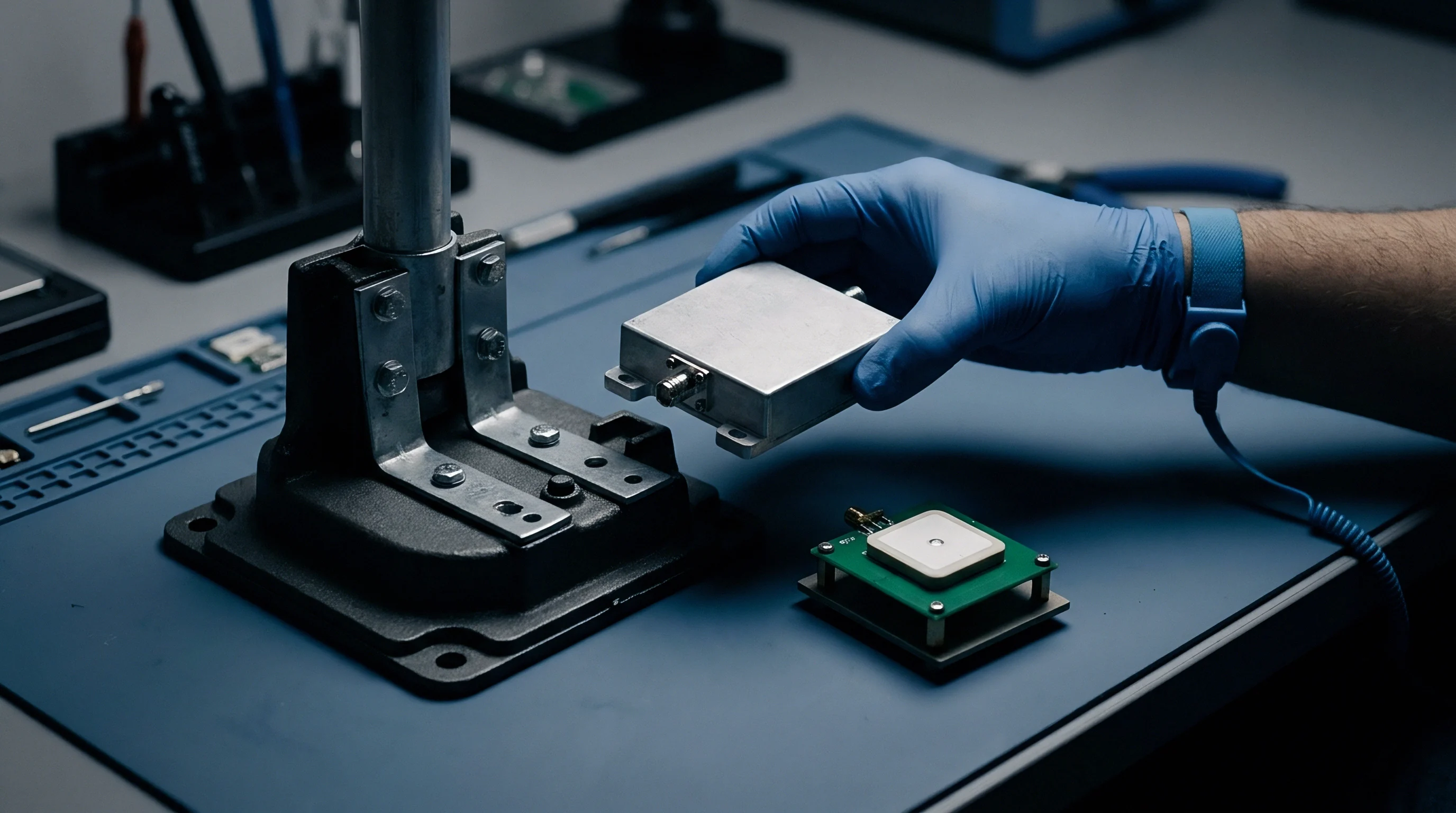
RF production testing requires isolated electromagnetic environments to conduct repeatable transmitter power and receiver sensitivity measurements without ambient interference. Specialized radio frequency shielding enclosures, or anechoic RF test boxes lined with radar-absorbent ferrite tiles and carbon-loaded foam pyramids, represent capital equipment assists when provided by the buyer. These test chambers incorporate filtered bulkhead pass-through connectors for USB, Ethernet, DC power, and RF SMA connections, preventing radiated test leakage from breaching local radio regulatory limits.
When an importer pays a specialized test equipment vendor to construct these shielded isolation cages and delivers them directly to an overseas assembly partner, the capital outlay constitutes a manufacturing aid. The dutiable cost basis must incorporate the custom fabrication of the enclosure, internal RF absorbing materials, pneumatically actuated lids, and integrated coaxial switching matrices. Customs auditors treat the physical chamber as an essential tool used directly in the production and testing of the imported radio subassemblies, demanding full duty inclusion on entry declarations.
The following procedures govern the tracking and customs reconciliation of production tooling assists for imported radio assemblies:
- Fixed Asset Ledger Segregation isolates physical test chambers and ATE fixtures destined for overseas manufacturing plants into dedicated customs tracking accounts.
- Direct Cost Consolidation aggregates engineering fabrication expenses, third-party component costs, freight charges, and non-refundable import taxes paid during fixture delivery to the factory.
- Production Life Estimation establishes formal written commitments defining the total number of production units expected to traverse the specialized RF test tooling.
- Entry Summary Apportionment applies the calculated unit-assist assist value to every commercial invoice line item entered under customs classification 8517.62.
- Annual Reconciliation Filing balances physical production yield against declared assist amortization schedules to remit outstanding duty on residual capital balances.
Failure to submit annual tooling reconciliation filings leads to administrative penalties under customs enforcement statutes.

Drift
Software development, algorithmic firmware updates, and RF calibration tables supplied to an overseas assembly partner introduce intangible assist exposure subject to strict jurisdictional rules. Customs valuation statutes differentiate between engineering development performed within the country of importation and development conducted in third-party territories. Under US customs law, design, engineering, and firmware development undertaken within the United States are exempt from assist treatment.
If the identical firmware development or RF tuning algorithm is authored by an engineering subsidiary in India, Taiwan, or Ukraine, the engineering expenditure represents an assist that increases the dutiable value of the imported boards.
Radio systems rely heavily on embedded look-up tables stored inside non-volatile EEPROM or flash memory to counteract temperature-induced frequency drift and power amplifier nonlinearities. These tables contain factory calibration parameters calculated by running ATE test routines across frequency bands and temperature profiles. The mathematical algorithms that calculate these coefficients, if developed outside the country of import, constitute engineering work necessary for the production of the imported radio assembly.
Importers must rigorously track where each software module and firmware binary was developed.
| Engineering Asset or Activity | Geographic Development Location | Customs Assist Classification | Dutiable Treatment Under 19 U.S.C. 1401a |
|---|---|---|---|
| Baseband modem firmware source code | Domestic engineering center | Statutory exemption | Non-dutiable |
| Power amplifier linearization algorithm | Offshore software subsidiary | Intangible engineering assist | Dutiable, allocated over unit volume |
| RF calibration lookup table generator | Contract manufacturer internal staff | Direct foreign manufacturing cost | Captured inside product invoice price |
| Printed circuit board layout CAD files | Third-party overseas contractor | Intangible design assist | Dutiable, capitalized or unit-allocated |
| Golden unit reference calibration files | Domestic system architecture team | Statutory exemption | Non-dutiable |
Customs authorities place the evidentiary burden on the importer to prove that engineering development occurred within the domestic territory. In the absence of detailed timesheets, developer payroll registers, IP allocation contracts, and project milestone logs, customs auditors presume unbilled software and design assets originated overseas. This presumption converts exempt domestic software into dutiable assists, resulting in retroactive duty assessments, interest charges, and administrative penalties.
Radio engineering organizations must coordinate with corporate trade compliance teams to ensure engineering development tracking supports customs declarations.

Firmware Injection and Licensing Mechanics
The stage at which firmware is flashed into the radio assembly dictates its customs valuation treatment. When bare printed circuit board assemblies are imported without loaded firmware, classification disputes often arise regarding whether the board possesses the essential character of a transmission apparatus under GRI 2(a). If the radio assembly is imported with bare flash memory, requiring post-import firmware flashing to become functional, the unprogrammed board may still be classified as an incomplete radio under 8517.62 if the physical hardware layout is dedicated solely to RF communications functions.
Licensing fees paid for third-party radio protocol stacks, such as proprietary cellular baseband stacks, IEEE 802.15.4 Zigbee protocols, or Bluetooth Low Energy profiles, complicate the transaction value. If the importer pays license fees to a foreign intellectual property licensor, and that license is a condition of the sale for export of the merchandise to the importing jurisdiction, customs authorities classify the royalties as dutiable additions to transaction value. Royalties must be evaluated under 19 U.S.C. Section 1401a(b)(1)(E) to determine whether they relate directly to the imported radio subassemblies.

Calibration Coefficients and Digital Tuning Assets
Radio transceivers require digital calibration data to meet emissions limits mandated by telecommunications regulatory authorities. This calibration process involves measuring the board’s intermediate frequency response, local oscillator leakage, and carrier suppression using automated spectrum analyzers. The test software drives the transceiver through discrete transmission states, reads radiated or conducted output power, and burns corrective offset values into the module’s one-time programmable (OTP) memory.
The engineering effort required to design this calibration cycle constitutes a direct production input.
When design teams modify calibration scripts to improve manufacturing yield or correct harmonic radiation spikes, they modify the production process itself. If an offshore engineering contractor develops these tuning scripts, the importer must account for the development invoices as assist costs. Customs auditors routinely review engineering change orders (ECOs) and software repository commit histories to detect offshore software assets that contributed directly to the production of the imported radio hardware.
Offshore firmware development that modifies production calibration registers represents a dutiable assist across all imported unit quantities.
Contractual terms dictate assist liability across multi-tier development environments. Under standard corporate supply agreements, the following contractual provisions directly affect how customs agencies evaluate the dutiable value of imported radio subassemblies:
- Engineering Services Separation clauses that distinguish non-dutiable domestic architectural research from dutiable offshore production firmware development.
- Tooling Title Retention language confirming that custom RF test enclosures remain the property of the buyer and constitute bailments to the factory.
- Software Licensing Pass-Through stipulations identifying whether third-party stack royalties are paid as a condition of export or as post-import operating rights.
- Consignment Value Declarations establishing the baseline replacement and acquisition costs of customer-furnished semiconductor components.
The customs broker rejects entry summaries when the software development location cannot be verified through auditable corporate records.


Friction
Border authorities and market surveillance agencies intersect when radio assemblies arrive at customs checkpoints, creating clearance friction. Customs administrations enforce intellectual property rights, tariff classifications, and trade remedy duties, while telecommunications regulators enforce spectrum protection rules. Under United States regulations, customs authorities enforce Federal Communications Commission (FCC) compliance at the border via electronic entry filings.
The automated commercial environment requires specific declarations indicating whether imported radio modules are certified, represent unapproved transmitters imported for testing, or qualify for modular grant exemptions.
When an assembly enters the port carrying a modular approval grant, the customs declaration must link the product’s physical identifiers to the regulatory grantee code and equipment authorization filing. If an importer attempts to clear an assembly under an existing modular grant while the physical board exhibits alterations in RF trace layout, antenna matching networks, or output stage filtering, customs or spectrum enforcement agents may hold the shipment. Altering the RF layout invalidates modular approval grants, converting an approved modular transmitter into an unauthorized intentional radiator subject to border seizure.

Where Does Modular Relief End during Customs Entry?
A modular grant provides regulatory clearance for an RF subassembly only when the integrator respects all grant restrictions and technical constraints specified by the original equipment grantee. These conditions, detailed on the public equipment authorization grant, dictate antenna types, maximum permissible gain, minimum physical separation distances, and operational co-location boundaries. Importers frequently import populated modular transceivers mounted on carrier development boards, claiming the entire assembly passes clearance under the module’s modular grant.
This assumption is legally flawed.
Customs agents and regulatory inspectors classify a modular transceiver mounted onto a carrier motherboard as a composite host system. The carrier board introduces power supply traces, digital bus clock lines, and peripheral circuitry capable of generating unintentional radiation. The completed assembly requires verification or certification as a composite system.
The modular grant covers only the standalone transceiver within its defined shielding can; it does not exempt the host assembly from Part 15 subpart B unintentional radiator testing or European RED EMC compliance under ETSI EN 301 489. Importers relying solely on the module’s modular certification face document rejections and mandatory product quarantines at the port of entry.

Permissive Changes and the Customs Description Gap
Engineers modify production circuit boards to mitigate supply chain disruptions, replacing passive inductors, crystal oscillators, or low-noise amplifiers with equivalent components. In the telecommunications regulatory framework, these modifications require evaluation under permissive change rules. A Class I Permissive Change governs modifications that do not degrade RF characteristics, requiring internal documentation without mandatory regulatory filings.
A Class II Permissive Change involves modifications that degrade measured characteristics but remain within regulatory boundaries, requiring formal laboratory test reports and a supplemental grant from a Telecommunications Certification Body (TCB).
These hardware revisions create customs friction when commercial documentation diverges from regulatory records. If an importer updates an internal bill of materials from revision B to revision C following a component swap, the commercial invoice reflects the new internal revision. If the FCC or regional regulatory database lists the product under revision B, border clearance algorithms flag the mismatch.
Resolving this discrepancy requires legal and technical proof confirming that the imported revision C hardware is fully authorized under the existing equipment grant through an executed Class II Permissive Change. Compiling this documentation while shipments sit in demurrage creates costly supply chain delays.
The commercial contract standard terms stipulate that all regulatory hold costs fall on the importer of record.


Settlement
Final commercial settlement for imported radio assemblies requires reconciling customs duty declarations, assist additions, and landed manufacturing costs. Sourcing organizations must construct auditable accounting pipelines that consolidate transaction values, tooling amortizations, and offshore engineering expenditures into definitive reconciliation entries. In jurisdictions operating reconciliation programs, such as the US Customs Reconciliation Prototype (ACS/ACE Recon), importers flag entries upon arrival and submit final adjustments within fifteen months.
This mechanism allows companies to clear goods using estimated assist rates and pay true-up duties when annual production volumes close.
The financial arithmetic of radio assembly imports is driven by base tariff rates, trade remedy actions, and assist allocations. Populated circuit boards under subheading 8517.62 frequently enter under low base duty rates, but supplementary tariffs, such as Section 301 trade remedies in the United States, impose severe additions reaching twenty-five percent. When high tariff rates apply, every unassisted dollar in tooling, consigned RFICs, or offshore firmware algorithms magnifies the final landed duty burden.
Inaccurate accounting of these costs distorts landed margins across all production product lines.
| Cost Component | Initial Estimate Basis | Reconciled Settlement Basis | Customs Duty Impact at 25% |
|---|---|---|---|
| Base assembly invoice price | $18.50 per unit (100k units) | $18.50 per unit (80k units actual) | Base transaction duty |
| Consigned cellular transceiver ASIC | $4.20 per unit (pre-purchased) | $4.20 per unit (actual assist) | +$1.05 duty per unit |
| ATE shielded test fixtures ($60k total) | $0.60 per unit (100k amortized) | $0.75 per unit (80k amortized) | +$0.0375 duty per unit shift |
| Offshore calibration firmware contract | $0.00 (improperly treated as exempt) | $0.40 per unit ($32k foreign invoice) | +$0.10 duty per unit addition |
| Total dutiable value per unit | $23.30 estimated | $23.85 reconciled final | +$0.1375 net duty underpayment |
The worked calculation reveals the cumulative financial impact of production adjustments and assist oversight. The original production plan assumed one hundred thousand units, yielding an estimated dutiable value of twenty-three dollars and thirty cents per board. Slower production yielded only eighty thousand units, which raised the per-unit amortization of the sixty-thousand-dollar test fixture from sixty cents to seventy-five cents.
Discovering that a thirty-two-thousand-dollar firmware optimization contract was executed by an offshore team added forty cents of dutiable value per board. The resulting fifty-five-cent per-unit underdeclaration creates an eleven-thousand-dollar duty deficiency across the eighty-thousand-unit production run, excluding accrued statutory interest.

Audit Protocols and Reconciliation Windows
Customs regulatory audits target transaction value calculations and assist reporting up to five years post-importation. Auditors from customs authorities demand detailed documentation linking General Ledger accounts directly to individual customs entry summaries. The review encompasses accounts payable ledgers, wire transfers, capital expenditure schedules, and intercompany service agreements.
If an importer cannot demonstrate a systematic reconciliation process for radio assists, authorities may initiate formal penalty proceedings under administrative negligence or gross negligence standards.
A rigorous audit defense relies on traceable records establishing that assist values were properly tracked, declared, and amortized. Importers maintain detailed packages for every radio assembly product line, containing the original equipment purchase orders, component consignment agreements, engineering development location affidavits, and final customs true-up filings. Demonstrating that domestic software was kept separate from foreign firmware updates prevents auditors from recharacterizing non-dutiable engineering investments as dutiable production assists.

How Do Disputed Assist Costs Impact Multi-Year Supply Contracts?
Unresolved assist liabilities destabilize long-term contract manufacturing agreements and supplier pricing structures. When a customs authority audits an importer and issues retroactive duty assessments on historic radio shipments, the importer must absorb the unbudgeted tax liability. Importers often attempt to recover these costs from contract manufacturers, arguing that the supplier’s commercial invoices failed to properly separate labor from material costs.
If the underlying supply contract lacks clear language assigning customs compliance responsibilities, the resulting disputes disrupt the ongoing supply chain.
Multi-year procurement agreements must define how component assists, test fixtures, and engineering fees are invoiced and documented. Clear contract schedules specify which entity holds title to specialized production tooling, where firmware development occurs, and how assist values will be calculated for customs declarations. Establishing transparent, auditable reporting procedures between the buyer, the contract manufacturer, and the customs broker protects profit margins and ensures uninterrupted global movement of radio hardware.
Whether customs authorities will accept retroactive true-up filings for unamortized test tooling after a manufacturing run terminates prematurely remains an unresolved question across multiple customs audit jurisdictions.