Managing FCC Class II Permissive Changes across Alternate Module Vendors
Secondary radio module sourcing demands either grantee authorization for a Class II change or a fresh equipment grant under an independent host FCC identifier.

Substrate
Hardware Divergence across Form Factors
Pin compatibility between modular transceivers from alternate suppliers masks critical electrical variations. A footprint matching thirty-two surface-mount pads often conceals distinct internal ground stitch patterns, decoupling capacitor placements, and printed circuit board layer stackups. Swapping a primary Bluetooth Low Energy or Wi-Fi module for a secondary vendor alternative alters high-frequency return paths.
As the radio frequency signal path interacts with host copper structures, unexpected parasitic resonances show up in adjacent circuitry. Thermal relief geometry and pad capacitance differences shift the impedance seen by the output power amplifier, converting a tuned fifty-ohm microstrip launch into a reactive mismatch.
Harmonic generation changes instantly when copper geometry shifts. Even when both vendors select identical core silicon from the same semiconductor foundry, layout execution across the organic package determines spurious radiated power. Secondary vendors frequently change passive component tolerances, replacing thin-film ceramic inductors with wirewound alternatives exhibiting lower self-resonant frequencies.
The resulting RF phase noise and out-of-band emissions breach the limits established under 47 CFR Part 15 Subpart C.
A three-millimeter shift in reference plane grounding displaces parasitic resonance frequencies by several hundred megahertz.
Shielding materials introduce another major physical divergence. Primary vendors often utilize drawn nickel-silver cans with soldered continuous perimeters. Lower-cost alternates regularly substitute stamped two-piece tin-plated steel covers secured with mechanical friction dimples.
Microscopic seam gaps in two-piece enclosures leak radiated energy above five gigahertz. Cavity resonances shift upward, discharging spurious current into the host ground plane, where return currents traverse digital interfaces and excite cables connected to USB and Ethernet ports.
The host enclosure acts as an external cavity resonator. Aluminum chassis designs reflect radiated harmonics back onto unshielded regions of the replacement module. Plastic enclosures with vacuum-metallized conductive paint suffer capacitive coupling changes when the distance between the shield can and the housing wall drops below one millimeter.
An alternate transceiver with an extra half-millimeter of vertical height modifies near-field reactive coupling to adjacent display panels, creating localized fields that fail commercial electromagnetic compatibility scans.
Antenna integration demands strict physical qualification. Trace antennas printed directly on module substrates exhibit different gain patterns across alternate suppliers, regardless of matched datasheet peaks. Dipole and ceramic chip configurations require verified keep-out zones that rarely overlap precisely between competing vendors.


Authorization

Permissive Change Pathways and Legal Ownership
Equipment authorization records held by the Federal Communications Commission establish strict rules for product modifications under 47 CFR 2.1043. A Class II Permissive Change applies when hardware adjustments degrade measured electrical characteristics while remaining within statutory limits. Crucially, the original grantee of the FCC identifier controls the regulatory grant.
A host product integrator purchasing off-the-shelf certified radio modules holds no legal standing to unilaterally submit a permissive change against another company’s FCC ID.
Procuring a secondary radio module vendor introduces an immediate institutional barrier. Substituting Vendor B into a slot certified under Vendor A requires one of three regulatory routes. The most common administrative route involves a Change in Identification under 47 CFR 2.933.
The host manufacturer files an administrative application referencing the alternate vendor’s original FCC grant, assuming the secondary module carries full modular certification. Once the Commission issues a new FCC ID under the host company’s grantee code, the host manufacturer acts as the legal authorization holder. Only then can the integrator execute a Class II Permissive Change under their own authority.
| Filing Route | Grantee Requirement | Lab Test Burden | Regulatory Lead Time | Host Enclosure Mark |
|---|---|---|---|---|
| Direct Grantee Class II Change | Original module vendor | Radiated spurious scans only | Two to four weeks | Original module FCC ID |
| Change in ID with Class II Change | Host product manufacturer | Complete host co-location testing | Four to six weeks | New host-owned FCC ID |
| Fresh Standalone Equipment Grant | Host product manufacturer | Full intentional radiator suite | Six to eight weeks | Product-specific FCC ID |
Grant conditions impose strict operating boundaries. Many modular approvals specify mobile exposure conditions, enforcing a minimum separation distance of twenty centimeters from the human torso. Integrating an alternate module into a handheld or wearable host breaks that condition, classifying the device as a portable installation under 47 CFR 2.1093.
This shift mandates specific absorption rate evaluation. The host manufacturer cannot rely on the original vendor’s modular grant data when portable operational environments apply.
Antenna changes introduce identical filing triggers. When an alternate module requires an antenna type omitted from the original modular grant, a Class II filing becomes mandatory. The integrator must prove that the replacement radiating element exhibits equal or lower gain than the approved assembly.
Radiated emission profiles must remain compliant across all operating bands.
Section 2.933 of the Commission rules permits an integrator to establish a proprietary grant without repeating foundational conducted transmitter evaluations.
The original module vendor routinely refuses to sign letters of authorization allowing integrators to modify their grants, protecting certification records against liability arising from third-party host testing failures. While alternate suppliers frequently promise plug-and-play regulatory equivalency, unapproved drop-in swaps collapse during customs audits for lack of proper paperwork.


Rig

Turntable Execution and Spurious Verification
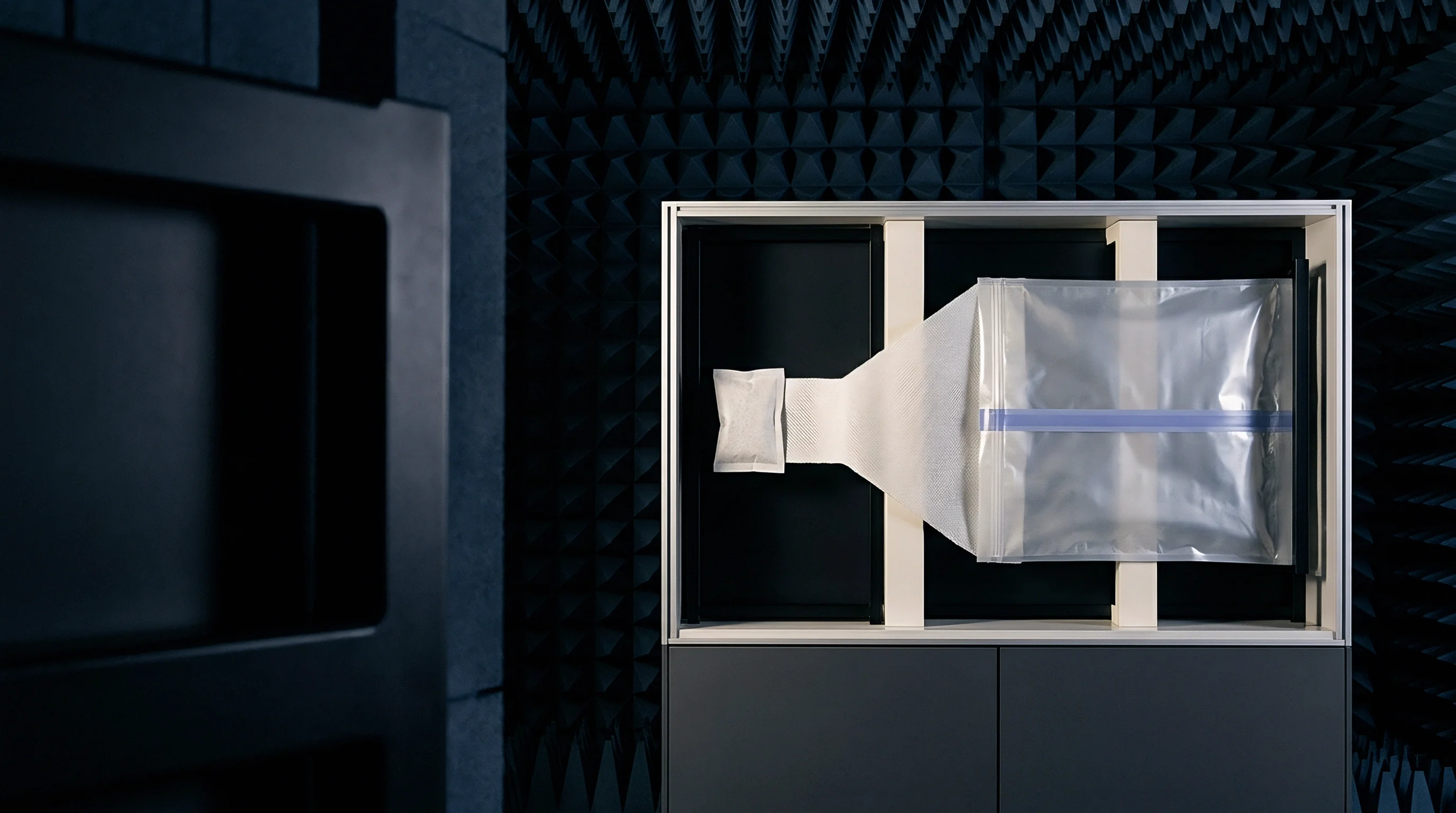
Chamber measurement exposes the true radiated performance of an alternate transceiver integrated within a finished enclosure. The test apparatus centers the host product atop a non-conductive styrene turntable inside an anechoic chamber lined with hybrid pyramidal absorbers. The measurement antenna moves continuously between one and four meters in elevation, cycling through horizontal and vertical polarizations.
The turntable rotates through three hundred sixty degrees at every elevation step, searching for worst-case emission peaks across three orthogonal axes. Frequency spans extend from thirty megahertz up to the tenth harmonic of the highest fundamental clock frequency under ANSI C63.10 procedures.
Fundamental power verification confirms conducted output alignment between alternate modules. An RF power meter connected via coaxial pigtail records peak and average conducted power across low, mid, and high operational channels. An alternate module with two decibels higher conducted drive power will flood the test receiver, pushing edge-of-band bandgap spurious emissions over the strict regulatory threshold.
Technicians lock the radio into test modes using vendor-specific diagnostic software, forcing continuous transmission at maximum duty cycle across multiple modulation modes.
Radiated spurious emissions reveal the primary failure modes. Digital noise generated by microcontrollers and high-speed memory interfaces mixes with the alternate transceiver local oscillator. Intermodulation products appear in bands reserved for restricted services under 47 CFR 15.205.
The receiver scans these restricted frequencies with an average detector and a CISPR quasi-peak detector, tracking emissions against tight microvolt-per-meter thresholds.
- Intermodulation Products emerge from non-linear mixing between the alternate radio local oscillator and high-speed host clock buses, generating spurious radiated energy inside protected aeronautical navigation bands.
- Local Oscillator Leakage breaches out-of-band limits when internal shield seams loosen during mechanical integration, coupling energy onto adjacent printed trace networks.
- Band Edge Regrowth occurs when alternative output power amplifier stages enter saturation under high-temperature testing environments, widening spectral sidelobes into restricted adjacent frequencies.
- Harmonic Radiated Peaks exceed statutory Part 15 limits due to impedance mismatches at the printed trace antenna boundary, projecting secondary and tertiary multiples across three orthogonal axes.
Simultaneous transmission testing adds another layer of chamber complexity. When the host integrates an alternate cellular modem alongside a Wi-Fi or Bluetooth module, intermodulation scans verify that composite emissions remain compliant. Radiated fields sum in free space.
The receiver tracks intermodulation products generated within metallic fasteners, connector shells, and display brackets.
Radiated spurious failures concentrate heavily inside restricted frequency bands defined by Part 15 Section 205.
Test sample configurations dictate measurement accuracy. Integrators prepare multiple units, including one unit fitted with temporary RF coaxial connectors for conducted measurements, alongside fully sealed production enclosures for radiated sweeps. Missing conducted test firmware halts laboratory evaluations immediately.
Radiated traces climbing within three decibels of the regulatory limit force re-scans with reduced receiver resolution bandwidths, consuming allotted chamber time.
Thermal stability across the operational envelope alters emission characteristics. Modules evaluated at twenty degrees Celsius drift when ambient chamber temperatures reach fifty degrees during industrial environmental screening. Frequency drift displaces carrier energy, breaching emission masks at band boundaries.
Output power tuning margins must accommodate manufacturing tolerances across silicon lots.

Surcharge

Expense Modeling for Parallel Sourcing
Budgeting for alternate radio sourcing requires tracking direct laboratory testing charges alongside administrative filing fees across multiple regulatory bodies. Sourcing teams frequently budget for component unit prices while ignoring the non-recurring engineering fees required to bring a second-source radio into commercial compliance. Telecommunication Certification Bodies charge fixed fees to evaluate Class II submissions, issue updated grant certificates, and coordinate public filings within the Commission database.
Radiated test chamber time drives the physical expense profile.
A host manufacturer qualifying an alternate Wi-Fi module must book chamber time at an accredited ISO/IEC 17025 testing facility. Accredited commercial labs bill an average of three hundred dollars per hour for semi-anechoic chamber utilization, running standard radiated scans for twelve to sixteen hours per host configuration. If the alternate transceiver operates across both 2.4 GHz and 5 GHz frequency bands, test matrices expand rapidly.
Unlicensed National Information Infrastructure bands under 47 CFR 15.407 demand dynamic frequency selection verification, adding software simulation routines and technical labor charges to the invoice.
| Expenditure Category | Primary Vendor (Baseline) | Secondary Vendor (C2PC) | Secondary Vendor (Full Grant) |
|---|---|---|---|
| Semi-Anechoic Chamber Time | $4,800 to $7,500 | $2,400 to $3,800 | $6,500 to $9,000 |
| TCB Application and Review Fees | $1,500 to $2,200 | $1,200 to $1,800 | $1,800 to $2,500 |
| FCC Filing Administrative Costs | $450 to $750 | $450 to $750 | $900 to $1,400 |
| SAR Evaluation (if portable) | $3,500 to $6,000 | $3,500 to $6,000 | $3,500 to $6,000 |
| Engineering Overhead and Re-spins | $2,000 to $5,000 | $1,500 to $3,000 | $3,000 to $8,000 |
Administrative handling expenses accumulate when overseas laboratories execute initial scans. Foreign test reports require comprehensive review by a domestic TCB to confirm compliance with FCC Knowledge Database publications. Deficiencies in test mode descriptions or antenna pattern documentation trigger formal requests for information, pausing review cycles while chamber engineers generate supplementary data.
Each round of technical inquiries incurs administrative processing fees from the certification body.
The total landed regulatory expense for a secondary module integration ranges between five thousand and fifteen thousand dollars for mobile equipment. Portable battery-operated devices requiring localized SAR body scans easily double this financial commitment. Sourcing managers attempting to capture fifty cents of bill-of-materials savings per module often discover that production volume must exceed thirty thousand finished units to amortize the regulatory outlay.
Shipment delays compound testing expenditures. Customs authorities halt shipments of imported consumer electronics bearing FCC identifiers that mismatch the active equipment grant database. Port demurrage fees, airfreight rerouting surcharges, and factory production line stoppages rapidly exceed total laboratory certification invoices.
Unqualified component substitutions lead directly to product recalls, border impoundments, and civil forfeiture penalties issued by federal market surveillance authorities.

Pact
Contractual Guardrails and Sourcing Covenants
Procurement agreements must enforce strict regulatory accountability across alternate component suppliers. Master service agreements and supply contracts often treat radio modules as standard commodity silicon, ignoring the regulatory constraints tied to equipment authorizations. When a secondary vendor alters a printed circuit board trace, replaces an internal crystal oscillator, or revises transceiver firmware, the host manufacturer bears absolute legal liability for non-compliant emissions entering commercial distribution.
Purchase orders must integrate definitive regulatory covenants. Sourcing teams draft change notification clauses specifying that any modification to module schematics, bill of materials, antenna geometry, or firmware drive tables requires ninety days advance written notification. The supplier delivers engineering change notices supported by internal pre-scan radiated data prior to shipping modified revisions.
Contracts specify which party absorbs laboratory testing invoices when a component change triggers mandatory permissive change filings.
- Grantee Authorization Covenants legally bind the module manufacturer to execute regulatory paperwork, sign authorization letters, and support permissive change filings through accredited Telecommunication Certification Bodies.
- Firmware Version Locking Clauses prevent unauthorized updates to physical-layer radio control code, maintaining transmission power tables, channel plans, and modulation schemes identical to approved laboratory configurations.
- Component Substitution Indemnification assigns full financial responsibility for re-certification testing, customs holding costs, and regulatory fines to the vendor if unannounced component changes degrade RF performance.
- Escrow of Regulatory Documentation guarantees long-term buyer access to internal schematics, block diagrams, operational descriptions, and antenna gain files necessary to defend equipment authorizations during market surveillance audits.
Product labeling clauses represent another essential commercial requirement. Host equipment packaging and physical product enclosures must carry the precise regulatory identifiers authorized by the Commission under 47 CFR 15.19 and 2.925. If an alternate vendor requires an independent FCC ID via a Change in Identification, the assembly factory manages two distinct inventory bins with segregated serial numbers and unique exterior housing labels.
Mixing alternate modules inside a single housing batch bearing the incorrect FCC identifier invalidates the product warranty and violates federal distribution laws.
Purchase specifications explicitly incorporate standard engineering change protocols, stating that any unilateral modification to internal transceiver layout constitutes a material breach of contract that voids batch acceptance.