Resolving Border Classification Disputes for Multi Component Integrated Circuits Carrying Radio Frequency Front End Structures
Resolve border classification disputes by verifying Chapter 85 Note 9(b) packaging criteria through laboratory cross-sections and advance ruling dossiers.
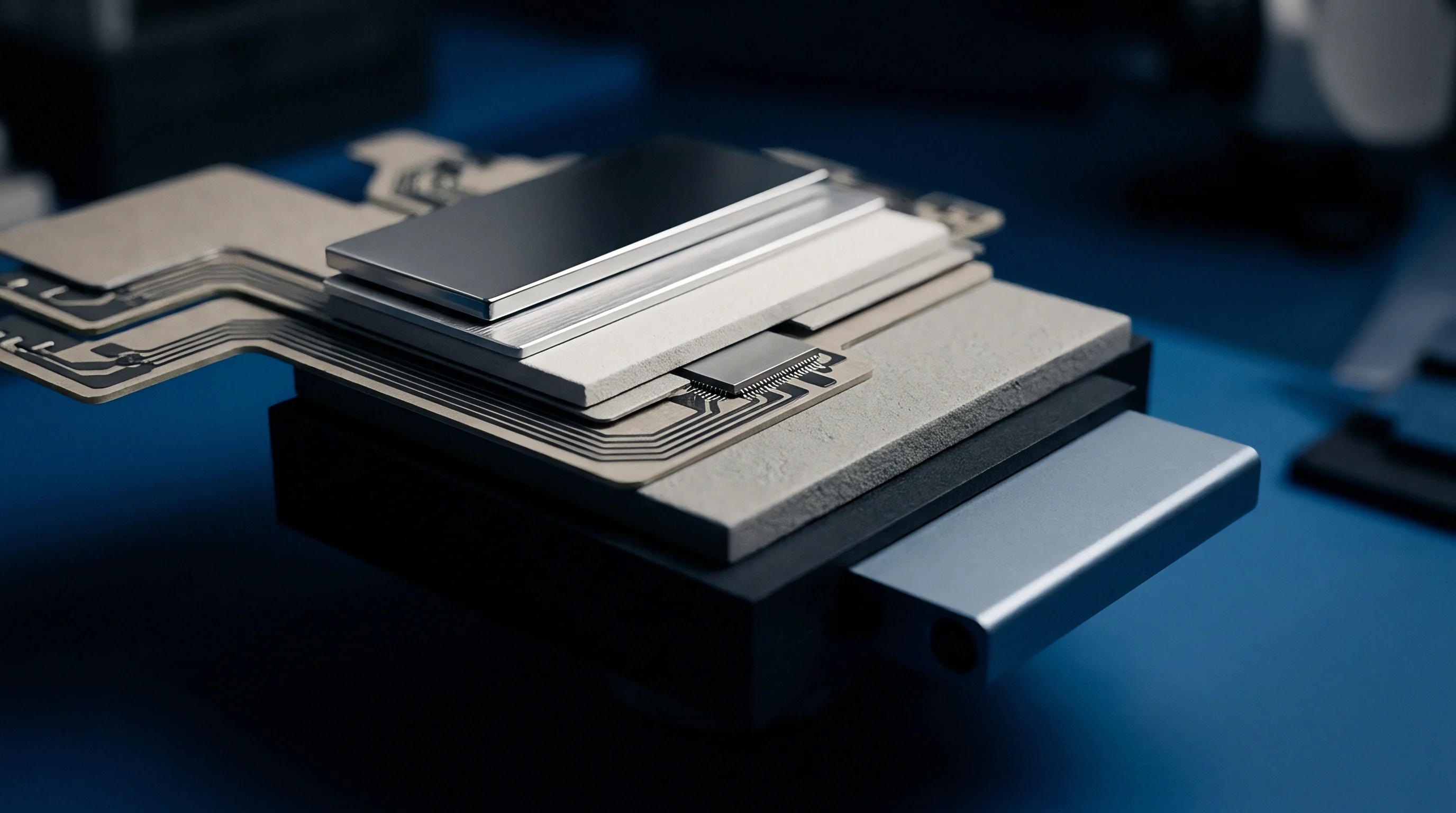

Package
Cross-sectional micro-sectioning of a 5G sub-6 GHz front-end module reveals die-to-die spacings down to 45 micrometers, wire-bond interconnects on an organic resin substrate, discrete 0201 ceramic capacitors, and an encapsulated transfer-molded epoxy housing. Customs authorities examine this physical construction when determining whether an imported device meets the definition of a Multi-Component Integrated Circuit under Chapter 85 Note 9(b) of the Harmonized System. Heading 8542 requires electronic integrated circuits to consist of microcircuits formed on a single semiconductor substrate or assembled together through microassembly techniques.
When a device contains discrete passive components alongside semiconductor dies on a common printed substrate, border inspectors frequently challenge duty-free entry, arguing the unit is a complete radio sub-assembly or telecommunication apparatus.

Architectural Bounds of Multi Component Integration
Note 9(b) to Chapter 85 establishes the criteria for Multi-Component Integrated Circuits (MCOs). An MCO comprises two or more interconnected monolithic integrated circuits ~ such as a Gallium Arsenide power amplifier die, a Silicon-Germanium low-noise amplifier die, and a complementary metal-oxide-semiconductor RF switch die. These active microcircuits combine with discrete passives like ceramic capacitors, thin-film inductors, and surface acoustic wave filters.
The entire assembly sits on a common insulating or semiconductor substrate, encapsulated in epoxy resin or ceramic packaging. To qualify legally, these components must form an indivisible structural unit operating as an integrated circuit once placed on a board.
Customs officials inspect substrate construction to distinguish an MCO from a printed circuit board assembly under Heading 8517. Standard multi-layer organic laminates made of bismaleimide-triazine resin or FR-4 glass epoxy often trigger reclassification if lab analysis reveals conductive traces performing routing independent of inter-component links. Silicon interposers, redistribution layers, and ceramic substrates pass inspection provided trace lines strictly connect internal dies and passives inside the molded housing.
If internal micro-vias route signals directly between external package pads without touching an active semiconductor die, auditors reclassify the unit as a modular sub-assembly subject to duty.
Where passives sit within the package structure directly shapes the outcome. Discrete inductors or capacitors surface-mounted on top of an encapsulation layer or attached outside the main molded frame invalidate MCO status. Customs agencies require every passive element to sit inside or directly on the common substrate before final encapsulation.
A single exposed component added after transfer molding forfeits eligibility under Heading 8542.
- Unpassivated substrate traces point to external routing channels that extend beyond die-to-die links, prompting auditors to reclassify the package as a printed circuit sub-assembly.
- Discrete piezoelectric acoustic filters mounted on alumina carriers are treated as standalone components if cross-sectioning shows structural support independent of the main substrate.
- Embedded surface-mount components placed on the package body’s lower exterior break the single-molded unit requirement for semiconductor status.
- Organic laminate board structures with four or more internal copper layers trigger lab reviews to evaluate whether the substrate acts as an independent printed circuit.

Physical Verification of Package Substrate Boundaries
Laboratory cross-sectioning provides the evidence base for customs metrology teams in classification disputes. Focused ion beam milling cuts through the encapsulation epoxy to check dielectric thicknesses and trace spacing, while energy-dispersive X-ray spectroscopy identifies the elemental breakdown of internal solder bumps, wire bonds, and substrate metallization. If spectroscopy uncovers lead-based solder alloys or unexpected substrate plating that conflicts with the submitted bill of materials, customs authorities reject the technical documentation outright.
| Structural Parameter | HS 8542 MCO Threshold | Customs Disqualification Trigger | Mandatory Laboratory Test Method |
|---|---|---|---|
| Substrate Fabrication | Single continuous ceramic, silicon, or organic package carrier | Multi-layer printed circuit assembly with external signal routing | Scanning Electron Microscopy cross-sectioning |
| Passive Component Placement | Fully encapsulated within primary mold body or ceramic cavity | Surface-mounted passives exposed on external package faces | X-ray Computed Tomography scan |
| Active Die Interconnects | Direct flip-chip solder bumps or micro-wire bonding | Interposed socket connectors or separable board headers | Acoustic Micro-Imaging void analysis |
| Encapsulation Integrity | Indivisible molded resin or hermetic ceramic enclosure | Removable shield cans or mechanically fastened covers | Destructive physical decapsulation |
X-ray computed tomography allows customs laboratories to inspect package interiors non-destructively. Three-dimensional volumetric renderings map component layout, internal trace paths, and passive distribution. Inspectors use these scans to check whether passives perform basic biasing, decoupling, or impedance matching tied directly to active dies.
If scans reveal complete filtering networks operating independently of the dies, authorities argue the component functions as an autonomous radio frequency apparatus.
Substrate thickness ratios present another point of friction. Guidelines in several jurisdictions evaluate the volume ratio between semiconductor silicon and carrier substrate. If substrate volume exceeds 70 percent of total package volume, inspectors treat the product as a printed circuit board carrying dies rather than an integrated circuit.
Importers counter by providing thermal dissipation models and signal integrity calculations that justify the substrate’s bulk.
Encapsulation materials must show uniform chemical bonding across the substrate interface. Delamination gaps or secondary potting compounds visible under scanning acoustic microscopy point to multi-stage manufacturing, which contradicts unified IC assembly. Importers submit factory process logs to prove continuous molding execution during assembly.
Transfer-molded packages housing semiconductor dies and passive matching elements are often asserted to meet multi-component integrated circuit criteria regardless of internal laminate routing complexity.

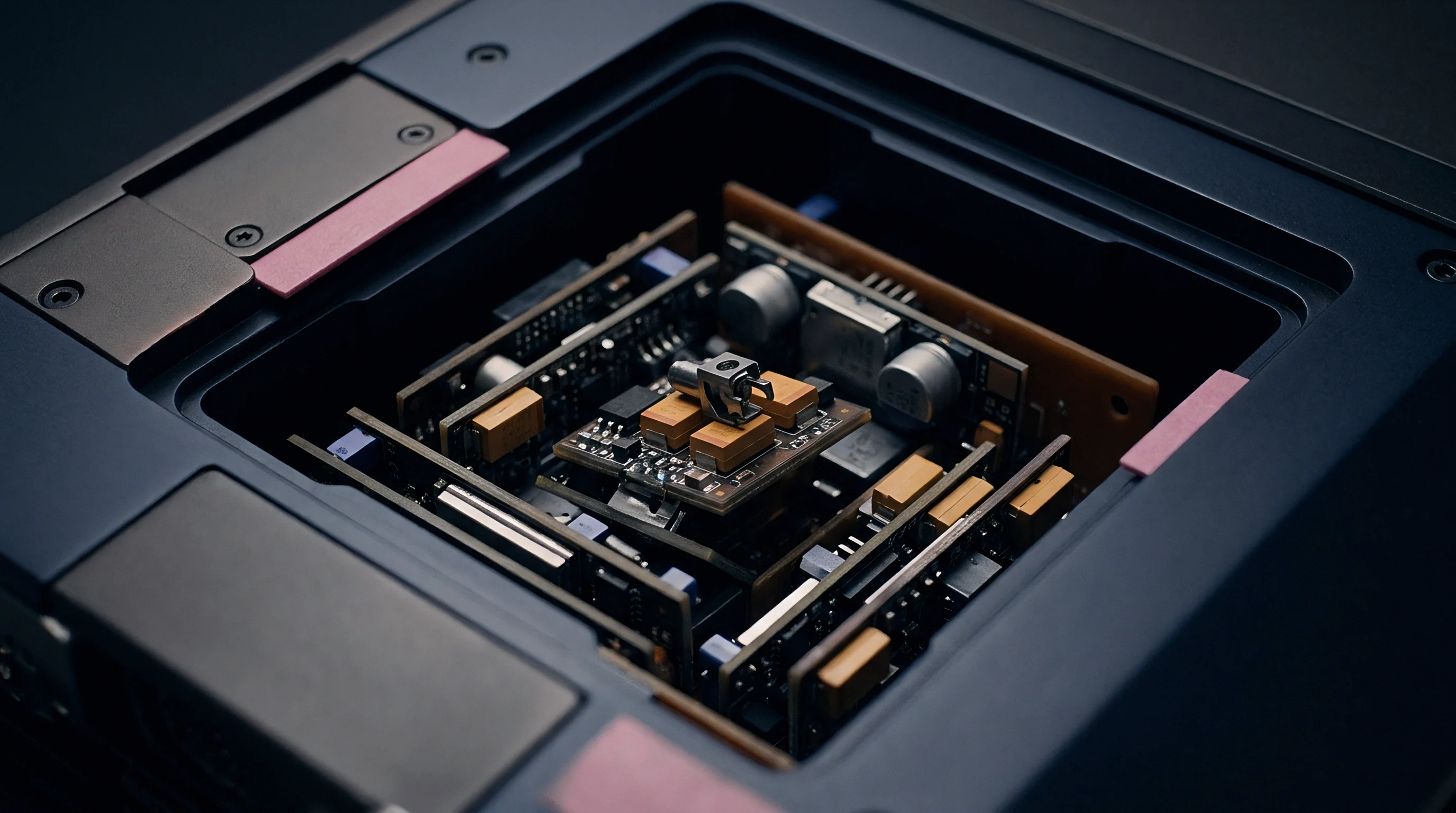
Heading
Tariff classification disputes center on choosing between electronic integrated circuits under Heading 8542 and telecommunication apparatus under Heading 8517 or electrical machines under Heading 8543. The World Customs Organization Harmonized System sets specific rules for placing multi-function semiconductor components into tax categories. Importers target subheadings 8542.31 or 8542.39, which enter duty-free under the Information Technology Agreement across most signatory nations.
Customs authorities often push for reclassification under 8517.62, 8517.79, or 8543.70, where statutory duties range from 2.5 percent to 25 percent before trade remedies.

Legal Mechanics Governing Tariff Headings
General Rules for the Interpretation of the Harmonized System dictate border decisions. Rule 1 states that classification depends strictly on heading terms and relative section or chapter notes. Note 9(b) to Chapter 85 acts as the gatekeeper for Heading 8542: if a Radio Frequency Front End structure meets every requirement in Note 9(b), Rule 1 assigns it to Heading 8542 regardless of alternative headings describing end-use applications.
When an imported module fails Note 9(b) structural tests, authorities apply Rule 3 to resolve competing headings. Under Rule 3(a), the heading providing the specific description takes precedence over general terms. Inspectors argue that subheadings for radio transmission or reception gear describe the item’s function more specifically than general microcircuit notes.
Importers defend Heading 8542 by showing the component cannot operate on its own without host system processing.
The legal text of Chapter 85 Note 9 takes precedence over end-use functional descriptions when physical microcircuit assembly criteria are fully met.
Rule 3(b) introduces the essential character test for composite goods unresolvable under Rule 3(a). Valuation teams analyze cost breakdowns, mass distribution, and functional weight within the module. If the power amplifier die and RF switches account for 80 percent of component value, importers argue the semiconductor assembly gives the item its essential character.
If proprietary ceramic acoustic filters account for most of the cost, officials take the filter function as defining classification under Heading 8517.
Subheading assignment follows General Rule 6. Importers weigh subheading 8542.31 for processors and controllers against 8542.39 for other integrated circuits and 8542.90 for parts. RF front-end modules carrying integrated digital control logic qualify under 8542.31 when control circuitry takes up significant silicon area.
Pure analog front-end modules with power amplifiers and switches fall under 8542.39.

Regulatory Grant Conflicts in Tariff Valuation
Importers face friction when customs officers pull filings submitted for radio spectrum approvals. Filings under Federal Communications Commission authorizations, European Union Radio Equipment Directive declarations, or China Ministry of Industry and Information Technology approvals describe devices to secure spectrum access ~ often listing them as modular transmitters or transceiver sub-assemblies. Customs officials treat these regulatory declarations as admissions of product identity to justify reclassifying modules under telecommunications headings.
Submitting an FCC modular grant to prove authenticity often backfires. Regulatory filings highlight full transmitter autonomy, antenna port impedance, and modulation performance ~ details inspectors extract to argue the module carries an independent telecommunication function under Heading 8517. Technical evidence compiled for spectrum regulators becomes financial liability at the border.
Importers counter this crossover by separating spectrum compliance definitions from tariff law. Spectrum rules classify products by RF exposure, occupied bandwidth, and spurious emissions; tariff schedules look exclusively at packaging, semiconductor fabrication, and substrate assembly. Holding a modular radio grant does not legally change a device’s physical status as an integrated circuit under Chapter 85 Note 9(b).
Documentation given to valuation panels must define the device’s physical limits clearly. Engineering schematics show the absence of local power management ICs, crystal oscillators, or baseband processing within the module frame. Establishing that the structure requires continuous control signals and power rails from an external host processor refutes claims of autonomous transceiver capability.
Customs rulings reflect sharp geographical divides. European Binding Tariff Information decisions strictly enforce physical micro-assembly standards, accepting MCO status as long as passives stay inside the mold. United States Customs and Border Protection rulings focus heavily on functional capability, reclassifying modules containing complete filter banks and power amplifiers under Heading 8517 or 8543 regardless of packaging format.
A standard customs indemnity clause in procurement contracts shifts retroactive tariff assessments, statutory interest, and legal fees back to the vendor if a declared integrated circuit classification fails audit.


Coupling
Radio Frequency Front End structures rely on tight electromagnetic coupling and impedance matching between active dies and passive filtering networks. Power amplifier dies fabricated in Gallium Arsenide or Silicon-Germanium generate heat and high RF signal levels. Low-noise amplifier dies built in advanced CMOS or Silicon-on-Insulator nodes demand low noise figures and high linearity.
RF switches alternate paths between transmit and receive chains, while acoustic wave filters strip out-of-band harmonics. Packing these distinct operational blocks into a single multi-chip enclosure creates complex electromagnetic interactions that customs laboratories evaluate during audits.

Does Passive Integration Change Multi Component Classification?
Passive matching networks transform load impedances between power amplifiers and antenna ports. Discrete 0201 or 01005 ceramic inductors and capacitors offer the high quality factors needed for efficient power transfer, while integrated passive devices on glass, silicon, or gallium arsenide consolidate these circuits into compact dies. Customs inspectors examine whether these passive arrays handle simple circuit biasing or form filtering networks with independent functionality.
Surface Acoustic Wave and Bulk Acoustic Wave filters introduce non-semiconductor materials into the package. These filters use piezoelectric substrates like lithium niobate, lithium tantalate, or synthetic aluminum nitride deposited on silicon wafers. Customs auditors question whether piezoelectric acoustic wave transducers meet Note 9(b) criteria for integrated circuits.
Importers respond with crystalline structure analyses showing that acoustic filter dies undergo standard semiconductor photolithography and wafer-level microassembly.
Laboratory SEM cross-sections must confirm an active semiconductor silicon surface area ratio exceeding 60 percent relative to passive substrate carriers to sustain MCO customs status under European customs audits.
Electromagnetic shielding built directly into the module package also affects classification decisions. Internal compartment shields formed by trench etching and selective copper plating isolate sensitive low-noise amplifiers from high-power emissions, while external conformal shielding applied over the molded package body blocks radiated emissions. Customs inspectors maintain that external shielding turns a microcircuit into an equipment module under Heading 8543; importers counter that package-level shielding is an essential mechanical feature required for thermal and electromagnetic performance.
Internal interconnect topology dictates electrical performance alongside classification status. Flip-chip solder joints cut parasitic inductance relative to gold wire bonds, enabling millimeter-wave operation. Copper pillar bumps with lead-free solder caps connect active dies directly to redistribution layers.
Customs labs evaluate cross-sections to verify that solder alloy compositions match submitted manufacturing specifications.

Analytical Diagnostics in Laboratory Audits
Customs administrations enforce rigorous analytical verification procedures when an importer challenges a reclassification order. Metrology staff run non-destructive tests before subjecting samples to destructive chemical and mechanical analysis.
- Importers submit five unencapsulated production samples alongside twenty finished, molded production units directly to the designated customs laboratory facility.
- Customs engineers perform full-spectrum X-ray CT scanning to construct three-dimensional spatial maps of internal dies, wire bonds, discrete components, and substrate traces.
- Scanning acoustic microscopy identifies internal package delamination, void fractions in die-attach adhesives, and structural boundaries of ceramic acoustic filters.
- Chemical decapsulation using nitric acid or plasma etching exposes internal silicon dies, integrated passive devices, and substrate trace metallization layers.
- Scanning electron microscopy and energy-dispersive X-ray spectroscopy measure trace widths, layer thicknesses, and elemental compositions of semiconductor junctions and passive structures.
- Laboratory technicians draft a formal analytical report comparing physical measurements against the legal requirements of Chapter 85 Note 9(b).
| Analytical Technique | Observed Physical Parameter | Customs Determination Limit | Regulatory Impact on Tariff Heading |
|---|---|---|---|
| X-ray CT Volumetric Scan | Ratio of discrete passives to semiconductor die count | Exceeding 10 discrete passives per active die triggers sub-assembly review | Reclassifies from 8542.39 to 8517.70 parts designation |
| EDS Spectroscopy | Piezoelectric substrate composition in filter dies | Identification of non-semiconductor lithium tantalate substrates | Challenges MCO qualification under Note 9(b) criteria |
| SEM Cross-Sectioning | Substrate copper routing layer count | More than 2 independent routing layers without die contact | Reclassifies component as printed circuit assembly under 8517.62 |
| CSAM Acoustic Scan | External metal shield attachment mechanism | Mechanical clips or non-molded conductive epoxy seams | Reclassifies housing as apparatus frame under 8543.70 |
Diagnostic measurements focus heavily on active silicon area relative to overall footprint. When passives, acoustic filters, and carrier substrates make up over 50 percent of total package volume, auditors argue the device is an assembled circuit board. Engineering teams counter that high-frequency RF operation requires physical spacing between high-gain power amplifiers and sensitive acoustic filters to prevent parasitic oscillation and signal distortion.
Thermal management structures built into the package face similar scrutiny. Copper thermal blocks, coin inserts, and dense via arrays under power amplifier dies draw heat from active junctions down to host boards. Customs officials evaluate whether thermal coins act as structural frame members that disqualify the unit from semiconductor packaging definitions; documentation showing that thermal inserts remain fully inside the package supports MCO status.
Importers frequently overlook how customs labs handle heterogeneous integration, such as embedded fan-out wafer-level packaging. In fan-out designs, dies and passives sit inside a mold compound while thin-film redistribution layers replace traditional laminate substrates. Rules written for legacy wire-bonded packages adapt poorly to fan-out architectures, leaving it unclear whether thin-film redistribution layers count as an independent printed circuit carrier.


Binding
Securing certainty for cross-border shipments of multi-component integrated circuits requires formal advance rulings. Importers request binding classification decisions before launching high-volume production shipments. United States Customs and Border Protection issues rulings under 19 CFR Part 177, while European authorities issue Binding Tariff Information decisions under Regulation 952/2013, and Japan and China maintain national advance ruling mechanisms.
A binding ruling locks in the tariff code across all ports of entry for typically three to five years, shielding the importer from retroactive duty claims and border holds.

Administrative Dossier Preparation for Advance Rulings
Drafting an advance ruling application requires full technical disclosure. Importers build dossiers pairing legal arguments with semiconductor engineering data, including exploded-view assembly diagrams for every die, passive, wire bond, and substrate layer. Parts lists detail part numbers, electrical functions, substrate materials, and manufacturer data for all internal components.
Schematics submitted with applications must trace all internal connections. Engineers annotate these diagrams to show that passives function strictly as bias networks, impedance matching elements, or harmonic suppression filters tied directly to active dies. Demonstrating that the module contains no independent control microprocessors, memory arrays, or autonomous power management ICs proves it cannot run telecommunications processing without external host control.
- Exploded-view mechanical drawings show spatial arrangements of internal dies, passives, mold compounds, and substrate layers within the package.
- Chemical material composition certificates document elemental percentages for semiconductor dies, acoustic filter substrates, package resins, and metallization.
- Detailed bill of materials lists every internal part number, manufacturer, physical dimension, and electrical function inside the assembly.
- Cross-sectional high-resolution micrographs verify die bonding, routing channels, encapsulation boundaries, and substrate layer thickness ratios.
- Operational circuit schematics trace interconnections between active dies and passive matching elements, confirming the absence of independent baseband processing.
Customs authorities analyze dossiers against historical classification rulings and case law. Both the Court of Justice of the European Union and the United States Court of International Trade have issued decisions interpreting semiconductor integration limits, and dossiers routinely leverage these precedents where courts upheld MCO status for complex multi-chip modules containing integrated passives.
Standard ISO 17025 accredited laboratory test reports verifying physical encapsulation parameters must accompany all Binding Tariff Information applications submitted to European customs authorities.

Commercial Dispute Timelines and Inventory Risk
Filing an advance ruling application introduces timing risks into product launch schedules. Customs offices take three to nine months to issue formal decisions, and if an administration requests additional lab testing or cross-sectioning, reviews can stretch past twelve months. Importing components while an application remains pending exposes shipments to holds, redelivery demands, and unexpected duty adjustments at entry ports.
When border officers issue a notice of reclassification on active shipments, importers must respond within strict deadlines. In the United States, administrative protests under 19 U.S.C. 1514 must be filed within 180 days of entry liquidation. A protest suspends final duty collection while customs legal specialists review the dispute; missing the technical evidence submission window forfeits administrative remedies, leaving the higher duty rate final.
Importers facing commercial launch deadlines rely on bonded warehouse storage and entry suspension mechanisms. Storing disputed shipments in a Foreign Trade Zone or customs bonded warehouse defers duty payments during litigation, preventing inventory clearance delays while preserving the right to re-export shipments without penalties if an adverse ruling comes down.
Securing a favorable binding ruling in one national jurisdiction does not guarantee automatic acceptance across other customs territories.


Ledger
Tariff classification directly dictates the landed cost of multi-component integrated circuits. Under the Information Technology Agreement, integrated circuits entering under subheadings 8542.31, 8542.39, or 8542.90 carry a zero percent statutory duty rate across major economies. Reclassification under 8517.62, 8517.79, or 8543.70 triggers base duties between 2.5 percent and 6 percent.
When trade remedies or Section 301 retaliatory tariffs apply, total duty assessments on disputed RF front-end shipments can reach 27.5 percent to 31 percent of declared entry value.

Landed Cost Sensitivity to Reclassification
Financial models highlight the extreme sensitivity of landed costs to reclassification. Consider an enterprise importing 10,000,000 Radio Frequency Front End modules annually at a unit valuation of $3.80, representing $38,000,000 in declared value. Under subheading 8542.39, duty liability is $0 under duty-free ITA provisions.
If customs reclassifies the product under 8517.62 with a 2.5 percent base duty plus a 25 percent trade remedy tariff, annual duty liability rises to $10,450,000.
Audit lookback windows compound this exposure. Customs agencies routinely execute compliance audits covering entry records dating back three to five years. A retroactive reclassification covering four audit years on $38,000,000 in annual imports creates $41,800,000 in accumulated back duties, before mandatory interest from the original entry dates or civil penalties under 19 U.S.C. 1592 for gross negligence or misclassification.
A total reclassification duty differential of 27.5 percent converts a profitable high-volume component procurement program into an unviable commercial operation.
| Entry Scenario | Declared HS Code & Duty | Disputed HS Code & Duty | Retroactive Exposure per $10M Volume | Cash Mitigation Mechanism |
|---|---|---|---|---|
| Standard ITA Duty-Free Clearance | 8542.39 (0.0%) | N/A (Declared Correct) | $0 base exposure | Direct entry liquidation |
| Base Telecom Reclassification | 8542.39 (0.0%) | 8517.70 (2.5%) | $250,000 per entry year | Administrative protest under 19 U.S.C. 1514 |
| Trade Remedy Tariff Reclassification | 8542.39 (0.0%) | 8517.62 (2.5% + 25.0%) | $2,750,000 per entry year | Customs Bonded Warehouse deposit |
| Full Apparatus Penalty Assessment | 8542.39 (0.0%) | 8543.70 (2.6% + 25.0% + Penalty) | $5,300,000 per entry year | Prior Disclosure filing under 19 CFR 162.74 |
Penalties escalate if authorities allege false declarations. When auditors decide an importer failed to exercise reasonable care declaring modules under Heading 8542 despite holding contrary technical data, civil penalties can reach up to twice the unpaid duty or 20 percent of entry value. Submitting a voluntary Prior Disclosure under 19 CFR 162.74 before an investigation opens caps penalty exposure, limiting liabilities to unpaid duty plus interest.

Contractual Risk Transfer in Sourcing Agreements
Procurement agreements for custom RF front-end assemblies use risk-shifting clauses to protect buyers from classification disputes. Contracts set delivery terms under INCOTERMS 2020 rules; choosing Delivered Duty Paid (DDP) places responsibility for customs clearance, tariff declarations, and duty payments squarely on the vendor. Under DDP terms, the vendor serves as importer of record, bearing full liability for holds, audits, and retroactive duty adjustments.
When buying under Free Carrier (FCA) or Delivered at Place (DAP) terms, the buyer assumes importer-of-record obligations. Procurement teams mitigate risk by inserting technical compliance guarantees into contracts. These clauses compel vendors to provide packaging cross-sections, material composition data, and decapsulation micrographs needed to support MCO status during audits.
Contractual indemnity provisions specify remedies if customs reclassifies imported components. These clauses require suppliers to reimburse buyers for underpaid duties, interest charges, legal fees, and fines stemming from inaccurate packaging declarations or bills of materials. Buyers frequently hold back a set percentage of payments in escrow until customs liquidation periods pass unchallenged.
Supply contracts also enforce strict rules around technical changes. If a vendor alters substrate materials, passive layouts, or die encapsulation processes without advance engineering change notifications, the agreement gives the buyer termination rights and liquidated damages for any resulting customs liabilities.
Shipping high-volume integrated front-end assemblies without securing formal advance rulings leaves companies vulnerable to border impoundments, heavy tariff penalties, and unrecoverable margin losses.