Tariff Classification Rules for Embedded Radio Equipment
Embedded radio classification follows host machine principal function under Section XVI Note 3 rather than heading 8517 unless communications form primary utility.

Canon
Harmonized System codes determine duty rates, border clearance times, and paperwork requirements for every connected industrial device crossing an international frontier. Embedding a wireless transceiver into a previously inert mechanical or electrical product alters its legal identity under customs law. Importers frequently assume that adding a Wi-Fi, Bluetooth, or cellular module turns the finished unit into a telecommunications device under heading 8517, but national customs administrations routinely reject that interpretation.
Under the World Customs Organization Harmonized Commodity Description and Coding System, embedded radios trigger a strict hierarchy between the host machinery chapters and the provisions covering electrical communication.

Harmonized System Structure for Connected Devices
Tariff classification across all six-digit global categories begins with the General Rules for the Interpretation. Under General Rule of Interpretation 1, classification is determined by the terms of the headings and any relative section or chapter notes. Goods with integrated radio modules generally land in Section XVI, covering Chapter 84 mechanical machinery and Chapter 85 electrical equipment.
Heading 8517 covers telephone sets, smartphones, and other apparatus for the transmission or reception of voice, images, or other data, including apparatus for communication in a wired or wireless network. In most developed jurisdictions, heading 8517 enters duty-free under the Information Technology Agreement, so importers naturally prefer it over the positive duty rates typical of base machines in Chapter 84 or measuring instruments in Chapter 90.
Customs authorities resolve competing headings through statutory priority mechanisms. Section XVI Note 3 governs composite machines consisting of two or more machines fitted together to form a whole, as well as machines designed for the purpose of performing two or more complementary or alternative functions, directing customs officers to classify the composite apparatus according to its principal function. For example, when a high-precision liquid flow meter incorporates a short-range radio to transmit telemetry back to a centralized monitoring console, its principal function remains fluid measurement under heading 9028; the radio serves as an auxiliary feature, leaving classification with the meter.
Under Section XVI Note 3, auxiliary wireless transceivers that support host operations without altering primary physical work yield entirely to the classification of the host machine.
General Rule of Interpretation 3 comes into play only when classification fails under General Rule of Interpretation 1 and the accompanying legal notes. General Rule of Interpretation 3(b) directs that mixtures, composite goods consisting of different materials or made up of different components, and goods put up in sets for retail sale, be classified by the component that imparts their essential character. Importers often conflate principal function under Section XVI Note 3 with essential character under General Rule of Interpretation 3(b).
Principal function turns on operational purpose and mechanical design, whereas essential character evaluates component value, bulk, weight, role in use, and commercial identity. Under World Customs Organization guidance, officers must exhaust Section XVI Note 3 before turning to General Rule of Interpretation 3(b).
Separating primary machinery from communications equipment is an evidence-driven exercise. Customs auditors examine the product architecture across several technical parameters to establish whether the device operates as an independent data terminal or strictly as an instrument with onboard telemetry.
- Primary utility analysis isolates the fundamental mechanical, thermodynamic, or analytical work performed by the physical hardware during normal operation.
- Autonomous transmission capability verifies whether the internal radio can receive and route arbitrary third-party packet traffic without intervention from the host processor.
- Value contribution index contrasts the raw bill-of-materials cost of the RF subsystem against the accumulated manufacturing cost of the host mechanical chassis.
- Firmware operational dependency tests whether the embedded transceiver halts packet transmission if the host diagnostic sensor is disconnected from the main logic board.
Secondary sub-assemblies inside an embedded device retain no separate tariff identity once permanently integrated. Goods are classified in the physical condition they present at import. When an overseas assembly facility ships a finished valve actuator containing a pre-certified radio, the tariff treats the entire shipment as an actuator; the presence of radio frequency circuitry does not displace the mechanical heading.
| Finished Apparatus | Embedded Wireless Standard | Contested Telecommunications Code | Statutory Assigned Tariff Code | Governing Legal Mechanism |
|---|---|---|---|---|
| Ultrasonic Gas Meter | Sub-GHz Wireless M-Bus | HS 8517.62 | HS 9028.10 | Section XVI Note 3 / Principal Function |
| Variable Frequency Drive | Bluetooth Low Energy 5.3 | HS 8517.62 | HS 8504.40 | Section XVI Note 3 / Host Drive Control |
| Multi-Parameter Patient Monitor | Wi-Fi 6 (802.11ax) | HS 8517.62 | HS 9018.19 | Chapter 90 Note 3 / Medical Diagnostic Purpose |
| Cellular Vehicle Tracker | LTE Cat-M1 / GNSS | HS 8526.91 | HS 8517.62 | GRI 3(b) / Data Transmission Primacy |
| Centrifugal Slurry Pump | Semtech LoRaWAN | HS 8517.62 | HS 8413.70 | Section XVI Note 3 / Hydraulic Work Dominance |
An embedded transceiver operating under secondary command authority follows the host enclosure in tariff classification at every border crossing.


Board
How radio hardware is physically integrated largely dictates whether customs treats it as a separable component or an indivisible part of the host. Connectivity is generally sourced in two form factors: surface-mount solder-down modules and discrete connectorized add-in cards. This structural divide reshapes tariff liability and customs documentation workflows.
Solder-down modules bond directly to the host printed circuit board during surface-mount reflow, whereas add-in cards seat into standardized interfaces such as M.2, Mini-PCIe, or board-to-board mezzanine headers.

Will Solder down Modules Escape Finished Equipment Duty?
Surface-mount transceivers soldered onto host circuit boards lose their separate identity under customs review. When an unpopulated or semi-populated board arrives at a port of entry, it classifies according to its current state of manufacture. Imported on standalone reels or trays before placement, solder-down wireless modules classify unequivocally under subheading 8517.62 as machines for the reception, conversion, and transmission of data, entering duty-free under the Information Technology Agreement.
Once surface-mount placement puts that module onto a specialized industrial controller motherboard, its classification changes. It is no longer an independent radio transceiver; customs treats the assembly as a populated printed circuit board or an incomplete machine. Under Section XVI Note 2(a), parts that are goods included in any of the headings of Chapter 84 or Chapter 85 are in all cases classified in their respective headings.
A populated board carrying microcontrollers, motor drivers, power conversion stages, analog front ends, and a soldered wireless chip ceases to be a radio part and instead falls under the specific parts heading for the end machine ~ such as heading 8473 for data processing machinery or heading 9032 for automatic regulating instruments.
The physical attachment is decisive. Solder creates a permanent metallurgical bond: removing a reflowed radio module damages the solder pads, tears internal PCB traces, and destroys the electromagnetic shielding can. Customs authorities take this non-reversible mechanical integration as clear proof that the module has become an indivisible element of the board.
Permanent metallurgical solder joints strip an embedded radio module of its independent tariff identity at the port of entry.

Connectorized Cards and Autonomous Assemblies
M.2 and Mini-PCIe cards maintain distinct six-digit classifications when packed alongside host equipment rather than permanently bonded. If an importer ships an industrial automation cabinet in one container and packages plug-in wireless modem cards in a separate internal carton, customs assesses the shipment under the rules for separate articles or functional units. Where a modular card slots into an external socket without tools, border officers frequently assess the card under heading 8517.62 while the cabinet clears under heading 8537.
Customs laboratories evaluate physical board integration on the bench through a routine verification sequence.
- Technicians check whether the RF shielding enclosure is soldered permanently to ground planes or held by field-removable mechanical spring clips.
- Testing staff measure power rail continuity to establish whether the transceiver draws power from a shared host power management IC.
- Inspectors check trace layouts to see whether high-speed communication buses run directly to a host system-on-chip or exit through a proprietary connector interface.
- The laboratory powers the board to determine if the wireless subassembly boots and broadcasts an identifier without host processor initialization commands.
While testing laboratories document whether a module retains independent function, they do not file customs entries; tariff exposure is decided by the physical architecture of the assembly.
Leaving antenna pins unpopulated does not turn an autonomous wireless transceiver into an unclassified slab of fiberglass and copper; customs evaluates the assembly according to its functional circuitry and latent radio capability.


Character
When General Rule of Interpretation 1 and the chapter notes fail to yield an unambiguous classification, customs authorities turn to General Rule of Interpretation 3(b) to resolve competing tariff headings. Designed for composite goods and multi-function assemblies, this rule requires establishing which component gives the article its essential character. In connected equipment disputes, this question forms the core disagreement, and importers need defensible technical evidence to sustain their declared classifications during post-entry audits.

Have Customs Audits Reclassified Composite Apparatus Entries?
Revenue authorities routinely challenge declarations that assign industrial equipment to telecommunications subheadings, particularly in jurisdictions with steep trade remedy tariffs. For example, declaring a connected residential power generator under duty-free heading 8517 invites reclassification under heading 8502: the generator produces electrical energy, while the cellular modem reporting operating hours and fuel reserves provides only incidental telemetry. Reclassification leaves the importer liable for back duties, compounding interest, and administrative penalties.
The core issue is functional primacy. Precedents consistently deny heading 8517 when an embedded radio module merely reports operational data. A commercial vehicle tire pressure sensor containing a piezoresistive transducer and an integrated 433 MHz RF transmitter classifies under heading 9026 as an instrument for measuring pressure.
The radio link does not convert the gauge into a data transmission machine; the transmitter exists exclusively to communicate the measurement taken by the transducer.

Essential Character Metrics and Commercial Value
Bills of materials, software line counts, and user interface prominence form the evidentiary base in contested classifications. In both United States Customs and Border Protection rulings and European Union Binding Tariff Information decisions, hearing officers apply multi-factor tests to isolate essential character. Marketing claims about connected features carry little weight with auditors, who examine engineering documentation to determine how the product functions in real operating conditions.
Four objective criteria govern essential character determinations during customs audits:
- Cost distribution profile compares the raw component procurement expenditure of the radio subsystem against the aggregated expenditure of all non-RF mechanical, structural, and electrical assemblies.
- Physical mass allocation measures the dimensional footprint and weight of RF shielding, matching networks, and trace antennas against the total enclosed mass of the finished apparatus.
- Consumer purchase motivation analyzes commercial marketing data, product specifications, and retail listings to confirm whether buyers purchase the unit for data handling or mechanical work.
- Firmware execution dominance calculates the percentage of microprocessor clock cycles and system memory dedicated to local data processing versus wireless packet framing and protocol negotiation.
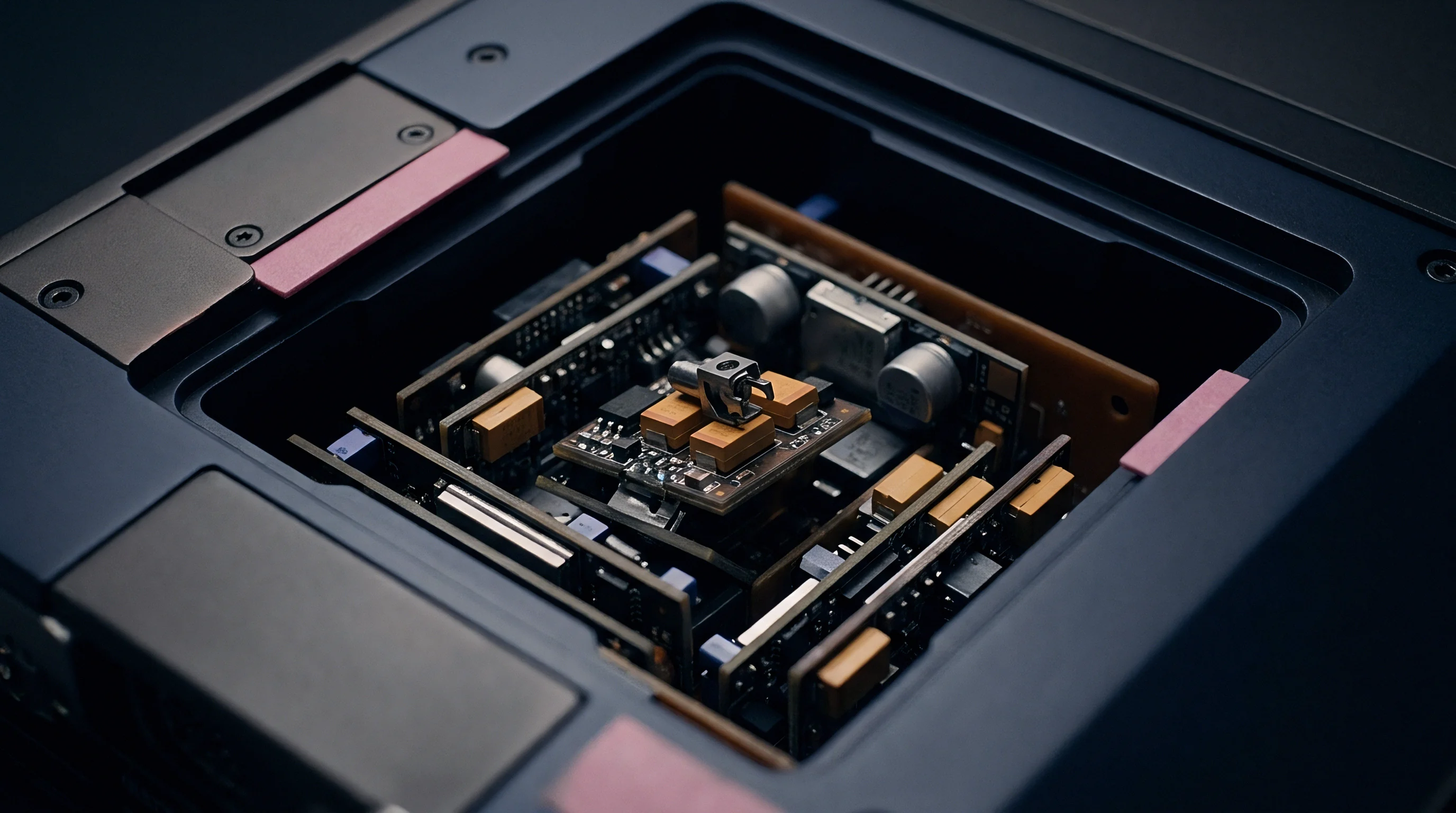
Customs examiners inspect the interior housing directly: while the host unit governs primary utility, antenna layout and trace routing indicate whether the wireless hardware can function on its own.

Financial Impact of Section 301 Duties
Trade remedies impose punitive tariffs on specific headings irrespective of baseline most-favored-nation rates. In the United States, Section 301 tariffs on Chinese-origin merchandise create massive tariff rate disparities between Chapter 84/85 industrial items and telecommunications gear, leaving sourcing teams that misjudge classification vulnerable to substantial audit liabilities.
Consider a realistic commercial manufacturing scenario. Take an annual procurement lot of 50,000 smart fluid flow meters manufactured in China and imported into the United States. Each finished meter carries a customs transaction value of 180.00 USD, yielding a total annual entered value of 9,000,000.00 USD.
The internal assembly includes a 4.50 USD cellular module supporting NB-IoT and LTE-M. Two competing classifications exist:
- Declared Heading 8517.62.0050 carries a Most-Favored-Nation duty rate of 0.0 percent, alongside an active Section 301 List 4A punitive tariff of 7.5 percent. The total effective duty rate stands at 7.5 percent. Total annual customs duty amounts to 675,000.00 USD.
- Reclassified Heading 9028.20.0000 carries an MFN base duty rate of 1.4 percent, plus an active Section 301 List 2 punitive tariff of 25.0 percent. The total effective duty rate stands at 26.4 percent. Total annual customs duty amounts to 2,376,000.00 USD.
A tariff reclassification from heading 8517 to host heading 9028 increases annual customs duty liabilities by exactly 1,701,000.00 USD on an entry volume of 9,000,000.00 USD.
Because customs audits routinely reach back across a three-year statutory window, US Customs and Border Protection and European customs administrations assess unpaid duties retroactively. Importing these flow meters over a three-year period under the mistaken assumption that the cellular radio dictated classification exposes the company to a retroactive duty assessment of 5,103,000.00 USD, accompanied by statutory interest and civil penalty actions under 19 U.S.C. 1592.
| Product Architecture | Declared Code | Audited Code | Base MFN Rate | Trade Remedy Rate | Net Tariff Exposure |
|---|---|---|---|---|---|
| Industrial Wi-Fi Thermostat | 8517.62.00 | 9032.10.00 | 1.7% | 25.0% (List 2) | 26.7% |
| Connected DC Power Supply | 8517.62.00 | 8504.40.95 | 1.5% | 25.0% (List 3) | 26.5% |
| Smart Water Dispenser | 8517.62.00 | 8421.21.00 | 0.0% | 25.0% (List 1) | 25.0% |
| Bluetooth Hydraulic Valve | 8517.62.00 | 8481.20.00 | 2.0% | 25.0% (List 1) | 27.0% |
| Rates reflect US Harmonized Tariff Schedule baseline provisions and active Section 301 trade remedies on Chinese origin goods. | |||||
Misidentifying the principal function exposes an entire import program to retroactive duty recalculations, penalty assessments, and administrative redelivery orders at the port.


Friction
Automated import clearance systems cross-reference shipping documents against regulatory grant databases to identify misdeclared products. In the United States, CBP operates the Automated Commercial Environment, which interfaces directly with the Federal Communications Commission equipment authorization database. In the European Union, national customs systems interface with market surveillance authorities monitoring compliance with the Radio Equipment Directive 2014/53/EU.
When sourcing desks treat customs classification and radio approvals as disconnected work streams, the gap generates cargo holds, documentary rejections, and border seizures.

Discrepancies between Grants and Invoices
Entry summaries filed on CBP Form 7501 trigger automatic cargo holds whenever the listed commercial description conflicts with the underlying equipment authorization. An importer bringing in an industrial data gateway under heading 8517 must provide the valid FCC Identifier on the digital customs entry. When customs targeting software observes an FCC ID issued for an embedded modular transmitter registered to an offshore component supplier, but the commercial invoice lists a finished end-market industrial sensor under Chapter 90, the system flags the consignment for documentary inconsistency.
Such discrepancies frequently trigger physical examinations, during which field officers cross-check unit labels against clearance paperwork. If the host chassis carries an FCC ID label claiming modular transmitter integration under 47 CFR 15.212, customs officers expect the entry documents to reflect the host apparatus. When the customs broker enters the product as an 8517 communication device simply because the shipping carton carries an FCC logo, the contradiction halts clearance, sending the cargo into bonded storage while the customs broker, compliance manager, and import specialist resolve the file.
Border processing software halts entry clearance whenever the product description on the commercial invoice contradicts the equipment classification on the radio grant.

Radio Equipment Directive Compliance Pitfalls
European customs authorities demand that the Declaration of Conformity match the precise model designation stamped on the outer transit carton. Under Article 10 of the Radio Equipment Directive, manufacturers must place their name, registered trade name, and single contact address on the radio equipment, or on the packaging where physical dimensions prevent direct printing. If an importer classifies an embedded product as an industrial water valve under heading 8481, but submits an EU Declaration of Conformity listing only ETSI EN 300 328 radio test standards without citing the host machinery directives, customs agents refuse entry.
European market surveillance authorities operating at ports of entry, such as the German Federal Network Agency or the Dutch Radiocommunications Agency, require complete technical schematics and instruct customs officers to impound shipments that lack comprehensive CE marking dossiers. The importer must produce test reports covering both the host device’s electromagnetic compatibility under ETSI EN 301 489 and electrical safety under IEC 62368-1. An embedded module grant never covers the finished host product.
Anechoic chamber reports reveal the underlying host architecture, and while heading 8517 offers duty-free entry, sourcing managers must reconcile four primary operational documents before shipping production volume from overseas manufacturing sites.
| Documentation Instrument | Governing Regulatory Body | Mandatory Technical Field | Targeted Classification Value | Border Discrepancy Failure Mode |
|---|---|---|---|---|
| CBP Form 7501 / ACE Entry | US Customs and Border Protection | HTS 10-Digit Code / FCC ID | Host Heading (e.g. 9028.20.00) | Code indicates 8517 but invoice lists flow meter |
| FCC Grant of Equipment Authorization | Federal Communications Commission | Equipment Class / Grant Notes | Part 15C / Part 15E Modular | Host manufacturer declares modular grant as finished device |
| EU Declaration of Conformity | National EU Market Surveillance | Applied Harmonized Standards | RED 2014/53/EU + Machinery Directive | DoC lists only RF standards, ignoring host safety mandates |
| Commercial Invoice / Packing List | Carrier / Port Authority | Item Description / Value Breakout | Precise Engineering Identity | Description states wireless module while packaging shows pump |
Contracts written under Delivered Duty Paid terms assign re-classification liabilities and administrative penalties directly to the overseas seller.


Ruling
Prospective importers protect supply lines by petitioning national customs authorities for formal classification determinations prior to volume manufacture. A formal binding ruling binds the customs administration across all domestic ports of entry, providing absolute legal certainty for landed cost calculations. Without a binding ruling, clearance depends on the judgment of individual port inspectors who apply subjective interpretations of Section XVI Note 3 and General Rule of Interpretation 3(b).
In the United States, binding rulings are issued under 19 CFR Part 177. In the European Union, traders apply for Binding Tariff Information decisions via the EU Customs Trader Portal.

Binding Tariff Information Mechanics
Formal petitions submitted under EU or US administrative procedures require detailed circuit schematics, operational descriptions, and functional sample units. The applicant must disclose the complete bill of materials, highlighting the procurement costs of both the host mechanical structure and the embedded radio subassembly. Customs attorneys and laboratory chemists evaluate the physical hardware, confirming whether the wireless features operate as secondary telemetry or represent the primary commercial identity of the apparatus.
Securing a binding determination largely removes clearance uncertainty. Once an importer secures a binding determination, the ruling number must appear on every future customs entry summary. If a local customs inspector at the port of entry attempts to reclassify the shipment under a higher tariff line, the importer presents the ruling letter.
The port inspector cannot overturn a National Commodity Specialist Division determination without formal revocation proceedings initiated through customs headquarters.

Filing Timelines and Administrative Appeals
National customs administrations process formal classification petitions over cycles ranging from sixty to one hundred eighty calendar days. Importers must schedule this regulatory runway into their product introduction milestones. Filing a ruling request while production lots sit on commercial container vessels creates logistical gridlock.
If customs issues an adverse determination, the importer possesses thirty days to initiate administrative review procedures or file a formal protest under 19 U.S.C. 1514.
When administrative remedies fail, appeals move to the courts. In the United States, contested customs rulings escalate to the United States Court of International Trade. In Europe, appeals move through national financial courts and ultimately to the European Court of Justice.
These legal proceedings consume hundreds of thousands of dollars in litigation expenses and extend over multi-year timelines. A sourcing practice must establish an airtight technical dossier long before the first production run enters an overseas shipping container.
Customs valuation teams continue to debate whether software enablement keys downloaded after physical importation alter the underlying hardware classification of dormant wireless silicon.