Meaning
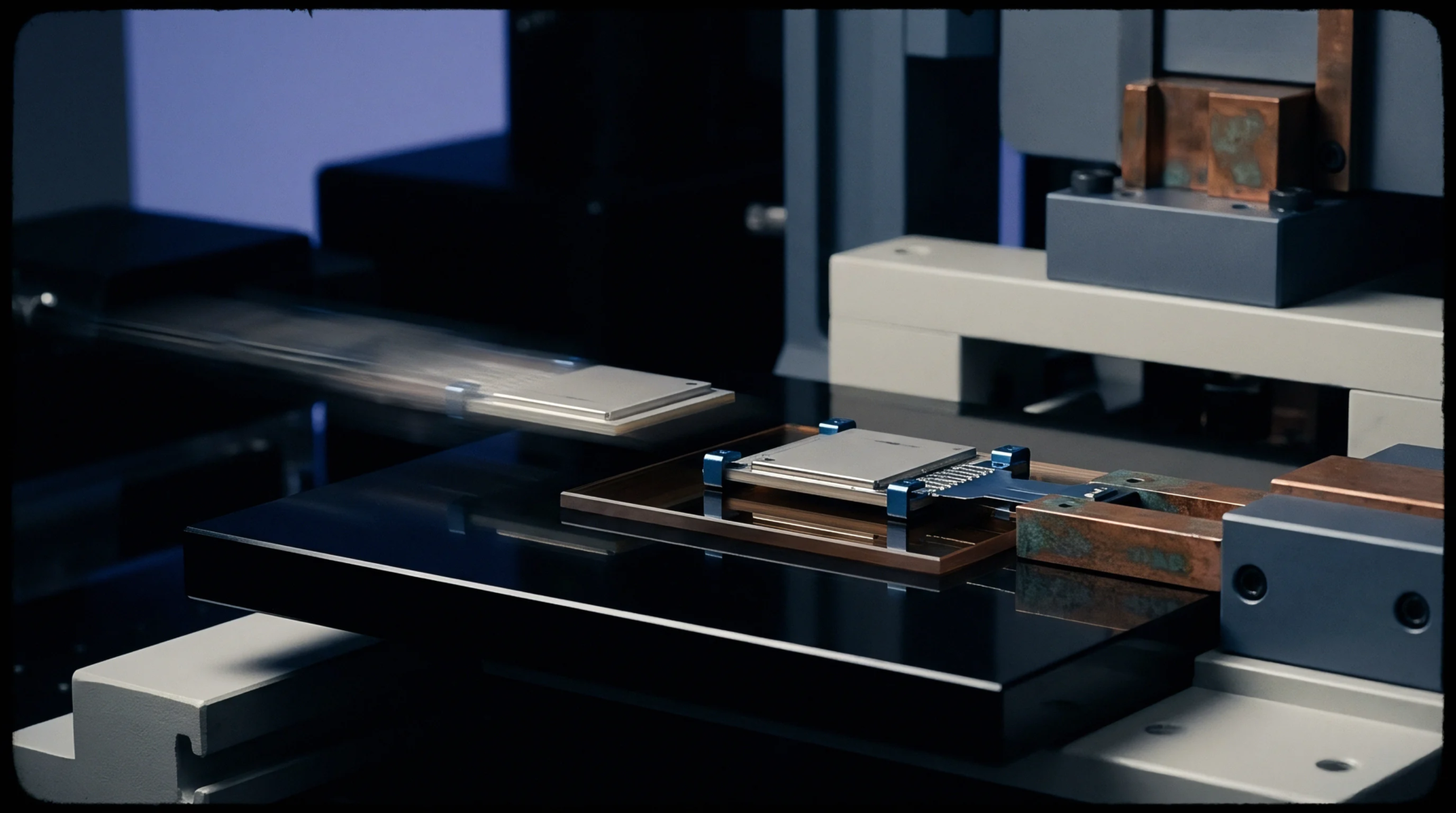
Specialized electromechanical docking assemblies position instrumentation electronics directly against wafer probers or device package handlers to minimize signal path degradation during automated semiconductor qualification. Inside high-speed verification cells, the automated test head acts as the physical bridge containing pin electronics, precision drivers and local power resources. Its boundary terminates at the device under test contact interface, excluding the remote chiller loops or the mainframe host controller.
Signal Integrity
High-frequency digital lines and sub-nanosecond clock paths experience severe dielectric attenuation and phase distortion when routed across long coaxial cabling. Docking an automated test head directly over the handler socket eliminates secondary reflections by shortening connection runs to mere centimeters. Controlled impedance traces on the integrated load board maintain uniform 50-ohm characteristic matching straight into receiver pins.
Precision spring pins complete the mechanical path under calibrated downward pressure.
Thermal Loading
Internal cooling manifolds circulate liquid coolant or forced chilled air across densely packed channel cards to evacuate heat produced by dozens of parallel pin electronics channels. High-density radio-frequency test vectors push power dissipation beyond several kilowatts across a compact cubic meter chassis. Structural thermal expansion within the automated test head must remain below micrometric thresholds to prevent contact misalignments over extended multi-hour test cycles.
Temperature sensors distributed across internal pin boards report real-time readings back to the system console to avoid thermal drift during sensitive analog measurements.
Production Handover
Factory validation protocols require documented mechanical coplanarity certification alongside electrical ground-plane resistance checks before releasing equipment to the active assembly floor. Operators calibrate the automated test head using dedicated loopback diagnostic boards that verify contact pin resistance and signal loop delays against factory acceptance parameters. Handover certificates catalog pin planarity deviations alongside receiver channel noise floors under full load conditions.
Maintenance schedules enforce periodic replacement of worn pogo interfaces based directly on actuation counter logs recorded during functional runs.