Meaning
Direct galvanic measurement methods quantify radio transceiver performance through temporary or permanent coaxial interfaces without radiated air-interface propagation. The conducted radio frequency test separates intrinsic transceiver output, spectral purity, and receiver front-end sensitivity from antenna radiation efficiency and enclosure reflections. Boundaries stop at the physical edge of the radio frequency board connector or detuned switch port, leaving free-space propagation and housing interactions to over-the-air evaluations.
Fixture Interface
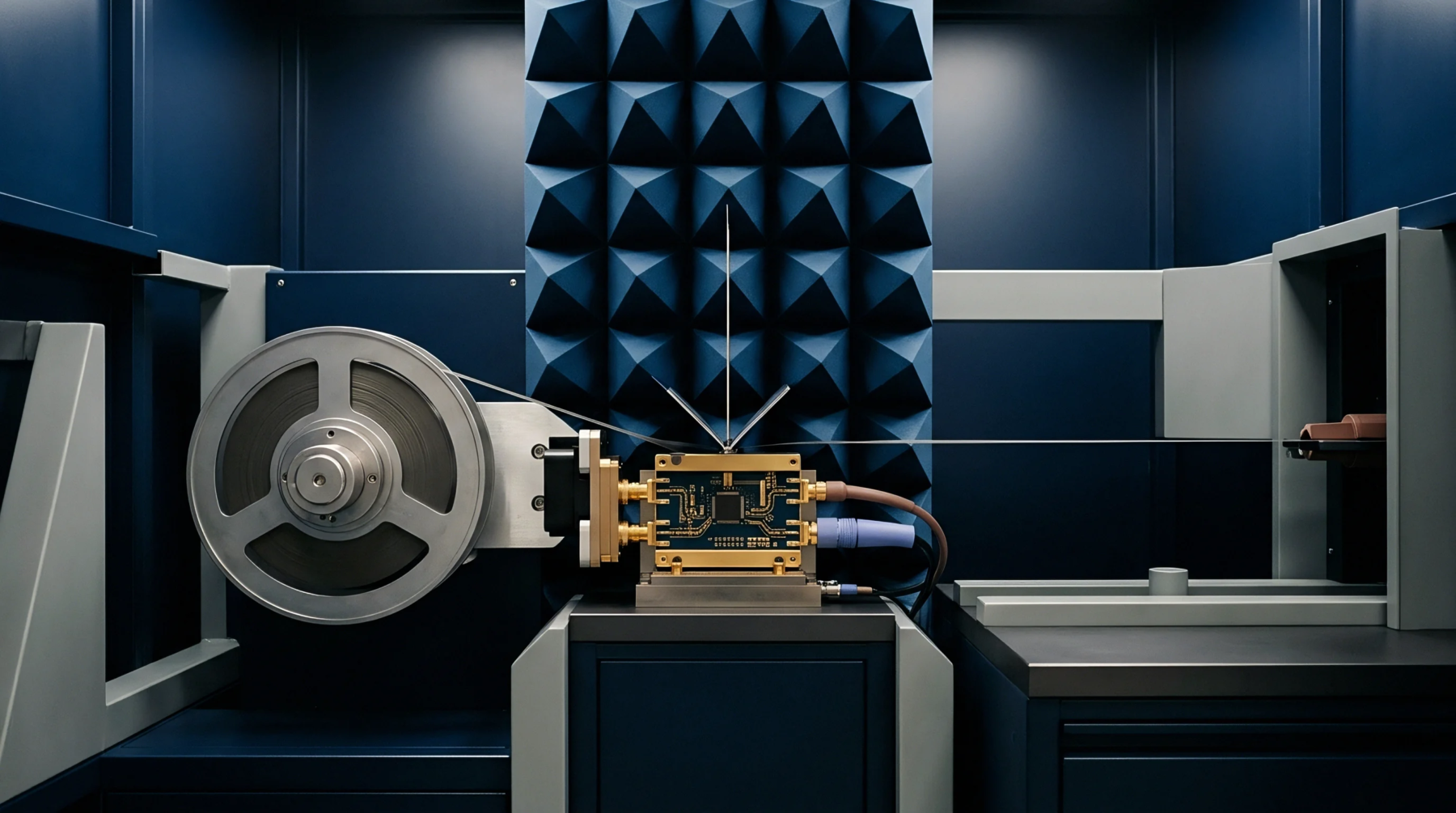
Mechanical coupling uses fifty-ohm micro-coaxial connectors, calibrated switch probes, or edge launches soldered onto development printed circuit boards. Connecting through a conducted radio frequency test bypasses multipath loss, internal antenna detuning, and ground plane parasitics caused by neighboring battery packs. Attenuation values of test cables and inline pads undergo continuous vector network analyzer calibration to transfer measurement planes directly to the transmitter output pin.
Measurement Sequence
Automated signal analyzers capture fundamental power profiles alongside adjacent channel leakage ratios and harmonic distortion across nominal power levels. Digital baseband emulators simultaneously inject modulated waveforms across step-down attenuators to record bit error rates and packet error rates against calibrated input thresholds. Thermal chambers subject the connected assembly to voltage extremes and operational temperatures between negative forty and positive eighty-five degrees Celsius.
Variations in raw baseband output power reveal phase noise degradation, power amplifier saturation, and local oscillator frequency drift across operational bands.
Handover Deliverable
Factory test records and integration approvals compile the resulting spectral masks into formal engineering verification test reports. A fully documented conducted radio frequency test establishes baseline radio performance before enclosure integration complicates troubleshooting. Unaltered coaxial results form the reference dataset against which subsequent radiated power losses are benchmarked.