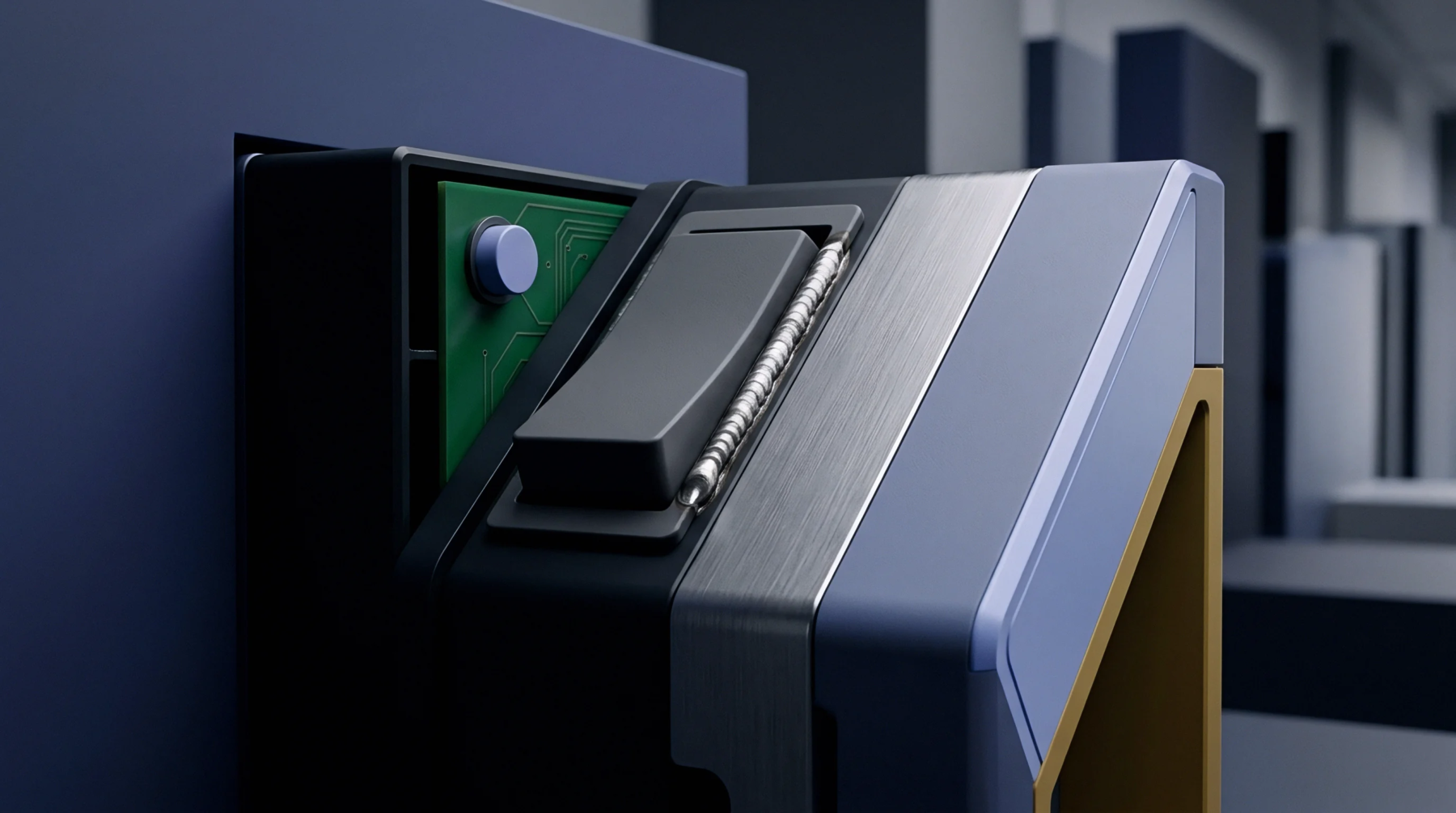
Quantifying Gate Land Erosion Rates in Powder Metallurgy Mold Inserts
Optical profilometry tracking of gate land recess under abrasive feedstock flow bounds replacement cycles and prevents cavity packing imbalance.
Uniformity of melt flow distribution across multi-cavity or multi-gate injection mold feeding systems ensures identical filling times, pressures, and temperatures at every cavity entrance. In multi-cavity tooling for device internal clips, connector housings, and audio enclosures, runner balance establishes process consistency between all parts produced within a single machine cycle. Balanced delivery demands equal flow lengths, identical channel diameters, and symmetrical branching angles to enforce matched pressure drops through the manifold.
Imbalances lead to uneven cavity packing, causing part weight discrepancies, localized flash, and variable part shrinkage. This hydrodynamic requirement covers the melt delivery conduit network from the machine nozzle tip down to the individual cavity gates, ending where the resin passes into part cavities.
Geometrically balanced runner layouts split flow paths through symmetrical branches of equal length and cross-sectional profile. Even within geometrically balanced cold runner systems, melt shear heating generates an asymmetrical temperature distribution that drives hotter polymer into specific downstream branches. Shear-induced thermal stratification causes outer cavities to fill at different rates than inner cavities despite identical branch dimensions.
Specialized runner designs mitigate this imbalance by employing melt rotation technologies that invert thermal layers between successive splits. Proper diameter stepping along primary, secondary, and tertiary runners maintains consistent flow velocity while avoiding excessive hydraulic pressure drops across the feed network.
Cavities filling prematurely experience prolonged packing pressure, resulting in elevated part density, reduced dimensions, and ejection pin binding. Lagging cavities experience insufficient packing, which promotes sink marks over structural ribs, internal voids, and low mechanical strength. For multi-cavity connectors hosting sub-millimeter pin arrays, these dimensional shifts alter critical pitch tolerances across parts molded in the same shot.
Balancing runners directly narrows the processing window requirement, permitting lower clamping forces and preventing machine over-pressurization. Thermal variation along hot runner manifolds requires multi-zone thermocouple regulation to preserve balanced melt viscosity across every gate drop.
Verification protocols use short-shot progression testing to measure runner delivery balance across every cavity in the tool base. Technicians inject a series of incomplete parts at five to ten percent filling increments, documenting the simultaneous arrival of melt fronts at each gate. Scale measurements taken on individual short-shot cavities verify that fill percentages remain within a five percent bandwidth across the mold.
Flow balancing charts, runner layout schematics, and short-shot image sequences form mandatory exhibits within mold acceptance packages. Process engineers sign the final runner balance certificate only after full-pack cycles produce finished components whose weights and key dimensional measurements clear statistical capability hurdles.
Optical profilometry tracking of gate land recess under abrasive feedstock flow bounds replacement cycles and prevents cavity packing imbalance.
Expertise is a utility, not a secret. sentiention™ publishes its working knowledge as open reference: intelligence layer covering the materials it sources, the markets it enters, and the reference that serves both.