Meaning
Field propagation structures in which both electric and magnetic field vectors remain completely perpendicular to the longitudinal direction of travel govern primary signal transmission across coaxial and balanced planar lines. In transmission media supporting the transverse electromagnetic mode, wave propagation occurs without a longitudinal component of electric or magnetic energy along the axis of travel. Coaxial cables, parallel plate waveguides, and ideal striplines sustain this fundamental mode down to direct-current zero-frequency limits.
The absence of cutoff frequencies allows non-dispersive signal propagation across wide frequency bands, preserving signal pulse shapes. This propagation mode stops existing when boundary constraints introduce longitudinal field vectors, forcing conversion into transverse electric, transverse magnetic, or hybrid propagation states.
Waveguide Propagation
Uniform dielectric media enclosed by two isolated conductors provide the boundary conditions required to sustain fundamental TEM fields. Signal velocity along lines operating in the transverse electromagnetic mode depends solely on the permeability and permittivity of the surrounding insulating substrate. High-frequency signals maintain predictable phase relationships because propagation speed remains constant across all spectral frequencies below high-order mode cutoff points.
In contrast to hollow waveguides, multi-conductor systems transmit signals without a lower frequency cutoff boundary. Maintaining physical conductor spacing uniformity preserves the pure transverse orientation of passing wavefronts.
Coaxial Cable Performance
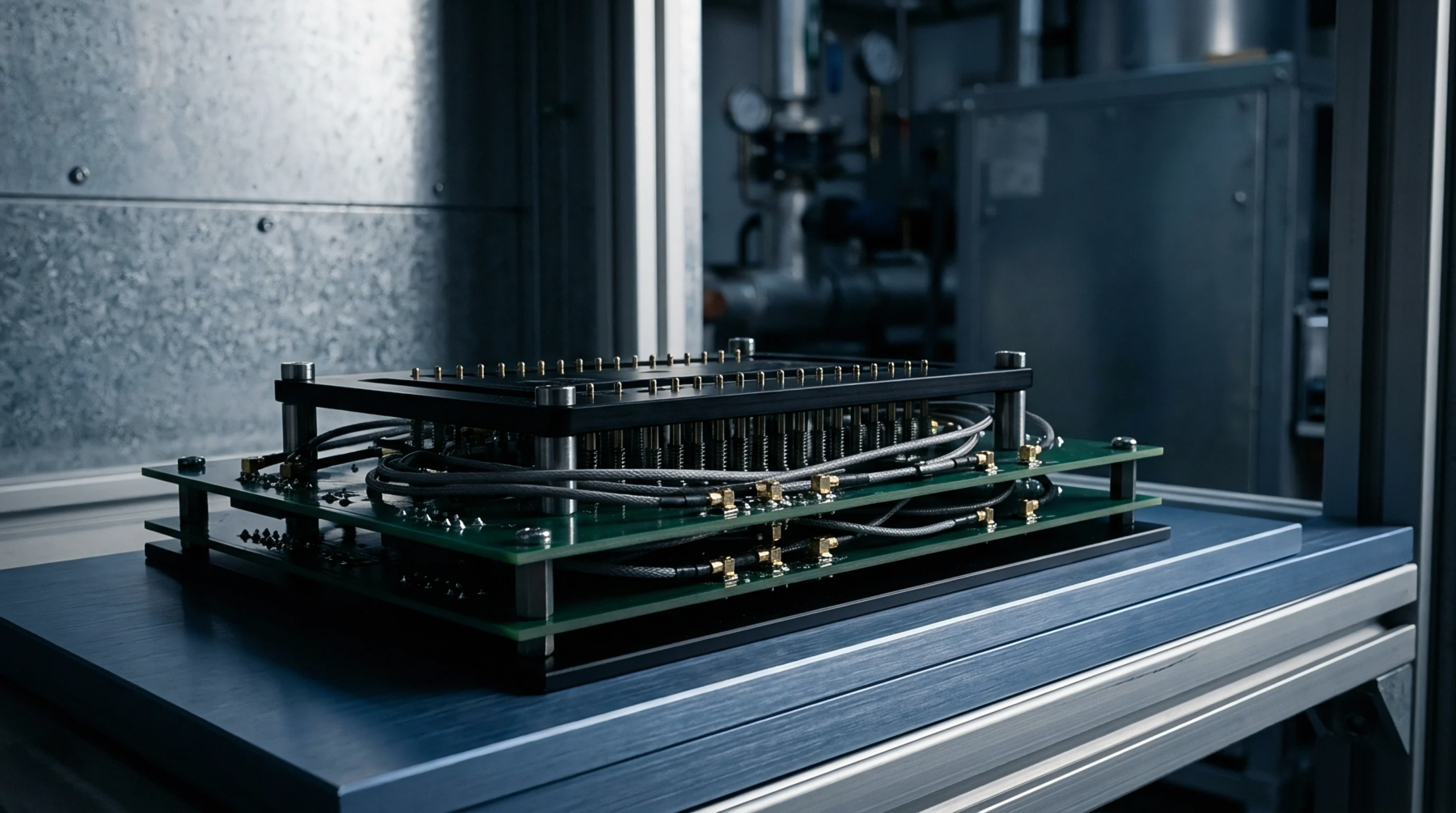
High-frequency signal routing within connected devices utilizes miniature coaxial cables to route radio frequency signals between modules and internal antennas. Discontinuities in cable manufacturing, like dielectric eccentricity or outer braid deformations, disrupt uniform field lines and introduce unwanted high-order transmission modes. Operating coaxial interconnects below their higher-order mode cutoff frequencies ensures that the transverse electromagnetic mode remains the sole operational transmission mechanism.
Cable assembly connectors must match characteristic impedances precisely to prevent reflection-induced standing waves. Proper termination safeguards communication links against phase distortion and insertion loss spikes.
RF Link Verification
High-frequency validation procedures demand vector network analyzer measurements to verify insertion loss and phase stability across all radio frequency cable assemblies. Laboratory test protocols check for high-frequency mode generation caused by poor connector pin alignment or abrupt cable bending radius limits. Discrepancies in signal delay or return loss point to local transmission mode degradation that alters impedance boundaries.
Test data logs document voltage standing wave ratios across target operating frequency bands to confirm signal integrity. Final interface qualification ensures low-loss connection between transceiver output ports and system antenna arrays.