Implementing Cryptographic Verification for Automated Test Jig Calibration Records across Regional Manufacturing Facilities
Cryptographic verification locks test jig calibration records to hardware security modules, preventing record falsification across regional contract factories.


Bench
Measurement accuracy across regional automated test lines hinges on regular instrument calibration. If a digital multimeter, RF power sensor, or programmable load drifts past nominal tolerance, the station quietly passes devices with undetected parametric faults. Protecting these offset values means anchoring a hardware root of trust directly on the test jig interface board instead of trusting records in a software database.
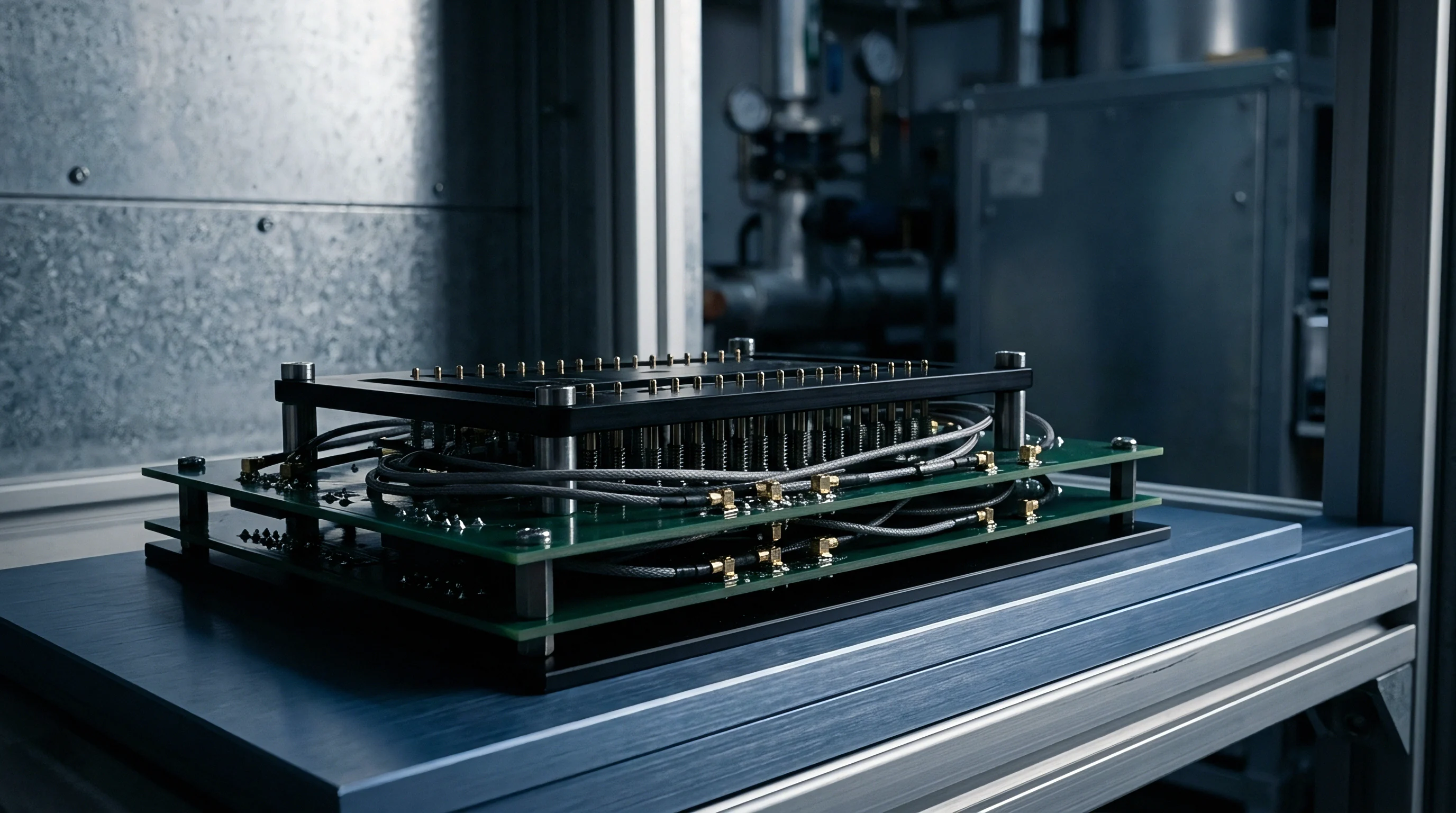
Dedicated chips like the Microchip ATECC608B or NXP SE050 supply tamper-resistant key storage and elliptic-curve cryptographic acceleration right on the fixture.
During initial bring-up, the fixture controller generates an asymmetric key pair. The private key stays locked inside the secure element silicon, out of reach of bench technicians and host operating systems alike, while the matching public key gets enrolled in the enterprise PKI during fixture commissioning. Calibration routines then apply certified reference signals to the fixture pins, derive offset coefficients, and write those values into secure element flash memory alongside an incremental operational counter.
The fixture interface isolates measurement circuitry from host PC interference. When a calibration run begins, an internal state machine samples raw ADC values, applies factory temperature compensation curves, and builds the record payload entirely inside the secure memory boundary.
| Parameter | TPM 2.0 (SPI/I2C) | Secure Element (ATECC608B) | Smart Card IC (ST33) |
|---|---|---|---|
| Interface Bus | SPI or I2C | I2C or SWI | ISO 7816 or SPI |
| Key Storage Capacity | 32 KB NVRAM | 16 Slots (10 KB) | 64 KB Secure Flash |
| Asymmetric Curves Supported | RSA-2048, ECC P-256 | ECC P-256, Ed25519 | RSA-4096, ECC P-384 |
| FIPS 140-3 Level Rating | Level 3 Physical | Level 3 Physical | Level 4 Physical |
| Unit Price (1000-unit lot) | USD 2.85 | USD 0.78 | USD 1.45 |
| Provisioning Overhead | High (Stack Config) | Low (I2C Commands) | Medium (APDU Scripts) |
Calibration drift degrades production yields well before a test fixture fails outright. On an RF test socket, even a slight shift skews parametric yield data without ever tripping a hardware alarm on the station host controller.
A 0.15 dB calibration drift on an RF test socket alters yield figures by 4.2 percent across 100,000 units.
To prevent tampering on the bench, the embedded microcontroller binds each measurement to a hardware timestamp sourced from an isolated local time server. Host software cannot falsify this timing: the secure element signs the composite payload ~ calibration offsets, timestamp, fixture serial number, and cycle counter ~ before transmitting anything over USB or Ethernet.
Unprotected calibration files invite trouble during production crunches, when line operators face pressure to bypass adjustment procedures. If automated test equipment accepts unsigned plain-text offset tables, a technician can adjust numbers by hand to squeeze marginal boards past acceptance thresholds. That falsifies factory yield data and ships latent defects straight into customer supply chains.

Stamp
Before sensor logs can be signed, they need to be converted into deterministic binary payloads. Test jigs serialize raw calibration readings into standardized structures like Concise Binary Object Representation (CBOR) under RFC 8949 or canonical JSON under RFC 8785. Stripping arbitrary whitespace, sorting keys lexicographically, and enforcing consistent floating-point representations ensures that the same calibration dataset always yields the exact same byte sequence for hashing.
Signing runs entirely within the secure element using the private key provisioned during commissioning. The station controller sends the canonical payload digest across the I2C bus to the security chip, which calculates an Ed25519 or ECDSA secp256r1 signature over the SHA-256 digest and returns a 64-byte array. Packaging this signature with the canonical payload and the fixture public key certificate produces an immutable record envelope.

Binary Record Envelope Structure
Take a four-channel data acquisition jig logging DC offset calibrations. Its raw measurement record holds zero-point offsets in millivolts for channels C0 through C3, ambient temperature in Celsius, an operational cycle count, and a UTC timestamp. This record must be packed into a deterministic CBOR layout prior to hashing.
The canonical CBOR payload resolves to the following byte sequence, represented in hex notation:
a662633000006263310005626332fffa62633300026474656d701819647365711904d2
Hashing this payload via SHA-256 produces the digest:
e3b0c44298fc1c149afbf4c8996fb92427ae41e4649b934ca495991b7852b855
The onboard Elliptic Curve Digital Signature Algorithm (ECDSA) engine signs this 32-byte digest using the key stored in Slot 0. The resulting signature yields two 32-byte integers, R and S, which attach directly to the CBOR payload along with the fixture certificate fingerprint.
- Canonicalization Drift occurs when host software updates alter field ordering, causing verification failures on valid records.
- Clock Skew Violations cause timestamp discrepancies that trigger automated rejection during enterprise hub ingest.
- Key Memory Exposure occurs when host microcontrollers buffer private keys in unencrypted SRAM during temporary processing.
- Truncated Payload Hashes break signature validation when third-party parsing tools drop trailing zero bytes in floating-point representations.
Any deviation in encoding or key management causes verification to fail downstream.
Section 7.2 of ISO/IEC 17025 invalidates calibration records lacking cryptographic proof of non-repudiation during transport.
Local teams often favor simple checksums or folder permissions to keep software overhead low. Storing password-protected CSV files on local drives might satisfy basic document checklists for ISO audits, but it cannot stop an operator with administrator privileges on the test PC from replacing files outright.

Transit
Network links between offshore assembly facilities and central servers are rarely stable. When contract manufacturing plants face degraded lines or local network drops, test stations need a store-and-forward queue so production can continue logging signed records without dropping data.
Edge Buffering and Local Storage Queues
Edge gateways stage signed calibration packages in an encrypted SQLite database using SQLCipher with AES-256 encryption at rest. Each entry pairs the signed payload and fixture public key with an arrival sequence index. If connectivity to the enterprise repository drops, logging continues uninterrupted, with write-ahead logging and transactional commits protecting queue integrity against sudden power loss.
Once network access returns, the gateway opens an HTTPS REST or MQTT over TLS 1.3 session with the regional broker. Mutual TLS verifies certificates on both sides before payloads move. The queue then drains in first-in, first-out order, streaming records to the enterprise database and retaining unacknowledged entries until delivery confirmation arrives.

What Prevents Local Operators from Overriding Key Store Flags?
Configuration registers are locked at boot using write-once hardware fuses. Blown fuses disable JTAG debugging, prevent flash readback, and restrict key slot commands strictly to authenticated cryptographic operations. Any attempt to alter these parameters requires a full chip erase, destroying the internal private key and immediately invalidating the fixture certificate across the enterprise PKI.
Local non-volatile storage preserves pending records until uplink connectivity is restored.
Technicians cannot reflash firmware to bypass record checks without wiping that hardware key. Swapping out a decommissioned or compromised secure element requires a formal key generation ceremony witnessed by quality engineers, keeping physical hardware changes audited and accounted for.
Enterprise repositories must ingest multi-day backlogs out of order without corrupting time-series calibration trends across the fixture fleet.

Vault
Enterprise PKI manages root authorities and validation services through a three-tier hierarchy: an Offline Root Certificate Authority, Intermediate Factory Certificate Authorities, and individual Test Fixture Certificates. Kept in a data-center Hardware Security Module (HSM), the Root CA issues signatures for regional Intermediate CAs once per year.
Intermediate Factory CAs operate on regional servers, minting operational certificates for individual test jigs. Segmenting the system this way limits exposure: compromising a single factory certificate does not jeopardize the rest of the manufacturing fleet. Revocation updates reach edge gateways within 15 minutes of an incident via Certificate Revocation Lists (CRLs) and Online Certificate Status Protocol (OCSP) stapling.
| PKI Level | Entity Responsible | Key Storage Method | Validity Period | Rotation Cycle |
|---|---|---|---|---|
| Root CA | Corporate Quality Assurance | FIPS 140-3 L3 Network HSM | 20 Years | 10 Years |
| Intermediate CA | Regional Operations Hub | PCIe Board HSM / Cloud HSM | 5 Years | 1 Year |
| Fixture Certificate | Local Manufacturing Jig | Secure Element Silicon | 1 Year | 90 Days |
| Operator Key | Calibration Engineer | Hardware FIDO2/PKCS11 Token | 2 Years | 180 Days |
Inbound calibration envelopes pass through automated validation routines at the central server. The service parses each envelope, hashes the canonical CBOR payload, and tests the signature against the fixture public key. It then traces the certificate chain to the enterprise Root CA and inspects OCSP responses to confirm that neither the fixture nor the intermediate authority has been revoked.
Rotating intermediate signing certificates every 90 days contains the impact of a compromised manufacturing line.
Private keys remain confined to dedicated cryptographic silicon across every tier of the architecture.
Master service agreements increasingly mandate cryptographic verification to satisfy compliance terms. ISO/IEC 17025 clause 7.8.2.1 demands that test records remain unaltered and verifiable throughout their retention lifecycle. Running automated cryptographic checks satisfies audit criteria by establishing clear mathematical proof of provenance and data integrity.

Ledger
Contracts between brand owners and manufacturing partners allocate direct financial liability for out-of-tolerance test equipment. Turnkey integration agreements define deliverables, software licensing, and infrastructure ownership before equipment ships to the floor. Non-recurring engineering (NRE) fees for cryptographic calibration cover secure element board layout, firmware key management, and central verification service deployment.
Setting up a single automated test line incurs distinct hardware and integration expenses. Equipping a regional plant requires dividing upfront engineering labor and component costs across stations.
Budget breakdowns for deploying cryptographic calibration systems typically include:
- Audit the physical key generation ceremony on the factory floor.
- Extract raw cryptographic calibration logs from five test stations.
- Run offline signature verification tools against the enterprise trust root.
- Perform deliberate tampering on sample log files to test automated revocation.
Line modifications and custom tooling drive up integration expenses during early deployment.
These non-recurring engineering fees amortize across the volume of long production runs.
Outfitting a four-station test cell with cryptographic validation runs about USD 28,500 in combined NRE and hardware outlays. Hardware components account for USD 0.78 per secure element chip and USD 450 per station for dedicated provisioning fixtures. Software bring-up, PKI integration, and verification routines take roughly 160 engineering hours billed at USD 125 per hour.
Offshore production facilities routinely reject non-conforming test records when automated validation scripts block batch release.
Automated validation gates hold production lots at the station until every signed envelope clears verification.
Supply agreements must spell out which party absorbs recall costs if station calibration logs fail retrospective audit checks. Defining key ownership in writing avoids jurisdictional disputes during factory handovers and contract transitions.
Ultimately, calibration integrity on the factory floor rests on cryptographic guarantees rather than procedural vigilance.