Calculating Sub-GHz Receiver Guard Windows from Crystal Thermal Drift
Guard windows must compensate for parabolic 32.768 kHz crystal drift to prevent sub-GHz packet loss and excessive battery consumption at thermal extremes.
Offset
Duty-cycled sub-GHz transceivers rely on low-power real-time clock oscillators to keep sender and receiver synchronized across sleep cycles. When a sensor node sleeps for tens of seconds or minutes at a time, frequency variation in its reference quartz crystal shifts packet arrival times. Uncompensated timing drift forces the receiver to open its RF front-end early or hold it open past the nominal packet boundary.
Low-power sleep timing generally relies on 32.768 kHz or AT-cut tuning-fork crystals. A standard 32.768 kHz tuning-fork resonator responds parabolically to temperature changes, following f(T) = f_0 (1 – k (T – T_0)^2), where f_0 is the nominal frequency at turnover temperature T_0 (typically 25 degrees Celsius) and k is the parabolic curvature coefficient, usually specified between 0.030 ppm/C^2 and 0.040 ppm/C^2. At room temperature, frequency error is mostly a matter of initial manufacturing tolerance, which spans plus-or-minus 10 ppm to plus-or-minus 50 ppm depending on binning.
Move away from 25 degrees Celsius, however, and quadratic thermal drift quickly dwarfs that baseline tolerance.
| Operating Temperature (C) | Thermal Deviation Delta T (C) | Parabolic Shift (ppm at k=0.034) | Initial Tolerance (ppm) | Worst-Case Total Deviation (ppm) |
|---|---|---|---|---|
| +25 | 0 | 0.0 | ±20.0 | ±20.0 |
| 0 | -25 | -21.25 | ±20.0 | ±41.25 |
| -20 | -45 | -68.85 | ±20.0 | ±88.85 |
| -40 | -65 | -143.65 | ±20.0 | ±163.65 |
| +60 | +35 | -41.65 | ±20.0 | ±61.65 |
| +85 | +60 | -122.40 | ±20.0 | ±142.40 |
An outdoor sub-GHz node operating at -40 degrees Celsius drops 143.65 ppm below nominal frequency from parabolic drift alone. Factoring in a 20 ppm initial tolerance brings total single-node offset to 163.65 ppm. If a transmitter sits indoors at +25 degrees Celsius while the receiver is outside at -40 degrees Celsius, link timing suffers from both receiver thermal shift and transmitter calibration error, driving combined clock skew to 183.65 ppm.
At an operating temperature of -40 degrees Celsius, a standard 32.768 kHz tuning-fork crystal introduces 143.65 ppm of thermal frequency error beyond its room-temperature manufacturing tolerance.
Crystal datasheets often present frequency tolerance as a single flat figure measured strictly at 25 degrees Celsius, while timing failures in extreme environments are frequently blamed on improper PCB load capacitance matching rather than off-ambient thermal degradation.
Span
Determining the receiver guard window requires combining all independent error sources into a total time uncertainty budget. Guard length T_guard is the window during which the RF front-end stays active to capture an incoming preamble pulse. This calculation has to account for transmitter and receiver sleep clock drift, hardware timer resolution, lifetime crystal aging, and oscillator startup latency.
Maximum time drift Delta t between two unsynchronized nodes over sleep period T_sleep uses the summation formula: Delta t = T_sleep (PPM_tx_total + PPM_rx_total) 10^-6 + t_quant + t_startup. The combined parts-per-million term merges initial calibration error, parabolic thermal drift over the operating temperature range, and cumulative crystal aging.
The following parameters illustrate timing calculations for an asynchronous sub-GHz node in the 915 MHz ISM band with a 10-second sleep interval:
Worked Parameter Assumptions
Transmitter nominal temperature: +25 degrees Celsius. Transmitter total clock deviation PPM_tx_total: 20 ppm initial tolerance + 5 ppm aging over 5 years = 25 ppm.
Receiver temperature environment: -30 degrees Celsius. Thermal delta relative to turnover: -55 degrees Celsius. Receiver parabolic drift: 0.034 (-55)^2 = 102.85 ppm.
Receiver initial tolerance: 20 ppm. Receiver 5-year aging: 5 ppm. Receiver total clock deviation PPM_rx_total: 127.85 ppm.
Timer tick resolution t_quant: 1 clock tick of 32.768 kHz crystal = 30.52 microseconds. Receiver synthesizer startup delay t_startup: 250 microseconds.
- Calculate combined link frequency error in ppm: PPM_link = 25.0 + 127.85 = 152.85 ppm.
- Calculate total accumulated time drift across sleep interval: Delta t_drift = 10.0 seconds 152.85 10^-6 = 1.5285 milliseconds.
- Add timer quantization error and startup overhead: Delta t_max = 1.5285 ms + 0.0305 ms + 0.2500 ms = 1.8090 milliseconds.
- Determine receiver guard window symmetrical padding: To ensure reception when packet arrival skews early or late, the receiver wakes up Delta t_max prior to expected nominal packet arrival and stays awake until Delta t_max after nominal arrival, yielding a total guard window T_guard = 2 Delta t_max = 3.618 milliseconds.
With transmitter preamble length fixed at 2.0 milliseconds, a 3.618 millisecond guard window guarantees packet capture, but requires listening 1.81 times longer than the preamble duration. Extending sleep intervals to 60 seconds under these same thermal conditions scales Delta t_drift linearly to 9.171 milliseconds, expanding required guard duration to 18.903 milliseconds.
Opening a receiver guard window without factoring low-temperature quadratic crystal drift results in complete packet loss when ambient temperature drops below minus twenty degrees Celsius.
Cutting guard window duration to save receiver current compromises link reliability, causing packet loss whenever temperature shifts drive crystal frequency past the expected timing boundary.

Slot
Channel access mechanisms dictate how guard windows interact with physical preamble structures. Synchronous sub-GHz protocols, such as IEEE 802.15.4g time-slotted channel hopping or LoRaWAN Class B ping slots, rely on periodic network beacons to resynchronize node clocks. Sleep duration, preamble length, and beacon interval determine whether standard crystals can maintain link reliability without driving guard window energy consumption too high.
Asynchronous wake-on-radio schemes periodically wake the receiver for a short carrier sense window T_sense to detect a long preamble from an initiating node. If clock drift shifts receiver timing relative to packet arrival, the receiver misses preamble detection unless preamble length T_preamble equals or exceeds polling interval T_poll plus twice accumulated thermal drift Delta t.

Does Guard Expansion Outweigh TCXO Landed Cost?
Comparing thermal crystal compensation against active receiver energy requires examining power draw during active guard windows. A sub-GHz receiver front-end at 868 MHz draws 8.5 mA from a 3.3V supply (28.05 mW). In sleep mode with the 32.768 kHz oscillator running, draw drops to 1.2 microamps (3.96 microwatts).
Widening the guard window from 1.0 millisecond to 18.9 milliseconds on a 60-second polling cycle raises average receiver current from 1.34 microamps to 3.87 microamps. Over a 10-year deployment, that extra window time consumes 221 milliamp-hours of primary lithium thionyl chloride battery capacity purely to absorb uncompensated crystal drift.
Protocol Integration Requirements
- Preamble Padding Factor The physical layer preamble must be extended by a duration equal to the worst-case single-sided timing drift Delta t to prevent the receiver from missing the synchronization word during early wake-up events.
- Adaptive Synchronization Drift Tracking Sensor firmware must record the timing offset of successfully received packets relative to internal timer ticks and adjust local clock phase to track thermal velocity across consecutive wake-up periods.
- Dynamic Guard Expansion Algorithm Receiver firmware must dynamically recalculate T_guard based on measured on-chip temperature sensor readings, shrinking the window at 25 degrees Celsius and widening it during thermal extremes.
- Slot Margin Allocations Network layer specifications governing scheduled transmission slots must enforce minimum inter-frame spacing gaps that exceed maximum accumulative multi-hop thermal clock skew across the entire network topology.
Under ETSI EN 300 220-1 standards governing sub-GHz European duty cycles, extra preamble duration added for asynchronous wake-up counts directly against maximum allowable transmitter airtime allocations.
Network designs must allocate preamble length equal to twice the maximum calculated clock drift plus the receiver carrier-sense preamble detection time.
Guard window sizing depends strictly on crystal physics, regardless of high-level protocol claims.
Chamber
Validating receiver guard window calculations requires empirical testing in an environmental chamber. RF test setups should evaluate packet error rate across the product’s full operating temperature range while ramping temperature to simulate rapid environmental changes.
Bench testing crystal timing only at static room temperature hides quadratic drift. Thermal ramp testing subjects the board to temperature gradients from -40 degrees Celsius to +85 degrees Celsius at rates of 1 to 3 degrees Celsius per minute.
Bench Verification Protocol Setup
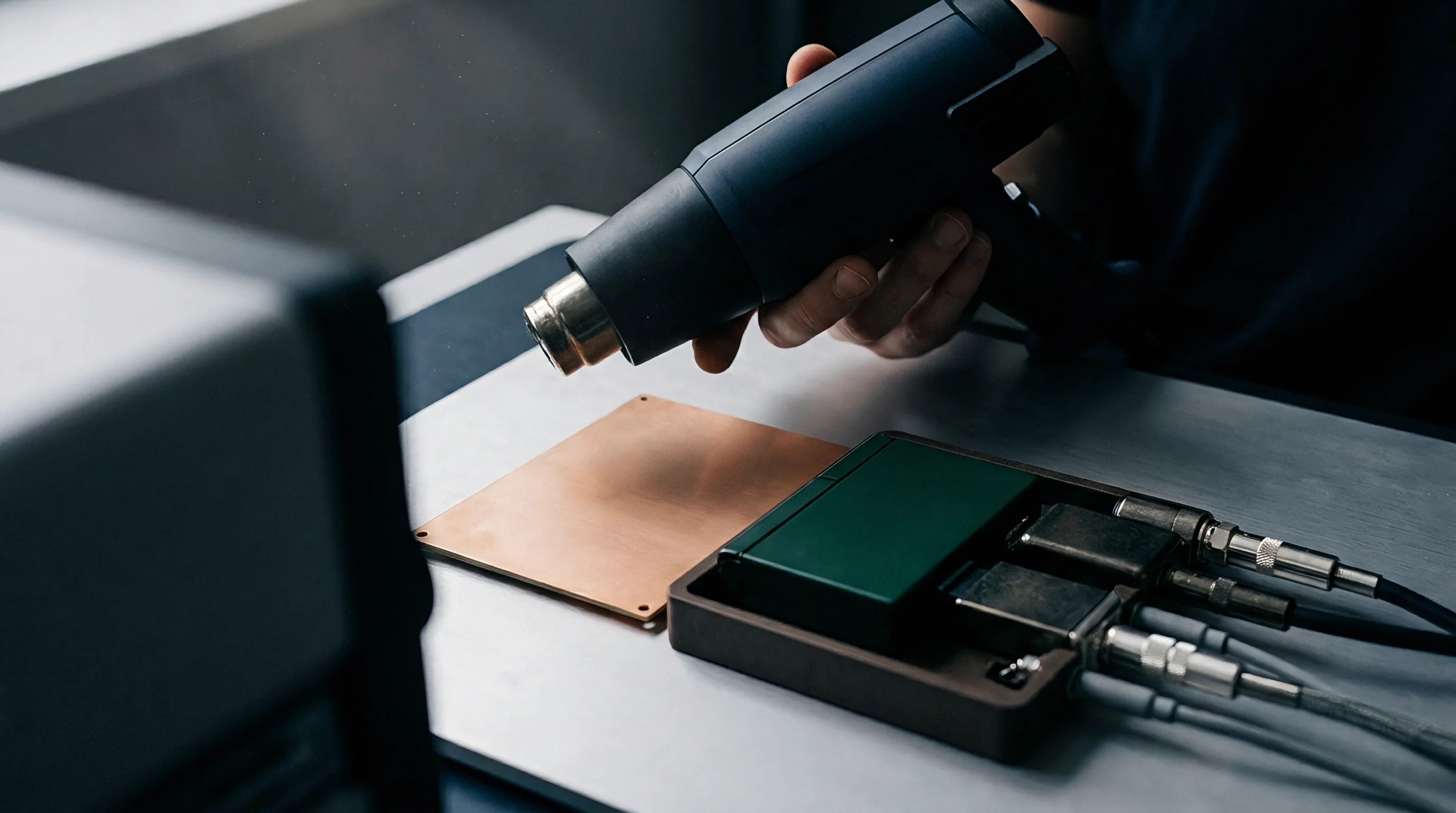
The receiver under test connects to a calibrated vector signal generator through a digital RF attenuator offering 100 dB of path loss control. Firmware on the device outputs sleep-timer wake-up pulses on a dedicated GPIO pin, allowing a logic analyzer to compare wake timing directly against signal generator packet transmissions.
Packet error rate is logged at 5-degree temperature intervals across the test profile, while artificial clock offsets introduced by the signal generator verify guard window margins near the edges.
Thermal Chamber Verification Failure Modes
- Parabolic Slope Excursion Standard tuning-fork crystals exceeding specified curvature coefficients cause receiver wake-up pulses to fall outside the guard window prior to reaching minimum target temperature thresholds.
- Capacitor Thermal Coeffcient Shift Ceramic load capacitors fabricated with dielectric materials rated below C0G or NP0 drift across temperature, altering total circuit load capacitance and shifting crystal turnover temperature away from 25 degrees Celsius.
- Parasitic Trace Capacitance Drift PCB substrate dielectric constant changes over temperature, introducing unmodeled load capacitance variations that exacerbate frequency offset.
- Frequency Skew Lock Failure Receiver baseband phase-locked loop tracking algorithms fail to acquire frequency lock when differential thermal offset between transmitter and receiver exceeds receiver channel filter bandwidth.
Thermal gradients detune reference clocks, causing radios to drop packets when wake windows fail to overlap.
Testing board assemblies under 2 degrees Celsius per minute thermal ramp conditions surfaces load capacitor dielectric shifts that static temperature soaks mask completely.
How does localized board self-heating from power management circuitry skew the effective turnover temperature of adjacent sleep crystals during high-duty-cycle transmission bursts?
Toll
Managing receiver timing drift involves trade-offs between bill-of-materials cost, board space, and battery life. Design choices generally span uncompensated AT-cut crystals, standard 32.768 kHz tuning-fork resonators, digital temperature-compensated crystal oscillators (DTCXOs), or integrated sub-GHz SoC real-time clocks with thermal calibration routines.
A temperature-compensated crystal oscillator eliminates parabolic drift by sampling internal temperature and updating a capacitive tuning array every few seconds. Maintaining stability within plus-or-minus 2.0 ppm to plus-or-minus 5.0 ppm from -40 degrees Celsius to +85 degrees Celsius removes the need for thermal guard window expansion.
| Oscillator Topology | Unit Cost at 10k Volume (USD) | -40C to +85C Stability (ppm) | 60s Sleep Guard Window (ms) | Continuous Supply Current (uA) | 10-Year Battery Impact (500mAh Cell) |
|---|---|---|---|---|---|
| Standard 32.768 kHz Crystal | $0.12 | ±165.0 | 19.80 | 0.90 | 221 mAh consumed by guard padding |
| High-Precision AT-Cut Crystal | $0.28 | ±50.0 | 6.00 | 1.10 | 67 mAh consumed by guard padding |
| Ultra-Low-Power DTCXO Component | $0.75 | ±3.5 | 0.42 | 1.45 | 5 mAh consumed by guard padding |
| SoC Internal Calibrated RC Oscillator | $0.00 | ±500.0 | 60.00 | 0.40 | 670 mAh (Battery depleted < 5 years) |
Spending an extra $0.63 per unit on a DTCXO reduces 10-year guard-window energy consumption from 221 mAh to 5 mAh. On an industrial sensor powered by a CR2032 coin cell (220 mAh nominal capacity), timing uncertainty alone with a standard crystal depletes the battery before reaching target operational life, whereas a DTCXO leaves capacity for measurements and transmissions.
Specifications for sub-GHz connectivity modules should explicitly include temperature-dependent timing drift limits in supplier qualification requirements.
Component supply agreements often specify that delivered crystals maintain parabolic temperature coefficients between 0.030 ppm/C^2 and 0.038 ppm/C^2, with incoming lots rejected if turnover temperature offsets exceed plus-or-minus 3 degrees Celsius from 25 degrees Celsius.