Modelling Primary Battery Capacity Amortisation against Dynamic Roaming Network Timer Restrictions in Field Deployments
Dynamic roaming timer restrictions compress cellular power saving intervals, requiring autonomous module detach logic to halt accelerated primary cell depletion.


Impedance
Primary lithium cells suffer sharp voltage drops when transmission bursts hit internal passivation films. A bobbin-type lithium thionyl chloride cell offers high theoretical gravimetric energy density over a ten-year deployment horizon, but the passivating lithium chloride layer restricts instant current output to tens of milliamperes. By contrast, LTE-M and NB-IoT transmitters draw peak pulses between 400 and 550 milliamperes at 23 dBm output power.
Marrying this low-drain chemistry to a cellular transceiver requires bridging the gap with a hybrid layer capacitor or moving to a spiral-wound cathode.
Field hardware counts on sleep windows of hours or days to let the cathode recover and restore open-circuit potentials above 3.6 volts. Connecting through a visited terrestrial carrier upsets this balance. The visited public land mobile network often denies requested tracking area updates, overrides negotiated power-saving timers, and forces the module into active listening.
The transmitter stays up while hunting across unfamiliar radio frequency bands, sweeping power amplifiers over channel rasters, and running authentication handshakes. These extended transmit cycles drain the rail until it sags past the baseband power-management cutoff.
A 100-millisecond RF burst at 23 dBm output drops an unbuffered bobbin cell rail below the 2.7-volt silicon brownout cutoff at minus twenty degrees Celsius.
Internal resistance rises steeply as temperature drops and cathode material is consumed. At twenty degrees Celsius, a fresh cell typically shows an equivalent series resistance near ten ohms; cool it to minus thirty degrees Celsius and resistance climbs past eighty ohms. Voltage sag across this impedance starves the transceiver during physical random access channel transmissions, tripping microcontroller brownouts.
Each reset forces the modem through another full boot, radio stack initialization, and an unprompted band scan.
Sudden field collapses are frequently treated as environmental anomalies rather than structural mismatches between carrier radio timers and electrochemical delivery ceilings.


Steering
Roaming agreements govern how visiting subscriber identity modules move across regional networks, with core-level steering mechanisms tuned to limit settlement costs between carriers. When a remote sensor wakes to transmit telemetry, the local radio access node checks the international mobile subscriber identity against priority partner lists. If the device attempts to attach to a non-preferred network, the core returns an explicit registration rejection that kicks off a new search.

Where Do Carrier Timers Override Module Sleep?
Tracking area update intervals and connected-mode standby timers are defined in Third Generation Partnership Project specifications such as TS 24.008 and TS 24.301. The periodic tracking area update timer, T3412, dictates how long a device can sleep before checking in with the core network. The active timer, T3324, governs how long the terminal must monitor the physical downlink control channel after sending data before entering power saving mode.
Devices request these values directly in attach request or tracking area update request information elements.
Visiting networks routinely ignore those requests. Rather than granting a requested 24-hour T3412 sleep window, an operator may return a two-hour timer or disable power saving mode altogether, forcing the device through frequent re-registrations. Serving cells can also stretch active timers well beyond requested bounds, keeping the receiver awake to monitor paging channels for downlink traffic that never arrives.
Disabling power saving mode on a roamed cellular session elevates baseline quiescent current from 3.5 microamperes to continuous 1.8 milliampere discontinuous reception idle.
Steering mechanisms compound the penalty by degrading the connection deliberately. A base station will respond with Evolved Packet System Mobility Management cause code 17 for network failure or cause code 15 for no suitable cells in tracking area, adding that public land mobile network identifier to the SIM’s forbidden list and stalling the modem in an idle state.
Modem firmware then falls back to an unguided raster scan across supported frequencies to find another network. The transceiver sweeps through band 1, 2, 3, 4, 5, 8, 12, 13, 20, and 28, attempting synchronization on each primary and secondary synchronization channel. That search pulls between 80 and 140 milliamperes continuously, often lasting three minutes or longer.
- Cause Code 11 forces the terminal to purge current tracking identities and search foreign radio carriers from absolute frequency channel raster zero.
- Cause Code 14 marks the roamed tracking area invalid, locking the radio modem into iterative band searches until exhausting neighbor cell lists.
- Cause Code 15 banishes the serving carrier from active selection, directing the transceiver to execute high-drain physical layer synchronization across secondary bands.
- Cause Code 17 signals roaming steer rejection, imposing backoff penalties that keep the receiver active while core infrastructure re-routes the subscriber profile.
Carrier timer overrides alter the power profile of remote sensor hardware. The table below compares nominal values configured during provisioning against parameters routinely imposed by roaming networks across North American and European deployments.
| Timer Designation | Device Target Setting | Visiting Carrier Assignment | Physical Radio State | Energy Penalty Factor |
|---|---|---|---|---|
| T3412 Extended | 1440 Minutes (24h) | 54 Minutes (Overridden) | Periodic Attach Wake | 26.6x attach cycling |
| T3324 Active | 2 Seconds | 60 Seconds (Forced) | RRC Connected to Idle | 30.0x receive listening |
| T3412 Standard | Disabled | 30 Minutes (Fallback) | Full System Signaling | 48.0x signaling draw |
| Paging eDRX Cycle | 40.96 Seconds | 2.56 Seconds (Overridden) | Paging Channel Demodulation | 16.0x receiver sampling |
| Scan Backoff Timer | 300 Seconds | Zero Seconds (Immediate) | Continuous Channel Search | Infinite loop risk |
While GSMA PRD IR.73 Annex A advises that roaming profiles honor negotiated terminal sleep parameters, visited carriers retain discretion under interconnect agreements to manage local capacity by altering information elements in Downlink Non-Access Stratum frames.
Shunt
Profiling consumption across wide dynamic ranges demands low-burden test gear. Transceiver load alternates between nanoamperes during deep sleep and half-ampere bursts while transmitting. A standard inline digital multimeter adds enough burden voltage to cause artificial brownouts during those pulses.
Accurate current capture instead requires a calibrated coaxial shunt paired with a high-speed differential digitizer, or an autoranging electrometer using active virtual ground amplification.
Bench tests at room temperature rarely reflect field discharge conditions. In deployment, primary cells sit inside enclosures on concrete pads, utility pits, or exposed pipelines where thermal swings alter electrolyte diffusion rates and cold restricts ion transport. When a visited network cuts T3412 and extends T3324 during freezing weather, the battery takes a double hit: elevated internal impedance coincides with prolonged power amplifier draw.
Third Generation Partnership Project TS 36.521 Section 6.2 dictates a 23 dBm maximum transmitter power, which extracts 520 milliamperes through the battery shunt during band 20 transmission at low voltage.
Evaluating these combined stresses requires a controlled qualification run. The test bench needs to replicate thermal degradation and network signaling behavior before hardware reaches the field.
- Soak the primary battery pack inside an environmental chamber at minus twenty degrees Celsius for twenty-four hours to stabilize internal chemistry.
- Connect the pack to the module test fixture through an calibrated twenty-milliohm shunt resistor terminated into an oscilloscope with high input isolation.
- Attach the transceiver RF port to a cellular base station emulator configured to mirror foreign visiting carrier tracking area update rejections.
- Inject non-access stratum cause code 17 during registration to force the modem into full-band channel raster scanning.
- Record the terminal voltage sag during initial physical random access channel preamble transmissions across low-band allocations.
- Observe whether terminal rail potential drops below the supervisory reset IC threshold before the transceiver receives the downlink radio resource control release.
Microcontroller supervisory circuits trip when transmit sag pulls the supply rail below the brownout threshold, typically set at 2.7 or 2.8 volts. The resulting restart clears temporary non-access stratum state from volatile memory, prompting the modem to repeat registration against the same rejecting cell and compounding the drain.
Passivation films reform during inactive periods. If an unbuffered bobbin cell sits idle for twelve hours between transmissions, the lithium chloride layer thickens, driving up initial impedance for the next burst. If network timers force thirty-minute check-ins, that layer never fully re-establishes; voltage delay diminishes, but cumulative coulombic draw climbs substantially.
Which trade-off extracts a heavier toll over seven years depends heavily on the local temperature profile.

Depletion
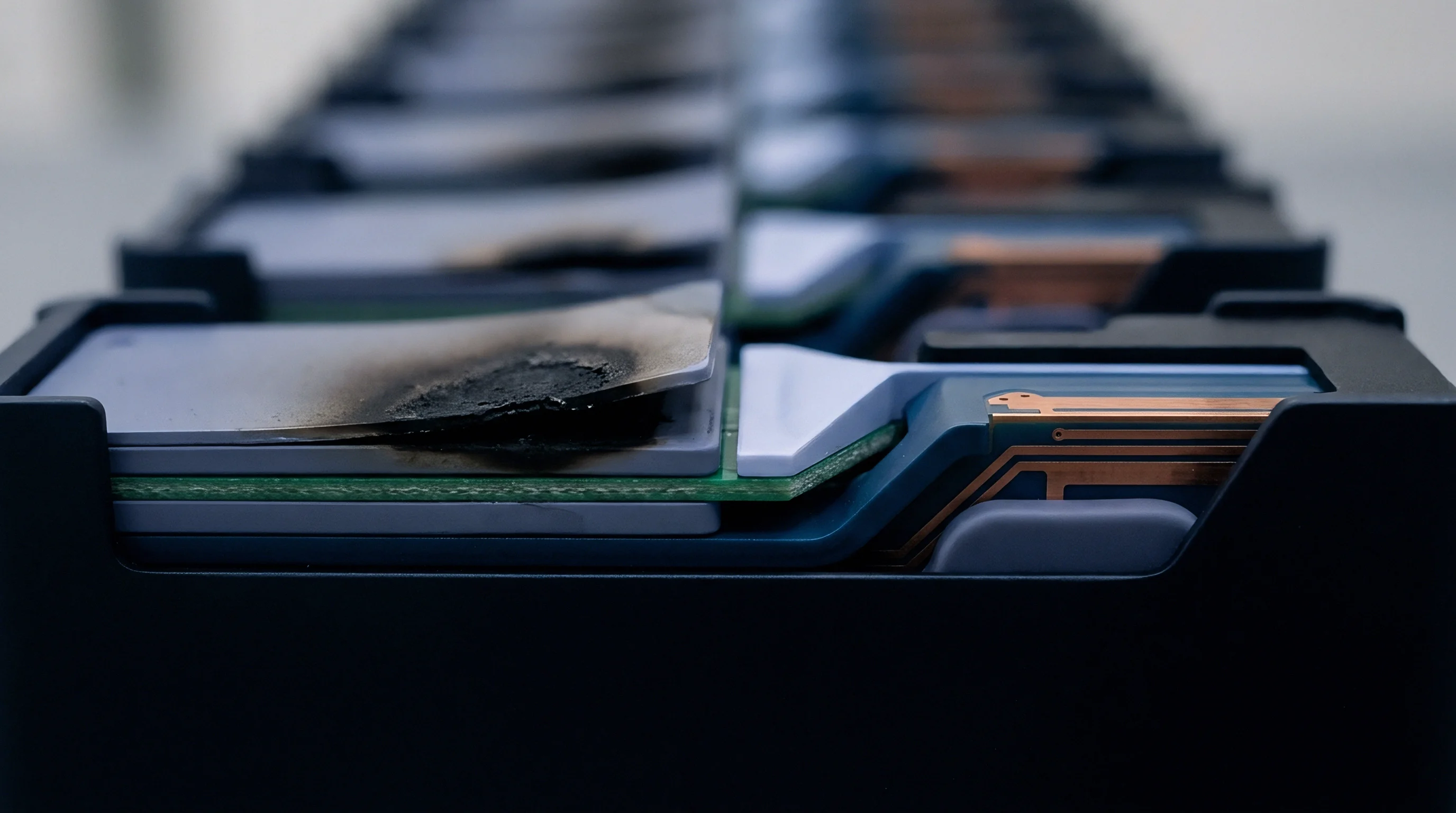
Primary cell depletion rarely matches simple linear subtraction of ampere-hour figures. Lithium chemistries follow discharge curves shaped by Peukert losses, temperature-dependent kinetics, and electrolyte diffusion limits. Datasheet ratings reflect continuous, low-rate drains ~ typically two milliamperes at twenty degrees Celsius down to a 2.0-volt cutoff.
That same cell, rated at 19.0 ampere-hours, often delivers under 11.5 ampere-hours under periodic half-ampere pulses in sub-zero environments.
What Equations Quantify Dynamic Sleep Truncation?
Modeling capacity loss requires separating baseline sleep current from active transmissions and timer-driven signaling overhead. Total consumption across an operating cycle breaks down into several distinct phases.
Total drawn charge corresponds to the integral of current over time, expressed across discrete operating intervals as:
Q_total = (I_sleep T_sleep) + (N_tx Q_tx) + (N_tau Q_tau) + (N_scan Q_scan) + Q_self
Here I_sleep is baseline quiescent current in power saving mode, and T_sleep is total duration in that state. When a visiting network rejects requested T3412 values, T_sleep drops accordingly. Q_tx covers the charge consumed by an application transmission, incorporating radio resource control connection setup, data payload transfer, and the T3324 active monitoring window:
Q_tx = (I_rrc t_rrc) + (I_rf t_rf) + (I_idle T3324)
The term Q_tau accounts for tracking area update overhead. When a network replaces extended T3412 timers with standard short intervals, N_tau climbs from once a day to dozens of events daily. Each update expends between 15 and 35 millicoulombs depending on link budget and path loss:
Q_tau = (I_rach t_rach) + (I_nas t_nas) + (I_idle T3324)
The term Q_scan accounts for roaming steering rejections, during which the module searches across multiple frequency bands:
Q_scan = I_scan t_scan
An unguided raster search pulling 95 milliamperes for 180 seconds consumes 17.1 coulombs per event. If network policies trigger three steering rejections a week, hunting alone burns roughly 2,667 milliampere-hours per year ~ over twenty percent of a 13-ampere-hour cell’s total capacity.
A single carrier steering loop consuming seventeen coulombs negates the energy savings achieved by two thousand hours of optimized module deep sleep.
Self-discharge (Q_self) accelerates with heat. At twenty degrees Celsius, bobbin lithium thionyl chloride cells lose roughly one to two percent of capacity annually to internal oxidation. At fifty-five degrees Celsius, that figure reaches five percent.
When compressed timers increase transmitter duty cycle, Joule heating across the cell’s internal resistance elevates core temperatures, further driving chemical self-discharge.
The following model estimates usable operational life across various roaming timer scenarios for a sensor sending a fifty-byte message twice a day, powered by a single D-size lithium thionyl chloride cell rated nominally at 13.0 ampere-hours.
| Operational Scenario | Active Timers (T3412 / T3324) | Monthly Scanning Burden | Average Current Draw | Projected Field Lifespan |
|---|---|---|---|---|
| Ideal Domestic Profile | 24 Hours / 2 Seconds | 0 Searches | 14.2 Microamperes | 10.8 Years (Theoretical) |
| Mild Roaming Truncation | 4 Hours / 20 Seconds | 1 Search / Month | 68.5 Microamperes | 6.4 Years |
| Aggressive Carrier Steer | 54 Minutes / 60 Seconds | 4 Searches / Month | 215.0 Microamperes | 2.8 Years |
| PSM Rejection / eDRX Only | Disabled / Continuous eDRX | 8 Searches / Month | 1.24 Milliamperes | 0.7 Years (8.4 Months) |
| Steering Failure Lock | Rejected / Search Loop | Continuous Scans | 18.60 Milliamperes | 0.03 Years (11 Days) |
Specifying battery-powered cellular hardware requires validating roaming profile behavior against discharge models before locking bills of materials. Overlooking non-access stratum timer overrides leads to premature cell exhaustion, leaving remote equipment dark and forcing truck rolls to widely distributed sites.
Exposure
Procuring cellular IoT hardware requires vetting network profile terms alongside the RF front end. Roaming connectivity contracts rarely guarantee core timer behavior; aggregators sell geographic reach while leaving timer negotiation to local operators. When cells deplete prematurely as a result, remediation requires hands-on service in the field.
Procurement specifications need explicit rules for how baseband firmware handles aggressive timer assignments. Rather than deferring unconditionally to network-assigned values, firmware should apply local thresholds to counter timer compression. If a visited network imposes a T3412 interval that endangers the target battery budget, the module can detach completely and enforce an internal sleep cycle before attempting to connect again.
- Autonomous Detach Thresholds decouple the transceiver from aggressive tracking area update schedules by gracefully terminating registration prior to extended sleep.
- Raster Whitelisting Controls restrict the baseband search engine to confirmed operational bands, capping peak current duration during steering rejections.
- Supervisory Brownout Buffers introduce hybrid layer capacitor banks parallel to bobbin cells, absorbing pulse burdens and insulating the core processor from transient sags.
- Fallback Connection Limits prevent unguided continuous attachment attempts by applying exponential backoff limits following non-access stratum rejections.
Verifying these behaviors prior to mass deployment protects against severe operating costs. Hardware qualification should test modules against base station emulators running the non-access stratum rejection codes common to target deployment regions. Replacing dead batteries in industrial field installations quickly erases any initial bill-of-materials savings.
Unrestricted timer overrides will exhaust a primary cell reserve regardless of nominal capacity.