Thermal Frequency Shift in Sub-GHz Low Power Sleep Oscillators
Thermal drift in sub-GHz sleep oscillators forces wider receiver listen windows, multiplying airtime current drain and cutting battery operating lifetime.
Drift
Clamping a calibrated current probe over the power rail of an outdoor sub-GHz transceiver shows the real penalty of timing jitter during cold qualification. At room temperature, a device sleeping for sixty seconds wakes right on time for the gateway’s synchronization beacon. Brought down to minus thirty degrees Celsius inside an environmental chamber, that same board misses the beacon window entirely.
The radio then sits in high-current receive mode for tens of milliseconds hunting for an absent preamble: while sleep current sits at 900 nanoamps, active listening pulls 8.5 milliamps, and the battery budget collapses.
Every sub-GHz radio architecture depends on a low-power sleep clock to keep time while the host processor and high-frequency synthesizer stay powered down. Designers generally choose between internal resistor-capacitor relaxation oscillators, external 32.768 kilohertz tuning-fork quartz crystals, or temperature-compensated crystal oscillators. Each option exhibits a distinct downward frequency shift across temperature that dictates how long the receiver must remain active, and the physical origin of that drift determines how much timing margin firmware designers must allocate against dropped packets.
Parabolic Curves in Tuning Fork Quartz
Standard 32.768 kilohertz crystals use an XY-cut or NT-cut quartz blank with a resonant frequency that follows a second-order polynomial centered near room temperature. The shift follows delta f over f equals minus B multiplied by the square of the difference between operating temperature and turnover temperature, where the parabolic turnover coefficient B lands between 0.030 and 0.042 parts per million per degree Celsius squared around a turnover point of 25°C. Out toward thermal extremes, this quadratic profile drags the oscillator well below its nominal frequency.
At minus forty degrees Celsius, an uncompensated 32.768 kilohertz tuning-fork crystal with a nominal turnover coefficient of minus 0.035 parts per million per degree squared incurs a negative frequency shift of approximately 148 parts per million.
Pushed to eighty-five degrees Celsius, that same crystal drifts low by more than 125 parts per million. Because the thermal coefficient stays negative on either side of the turnover point, tuning forks run slow in severe cold and high heat alike, while the resulting phase noise degrades receiver demodulation. Mechanical mounting strain and aging package seals worsen the offset over years in the field.
When qualifying bare quartz, board layout matters just as much: stray PCB trace capacitance shifts the turnover parabola vertically, introducing static timing error before temperature even moves.
Internal RC Relaxation Inaccuracies
On-chip low-frequency relaxation oscillators eliminate external parts and recover board space, but their thermal stability is far worse than quartz. These circuits set their period by charging and discharging on-chip capacitors through resistors or bandgap-referenced current sinks. As temperature moves, semiconductor sheet resistance and comparator propagation delays shift with it, driving drift rates between 500 and 2,000 parts per million per degree Celsius.
Left uncalibrated across an industrial temperature range, total frequency variation regularly exceeds five percent.
Periodic runtime recalibration limits this error by comparing the low-frequency RC oscillator against a high-frequency crystal reference whenever the radio wakes to transmit. Counter-based trimming locks the frequency to the crystal for a moment, but thermal gradients between wake cycles eat away at the fix. If an outdoor unit sits in a ten-minute sleep while a cold front drops the ambient temperature, the calibrated RC value slips out of sync long before the next cycle.
Window
Synchronous and pseudo-synchronous wireless protocols rely on tight reception apertures to keep battery-powered field devices alive. In LoRaWAN Class B ping slots, Wireless M-Bus bidirectional modes, and IEEE 802.15.4g SUN channel-hopping layouts, nodes sleep through dead air and wake just before a scheduled transmission. If the sleep clock drifts, the receiver wakes out of phase.
Firmware developers have to widen the receive window to catch the packet despite the skew, converting sleep-mode savings directly into active current drain.
| Oscillator Topology | Quiescent Current (μA) | Nominal Drift at -40°C (ppm) | Max Timing Skew per Hour (ms) | Receiver Window Overhead | Unit Cost Adder (USD) |
|---|---|---|---|---|---|
| Internal RC (Uncalibrated) | 0.7 to 1.2 | -35,000 to +50,000 | 180,000 | Continuous or Preamble Scan | 0.00 |
| Internal RC (Calibrated at 25°C) | 1.0 to 1.5 | -8,000 to +12,000 | 43,200 | Extremely Wide (>100 ms) | 0.00 |
| Standard 32.768 kHz Quartz | 0.9 to 1.8 | -140 to -170 | 612 | Moderate (2 to 15 ms) | 0.12 to 0.25 |
| 32.768 kHz TCXO Module | 1.8 to 3.5 | -5 to +5 | 18 | Minimal ( | 0.65 to 1.40 |
| Data reflects typical performance parameters across industrial silicon families operating at 3.0V supply. | |||||
Which Circuit Topologies Minimize Cold Frequency Drift?
Choosing between integrated silicon oscillators and external resonators comes down to trading baseline microamp consumption against discrete timing accuracy. Packaged temperature-compensated crystal oscillators pair an AT-cut or tuning-fork quartz strip with an internal compensation ASIC and temperature sensor, holding stability within five parts per million across the industrial range. That circuitry, however, draws 1.5 to 3.0 microamps of continuous bias current.
By contrast, a standard quartz crystal running on an ultra-low-power inverter stage takes only 500 nanoamps, but loses accuracy rapidly as conditions drop below freezing.
Bipolar-junction thermal tracking circuits integrated into current sub-GHz microcontrollers offer a middle path. The radio sleeps on its baseline quartz resonator while reading an on-die temperature sensor at set intervals. Firmware runs a polynomial to adjust the sleep counter modulus: if the crystal slows by 130 parts per million at minus thirty degrees, the microcontroller adds compensatory clock ticks to the wake comparator register.
That digital correction sidesteps the continuous milliamp overhead of active heating while holding total sleep current under two microamps.
Guard Band Sizing across Protocol Standards
Timing uncertainty equations dictate how many symbols firmware must add to the receiver wake aperture. The formula for bidirectional guard time T guard equals two multiplied by the sleep interval T sleep multiplied by the total ppm tolerance plus the transmitter drift and radio turn-on latency. With long spreading factors or low bitrates, a single symbol period can take several milliseconds.
In a LoRa link running Spreading Factor 12 at 125 kilohertz bandwidth, one symbol spans 32.77 milliseconds, and missing that boundary breaks demodulator synchronization altogether.
- Preamble detection loss occurs when thermal skew shifts the receiver wake point past the transmission preamble into the packet payload area, aborting synchronization immediately.
- Premature receiver timeout causes the node to terminate its listen state and return to deep sleep prior to the arrival of delayed packets from a drifting gateway.
- Channel collision spikes manifest in shared medium access topologies when multiple drifting nodes wake asynchronously and transmit over synchronized beacon periods.
- Buffer overflow cascade develops on repeating router nodes forced to store deferred packets during prolonged link realignment phases.
Underestimating cumulative drift inflates preamble search intervals, exhausting lithium thionyl chloride cells years before mechanical meters reach their planned replacement intervals.
Frost
Outdoor utility meters, agricultural monitors, and pole-mounted transformer sensors regularly face sub-zero cold soak conditions that punish low-power timing circuits. When winter temperatures sit below minus twenty degrees Celsius for weeks at a time, quartz parabolic curves push nodes into their deepest timing offsets. Battery chemistry suffers simultaneously: lithium thionyl chloride and lithium manganese dioxide cells develop higher internal impedance in deep cold, causing the supply rail to sag the instant active modes engage.
A hardware design operating under the EN 13757 standard must maintain synchronization across wide outdoor thermal ranges to prevent premature battery exhaustion.
A drifting sleep clock accelerates cold-temperature battery degradation. When an uncompensated crystal slows by 150 parts per million, firmware widens the listening window to protect link margins, pulling 8 to 15 milliamps from a cell whose effective series resistance has quadrupled in the frost. That voltage drop can trip internal power-on-reset circuits, clearing real-time registers and forcing the node into full network re-joins that burn heavy airtime and deplete reserves.
Sub-Zero Turnover Mechanics
Silicon and quartz respond differently to severe cold. Quartz stiffens, shifting the acoustic velocity across the crystal blank’s cut planes. Board-level load capacitors introduce further drift as their dielectric constants change with temperature.
Low-cost ceramic capacitors with Y5V or Z5U dielectrics can lose up to eighty percent of their rated capacitance around freezing, pulling the oscillator off frequency. Using C0G or NP0 dielectric formulations in crystal load networks prevents that secondary thermal shift.
Condensation on outdoor boards creates another failure point. Moisture bridging exposed 32.768 kilohertz traces introduces parasitic parallel resistance and picofarad-scale capacitance. Because sleep oscillator drive stages run below one microamp to preserve battery life, that leakage path can stall oscillation outright.
Conformal coating and guarded PCB layouts protect those high-impedance crystal nodes from ambient moisture.
Why Uncalibrated RC Oscillators Force Extended Windows?
Relying on raw RC relaxation timing in sub-zero environments forces transceivers to listen across wide intervals. An RC circuit drifting three percent across temperature requires thirty milliseconds of active listening for every second of sleep. Over a five-minute reporting cycle, that cumulative uncertainty builds to nine seconds.
A sub-GHz receiver cannot listen for nine seconds searching for a gateway beacon without violating municipal airtime regulations and exhausting its battery within months.
Telemetry protocols handle these thermal swings by standardizing longer preamble lengths. In Wireless M-Bus Mode N, extended preambles give asynchronous collectors enough time to sweep channels and settle demodulator loops. That shifts the energy burden onto the transmitter, which spends airtime broadcasting synchronization symbols, because wide temperature swings demand much larger margins than steady cold soaking.
Penalty
Standby current in wireless datasheets is almost always quoted at room temperature, leading sourcing teams to review an 800 nanoamps specification and project ten-year battery life. Field deployments routinely disprove that calculation. The real energy cost of a sleep oscillator includes both baseline quiescent draw and the extra receiver runtime forced by frequency drift, with the penalty compounding on every wake cycle.
When an oscillator wanders, firmware has to lengthen the wake buffer ahead of each transmission. Waking two milliseconds early under an assumed 50 ppm drift burns two milliseconds of active receive current; if drift hits 200 ppm, that guard window expands to eight milliseconds. Over hundreds of thousands of cycles across a decade, this extra listening window consumes more total energy than sleep mode itself, pulling peak currents up to 18 milliamps whenever timing slips past the expected slot.
Microamp Audits in Cyclic Sleep States
Energy budgeting requires tracking every phase between deep sleep and RF reception: quiescent sleep current, oscillator startup, guard-band listening, and payload processing. The following five-step sequence outlines one synchronous receive cycle under thermal drift:
- The low-frequency sleep counter counts down the calculated sleep duration, operating at elevated ppm offsets caused by ambient cold.
- The power management unit asserts internal regulators, waking the high-frequency crystal oscillator and waiting for amplitude stabilization.
- The radio enters reception mode early, establishing a guard band to ensure the incoming packet preamble is fully captured despite clock skew.
- The baseband demodulator detects the synchronization word and clocks in the packet payload, holding the radio in active receive mode.
- The microprocessor validates the packet checksum and re-enters low-power sleep, resetting the sleep counter with thermal correction values.
Skipping step three leads directly to dropped frames when thermal drift pushes packet arrival outside the default receiver window.
Worked Scenario for Preamble Expansion
Consider an outdoor sensor node on an 868 MHz Wireless M-Bus link using a Class A profile with a fixed rendezvous window every 128 seconds. The sub-GHz receiver draws 10 milliamps when active, while the microcontroller draws 1.2 microamps in deep sleep with its 32.768 kilohertz oscillator running. Operating at minus twenty degrees Celsius over a three-month winter period, an uncompensated crystal exhibits minus 110 parts per million of drift.
Gateway oscillator drift adds another plus or minus 20 parts per million, yielding a total timing uncertainty of 130 parts per million.
Oscillator drift of 130 parts per million over a 128-second sleep interval produces a cumulative timing uncertainty of 16.64 milliseconds per cycle.
| System Parameter | Standard Quartz (Uncompensated) | Standard Quartz (Firmware Compensated) | TCXO Hardware Solution |
|---|---|---|---|
| Sleep Clock Accuracy (ppm) | 130 | 15 | 3 |
| Required Guard Window (ms) | 33.28 | 3.84 | 0.77 |
| Guard Window Energy (μC) | 332.8 | 38.4 | 7.7 |
| Sleep Current Drain (μA) | 1.2 | 1.3 | 2.8 |
| Sleep Energy per Cycle (μC) | 153.6 | 166.4 | 358.4 |
| Total Cycle Charge (μC) | 486.4 | 204.8 | 366.1 |
| Average Equivalent Current (μA) | 3.80 | 1.60 | 2.86 |
Without compensation, the receiver must open 16.64 milliseconds early and stay open 16.64 milliseconds late to catch delayed packets, creating a 33.28-millisecond active window that burns 332.8 microcoulombs per cycle. Baseline sleep consumes only 153.6 microcoulombs, meaning guard-band listening demands more than double the energy of the sleep interval itself. Firmware compensation narrows that window to 3.84 milliseconds, dropping average current draw from 3.80 microamps to 1.60 microamps even as cold temperatures double battery internal resistance.
Whether periodic recalibration using high-frequency crystals uses less net energy than powering a continuous low-power TCXO remains an open design trade-off.
Quartz
Procuring timing parts for long-life sub-GHz hardware requires careful attention to quartz cut, package hermeticity, and drive level. Standard industrial crystals specify initial tolerances of plus or minus 20 parts per million at 25 degrees Celsius, but that is only the starting point. Solder reflow shock introduces another 3 parts per million of permanent offset, and aging adds roughly 3 parts per million in the first year followed by 1 ppm annually.
Layered over a 150 ppm thermal swing, total tolerance easily reaches 180 parts per million.
| Clock Source Option | Component Cost (10k pcs) | PCB Area Overhead | Production Trimming Cost | Expected Life Rating |
|---|---|---|---|---|
| Silicon RC (Firmware Calibrated) | $0.00 | None | Zero | 15+ Years (Silicon limited) |
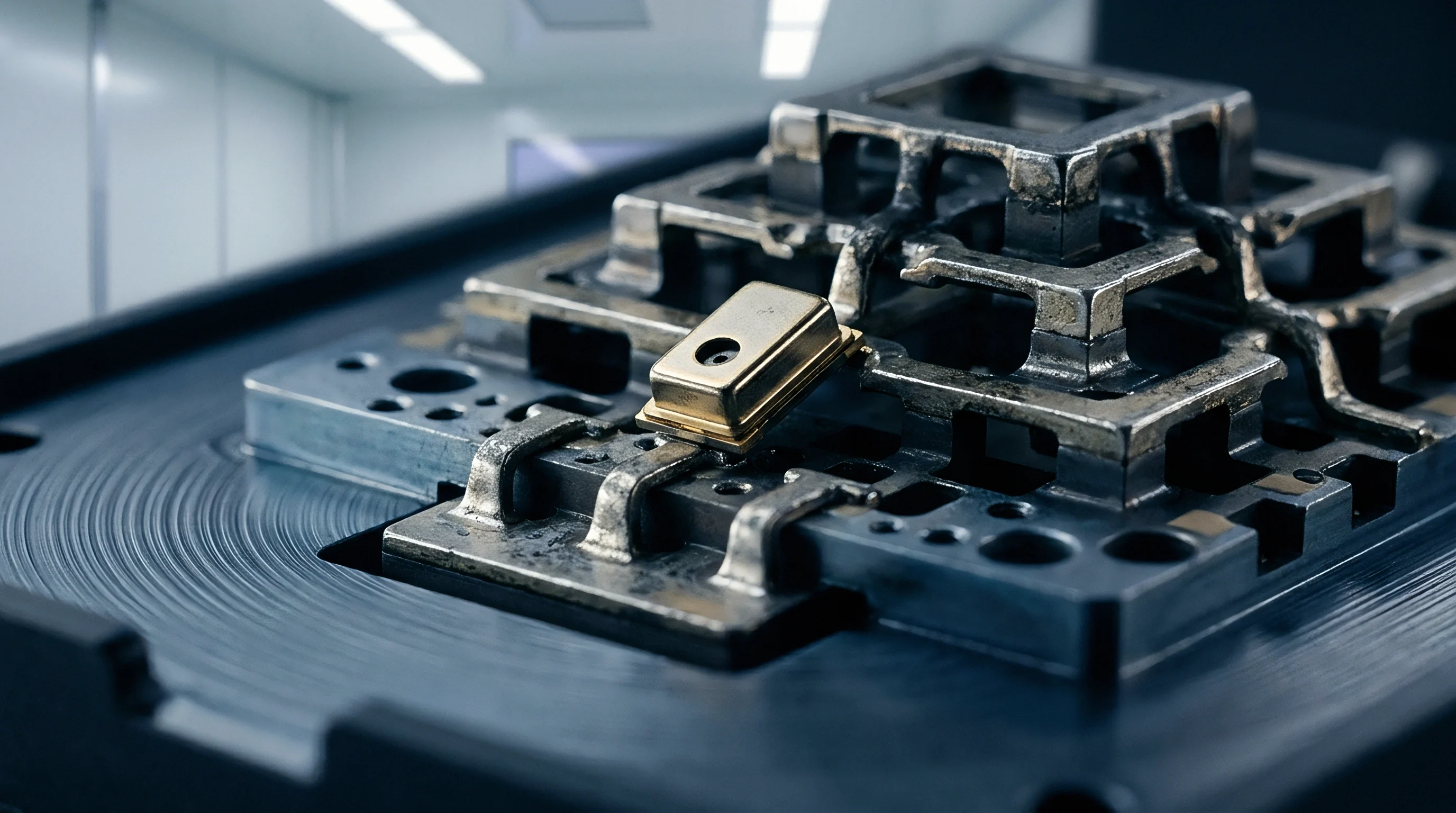
| Standard Tuning Fork (SMD 3.2×1.5mm) | $0.14 to $0.22 | Moderate (8 mm²) | Low to Moderate | 10 to 12 Years |
| High-Stability Tuning Fork (SMD 2.0×1.2mm) | $0.28 to $0.45 | Small (4 mm²) | Low | 15+ Years |
| Low-Power TCXO (SMD 2.5×2.0mm) | $0.75 to $1.25 | Moderate (10 mm²) | Zero | 10 to 15 Years |
Crystal Sourcing and Specification Tolerances
Specifying crystal units requires setting strict boundaries on Equivalent Series Resistance and maximum drive level alongside nominal frequency and turnover temperature. Sub-GHz microcontrollers often feature drive inverters rated below 0.5 microwatts. If procurement substitutes an unverified crystal with ESR above 70 kilohms, the oscillator can fail to start at minus forty degrees Celsius when amplifier transconductance drops.
Qualifying parts across temperature ensures the oscillation margin stays at least five times the maximum ESR.
Suppliers offer turnover temperature options targeted to specific operating environments. Standard commercial blanks center at 25°C, but units destined for cold-chain monitoring or pipeline telemetry can be specified with turnover points shifted toward 10°C or 0°C. That shifts the curve to lessen drift at minus forty degrees, though it increases error during hot summer peaks, while trace capacitance continues to pull the overall resonance frequency.
Production Acceptance Testing Criteria
Incoming quality control for quartz lots involves screening for frequency offset, ESR, and insulation resistance over temperature. Measuring passive tuning-fork crystals on production fixtures requires dedicated high-impedance probes: attaching a standard oscilloscope probe adds roughly ten picofarads of capacitance, shifting frequency by dozens of parts per million or damping oscillation completely. Production test fixtures instead monitor buffered clock output pins exposed through test firmware.
Purchase contracts for volume sub-GHz builds should establish clear parameter envelopes across temperature instead of relying on baseline commercial datasheets. Enforcing a strict ppm tolerance window from minus forty to plus eighty-five degrees Celsius in supply agreements prevents disputes over parts that only meet specifications under room-temperature conditions.