Integrating Dynamic Power Averaging Firmware Files into Global Type Approval Packages
Dynamic power averaging firmware files demand cryptographically locked parameter tables, dynamic bench validation, and regional window alignment for type approval.

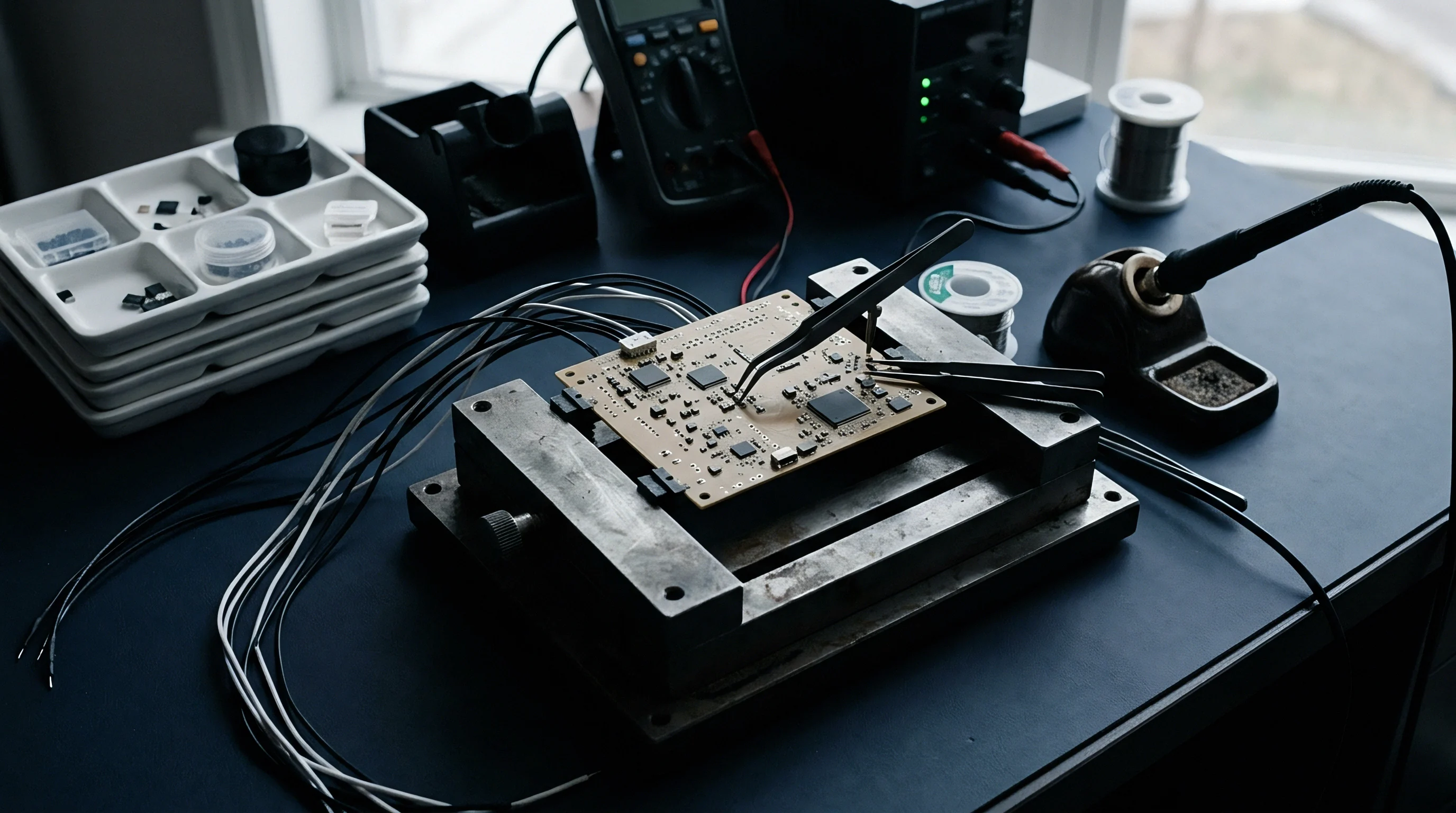
Payload
A spectrum analyzer sweep drops twelve decibels across eighty milliseconds on the Rohde and Schwarz CMW500 display while the conducted RF port tracks an escalating link budget demand. Modern cellular and Wi-Fi transceivers operate against strict Specific Absorption Rate thresholds while demanding maximum radiated performance during weak signal conditions. Traditional static back-off designs permanently attenuate conducted energy whenever an auxiliary sensor detects human proximity.
Firmware-driven time-averaging algorithms replace fixed limits by tracking energy deposition across predefined regulatory windows, permitting instantaneous burst transmissions up to maximum saturated capability while maintaining legal mean field strength. The core binary that implements this mechanism contains mathematical look-up matrices, antenna coupling coefficients, sensor trigger maps, and exposure budget allocations.
Integrating these operational assets into an international certification filing demands an exact accounting of every parameter flashed to non-volatile memory. Sourcing engineers routinely receive vendor evaluation kits with unlocked reference configurations that clear compliance laboratory scans under artificial operating limits. Transferring that radio into a commercial host device alters antenna gain, ground plane reflections, hand-grip capacitance, and thermal dissipation paths.
A failure to synchronize the flashed firmware tables with the host enclosure RF path causes either severe carrier throughput penalties or direct regulatory non-compliance.
Under FCC Part 2.1033(c)(13), omission of the radio frequency exposure power averaging algorithm description results in an immediate dismissal of the certification application.

Binary Architecture and Power Lookup Tables
Embedded transceiver chipsets store regulatory constraints within compiled hexadecimal structures known variously as board configuration data or non-volatile configuration items. The baseband processor reads these indices during boot initialization before enabling the front-end power amplifier modules. Within these records, two discrete values govern each supported transmission band, frequency allocation, and antenna switch state:
- Conducted Maximum Threshold determines the absolute hardware saturation ceiling that the power amplifier cannot exceed under any instantaneous burst condition.
- Time Averaged Exposure Limit establishes the calculated target power corresponding to the maximum allowable SAR rating calculated across sixty or one hundred seconds.
- Reserve Budget Headroom defines the dedicated decibel margin set aside to prevent packet drops when handovers force a shift to higher modulation orders.
- Sensor State Array maps capacitive, inductive, or motion detector inputs to specific absorption reduction offsets across distinct physical user scenarios.
The baseband processor clamps power output. When a device operates far from a cell tower, the software allows transmission levels to spike to the conducted maximum threshold. As the sliding time window fills with high-energy samples, the algorithmic governor progressively throttles the power amplifier gain stage toward the lower time-averaged limit.
The link margin holds without violating absorption regulations. This closed-loop calculation executes continuously across active sub-frames, processing duty cycles, carrier aggregation splits, and simultaneous uplink states across cellular and wireless local area connections.

Regulatory Parameter Partitioning in Modern Modems
Test houses require unambiguous separation between factory calibration constants and end-product configuration files. Calibration tables quantify raw silicon tolerances, trace losses, and power amplifier thermal drift measured during board manufacturing. These variables remain device-specific and unalterable.
Conversely, the regulatory parameter file maps specific antenna configurations, enclosure separation distances, and geographic operational domains directly to localized specific absorption constraints.
Different jurisdictions impose incompatible time windows and field strength definitions. Equipment destined for North America must adhere to localized Specific Absorption Rate ceilings of 1.6 watts per kilogram averaged over one gram of tissue, using a rolling window of one hundred seconds below three gigahertz. Products entering European member states evaluate compliance against 2.0 watts per kilogram averaged over ten grams of tissue, governed by shorter averaging intervals.
Flashing a universal configuration file across all regional variants degrades performance in markets with more permissive averaging mechanisms while inviting border detentions in regions with tighter instantaneous thresholds.
Supply agreements establish this boundary by specifying that any revision to the parameter table version string invalidates the associated declaration of conformity unless accompanied by signed laboratory delta scans.

Clock
Metrology laboratories evaluate time-windowed algorithms through automated conducted benches coupled with liquid-filled tissue phantoms. An automated signal generator applies rapid call-box attenuation changes to trick the baseband into demanding maximum transmission output. Technicians observe the radio terminal through a directional coupler connected to a high-speed diode power sensor recording samples every millisecond.
The recorded power curve reveals the exact timing dynamics of the embedded power governor.

Does Baseband Telemetry Satisfy Real Time Exposure Limits?
Digital signal processors monitor instantaneous transmitter currents alongside internal baseband transmit sample counts. Telemetry calculations convert forward power readings into instantaneous absorption units using pre-calibrated absorption-to-power ratios stored in the device configuration file. The algorithm maintains a discrete circular buffer that continuously sums accumulated milliwatt-seconds over the regulatory averaging duration.
A 100-second conduction measurement window across LTE Band 7 allows an instantaneous peak of 26.5 dBm when the running average maintains the nominal 23.0 dBm ceiling.
Instantaneous power jumps during high data demand scenarios, consuming significant portions of the rolling absorption budget. Once the cumulative sum touches the upper regulatory boundary, the baseband firmware executes a deterministic back-off command within two transmit sub-frames. The radio halts transmission immediately.
This rapid intervention keeps localized tissue heating well within statutory exposure envelopes without terminating the active data connection.
| Regulatory Regime | Frequency Band | Window Duration | Exposure Metric Limit | Evaluation Standard |
|---|---|---|---|---|
| United States FCC | Below 3 GHz | 100 Seconds | 1.6 W/kg (1g Tissue) | IEEE C95.1 / KDB 447498 |
| United States FCC | 3 GHz to 6 GHz | 60 Seconds | 1.6 W/kg (1g Tissue) | KDB 248227 D01 |
| European Union RED | Below 6 GHz | 360 Seconds | 2.0 W/kg (10g Tissue) | EN 50665 / EN 62209-3 |
| Canada ISED | Below 3 GHz | 100 Seconds | 1.6 W/kg (1g Tissue) | RSS-102 Issue 6 / SPR-004 |
| Japan MIC | Below 6 GHz | 360 Seconds | 2.0 W/kg (10g Tissue) | MIC Notice No. 88 / ARIB STD |
| Methods note: Test durations reflect standardized conducted test scripts specified in regulatory technical guidance bulletins; European and Japanese regimes utilize larger tissue mass averaging and extended thermal equilibration periods compared to North American benchmarks. | ||||

Chamber Verification Sequences for Rolling Windows
Validating these time-averaged algorithms requires complex multi-step bench procedures that exercise every operational permutation. Test technicians cannot merely verify static output levels at channel band edges. The certification package must document dynamic transitions between power states, handovers across frequency bands with different absorption targets, and concurrent transmissions spanning distinct cellular and wireless LAN radios.
- Configure the device under test inside a shielded enclosure connected directly to a multi-port radio communication tester through calibrated low-loss coaxial cabling.
- Flash the production regulatory configuration file containing the target lookup tables, verifying binary hash values through serial debug console commands.
- Establish an active voice and data call on the lowest frequency anchor band, commanding the terminal to maximum radiated output via baseband call-box signaling.
- Inject sudden path loss attenuation steps exceeding ten decibels, observing the instantaneous power surge and subsequent algorithmic clamping over the designated hundred-second duration.
- Initiate an inter-band handover to a higher frequency carrier, verifying that the energy tracking engine correctly re-scales cumulative absorption totals across the differing averaging time domains.
- Trigger auxiliary proximity sensors using dielectric tissue-equivalent spacers, confirming that power drop execution occurs within twenty milliseconds of sensor state assertion.
The chamber turntable rotates through 360 degrees. Engineers must monitor radiated fields while the device transitions between multiple antenna elements to ensure that combining losses do not generate constructive interference peaks exceeding limits during algorithmic switching. Antenna arrays running simultaneous uplinks present severe computational burdens for the baseband processor.
When multiple transmitters fire concurrently, the firmware normalizes individual absorption contributions against each band limit, holding the aggregate normalized exposure sum beneath unity.
Mishandling these timing windows causes immediate regulatory rejection, requiring complete chamber re-scans that consume fifteen thousand dollars per week in accredited laboratory fees and push commercial launch milestones back by two full fiscal quarters.

Lock
Regulatory authorities exhibit deep skepticism toward software-defined radio configurations capable of field modification. The Federal Communications Commission KDB 594280 alongside European Union Radio Equipment Directive Article 3.3(i) enforce strict security controls over any firmware asset that alters transmitter operational parameters. A device cannot permit third-party operating systems, sideloaded applications, or local root users to modify power back-off curves, antenna mapping variables, or proximity sensor thresholds.
Is Factory Calibrated NVRAM Protected against Host Override?
Hardware root-of-trust engines anchor the integrity of the power averaging firmware stack. The silicon vendor fuses an asymmetric public key into one-time-programmable physical memory registers during baseband wafer fabrication. During the initial secondary bootloader phase, the hardware cryptographic accelerator computes an SHA-256 digest of the regulatory parameter binary, comparing that signature against an encrypted RSA or ECDSA certificate appended to the firmware blob.
OEM customers alter factory device tree overlays without realizing those changes break the cryptographic chain to the certified radio binary.
If an integrator attempts to modify a look-up table to recover antenna efficiency lost inside an unoptimized enclosure, the cryptographic check halts the modem core before RF transmission begins. The filing fee is nonrefundable. Regulators demand that test packages prove this lock mechanism is active and uncircumventable under standard user conditions.
Cryptographic Signing under Radio Software Directives
Maintaining security compliance across cross-border product lines introduces distinct vulnerabilities within OEM engineering workflows. Sourcing teams frequently encounter several systemic failure modes when integrating baseband binaries into host firmware packages:
- Engineering Key Leakage permits unauthorized debug binaries to execute on consumer hardware, invalidating modular grant exemptions across all regional markets.
- Decoupled Version Metadata occurs when host operating system updates increment build strings while leaving underlying baseband parameter blobs out of sync with published laboratory exhibits.
- Sensor Bypass Modes expose unauthenticated debug interfaces via external USB test points, enabling end users to disable proximity power back-off algorithms permanently.
- Cross Country Blob Flashing allows devices sold in one jurisdiction to run configuration profiles tuned for regions with significantly more permissive transmission thresholds.
Modern semiconductor fabrication plants burn foundational microcode directly into read-only memory, but downstream device assemblers retain responsibility for final parameter table flashing. This handoff represents a classic supply chain friction point where configuration drift frequently passes unnoticed until final type approval audits. A rigorous software tracking system hashes every parameter compilation alongside the host device tree source code.
Suppliers routinely dismiss these security audits by claiming that proprietary binary formats provide sufficient protection against end-user tampering, only to face immediate test report rejections from notified certification bodies requiring cryptographic signatures.

Dossier
Assembling a type approval submission containing dynamic power averaging files demands documentation architectures far beyond standard Part 15 or Radio Equipment Directive filings. A baseline modular grant application simply reports conducted power, occupied bandwidth, and static phantom scans. A power-averaging package must present the underlying baseband algorithmic theory, detailed state transition diagrams, mathematical proofs of normalized exposure sums, and exhaustive conducted validation traces confirming algorithm responsiveness.

Cross Border Exhibit Structures and Filing Variations
Regulatory authorities approach time-averaged exposure filings through divergent procedural paths. The United States Federal Communications Commission handles these packages under stringent equipment authorization guidance requiring specialized PAG inquiry tracking numbers before grant issuance. Canada mirrors these requirements through Innovation, Science and Economic Development technical briefs, while European Union market access relies heavily on notified body technical reviews certifying compliance with the Radio Equipment Directive.
| Filing Exhibit Category | FCC Part 2 / Part 24 / Part 27 | ISED Canada SPR-004 | EU RED Notified Body | ANATEL Brazil Act 1630 |
|---|---|---|---|---|
| Operational Algorithm Description | Mandatory (Confidential) | Mandatory (Confidential) | Mandatory Technical Construction File | Mandatory Technical Description |
| Firmware Binary Version Hash Sheet | Mandatory Verification | Mandatory Declaration | Mandatory Risk Assessment File | Declaration of Software Version |
| Dynamic Conducted Time Traces | Mandatory Test Report | Mandatory Test Report | Optional (Static SAR Preferred) | Not Accepted (Static Tests Only) |
| Software Security Attestation | Mandatory KDB 594280 | Mandatory RSS-HAC/SAR | Mandatory Article 3.3(i) Assessment | Manufacturer Self Declaration |
| Pre-Approval Guidance Tracking | Mandatory KDB Inquiry | Case-by-Case Review | Not Applicable | Not Applicable |
Modular grants transferring time-averaging authority to a host enclosure shift full laboratory retesting onto the integrator.
The operational description must explain how the device distinguishes between free-space radiation and human body proximity. If capacitive sensors control power drop execution, the package must document sensor sensitivity thresholds, hysteresis margins, and fallback behaviors during physical sensor hardware failures. If the proximity sensor disconnects or shorts, the firmware forces the radio into the lowest possible conducted power state permanently.
The test house rejects the submission. Every regulatory file tracks this signature.
Permissive Changes and Baseband Algorithm Updates
Modifying a certified device in production introduces significant compliance overhead. When an engineering team modifies an antenna trace layout, adjusts housing plastic permittivity, or changes front-end filter components, the power averaging configuration file must undergo recompilation. Sourcing teams must evaluate whether these modifications trigger a formal Class II Permissive Change under United States rules or an equivalent full reassessment under European standards.
The laboratory reissues the test report. If an updated parameter table reduces conducted power levels across all operational states without increasing SAR values, documentation burdens remain manageable through internal engineering change records. If the revision increases transmission burst thresholds in any band, full dynamic chamber validation scans become unavoidable.
Regulators inspect the binary hash table. Integrators cannot hide parameter revisions behind static compliance statements when the underlying firmware checksum differs from the original certification grant records.
This technical boundary leaves an unresolved question regarding whether international mutual recognition agreements will harmonize algorithmic validation across borders, or if regional regulatory divergence will force manufacturers to maintain fragmented firmware branches for every regional market.


Gate
Market access schedules collapse when sourcing teams underestimate the time required to clear dynamic exposure validations. A standard wireless certification filing clears accredited laboratories within four weeks when verifying static power tables. Injecting algorithmic power averaging expands chamber testing durations to ten or twelve weeks due to the extensive matrix of conducted dynamic transitions, sensor trigger verifications, and simultaneous multi-band exposure calculations.

Laboratory Lead Times and Validation Traps
Accredited laboratories capable of executing dynamic time-averaged test suites face severe equipment bottlenecks. Few test houses possess the high-speed specialized call boxes, calibrated directional couplers, and automated liquid phantom arrays required to validate complex firmware-driven exposure algorithms. Sourcing managers booking laboratory windows must reserve chamber slots three months in advance to prevent production inventory from idling in bonded warehouses.
That delta destroys the link margin. Sourcing teams that fail to coordinate early firmware delivery with manufacturing test fixtures find their production lines stalled waiting for signed regulatory configuration blobs. This mismatch stops factory flashing lines.
Customs impounds the entire container lot. Carrier acceptance stalls without this file. The signed checksum guarantees regulatory compliance.
Commercial viability hinges on recognizing that firmware binary files controlling RF power behave identically to critical physical components, where an uncertified parameter modification carries the same commercial risk as an unvetted antenna redesign.