Meaning
Millimeter-wave sensing systems transmit continuous frequency-swept signals across a broad high-frequency band to measure target distance and velocity. Operating in the assigned spectrum from 76 GHz to 81 GHz, 79 GHz FMCW radar provides available sweep bandwidths up to 4 GHz for short-range and mid-range industrial and vehicular perception systems. High operational bandwidth enhances range resolution compared to legacy 24 GHz equipment while reducing physical antenna aperture dimensions on host printed circuit boards.
The technology operates within radio spectrum rules that restrict maximum radiated power to prevent mutual interference between co-located sensor modules.
Frequency Allocation
Spectral regulation assigns specific wideband frequency windows to high-resolution radio detection equipment. Within modern vehicular sensor suites, 79 GHz FMCW radar relies on continuous linear frequency chirps generated by monolithic microwave integrated circuits. Synthesizer phase noise and voltage-controlled oscillator linearity directly constrain the signal-to-noise ratio at the receiver intermediate frequency stage.
Poor chirp linearity spreads target energy across adjacent range bins, decreasing object detection probability.
Azimuth Resolution
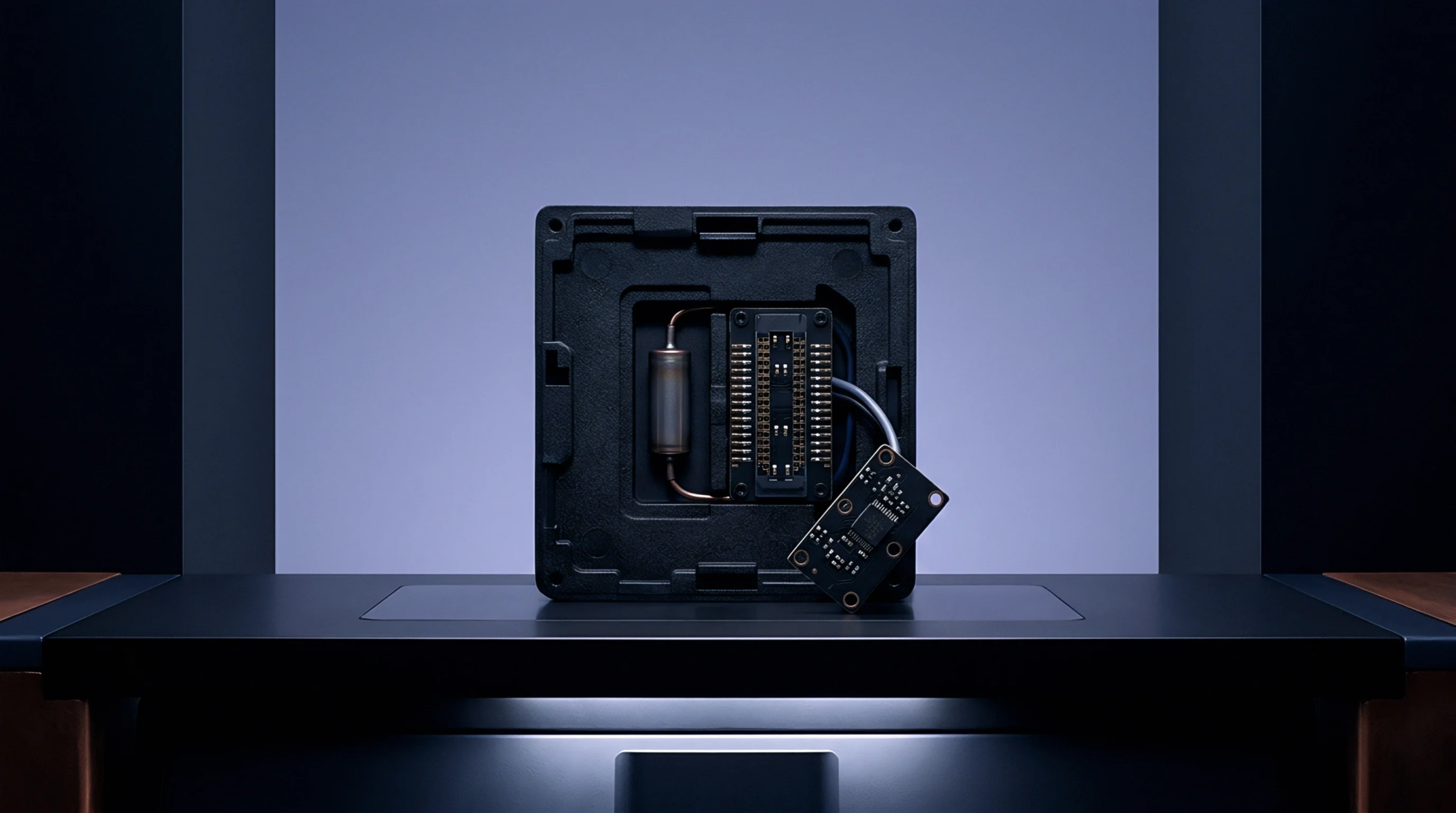
Spatial resolution depends on antenna array geometry and phase stability across array elements. When integrating 79 GHz FMCW radar modules into sealed plastic enclosures, radome thickness and material dielectric constant cause reflections that distort beam patterns. Phase distortion across multiple receiver channels degrades target angle-of-arrival estimation.
System integration requires precise calibration matrices to compensate for radome attenuation.
Integration Threshold
Thermal management determines continuous operation limits for high-density radar front-end silicon inside sealed housings. The power dissipation of 79 GHz FMCW radar transmitters raises junction temperatures inside compact bumper or chassis mounts. Thermal interface materials must transfer heat to external heat sinks without imposing mechanical stress on microstrip feed lines.
Excessive thermal stress causes solder joint cracking under thermal cycling tests.