Meaning
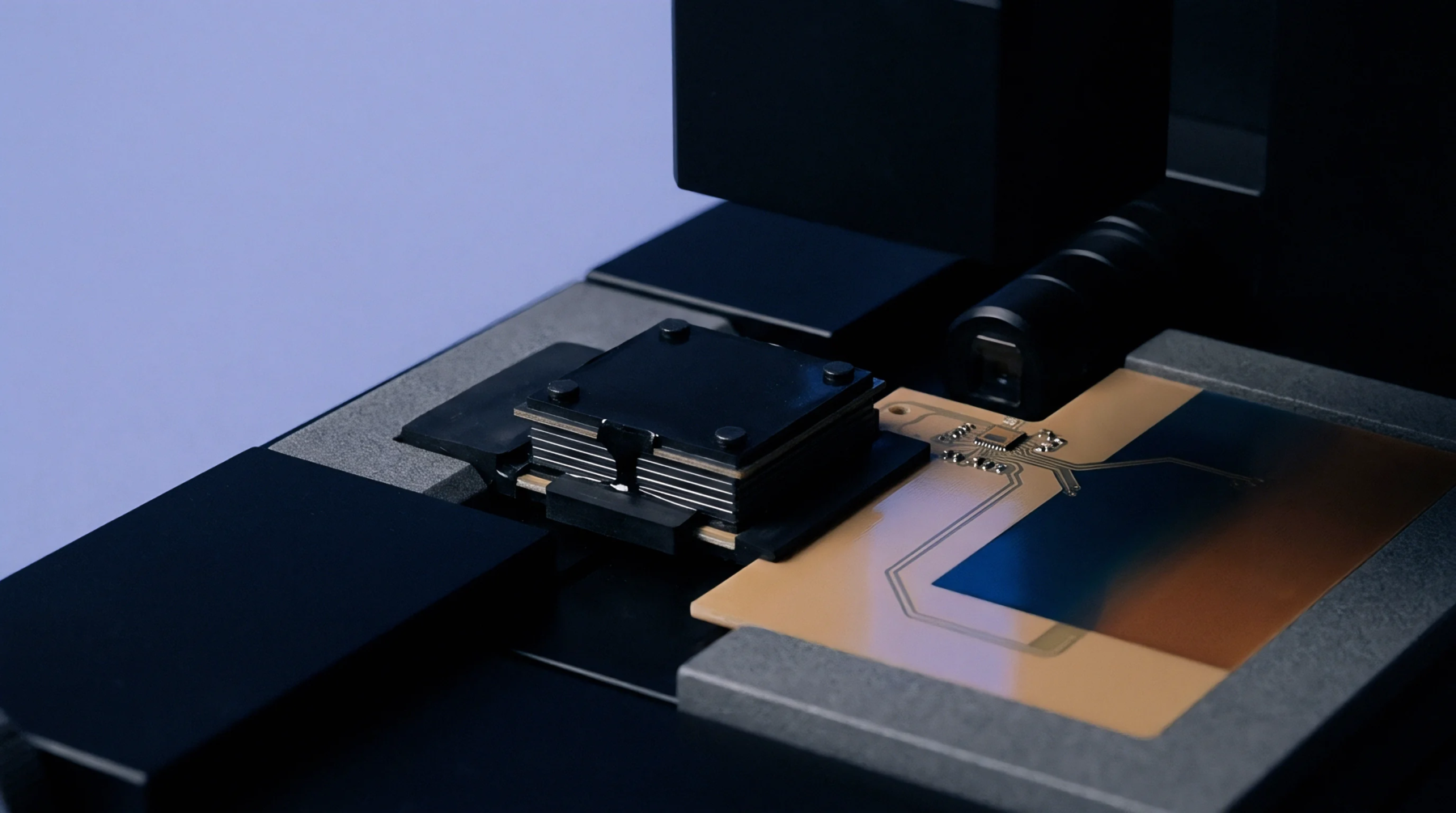
Manufacturing equipment adjusts optical paths during the assembly process to maximize signal coupling efficiency between light sources and waveguides. Active optical alignment relies on real-time feedback from monitoring sensors to manipulate component positions with sub-micron precision while adhesive materials cure. This method compensates for mechanical tolerances that prevent passive mounting techniques from achieving target loss specifications.
The procedure terminates once the hardware reaches peak performance levels and fixates the internal geometry against thermal or vibrational drift.
Assembly Integration
Photonic engineers utilize these automated systems during the final packaging phase to satisfy strict insertion loss requirements. Precise movement of the laser diode or optical fiber relative to the lens array ensures maximum energy transfer across the interface. Technicians monitor the optical power output continuously as the machine iterates through XYZ axes adjustments to find the global maximum of signal throughput.
Each completed unit undergoes this evaluation to verify that the final build matches the theoretical design specifications before moving to environmental stress screening.
Mechanical Constraint
Thermal expansion properties of the bonding agents influence the long-term stability of the junction after the alignment equipment releases the components. Shrinkage during the ultraviolet light curing cycle shifts the delicate alignment state if the fixture lacks adequate compensation logic. Designers account for these material behaviors by selecting low-shrinkage epoxies that maintain the optimal position established by the active process.
Engineers perform regular calibration of the motorized stages to guarantee that mechanical commands translate into accurate physical displacements at the scale of optical wavelengths.
Performance Metric
Coupling efficiency defines the quality of the light transmission path and dictates the overall yield of a manufacturing line. High return loss or low signal intensity signals an inadequate alignment operation that requires immediate recalibration of the feedback loops. Precise control over the spatial orientation of components minimizes variance across large production batches.
Maintaining strict alignment tolerances during mass production dictates the operational lifespan and reliability of high-speed communication modules.