Managing Silicon Errata Workarounds in Transferred Firmware Repositories
Managing errata workarounds in transferred firmware requires isolating stepping-specific register fixes to prevent fatal regressions across new silicon wafer lots.

Mask
Transfer packages for wireless microcontrollers arrive with silicon anomalies embedded directly into peripheral register initialisation sequences. Semiconductor vendors spin new lithographic masks to resolve hardware faults, generating stepping revisions designated by alphanumeric suffixes from A0 to C2. When an engineering house hands over a firmware repository to an original equipment manufacturer, the code base carries historical compensation routines for silicon faults present in early wafer runs.
These routines reside inside peripheral drivers, direct memory access handlers, and clock configuration trees. Microcontroller vendors document these bugs in errata sheets, yet firmware repositories rarely track the precise relationship between a patch and a specific die stepping.
Silicon errata alter the register-transfer level behavior of on-chip peripherals. A hardware bug in a serial peripheral interface bus controller can drop the clock line before the final bit shifts out of the buffer, forcing firmware to hold chip-select active for additional cycles through a software delay loop. Another silicon fault in a high-speed analog-to-digital converter causes the converter to hang if an interrupt fires during the sampling window, necessitating an auxiliary hardware timer to clear the state machine.
These patches introduce execution overhead, interrupt latency penalties, and non-standard register writes that remain invisible until an engineer attempts to port the code to a modern die revision.
A hardware timer clearing an analog-to-digital converter freeze adds 14 microseconds of baseline interrupt latency under an 80-megahertz core clock.
Design houses developing turn-key solutions frequently bundle vendor hardware abstraction layers with custom device drivers. In these repositories, silicon workarounds appear in three distinct forms: manufacturer-supplied macros wrapped in preprocessor directives, vendor field-application engineer patches applied directly to register definitions, and undocumented assembly sequences that prevent memory bus stalls. If the purchasing team receives the repository without an explicit mapping of which lines of code remediate specific errata bulletin entries, downstream manufacturing faces unquantifiable yield risks during component lot changes.
Fabrication plants change sub-micron gate dimensions between mask steppings to improve yields and transistor drive currents. A silicon revision that fixes an errata item often disables the workaround mechanism or causes the patch to introduce a fresh collision. When an early silicon erratum forces firmware to manually toggle an internal bus arbiter register, running that identical toggle on a corrected B1 stepping core can trigger a hard fault exception during memory transfer arbitration.
Upstream suppliers routinely assure the buyer that new silicon steppings maintain complete register compatibility with earlier firmware runs.

Branch

Managing Stepping Segregation in Repository Trees
Transferred source code repositories require an explicit branching and preprocessor isolation strategy for silicon errata workarounds. Microcontroller projects that mix silicon patch logic with application tasks introduce regressions whenever an engineer changes compiler optimization flags or updates an underlying peripheral driver library. Isolating errata mitigation routines inside dedicated abstraction modules preserves clear boundaries between functional business logic and hardware-dependent bug compensations.
A structured source tree organizes errata workarounds using silicon revision identifiers extracted at runtime from device signature registers. Modern 32-bit microcontrollers expose factory-programmed stepping information within system configuration registers or electronic signature blocks. By reading these registers during early reset routines, the startup architecture selects the correct operational path without requiring separate binary builds for each board lot.
- System identification registers read during reset read the device stepping and populate an immutable system configuration struct within internal static random access memory.
- Peripheral initialization routines consult the revision struct to conditionally toggle hardware workarounds before releasing device clocks to downstream buses.
- Runtime interrupt handlers execute errata-specific compensation loops through pointer offsets assigned dynamically during early peripheral configuration passes.
- Continuous build environments generate parallel firmware images using discrete compiler defines to validate build reproducibility across bare-metal and operating-system configurations.

Why Do Peripheral Errata Escape Standard Regression Suites?
Automated software verification suites typically test logic paths inside virtualized environments or against production-grade development boards carrying the newest silicon steppings. These tests validate application logic while bypassing the low-level register states where silicon flaws manifest. Hardware-in-the-loop fixtures equipped with early prototype silicon steppings reveal race conditions that newer evaluation silicon hides.
The table below details common silicon errata encountered in connected system-on-chip devices, the code modifications used to circumvent them, and the engineering liabilities introduced across firmware revisions.
| Peripheral Subsystem | Silicon Failure Mechanism | Software Mitigation Pattern | Integration Overhead |
|---|---|---|---|
| Direct Memory Access Engine | Bus arbiter deadlocks on simultaneous burst requests | Single-buffer transfers enforced via software polling loop | Triples processor core intervention time |
| Universal Asynchronous Receiver | FIFO underrun corrupts next frame framing byte | Hardware flow control toggled manually via GPIO writes | Consumes two general-purpose pins |
| Serial Peripheral Interface | Last clock edge clips when divider exceeds eight | Bit-bang assembly sequence injected for trailing byte | Generates jitter across interrupt vectors |
| Phase-Locked Loop Generator | VCO lock detector drops flag during rapid thermal drift | Dynamic frequency scaling locked to internal RC oscillator | Reduces computational throughput by half |
| Flash Memory Controller | Page erase fails when supply voltage drops beneath 2.7V | Software retry register holds execution until brownout fires | Blocks high-priority task scheduling |
Transferred firmware repositories that fail to isolate errata workarounds into low-level device drivers complicate long-term product maintenance. Firmware maintenance costs expand as the number of unisolated hardware workarounds multiplies across subsequent module hardware revisions.
Clamp
Silicon workarounds that restrict register access or pin states function as engineering clamps on the capabilities of the hardware. When an erratum limits a communication peripheral to half its rated clock speed, the firmware design compensates by restructuring task timing. In transferred codebases, these constraints frequently exist as hard-coded magic numbers inside register write macros.
An integration engineer tasked with increasing radio throughput or sensor polling rates encounters hard architectural walls placed there years prior to dodge silicon anomalies.
Hardware workarounds alter the operating envelop of low-power microcontrollers. A common erratum involves high sleep current caused by an internal voltage regulator failing to switch into retention mode when certain peripheral clocks remain un-gated. The firmware patch clamps the deep-sleep entry routine, forcing the processor to execute an eighty-instruction sequence that systematically powers down individual peripheral power domains before issuing the final wait-for-interrupt instruction.
Section 7.3 of IPC-2581 mandates complete structural netlist verification for every design iteration claiming electrical compliance.
System designers compensate for timing race conditions inside integrated flash memory controllers by inserting wait states into program fetch pathways. A silicon stepping that suffers from read access margin degradation at elevated temperatures forces the firmware to insert three flash wait states instead of two, dropping processing efficiency across the entire industrial operating band. When the development house transfers this repository, the client assumes the microcontroller runs at full performance.
The real computational capacity remains lower because the firmware clamps flash performance to prevent thermal latch-up.
Unchecked workarounds create secondary failures in complex systems-on-chip where multiple processor cores share internal bus fabrics. A core attempting to clear a peripheral interrupt flag through an errata-driven read-modify-write cycle stalls the shared bus, causing a secondary communications core to drop incoming radio packets. Removing the clamp without knowing the silicon defect re-engages the hardware bug; keeping the clamp locks the system into performance bottlenecks that defeat the commercial purpose of upgrading the bill of materials.

Audit

Where Errata Tracing Secures Repository Transfer
A rigorous engineering audit validates transferred firmware repositories against the silicon vendor errata notices. This process matches every conditional preprocessor flag, manual register override, and non-standard delay loop against a published tracking identifier from the semiconductor foundry. Repositories lacking an unbroken chain of documentation between errata notices and code commits present substantial financial risk during high-volume production transfers.
Verification requires physical test benches hosting multiple silicon steppings mounted on automated testing fixtures. Engineering teams deploy instrumented test runs to observe how the firmware interacts with peripheral registers across corner conditions of supply voltage and ambient operating temperature.
- Static analysis pipelines identify undeclared register writes to reserved memory addresses commonly used as back-door workarounds by silicon vendor design teams.
- Silicon revision sweeps execute the entire firmware integration regression suite across older A-step and production C-step hardware platforms to catch deprecated workarounds.
- Bus protocol analyzers capture high-speed peripheral signal timings to verify that software delays compensate for hardware race conditions across specified temperature extremes.
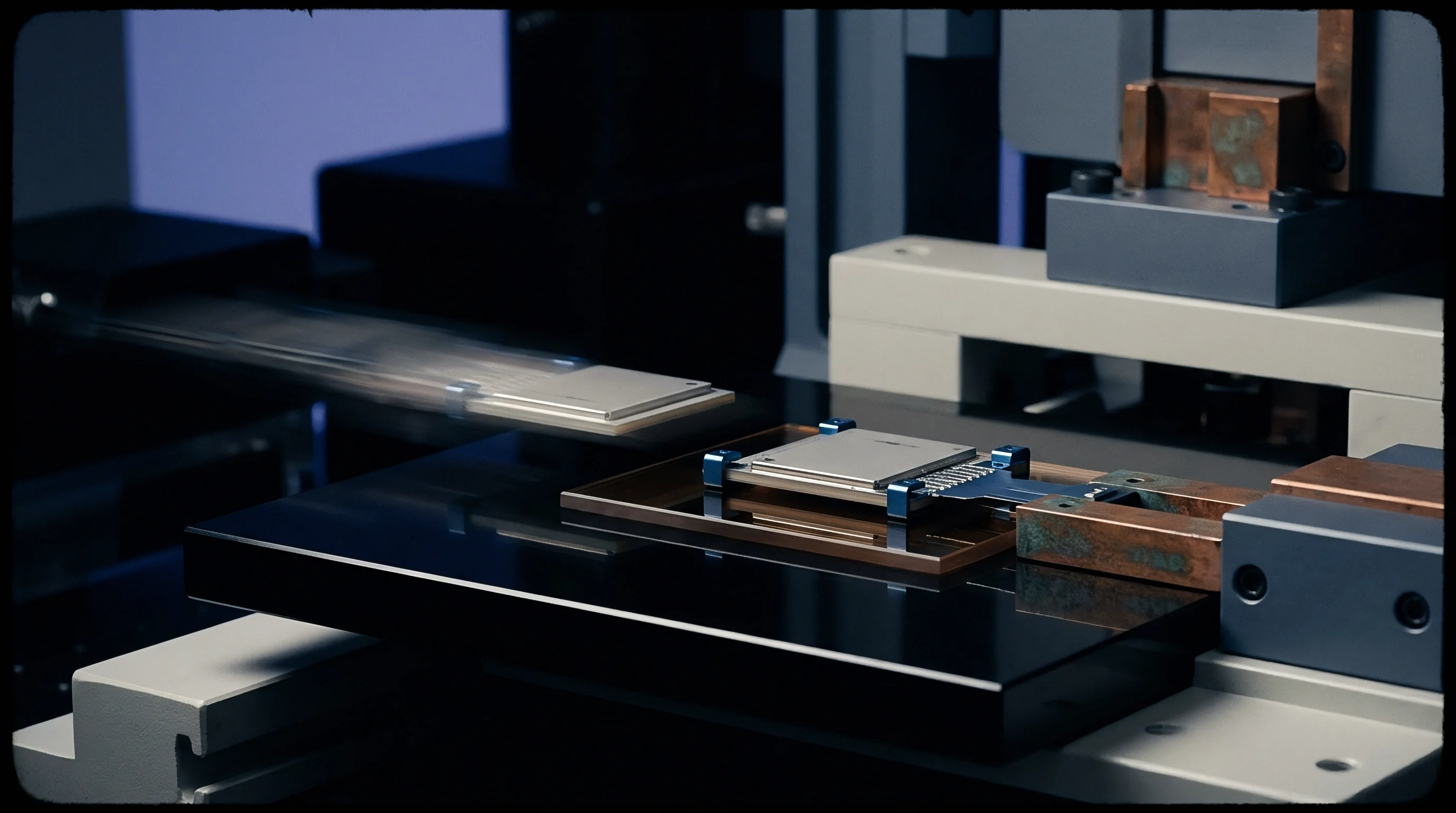
Bench Verification and Register Capture
Oscilloscopes and logic analyzers expose whether an errata workaround functions correctly or simply masks an underlying silicon timing fault. When a firmware routine addresses an erratum where an internal analog-to-digital converter reference drifts during radio transmissions, automated bench tests verify that the code samples inputs exclusively during radio idle slots.
Assume a microcontroller platform running at 64 megahertz consumes 12 milliamps during normal run mode and 2 microamps in deep sleep. An erratum in the system power controller prevents automated wake-up from low-power states if the peripheral bus clock runs above 16 megahertz. The firmware workaround drops the core clock to 16 megahertz prior to sleep entry, then steps the phase-locked loop back up to 64 megahertz following wake-up.
This clock transition consumes 850 microseconds per wake cycle.
| Operational State | Standard Hardware Spec | With Firmware Workaround | Energy Penalty per Event |
|---|---|---|---|
| Deep Sleep Current | 2.1 µA | 2.1 µA | 0.0 µJ |
| Clock Downscaling Transition | 0.0 µs | 120.0 µs @ 5.4 mA | 2.14 µJ |
| Wake-up and PLL Re-lock | 45.0 µs @ 12.0 mA | 850.0 µs @ 8.2 mA | 21.49 µJ |
| Total Wake Energy (10 Hz rate) | 1.78 µJ per cycle | 25.41 µJ per cycle | +1327% |
The energy budget of a battery-powered device increases by an order of magnitude because of a single clock management workaround. For an asset tracker designed to operate for five years on a primary cell, this erratum mitigation reduces field longevity to under eight months. The transfer agreement between the software developer and the system integrator determines who pays for the battery redesign or the silicon stepping recertification.
A contract clause mandating that transferred repositories include automated regression logs for all listed errata fixes indemnifies the buyer against undocumented silicon compensations.
Design transfers governed by standard quality engineering agreements include traceability matrices that connect every software driver directly to silicon revision change orders.
Bill
The financial liability of managing silicon errata workarounds in transferred firmware surfaces during sustaining engineering phases. When an engineering house develops a custom module or reference design, the quoted non-recurring engineering fee rarely includes the multi-year cost of tracking semiconductor mask revisions. Once the buyer signs the acceptance certificate and absorbs the repository, the internal software team becomes responsible for resolving conflicts when the silicon vendor issues an end-of-life notice on legacy steppings.
A procurement team analyzing a semi-custom module quotation must evaluate the engineering scope allocated to firmware errata maintenance. Maintaining a transferred codebase across three silicon steppings over a five-year lifecycle consumes roughly 120 engineering hours per peripheral subsystem. At typical engineering billing rates of $175 per hour, maintaining an unisolated radio driver, a power management module, and two high-speed serial buses costs over $84,000 in direct labor.
If the transfer package leaves these workarounds unmapped, this labor expenditure doubles during the first production stepping transition.
The boundary between turn-key design delivery and long-term repository ownership rests on source code transparency. Buyers accepting binary blobs or precompiled libraries from third-party design houses forfeit the ability to audit errata implementations. If the vendor hard-coded a silicon fix that breaks on the next silicon lot, the factory holds the production line until the vendor releases an updated binary, creating unrecoverable downtime costs.
Production stoppages arising from obsolete silicon workarounds quickly dwarf original development budgets. When a component lot transition triggers intermittent peripheral locks on the factory floor, identifying the offending register write takes weeks of diagnostic effort. Engineering contracts that explicitly define deliverables to include source files, revision-specific build recipes, and an itemized errata compliance dossier establish clear operational boundaries for both parties.
The commercial challenge remains whether the original design house can legally guarantee firmware compatibility with future silicon mask steppings that the semiconductor foundry has not yet fabricated.