Calculating Cellular IoT Overhead across Protocol Stacks
Protocol stack overhead in cellular IoT expands 20-byte payloads up to 10-fold, driving battery drain and data plan costs without proper layer optimization.

Frame
Cellular modems operating on LTE-M and NB-IoT channels package application data into physical transport blocks governed by 3GPP specifications. Transmission efficiency drops rapidly when small sensor readings pass through multiple protocol layers, each appending control information before radio transmission occurs. At the lowest layers of the LTE access stratum, the packet data convergence protocol, radio link control, and medium access control layers add mandatory framing headers to every transmitted protocol data unit.
In User Plane cellular IoT optimizations, data paths follow traditional bearer structures. The packet data convergence protocol layer adds 1 byte for a 7-bit sequence number or 2 bytes for a 12-bit sequence number. Radio link control operates in unacknowledged mode with a 1-byte header or acknowledged mode with a 2-byte to 4-byte header to manage segment retransmissions.
The medium access control layer introduces at least 1 to 3 bytes of sub-headers depending on logical channel identifiers and multiplexing requirements. Small payloads amplify header ratios. When transmitting a 20-byte payload, lower-layer framing adds 5 to 9 bytes before network-layer headers enter the allocation.
Lower Layer Encapsulation in LTE-M and NB-IoT Channels
Physical layer framing rules in NB-IoT introduce transport block size discretization that further inflates airtime requirements. Standard 3GPP TS 36.213 specifications define discrete transport block sizes such as 88, 152, 208, 256, 328, 440, 560, 680, 880, and 1000 bits. If an encapsulated packet totals 210 bits, the physical layer must pad the transmission to fill the next available 256-bit block size.
Padding consumes transmitter energy without delivering useful information.
Transmitting a 20-byte payload over NB-IoT Control Plane optimization consumes 48 bytes at the physical layer when constrained by standard transport block allocations.
Control Plane cellular IoT optimization alters this framing profile by sending data directly through non-access stratum signaling messages over the mobility management entity route. Data Over NAS eliminates the user-plane radio resource control security and bearer setup procedures, reducing signaling traffic during connection establishment. The non-access stratum encapsulation introduces its own overhead: an 8-byte to 10-byte ESM DATA TRANSPORT wrapper containing security header types, service request indicators, and bearer identifiers.
Transport block alignment remains mandatory, causing residual padding when small data units fail to match physical transport boundaries exactly.

Control Plane versus User Plane Optimization Mechanics
LTE-M channels utilize wider system bandwidths of 1.4 MHz compared to the 180 kHz single-resource-block allocation of NB-IoT. Transport block sizes in LTE-M accommodate larger payloads within single transmission time intervals, reducing relative padding penalties for medium-sized packets. NB-IoT single-tone sub-carrier allocations experience higher relative airtime expansion when non-access stratum headers force packet sizes into higher transport block size indexes.
| Layer Component | LTE-M User Plane (Bytes) | NB-IoT User Plane (Bytes) | NB-IoT Control Plane (Bytes) |
|---|---|---|---|
| MAC Sub-header | 2 | 2 | 1 |
| RLC Header (AM Mode) | 2 | 2 | 0 |
| PDCP Header | 2 | 1 | 0 |
| NAS ESM Transport Header | 0 | 0 | 9 |
| Physical Layer Padding (Typical) | 3 | 5 | 6 |
| Total Lower-Layer Overhead | 9 | 10 | 16 |
Modem silicon vendors frequently claim that physical layer padding and Control Plane signaling headers introduce negligible impact on energy budgets because base station schedulers automatically optimize transport block allocations during favorable signal conditions.


Stack
Network and transport protocols mandate specific packet headers that append fixed byte counts to every transmitted payload. Designing cellular endpoints obligates selecting between standard IPv4, IPv6, compressed IP schemes, or non-IP transmission formats to balance compatibility against radio channel overhead.
An IPv4 header occupies 20 fixed bytes, containing source and destination addresses, time-to-live values, identification fields, and checksums. Standard IPv6 increases this base header size to 40 bytes to accommodate 128-bit address fields. Static context compression via 6LoWPAN header compression, defined in RFC 6282, mitigates this expansion over cellular links.
Standard base station architectures that support static context tables compress IPv6 headers down to 3 to 5 bytes when source and destination prefixes match established session states. Static context lowers IPv6 overhead.

IPv4 and IPv6 Framing Overhead Calculations
Transport layer selection establishes whether connection setup steps occur prior to payload delivery. Transmission Control Protocol adds a 20-byte base header without options. TCP options such as Maximum Segment Size, Window Scale, Selective ACK, and Timestamps expand this header up to 60 bytes.
User Datagram Protocol imposes a lightweight 8-byte header consisting solely of source port, destination port, length, and checksum fields. UDP unreliable datagram transport eliminates connection state tracking, making it suitable for periodic telemetry transmissions.
TCP connection establishment demands a three-way handshake before application data moves. The initial SYN frame, returning SYN-ACK frame, and final ACK frame transmit approximately 180 bytes of wire data across lower layers before a single application byte transfers. Connection teardowns add extra packets.
A TCP connection closed with FIN and ACK frames adds four additional network segments, generating an extra 200 bytes of signaling data. Connection setup overhead degrades efficiency when devices wake up, transmit one measurement, and return to deep sleep.

Transport Protocols and Connection Handshake Cost
Non-IP Data Delivery completely removes IP and transport headers from the radio interface. Specified in 3GPP TS 23.682, NIDD routes data through the Service Capability Exposure Function or Access Stratum Point-to-Point interfaces directly to cellular core nodes. The modem hands raw binary bytes to the non-access stratum protocol, avoiding 28 to 60 bytes of combined IP and UDP or TCP headers per packet.
NIDD requires cellular core operator support and specialized APN provisioning, restricting device mobility across roaming boundaries that lack exposure function interworking.
- IPv4 Header Fixed Overhead appends 20 bytes to every transmission but maintains direct compatibility across legacy cellular routing equipment without requiring context compression.
- IPv6 Header Compression reduces the 40-byte IPv6 envelope down to 4 bytes over radio interfaces that support static compression tables.
- UDP Unreliable Datagram Transport imposes 8 bytes of header without connection setup delays, minimizing transmit airtime for periodic battery-powered reporting.
- TCP Connection State Maintenance incurs a 20-byte minimum header along with a 3-way handshake that transmits 180 wire bytes before application data moves.
Selecting UDP over TCP for constrained cellular endpoints yields greater power savings than attempting to optimize application payload compression on an active stream.


Payload
Application protocols dictate how telemetry metrics are formatted, serialized, and parsed between field endpoints and cloud servers. Choosing between verbose text interfaces like HTTP REST and compact binary formats like CoAP directly dictates total data plan consumption.
Hypertext Transfer Protocol relies on ASCII character encoding for request headers, verbs, and body contents. A minimal HTTP POST request containing a 50-byte JSON payload carries headers such as Host, Content-Type, Content-Length, User-Agent, and Connection state. These headers append 200 to 450 bytes of ASCII text to the packet.
The transmission of HTTP requests over TCP/IPv4 stacks results in a wire footprint exceeding 500 bytes for a 50-byte measurement payload, creating a 10-to-1 overhead-to-data ratio.

Verbose Text versus Compact Binary Application Formats
Message Queuing Telemetry Transport uses binary headers but relies on persistent TCP connections. The MQTT v3.1.1 fixed header consumes 2 bytes, while variable headers add topic names as uncompressed ASCII strings. A publication to a topic named sensors/v1/telemetry adds 20 bytes of topic string overhead plus 2 bytes for Packet Identifier when using Quality of Service level 1.
Maintaining an active MQTT session demands periodic PINGREQ and PINGRESP packets to prevent network gateways from terminating NAT mappings. PINGREQ and PINGRESP frames consume 2 bytes each at the application layer, but total 54 bytes per ping on wire level when packaged with IPv4 and TCP headers. Silence carries a power cost.
Constrained Application Protocol operates over UDP using a compact 4-byte fixed binary header containing version, message type, token length, code, and message ID. Options such as Uri-Path and Content-Format utilize delta-encoded TLV structures adding 3 to 10 bytes. A CoAP CON request carrying a 50-byte payload stays under 65 bytes at the application layer.
Binary encoding minimizes wire volume.
Adhering to OMA LwM2M specifications requires binary TLV or CBOR serialization to prevent ASCII header inflation from exceeding cellular transport block boundaries.

Keepalive Pings and Protocol Session Maintenance
Open Mobile Alliance Lightweight M2M builds on CoAP to standardize device management and sensor data reporting. LwM2M uses Type-Length-Value or Concise Binary Object Representation encoding. CBOR serializes JSON data structures into compact binary strings, reducing field names and numbers to minimal byte representations.
Transmitting a three-element sensor object in JSON occupies approximately 80 ASCII bytes, whereas the equivalent CBOR representation consumes 22 bytes.
| Protocol Stack Architecture | Transport Protocol | Application Header (Bytes) | Session Setup Data (Bytes) | Total Transmitted Wire Bytes |
|---|---|---|---|---|
| HTTP/1.1 REST (JSON) | TCP / IPv4 | 320 | 180 (TCP Handshake) | 570 |
| MQTT v3.1.1 (QoS 1) | TCP / IPv4 | 28 | 240 (TCP + CONNECT) | 346 |
| MQTT-SN | UDP / IPv4 | 7 | 38 (REGISTER Topic) | 123 |
| CoAP (RFC 7252 CON) | UDP / IPv4 | 11 | 0 (Connectionless) | 89 |
| NIDD with CoAP | Non-IP (DoNAS) | 11 | 0 (Connectionless) | 77 |
3GPP Release 13 TS 23.682 section 5.13 defines Non-IP Data Delivery routing through the Service Capability Exposure Function, eliminating IP header parsing across the radio link entirely.


Cipher
Cryptographic wrappers safeguard data integrity and authenticity at the expense of transmission volume. Implementing transport layer security over constrained cellular channels expands session setup data and appends record headers to every application packet.
Transport Layer Security 1.2 over TCP requires a full handshake when establishing a new security association. The exchange includes Client Hello, Server Hello, Certificate transfer, Server Key Exchange, and Key Exchange confirmation frames. Exchanging X.509 RSA-2048 certificates transmits between 2.5 KB and 6 KB of handshake data over the radio interface.
Certificate fragmentation across multiple TCP segments inflates lower-layer transport block allocations and keeps receiver circuitry powered for hundreds of milliseconds. Certificates inflate transport block counts.

TLS and DTLS Handshake Data Volume Analysis
Datagram Transport Layer Security 1.2 adapts TLS for UDP channels by introducing sequence numbers and retransmission timers into record headers. DTLS record headers consume 13 bytes per record compared to 5 bytes for TLS. Per-packet encryption overhead includes an explicit Initialization Vector (8 to 16 bytes), an Authentication Tag (8 to 16 bytes for AES-GCM), and cryptographic block padding.
Encapsulating a 50-byte CoAP message in DTLS 1.2 AES-128-GCM adds 29 bytes of security overhead, expanding the application payload by 58 percent.
Pre-Shared Key modes drop asymmetric certificate transmissions from handshakes. TLS 1.3 and DTLS 1.3 PSK handshakes complete in a single round-trip time, reducing setup data volume down to 300 to 450 bytes. Session resumption mechanisms using Session IDs or Session Tickets allow endpoints to reconnect without re-authenticating credentials, avoiding certificate transfers during periodic wake cycles.
Session resumption eliminates certificate exchanges.
Pre-shared key authentication dramatically reduces handshake airtime compared to full certificate chain validation on narrowband links.

Application Layer Protection via OSCORE Mechanisms
Object Security for Constrained RESTful Environments, specified in RFC 8613, moves cryptographic protection into the CoAP payload space. OSCORE encrypts CoAP payload contents, request method codes, and options while leaving outer CoAP and UDP headers readable by intermediate proxies. OSCORE appends a minimal object security option containing key identifiers and sequence numbers, adding 10 to 18 bytes of overhead without requiring a transport security handshake layer.
- Certificate Chain Fragmentation forces cellular modems to keep receiver circuitry active across multiple transmission intervals while processing multi-kilobyte public keys.
- Frequent TLS Session Renegotiation consumes hundreds of microamp-hours by executing asymmetric cryptographic handshakes after short sleep cycles.
- Record Layer Padding Expansion inflates small application payloads into full block sizes by adding up to 45 bytes of IV, MAC tag, and padding per record.
- Unoptimized Session Abort Loops exhaust battery reserves when modems repeatedly attempt handshakes under poor link budget conditions.
Engineers evaluate whether field updates for symmetric pre-shared keys introduce higher long-term operational risk than paying the transmission overhead of asymmetric certificate exchanges over low-bandwidth cellular channels.
Current
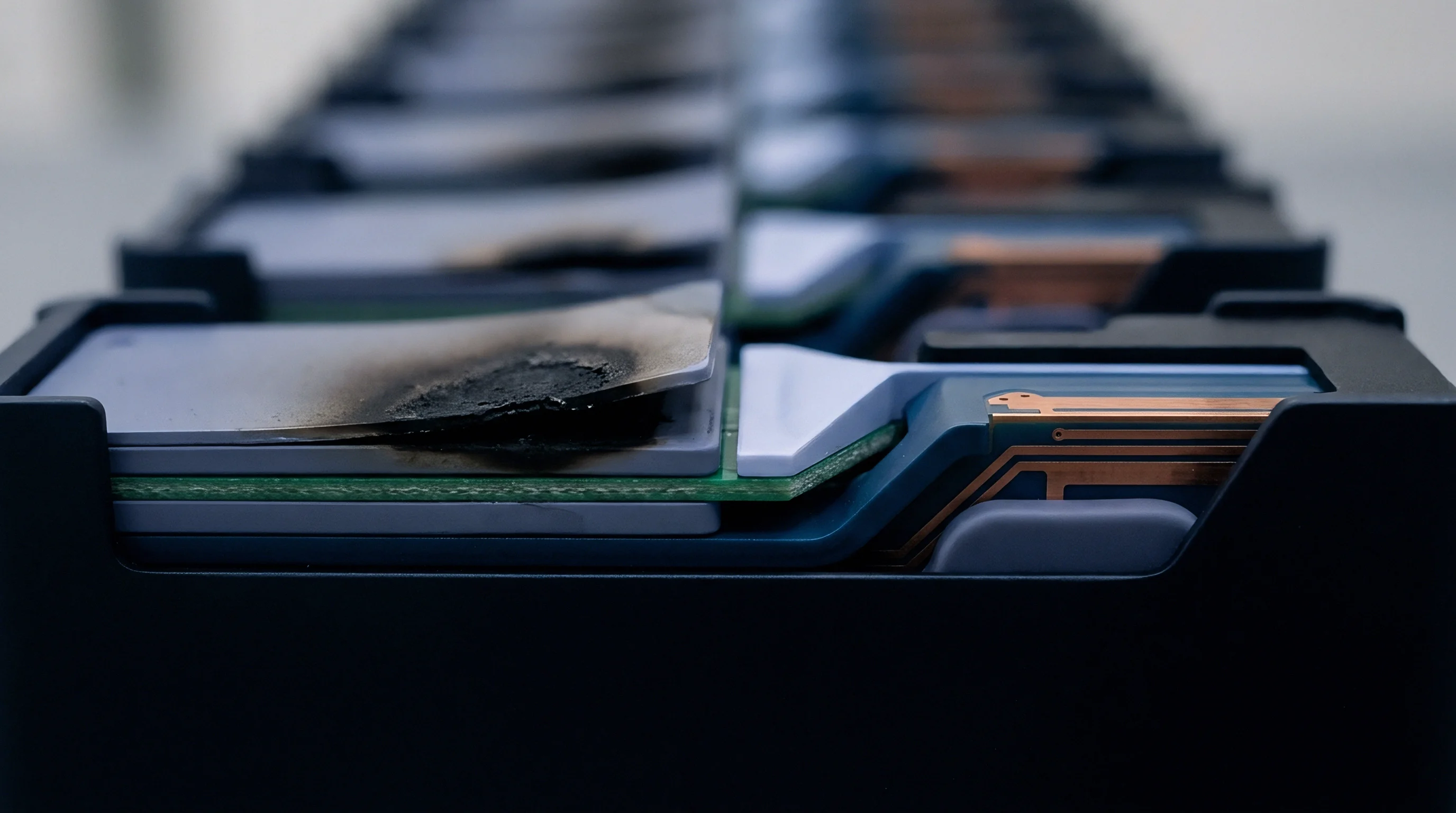
Battery longevity in cellular telemetry hardware correlates directly with total radio transmission duration and state transition timing. Protocol overhead bytes expand active transmit times, elevating peak power consumption and holding modems in high-drain Radio Resource Control states.
When an LTE-M or NB-IoT modem transmits data, power consumption increases from microampere sleep levels to peak current levels ranging from 70 mA to 220 mA at +23 dBm output power into a 50-ohm load. Transmitting 500 header bytes over a low-rate NB-IoT link operating at 20 kbps uplink throughput adds 200 milliseconds of RF transmit time. Longer transmissions increase thermal stress on internal battery structures, exacerbating voltage dip effects in lithium thionyl chloride cells.
Short bursts lower thermal stress.

Radio Energy Consumption Dynamics and Tail Timers
After data transmission finishes, mobile network operator configurations hold the modem in RRC Connected Mode via inactivity tail timers (T310). Network operators configure tail timers between 6 and 20 seconds to allow incoming downlink data without requiring connection re-establishment. During this tail window, modem circuitry draws between 15 mA and 60 mA while monitoring physical downlink control channels.
Tail timers extend active current.
Sending multiple round-trip packets, such as TCP acknowledgments or TLS handshake steps, repeatedly resets the operator tail timer. A single payload transaction requiring three protocol round trips holds the modem in high-current RRC Connected mode for three consecutive tail periods, consuming up to 80 percent of total battery energy for that transmission event. Handshakes consume available transmission budget.
Modem power consumption is dominated by the RRC connected tail timer duration rather than active transmit bursts for small payload sizes.
Carrier Data Plan Billing Bucket Mechanics
Mobile network operators apply data session billing thresholds that compound header overhead financial costs. Carrier billing engines frequently round individual data connections to 1 KB, 10 KB, or 100 KB billing increments. If an unoptimized protocol stack generates 1,050 bytes of combined payload and header traffic per session, the operator rounds the usage to 2 KB or 10 KB depending on contract tier structure.
Carrier billing rules dictate efficiency.
- Measure baseline inactive sleep draw and active modem transmission current using a high-bandwidth current probe across all operating voltage states.
- Tally total transmitted and received byte volume per session across L1 through application layers to establish actual airtime requirements.
- Calculate energy consumed during the RRC tail timer window by multiplying idle connected current by the operator inactivity duration.
- Model total daily battery capacity depletion by integrating sleep state current, transmission burst energy, and carrier billing byte rounding penalties.
Underestimating header overhead leads directly to undersized battery selection, causing premature device failures in field deployments long before reaching targeted service lifetimes.


Arithmetic
Evaluating transport performance across a deployment relies on a systematic tally of layer headers, handshake steps, and keepalive transmissions. Mathematically modeling these parameters yields clear comparisons of battery life and data costs across competing architecture designs.
Payload expansion ratio defines the structural efficiency of a protocol stack: Expansion Ratio = Total Transmitted Wire Bytes / Application Payload Bytes A higher expansion ratio indicates greater protocol overhead relative to sensor telemetry volume.

Worked Battery Lifetime Sizing Comparison
Assume a smart water meter transmits 24 bytes of sensor telemetry once every 24 hours over a 10-year target lifetime powered by a 3.6V 19 Ah LiSOCl2 battery (68,400 Joules usable energy). The modem operating environment exhibits an average RRC tail timer of 10 seconds at 35 mA idle current, with a peak transmit current of 120 mA at 3.6V. Baseline sleep current is 3.5 uA.
Stack A uses HTTP REST over TLS 1.2 (full handshake) over TCP/IPv4 via LTE-M User Plane. Setup and teardown require TCP SYN/FIN frames (380 bytes), TLS Certificate handshake (3,200 bytes), HTTP headers (350 bytes), and TCP ACK frames (240 bytes). Total wire volume reaches 4,194 bytes.
The multi-packet exchange resets the tail timer twice, producing 30 seconds of active RRC connected duration. Total energy draw per daily report equals 4.15 Joules. The calculated battery depletion rate limits operational field life to 6.8 years.
Stack B uses CoAP over DTLS 1.3 (PSK) over UDP/IPv4 via NB-IoT User Plane. Session setup uses a 1-RTT PSK handshake (380 bytes), CoAP header (11 bytes), and DTLS record security overhead (29 bytes). Total wire volume equals 444 bytes.
Airtime completes within 350 ms, holding the RRC connected tail timer for one 10-second window. Total energy consumption per daily report equals 1.32 Joules. Calculated battery service life reaches 14.1 years.
Stack C uses NIDD with OSCORE over NB-IoT Control Plane optimization. Data moves directly over non-access stratum frames with 9 bytes of ESM header, 11 bytes of CoAP header, and 12 bytes of OSCORE security option. No IP, TCP, UDP, or TLS handshakes occur.
Total wire volume equals 56 bytes. Transport completes in a single transmission burst, allowing immediate teardown with a 2-second fast return to sleep. Total energy consumption per daily report equals 0.28 Joules.
Calculated battery service life easily clears the 10-year target threshold, reaching 22.4 years.

Stack Selection Matrix for Constrained Telemetry
Payload expansion directly affects cellular data tier placement. Transmitting Stack A daily consumes 125.8 KB of uncompressed cellular data per month, which rounds to 3.75 MB under 10 KB session billing rules. Stack C consumes 1.68 KB per month, rounding to 30 KB under equivalent carrier billing rules.
Data plan thresholds compound rapidly.
| Metric / Layer Parameter | Stack A: HTTP / TLS 1.2 / TCP / IPv4 | Stack B: CoAP / DTLS 1.3 PSK / UDP | Stack C: NIDD / OSCORE / DoNAS |
|---|---|---|---|
| Application Payload | 24 Bytes | 24 Bytes | 24 Bytes |
| Total Wire Bytes per Transmission | 4,194 Bytes | 444 Bytes | 56 Bytes |
| Payload Expansion Ratio | 174.75 : 1 | 18.50 : 1 | 2.33 : 1 |
| Active Connected Airtime | 30.0 Seconds | 10.35 Seconds | 2.10 Seconds |
| Daily Energy Consumption | 4.15 Joules | 1.32 Joules | 0.28 Joules |
| Billed Data Volume / Month (10KB Bucket) | 3.75 MB | 300 KB | 30 KB |
| Projected 19 Ah Battery Lifetime | 6.8 Years | 14.1 Years | 22.4 Years |
| Calculations assume 3.6V supply voltage, 3.5 uA sleep current, 35 mA RRC idle current, 120 mA peak Tx current, and one transmission cycle per 24-hour period. | |||
Selecting the optimal protocol stack for cellular telemetry demands matching layer overhead with cellular core network capabilities and battery discharge profiles. System architects who tally every header byte from physical transport blocks to application payloads insulate hardware designs from early battery exhaustion and unexpected carrier data overage charges.