Evaluating Unlicensed Spectrum Congestion and Statutory Duty Cycle Compliance under Mass IoT Deployments
Operating mass IoT nodes within legal duty cycle limits demands payload compression, randomized airtime jitter, and automated multi-node sweep audits.


Density
Packing tens of thousands of battery-powered endpoints into a single sub-GHz or 2.4 GHz footprint alters the RF environment completely. In sparse layouts, nodes compete mostly with thermal noise near -174 dBm/Hz. Once gateway loads climb into the thousands, overlapping transmissions turn the deployment into an interference-limited channel. Unlicensed sub-GHz bands ~ such as 863 ~ 870 MHz in Europe and 902 ~ 928 MHz across North America ~ show measurable rises in aggregate noise as soon as local transmitter density passes a few hundred active devices per square kilometer.
Antenna height, ground plane layout, and device enclosures all determine the effective isotropic radiated power (EIRP) that reaches the channel. A +14 dBm radio sitting behind reinforced concrete easily drops 15 dB to 25 dB. System designs typically react by cranking output power or throttling data rates to buy back link margin with processing gain.
Throttling data rates, however, stretches time on the air: a packet that clears in 30 milliseconds at 50 kbps can tie up the channel for more than 400 milliseconds at lower bitrates, widening the temporal footprint of every single frame.
Thermal noise floors yield to aggregate physical interference as spatial transmitter counts cross critical node thresholds.
System designers routinely evaluate single links with standard log-distance path loss models, ignoring how concurrent traffic loads the channel. Link budgets measured on an isolated bench fall apart in field deployments. When three hundred nodes transmit across the same five-minute window on a shared channel, receiver front-ends suffer severe desensitization.
Spurious emissions and out-of-band bleed from neighboring devices spill across nominal channel edges, pushing operational noise floors from -120 dBm up to -98 dBm in heavy industrial environments.
Spectrum Occupancy and Channel Congestion Dynamics
Calculating spectrum occupancy requires factoring in both spatial distribution and duty cycles across every overlapping transmitter. In the 2.4 GHz ISM band, Wi-Fi activity on channels 1, 6, and 11 pours continuous wideband energy over lower-power IEEE 802.15.4 or Bluetooth Low Energy traffic. Sub-GHz allocations create the opposite problem: the longer wavelengths punch through building materials far better, but the narrower bands leave thousands of field devices crowding into a handful of shared channels.
High node densities also degrade receiver noise figures via non-linear intermodulation. When two strong out-of-band signals hit a low-noise amplifier (LNA) at the same time, third-order mixing products land squarely inside adjacent receive channels. The effective signal-to-noise-and-interference ratio (SINR) then plunges below the demodulation threshold, dropping frames even when raw received signal strength indicator (RSSI) readings look entirely healthy.
| Frequency Allocation | Nominal Channel Width | Typical Receiver Sensitivity | Observed Noise Floor Rise | Max Node Density Before PER > 10% |
|---|---|---|---|---|
| 868 MHz (EU Sub-band g1) | 125 kHz / 250 kHz | -137 dBm (SF12) to -117 dBm (SF7) | +12 dB to +18 dB | 450 nodes/km² |
| 915 MHz (US ISM) | 125 kHz / 500 kHz | -136 dBm (SF12) to -116 dBm (SF7) | +14 dB to +22 dB | 850 nodes/km² |
| 2.4 GHz (Global ISM) | 2 MHz (BLE) / 5 MHz (Zigbee) | -97 dBm (BLE 1M) to -102 dBm (Zigbee) | +25 dB to +35 dB | 1,200 nodes/km² |

Sub-GHz Channel Allocation in Mass Sensor Fleets
Fleet deployment planning has to handle uneven traffic arrival. Environmental sensor arrays often sit idle for hours before an external event wakes the entire cluster at once. That synchronized surge dumps packet traffic into tight, dense bursts, breaking the standard assumptions of steady-state Poisson models.
Random channel access breaks down rapidly under these burst conditions. Unslotted ALOHA tops out at an 18.4% theoretical throughput ceiling before collisions collapse the link entirely. Slotted ALOHA doubles that ceiling to 36.8%, but forces tight time coordination across every node.
Holding tight clock alignment across ten thousand low-cost crystals drains battery life quickly, since endpoints must wake on schedule simply to catch synchronization beacons.
RF coverage planning depends on realistic link margins. Sizing link budgets against baseline noise recorded in an empty band leads to field failures the moment the full inventory goes live.

Statute
Unlicensed frequency bands depend on strict regulatory constraints to keep spectrum usable across competing deployments. In practice, statutory duty-cycle limits place a rigid ceiling on firmware architecture: endpoints must meter their airtime within rolling windows or rely on certified mitigation mechanisms such as Listen-Before-Talk (LBT) and Adaptive Frequency Hopping (AFH). Operating outside these limits invalidates type certifications and risks forced market recalls.
For sub-GHz equipment in Europe, ETSI EN 300 220-1 divides allocations into discrete sub-bands with specific duty-cycle caps. The 868.0 ~ 868.6 MHz allocation imposes a 1.0% limit, restricting each endpoint to 36 seconds of cumulative airtime per hour. Channels between 868.7 MHz and 869.2 MHz drop that allowance to 0.1%, or barely 3.6 seconds an hour.
Crucially, the clock counts total transmitter on-time, including preambles, headers, payload data, and forward error correction overhead.
ETSI EN 300 220-1 Annex E clause 5.1 limits total transmitter airtime across rolling one-hour observation windows without exception for packet retransmissions.
In North America, Part 15 subpart C of the Federal Communications Commission (FCC) rules takes an alternate approach. FCC Part 15.247 omits hard duty-cycle percentages for digitally modulated transmitters in the 902 ~ 928 MHz band, capping peak conducted output at 1 Watt (+30 dBm) instead, provided the radio runs direct sequence (DSSS) or frequency-hopping spread spectrum (FHSS) across a compliant channel count. Frequency-hopping systems utilizing fewer than 50 channels must enforce a dwell time limit of no more than 0.4 seconds per channel within any 20-second window.

Regional Duty Cycle Ceilings and Dwell Rules
Managing divergent international regulations requires region-specific firmware profiles. Builds for the European market require software limiters linked to non-volatile millisecond counters. When repeated delivery attempts exhaust the 36-second hourly allotment, the radio driver has to drop outgoing transmission queues until the rolling window rolls over.
Under Japan’s ARIB STD-T108 standard, 920 MHz sensor nodes must pair carrier-sense checks with hard burst limits. Single transmissions cannot exceed 400 milliseconds and require a subsequent pause of at least 2 milliseconds ~ or an interval matching the prior transmission duration, depending on output power. Maintaining compliance means embedding strict timer enforcement directly into the lower layers of the device firmware.
| Regulatory Body | Standard / Rule | Target Frequency Band | Duty Cycle / Airtime Limit | Max Radiated Power (EIRP) |
|---|---|---|---|---|
| ETSI (Europe) | EN 300 220-1 sub-band g1 | 868.0 ~ 868.6 MHz | 1.0% (36 sec / hour) | +14 dBm (25 mW) |
| ETSI (Europe) | EN 300 220-1 sub-band g2 | 868.7 ~ 869.2 MHz | 0.1% (3.6 sec / hour) | +14 dBm (25 mW) |
| FCC (USA) | Part 15.247 (FHSS >= 50 channels) | 902.0 ~ 928.0 MHz | Max 0.4 sec dwell per 20 sec window | +30 dBm (1 Watt) |
| ARIB (Japan) | STD-T108 | 915.0 ~ 928.0 MHz | Max 400 ms burst duration | +13 dBm (20 mW) |

Listen before Talk and Clear Channel Assessment
Some statutory frameworks relax standard duty caps for transceivers utilizing certified Listen-Before-Talk routines. Under ETSI EN 300 220-1, pairing LBT with Adaptive Frequency Agility (AFA) grants higher throughput allowances provided the radio runs a Clear Channel Assessment (CCA) prior to each transmission. The receiver holds a continuous listen window for a set interval ~ typically 5 milliseconds ~ to gauge ambient power on the channel.
These Clear Channel Assessment thresholds follow strict formulas. ETSI ties the detection threshold to transmit power and channel bandwidth, establishing an energy cutoff near -85 dBm for 14 dBm transmitters. Any measured RF energy above that level flags the channel as occupied, requiring the endpoint to back off for a randomized delay before running another check.
- Initialize low-power system timers and retrieve queued payload bytes from microcontroller NVRAM.
- Query airtime tracking registers to verify that cumulative transmission time remains within hourly statutory limits.
- Tune the transceiver front-end to the target channel and drop into a low-noise receive state for the carrier-sense duration.
- Integrate received RSSI across a 5-millisecond window and compare the measurement against the legal threshold.
- Trigger an exponential backoff routine if detected channel energy exceeds the maximum threshold limit.
- Assert the power amplifier, modulate the payload frame, and log the packet’s total burst duration to persistent memory.
Overlooking airtime tracking introduces major commercial risk for hardware manufacturers shipping across multiple jurisdictions. Formal proof of compliance is a mandatory component of the technical documentation required for the EU Declaration of Conformity.
Interference
Packet collisions within shared unlicensed bands degrade channel efficiency rapidly as local node counts multiply. Most packet loss in massive IoT rollouts traces straight to simultaneous transmissions across overlapping frequencies. While schemes like Chirp Spread Spectrum (CSS) and Direct Sequence Spread Spectrum offer theoretical orthogonality across spreading factors or chip sequences, that separation erodes in real environments.
Capture effects complicate typical collision models. When two frames clash on the same frequency, a receiver demodulating the weaker signal can re-lock onto the stronger one if the power gap clears the capture threshold ~ roughly 6 dB for FSK, or between 1 dB and 3 dB for spread spectrum. The dropped transmission becomes in-band noise, driving up packet error rates (PER) for surrounding nodes that operate near sensitivity limits.
At Spreading Factor 12, a LoRaWAN payload requires 1,482 milliseconds on the air at 125 kHz bandwidth, consuming 40 times more temporal capacity than an equivalent SF7 burst.
Non-orthogonal leakage across spreading factors creates a major bottleneck in dense sub-GHz networks. SF7 through SF12 transmissions are theoretically independent on the same center frequency, but a high-power SF7 transmission nearby easily bleeds into and destroys a distant SF12 packet. Power differentials between a nearby transmitter and a fringe node frequently exceed 40 dB, demolishing theoretical orthogonality and driving high packet error rates across long-distance links.

Packet Collision Mechanisms in Unslotted Systems
Calculating collision probabilities requires accounting for spatial distribution, packet duration, and transmission intervals. Modeling node positions as a spatial Poisson point process yields exponential arrival distributions in time. Here, channel occupancy S scales directly with the product of active nodes N, packet arrival rate λ, and airtime duration T.
In unslotted ALOHA networks, the collision window spans twice the frame duration (2T). Any second radio keying up within that window corrupts both packets unless capture margin saves the stronger one. As node counts climb into the thousands, retry cascades quickly choke the channel, with transmitters burning battery capacity attempting retries over an already saturated band.
| Active Endpoint Count | Payload Size (Bytes) | Mean Transmission Interval | Observed PER (SF7, 125 kHz) | Observed PER (SF12, 125 kHz) |
|---|---|---|---|---|
| 500 | 50 | 15 minutes | 1.2% | 8.4% |
| 2,500 | 50 | 15 minutes | 5.8% | 34.1% |
| 10,000 | 50 | 15 minutes | 22.4% | 79.6% |
| 50,000 | 50 | 15 minutes | 61.3% | 98.2% |
Can Transmitter Synchronization Prevent Sub-GHz Spectrum Exhaustion?
Coordinating transmission windows across endpoints cuts the collision vulnerability interval in half relative to unslotted setups. Time-slotted channel hopping (TSCH), derived from IEEE 802.15.4e, sections time into discrete slots ~ typically 10 milliseconds wide. Endpoints hop across predefined pseudo-random channel sequences with every slot, spreading energy uniformly across the band.
Holding tight network timing on strict power budgets carries steep operational penalties. Gateways must broadcast periodic synchronization beacons, and endpoints must burn receiver current capturing those time markers ~ drawing down non-replaceable lithium thionyl chloride cells. If local oscillator drift causes an endpoint to miss consecutive sync frames, the radio drops into a continuous receiver search mode, draining battery reserves in short order.
Dense endpoint layouts drag down network throughput well before statutory duty limits ever come into play, leaving open the mathematical threshold at which deploying additional gateways stops recovering capacity because of widespread preamble collisions.

Bench
Verifying statutory duty-cycle limits and catching performance drop-offs requires physical test equipment rather than software reporting. Firmware logs cannot be trusted for compliance: stalled RTOS tasks or corrupted timer loops can cause transceivers to transmit continuously without logging the airtime. Reliable testing requires independent physical-layer capture using calibrated spectrum analyzers, high-speed current profilers, and dedicated test automation.
Current profiling provides clear visibility into the internal states of the radio. Transceivers exhibit distinct current draws across modes ~ roughly 1.5 microamps in deep sleep, 12 milliamps during active reception, and 45 to 120 milliamps when keyed up for transmission, depending on the power amplifier output. Sampling with high-bandwidth current probes at 1 megasample per second resolves transmission bursts down to the microsecond, confirming actual RF airtime against register configurations.
Physical measurement of current draw profiles provides indisputable verification of transmitter airtime duty cycles independent of internal firmware accounting logs.
Real-time FFT sweeps on a spectrum analyzer reveal dynamic channel loading and unexpected interference. Max-hold traces expose persistent narrow-band interferers, spurious emissions, and out-of-band leakage. In zero-span mode, the analyzer isolates frame preambles, payload blocks, and mandatory inter-frame quiet intervals directly in the time domain, confirming adherence to regional rules.
Measurement Setups for Duty Cycle Compliance
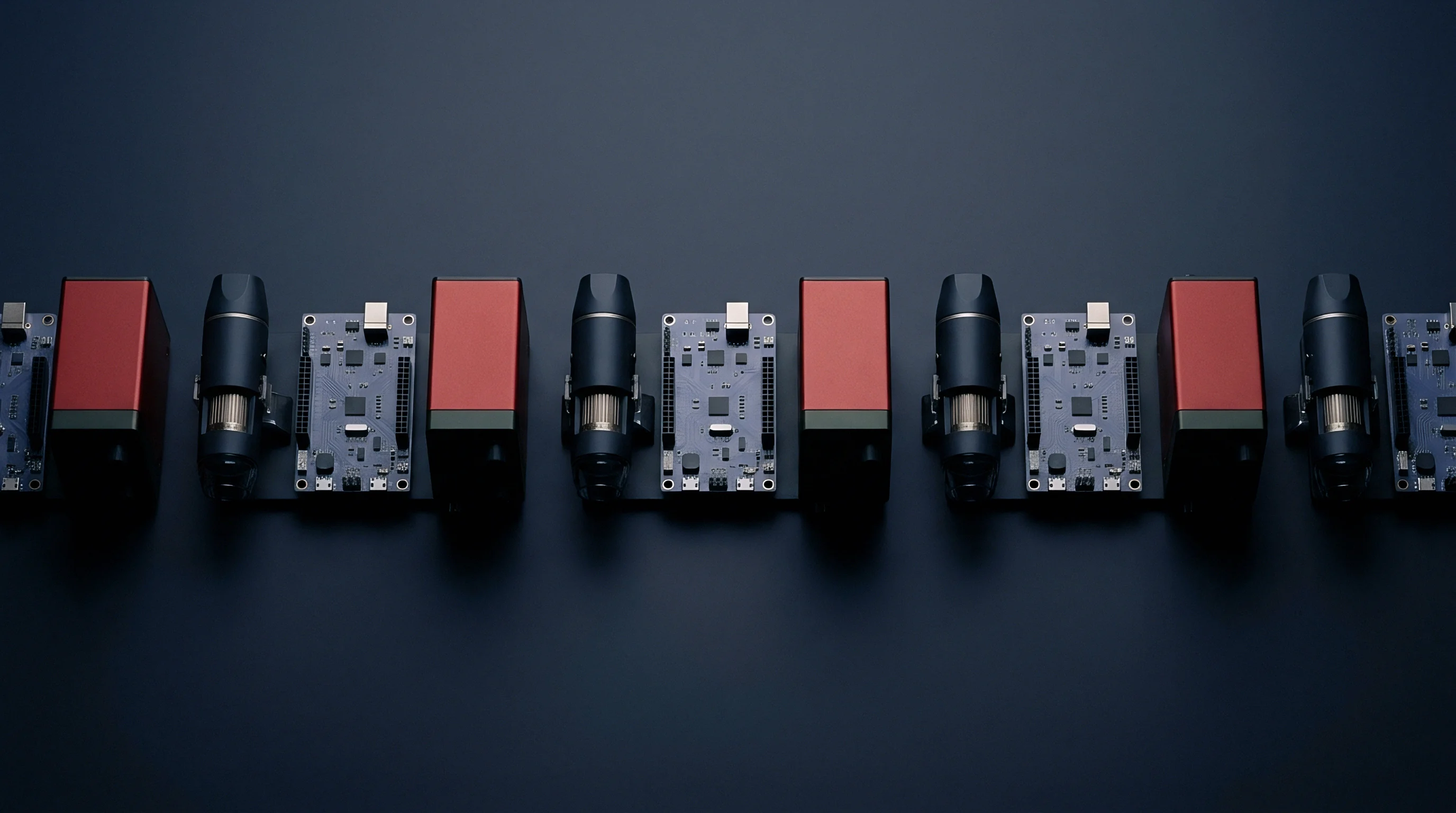
Formal type approval requires placing the device under test (DUT) inside a fully shielded anechoic chamber to strip out external RF signals. For conducted evaluations, the DUT antenna port connects straight to test instruments through calibrated coaxial attenuators. Power meters capture peak radiated power, while digital oscilloscopes monitor transmit-enable GPIO lines to log exact trigger states.
Validation test suites must push hardware into its worst-case operational states. Automated scripts trigger simulated sensor events in rapid succession, forcing the firmware into back-to-back queueing and aggressive retry cycles. Measuring cumulative on-air time over multi-hour runs verifies hard compliance with the one-hour rolling caps defined by ETSI EN 300 220.
- Connect the DUT antenna port directly to a 20 dB calibrated attenuator feeding the real-time spectrum analyzer.
- Insert a high-side current shunt sampled by an isolated differential probe operating at no less than 1 MS/s.
- Power the DUT and run normal boot routines while logging the baseline current profile.
- Fire automated digital I/O lines to trigger simulated sensor events that force maximum transmission rates.
- Record gapless trace data across a continuous 3,600-second test window.
- Integrate total duration where current draw exceeds baseline receive levels to calculate statutory duty cycle percentages.

Bench Protocols for Multi Node Occupancy Audits
Replicating dense field conditions in the lab requires multi-node RF test fixtures linked through passive coaxial combiner matrices. Connecting 50 physical endpoints to a central gateway through programmable attenuation networks reproduces high-density deployments within a single rack, with attenuation values configured to match path losses between 60 dB and 130 dB.
These multi-node rigs verify receiver firmware resilience against deliberate in-band interference. Signal generators inject continuous-wave (CW) or modulated FSK carriers into adjacent channels while automated test software monitors packet delivery ratios (PDR), cataloging dropped packets, retry counts, and data rate fallbacks across step-adjusted signal-to-noise thresholds.
Flawed bench validation risks delivering hardware that fails regulatory compliance checks in the field, exposing shipments to customs holds and mandatory commercial recalls.

Topology
Managing unlicensed spectrum congestion within legal duty cycles requires fundamental architectural adjustments. Boosting transmit power does not fix link budgets in dense environments; it only accelerates channel saturation. Controlling packet loss requires minimizing per-node airtime, distributing gateways more aggressively, and building in secondary protocol paths.
Compressing payload structures cuts on-air time immediately. Sending raw JSON or uncompressed binary tables wastes airtime unnecessarily. Packaging data with CBOR (Concise Binary Object Representation) or tailored bit-packed binary formats cuts payload sizes by up to 70%.
Smaller payloads shorten transmission bursts, preserving valuable margin beneath statutory duty-cycle ceilings.
Bit-packed binary payloads combined with randomized jitter delays mitigate mutual packet collision rates without increasing gateway physical hardware costs.
Introducing deliberate transmission jitter breaks up synchronized cadence patterns. When thousands of endpoints wake on hard periodic intervals, their transmit schedules eventually drift into phase, causing cyclical packet storms. Injecting pseudo-random delays into outbound queue dispatchers spreads transmissions across the operating window instead.

Payload Minimization and Transmission Jitter
Dynamic data rate adaptation balances link margins against total channel occupancy. Adaptive Data Rate (ADR) routines analyze received signal strength and SNR histories over moving frame windows, bumping nodes near the gateway up to faster bitrates to free up airtime, and reserving slower, high-processing-gain modulations strictly for fringe devices that need the link margin.
Randomization routines need non-repeating seed sequences tied directly to unique device identifiers (UUIDs). Shared or static seeds leave nodes drifting in lockstep over extended intervals. Adding pseudo-random variance between 20% and 50% of the standard reporting period smooths out traffic spikes, preventing channel collapse during coordinated telemetry events.
Hybrid Sub-GHz and Cellular Gateway Architectures
Routing high-frequency or priority sensor data over licensed cellular bands relieves strain on congested sub-GHz frequencies. Dual-radio architectures pairing local sub-GHz links with LTE-M (Cat-M1) or NB-IoT modems segregate high-volume sensor traffic from the backhaul network. Local nodes deliver low-power sub-GHz frames to field aggregators, which bundle the telemetry for upload via secure cellular connections.
Licensed cellular spectrum sidesteps fractional duty-cycle restrictions entirely, removing unlicensed band constraints from backhaul operations. Recurring SIM costs increase operational expenses, but delivery reliability rises in proportion. Dual-mode setups allow policy-driven traffic routing: routine heartbeats travel across unlicensed sub-GHz channels, while mission-critical events switch directly to cellular carriers.
While proprietary protocol stacks are presented as resolving high-density interference through software alone, uncoordinated transmissions in unsegmented sub-GHz channels hit physical airtime boundaries regardless of protocol adjustments.