Basic KC Certification Mechanics for Radio Equipment Importers
Radio imports into South Korea require RRA conformity assessment through designated domestic lab testing, local agent representation, and strict KC marking.
Statute
South Korea regulates intentional radiators under Article 58-2 of the Radio Waves Act, with technical enforcement delegated to the National Radio Research Agency. Equipment falls into three compliance tracks depending on output power, operating band, and potential spectrum impact. Commercial radio gear almost always requires Certification of Conformity or Registration of Conformity, while Interim Assessment is reserved for technologies without published test standards.
An overseas vendor’s claim that a product is certified for international commerce carries no legal weight at the port of Busan or Incheon. Korean regulation is strictly territorial: importers must either test through an accredited domestic lab or show compliance under a bilateral Mutual Recognition Agreement covering designated conformity assessment bodies.
The divide between certification and registration dictates test scope, dossier size, and post-market audit scrutiny. High-output transceivers, cellular equipment, and public safety gear require Certification of Conformity. Short-range devices ~ such as standard 2.4 GHz and 5 GHz industrial controllers, smart home sensors, and commercial radio modules ~ fall under Registration of Conformity.
This distinction determines whether a manufacturer must submit a full design dossier for state administrative review or upload an accredited lab test report to the agency portal.
| Conformity Track | Statutory Basis | Target Radio Equipment | Review Entity | Typical Queue Duration |
|---|---|---|---|---|
| Certification of Conformity | Radio Waves Act Article 58-2, Clause 2 | Cellular base stations, marine safety radios, high-power transmitters | National Radio Research Agency | Three to five weeks |
| Registration of Conformity | Radio Waves Act Article 58-2, Clause 3 | Wi-Fi routers, Bluetooth Low Energy transceivers, RFID readers, short-range devices | Designated testing laboratories | One to two weeks |
| Interim Conformity Assessment | Radio Waves Act Article 58-2, Clause 4 | Proprietary millimeter-wave links without established national testing standards | Ministry of Science and ICT | Eight to sixteen weeks |
Both filing paths require a direct link between the applicant and the Korean domestic market. A foreign manufacturer without a commercial registration in South Korea cannot submit paperwork solely under its own corporate name without naming an authorized local representative. The entity listed on the certificate assumes full civil and administrative liability for any radio violations discovered in the market.
Importers often buy from original design manufacturers who claim existing certification, only to learn at customs that the certificate belongs to a competing trading house.
Article 58-2 of the Korean Radio Waves Act invalidates customs entry for any imported intentional radiator lacking an agency-registered applicant identity.
Administrative requirements shape the timeline long before hardware enters a test chamber. First, every applicant must secure a unique three-character corporate identification code from the agency. This code serves as the prefix for every conformity string permanently marked on product enclosures.
Setting up this corporate identity early avoids costly modifications to packaging tooling and injection molds mid-production.
- Corporate Applicant Code secures the statutory three-character company identifier issued by the national research agency before laboratory registration opens.
- Radio Interface Specification details operational frequency ranges, maximum power ratings, antenna peak gain figures, and emission masks across all intended modes.
- Schematic Circuit Diagrams reveal full transmitter architecture down to individual passive component values and oscillator layout topology.
- Block Signal Architecture maps clock distributions, intermediate frequencies, mixer stages, and internal shielding boundaries for laboratory evaluation.
Commercial contracts need to assign compliance responsibilities clearly between foreign factories and domestic distributors. A well-drafted supply agreement places financial liability for lab retesting and administrative filings on whichever party modifies the RF hardware or enclosure layout.

Specimen
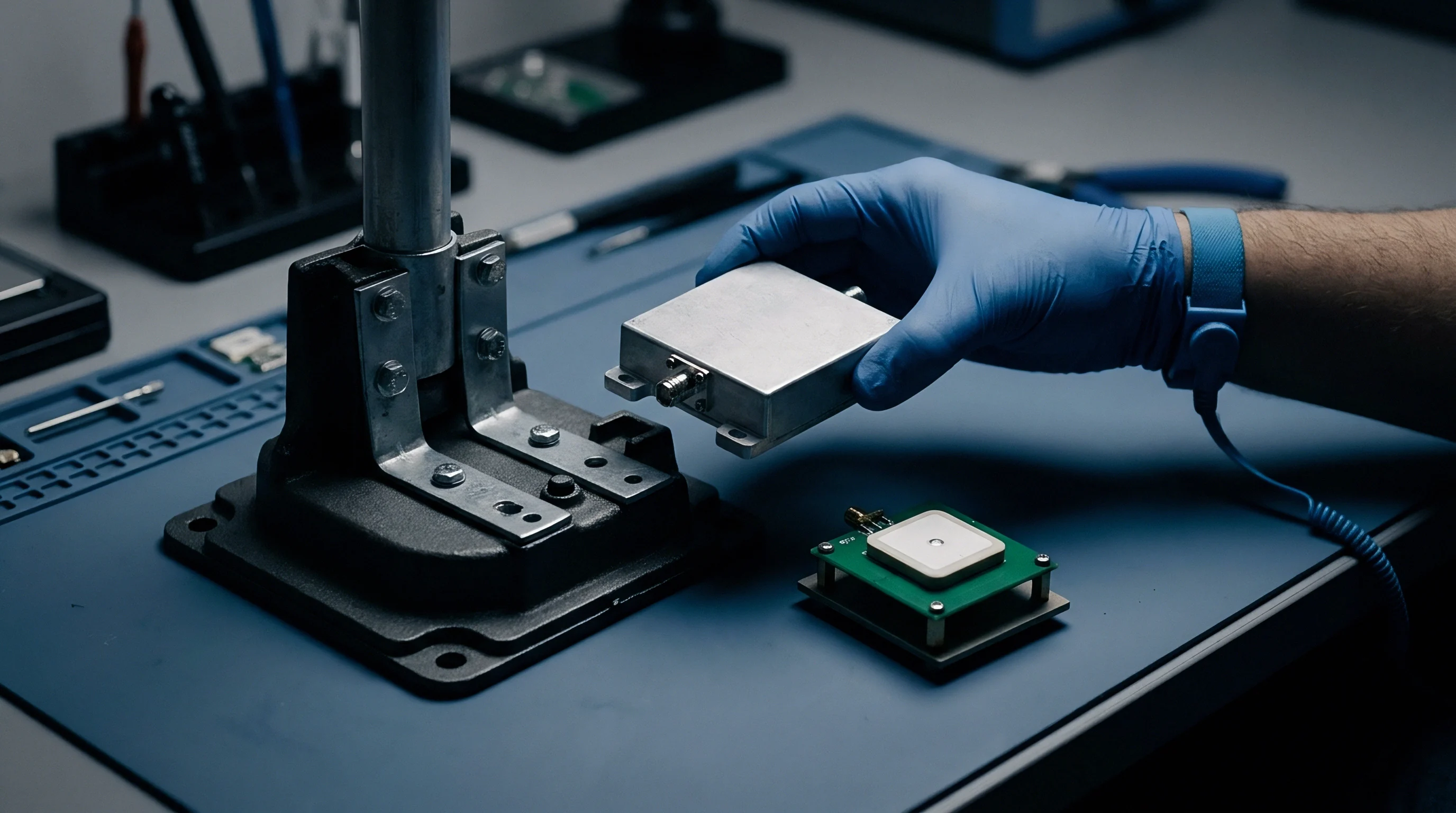
Testing intentional radiators in Korean labs requires specialized test hardware prepared for bench analysis and anechoic chamber sweeps. Off-the-shelf production units running standard consumer firmware fail intake within minutes because test engineers need direct control over carrier frequency, modulation schemes, channel bandwidth, and output power. Hardware that boots straight into pairing mode or searches for an access point wastes bench time.
Instead, importers must supply modified firmware images and serial commands that lock the transmitter into continuous transmission at maximum rated power.
Conducted test samples need external ports. Engineers build these by removing surface-mount ceramic or trace antennas and soldering semi-rigid coaxial pigtails with female SMA connectors. Poor soldering introduces parasitic inductance that skews output power readings and out-of-band spurious emissions.
Labs inspect these connections under magnification before hooking them up to calibrated spectrum analyzers and power sensors.
Conducted power measurements drift up to 1.8 dB when high-frequency semi-rigid coaxial pigtails exceed fifteen millimeters in unsupported length during 5 GHz carrier sweeps.
Radiated measurements are conducted in anechoic chambers to quantify effective radiated power, spurious emissions, and EMC. As the turntable completes a full 360-degree revolution, antennas move vertically from one to four meters to capture polar patterns and field intensities in both horizontal and vertical planes. Evaluation extends to the tenth harmonic of the highest fundamental frequency.
If an internal digital clock runs at 1.2 GHz while the radio operates at 2.4 GHz, the scan reaches 24 GHz, exposing trace cross-talk and inadequate shielding.
Can Foreign Importers Hold Radio Registrations Directly?
Under the Radio Waves Act, grants are issued only to domestic corporate entities or foreign companies with an officially designated local agent in South Korea. Without a Korean business registration number, a foreign enterprise cannot serve as the sole administrative contact. Establishing a Korean branch or hiring an independent compliance agent satisfies the law.
However, if an overseas brand lets a local distributor hold the certificate, that distributor gains exclusive control over market access ~ forcing the manufacturer to pay for new lab testing if they switch distributors.
- Firmware Command Latency causes transceiver register lockups when laboratory software pulses modulation state toggles faster than fifty milliseconds.
- Impedance Mismatch Degradation produces artificial harmonic spikes during conducted testing due to poorly matched PCB trace terminations on modified test boards.
- Heat Sink Thermal Saturation drops continuous wave power levels when transmitters operate at maximum output without production enclosure airflow.
- Electrolytic Capacitor ESR Spikes inject switching noise across power rails, tripping conducted emissions thresholds between 150 kHz and 30 MHz.
Modulation settings directly drive testing duration. Technicians must run separate sweeps for every supported modulation format, from legacy Gaussian Frequency Shift Keying to high-order Quadrature Amplitude Modulation. For multi-protocol systems-on-chip, each protocol is tested sequentially.
Omitting even one supported channel configuration invalidates the entire dataset, stopping registration until the sample can be remounted on the turntable.
Standard factory test fixtures rarely satisfy Korean laboratory requirements; test engineers routinely discard non-conforming test cables and require rebuilds of the conducted RF interface.
Dock
Cargo arriving at Korean ports faces immediate scrutiny from the Korea Customs Service, which links directly to the national research agency clearance portal. Officers check bills of lading, commercial invoices, and model numbers against the public registry of conformity certificates. If the model number stamped on a product housing differs from the certificate string by even a single hyphen, the system places an automatic hold on the shipment ~ and port warehouses charge steep daily demurrage fees while discrepancies are resolved.
Inspectors randomly pull cartons off pallets to check physical markings. Compliant products must display the official KC logo alongside a unique fifteen-character certification code on the packaging, outer carton, and physical housing. While micro-sized consumer goods sometimes qualify for exemptions that permit marking only on packaging and user manuals, intentional radiators almost never qualify for this relief.
- Declaration Submission transmits the import entry manifest through the UNIPASS clearance portal matching harmonized tariff codes with regulatory identifiers.
- Automated Cross-Referencing queries the research agency database to confirm the applicant business registration aligns precisely with the importing entity.
- Physical Carton Inspection pulls targeted cargo lots onto the examination dock to verify typography, logo geometry, and country of origin declarations.
- Release Authorization clears cargo out of bonded holding zones into national transportation corridors following digital reconciliation of test documentation.
Label dimensions must follow strict geometric proportions. The KC logo uses fixed contours that cannot be squeezed or restyled to fit compact product designs. The mark must be at least five millimeters tall unless extreme size constraints justify proportional scaling.
Below the mark, text in clear Korean must list the product name, basic model, certification number, applicant name, manufacture date, and country of origin.
Unmarked radio housings flagged at customs physical audit trigger mandatory relabeling inside bonded warehouses at rates exceeding forty thousand won per pallet hour.
Minor documentation errors will freeze clearance. If a freight forwarder enters a general series name instead of the exact certified model number, customs flags the shipment as an illegal radio import. Resolving this requires submitting technical explanations, photo evidence of casing labels, and formal correction paperwork before the cargo can leave bonded storage.
Customs checks the agency database directly; if a registration number does not appear in the system, port authorities refuse admission and order the cargo re-exported or destroyed at the importer’s expense.
Grant
A final conformity certificate is the legal prerequisite for selling radio equipment in South Korea. The grant sets strict limits on operating parameters, allowed internal antennas, and intentional radiation levels. Any later change to the bill of materials, circuit board trace geometry, or housing material requires review under permissive change rules.
Unapproved hardware modifications instantly void the grant, exposing distributors to penalties under the Radio Waves Act.
The grant names the single entity authorized to import and sell the device. If an overseas manufacturer holds the certificate, any domestic distributor can import that exact configuration with written authorization from the holder. If a local distributor registers the certification under its own Korean corporate identity, it gains exclusive distribution rights.
Any competitor wanting to sell the same hardware must fund an independent testing campaign to secure its own certificate.
Which Circuit Changes Void an Existing KC Registration?
Modifying passive filters, changing an internal power amplifier, or altering antenna trace dimensions automatically voids a conformity certificate. Minor non-RF changes ~ like replacing a pull-up resistor or switching an outer plastic case for a non-metallic resin of identical density ~ qualify as class-one permissive changes that require only administrative notification. However, swapping the RF transceiver silicon or replacing a PCB trace antenna with an external dipole requires new laboratory evaluation, including partial emissions sweeps, before an amended report can be submitted to the agency.
| Hardware Modification Type | Agency Classification | Laboratory Testing Required | Administrative Filing Impact |
|---|---|---|---|
| Passive non-RF component value change | Minor variation | None | Administrative database update within thirty days |
| Alternative pin-compatible crystal oscillator | Technical modification | Conducted emissions and clock harmonic check | Amended certificate issued following lab review |
| Antenna trace layout or antenna type change | Major RF alteration | Complete RF output, spurious, and pattern retest | Full supplementary report filed with agency |
| Core radio transceiver silicon swap | Fundamental design change | Full standard testing suite across all parameters | Complete cancellation and new certificate filing |
Modular approvals create common traps for integrators. Placing a pre-certified radio module inside a host device does not exempt the complete product from compliance. Integrators must perform full EMC testing on the final assembly under Korean standards.
A host enclosure changes radiated emission profiles, and high-speed internal buses can introduce unwanted RF interference. Consequently, the finished product requires its own conformity registration as an integrated unit.
Unplanned retesting quickly doubles laboratory bills, while engineering modifications made without regulatory pre-screening risk invalidating months of marketing work and stranding inventory in supply chains. Unannounced component changes by suppliers create further risk, leaving importers unsure whether incoming shipments match the schematics on file with the agency.
Surcharge
Budgeting for Korean compliance requires accounting for lab chamber time, local representative fees, government filing charges, and shipping costs for test samples. While pricing among accredited private labs is competitive, costs climb quickly for multi-radio devices. A product combining dual-band Wi-Fi, classic Bluetooth, Bluetooth Low Energy, and a sub-GHz proprietary link multiplies required chamber hours because every band and modulation scheme demands separate testing.
Labs charge flat rates for initial sweeps but add hourly fees for firmware troubleshooting and stabilizing test modes. If a device fails spurious emission masks at 4.8 GHz, testing stops until engineers debug matching networks or flash revised firmware ~ all while hourly bench charges accrue. Retesting power levels or emissions quickly eats into contingency funds.
Long-term budgeting must account for ongoing maintenance as well as upfront testing. Retaining a local representative involves annual fees to Korean legal or technical firms that manage agency correspondence, track regulatory updates, and maintain technical dossiers for the mandatory five-year retention period. During post-market audits, this representative must produce schematics, test reports, and quality logs on short notice.
| Budgetary Expense Category | Scope and Deliverables | Typical Cost Range (KRW) | Duration Impact |
|---|---|---|---|
| Agency Corporate Code Assignment | One-time administrative setup on portal | 100,000 to 200,000 | Three business days |
| RF Conducted and Radiated Testing | 2.4 GHz and 5 GHz bands under KS X 3123 | 4,500,000 to 7,500,000 | Ten to fifteen business days |
| EMC Emissions and Immunity Testing | KS C 9832 and KS C 9835 standard scans | 2,000,000 to 3,500,000 | Five to eight business days |
| Local Representative Annual Retainer | Statutory representation and document escrow | 1,800,000 to 3,600,000 | Ongoing annual coverage |
| Government Filing and Certificate Issuance | National agency administrative registration | 150,000 to 350,000 | Two to four business days |
| Cost data reflects typical private accredited laboratory fee schedules in the Seoul metropolitan area, exclusive of value-added tax and sample transit logistics. | |||
Lab testing itself takes about three weeks, but the overall process stretches to eight or ten weeks when accounting for sample preparation, shipping, customs clearance, and bench debugging. Importers should build realistic buffers into launch schedules; shipping uncertified inventory early risks warehouse seizures, cancelled orders, and lasting damage with local partners.
Market entry comes down to balancing initial testing costs against long-term sales volume. Companies planning sustained operations treat regulatory compliance as a core asset, securing direct control over their distribution by directly owning every technical grant.