Radio Module Permissive Change Requirements in Dual Sourced Hardware
Dual-sourcing radio modules requires radiated spurious verification and grantee-controlled permissive change filings before alternate hardware ships.

Pin
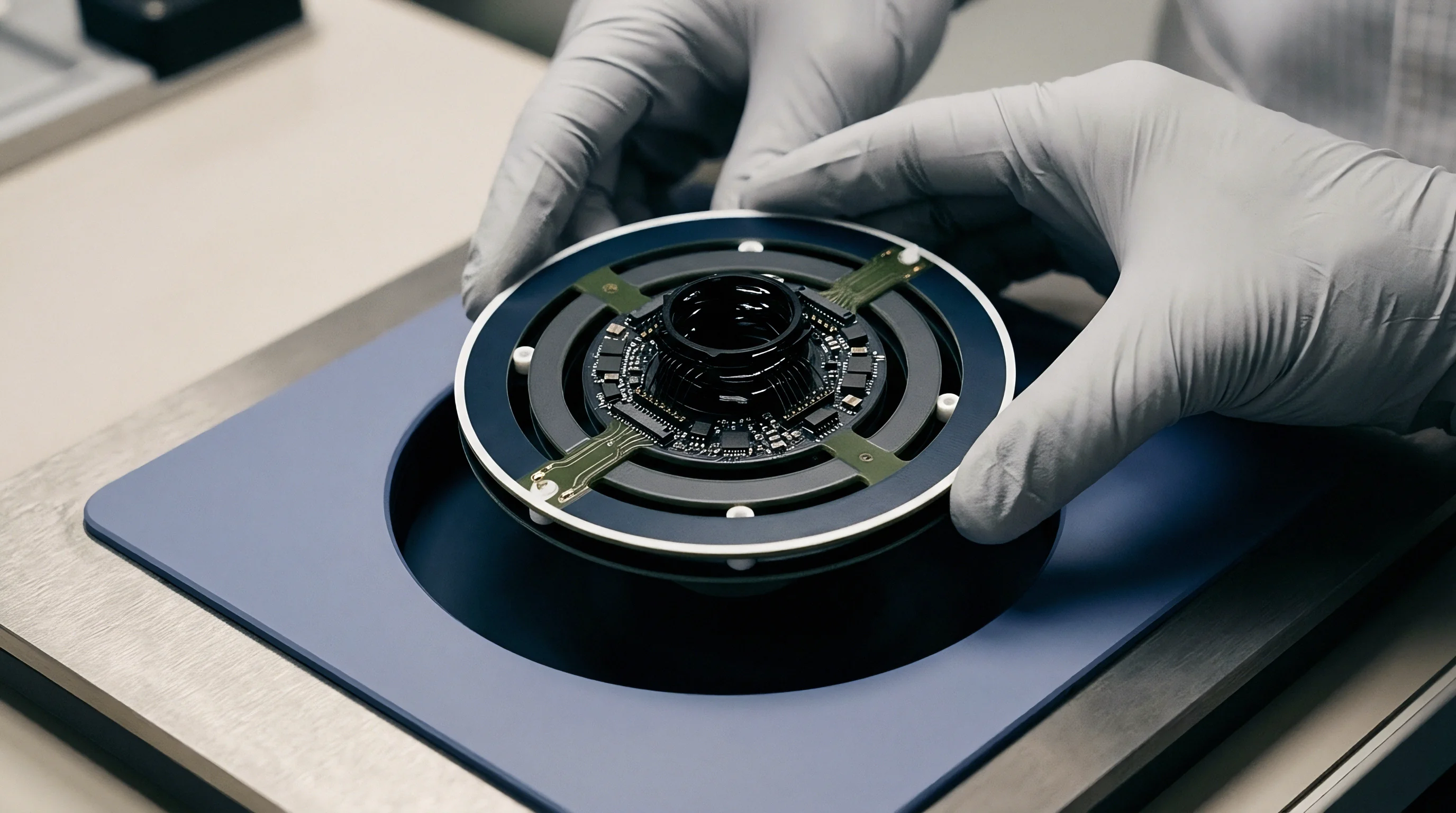
Copper land patterns on a four-layer host board govern the electromagnetic profile long before an antenna launches energy into the chamber. Swapping a primary radio module for an alternate footprint or a nominally identical pin-to-pin second source shifts return loss, alters ground return loops, and reroutes spurious currents through adjacent power planes. A transmitter delivering 20 dBm into a 50-ohm reference load generates subtle harmonic shifts when presented with the parasitic inductance of an alternate vendor package.
Solder fillet shapes, substrate dielectric tolerances, and bond-wire lengths differ between suppliers. These physical details alter radiated harmonic distributions even when transceivers share the same silicon core.
Hardware that drops cleanly onto identical solder pads rarely behaves the same way under radio frequency observation. RF performance tracks the exact physical continuity between the transceiver output and the trace. When an alternate radio sits on the host, slight variations in copper clearance around the radio frequency launch create impedance mismatches.
A voltage standing wave ratio shifting from 1.2:1 to 1.8:1 reflects energy back into the power amplifier stage, elevating thermal dissipation and pushing third-order intermodulation products over compliance masks. Ground returns are equally sensitive. If an alternate package routes RF ground return through two thermal pads rather than four perimeter ground landings, the return loop widens into an unintended slot radiator across the host ground plane.
A three-millimeter displacement in ground return via placement raises second-harmonic radiated emissions by 4.8 dB on an FR4 board operating at 2.44 GHz.
Coupling between the radio shield can and surrounding enclosure structures generates secondary radiated paths. Package height differentials between two suppliers shift capacitive coupling to nearby metal enclosures or display backlights. The radiated field changes shape, redirecting side lobes into polarization planes where test antennae record unexpected peaks.
- Package Parasitic Inductance alters transceiver output matching, shifting the tuned center frequency and degrading conducted band-edge margins.
- Ground Vias Displacement introduces localized loop areas, generating magnetic dipole radiation that bypasses host board isolation fences.
- Shield Can Seam Leakage radiates higher-order local oscillator harmonics when an alternate supplier presses folded metal shields instead of deep-drawn covers.
- Thermal Dissipation Pads alter heat sink grounding, creating parasitic capacitive paths that elevate common-mode noise on five-volt supply rails.
Conducted power measurements seldom reveal these physical modifications because spectrum analyzers terminate into calibrated 50-ohm test cables. The problem appears when the board enters the semi-anechoic space. The turntable rotates, the receiving antenna moves through vertical and horizontal polarizations from one to four meters, and the receiver flags a failing margin at the fourth harmonic.
Swapping components on an active assembly line without evaluating board trace dynamics strips the manufactured run of its compliance presumption, risking immediate port holds and warehouse quarantines.

Class
Federal Communications Commission rules under Title 47 CFR Section 2.1043 formalize the line between administrative paperwork and physical retesting. Integrating a secondary radio source forces the host manufacturer to evaluate whether the modification ranks as a Class I Permissive Change or escalates into Class II requirements. A Class I change covers alterations that do not degrade radio frequency characteristics or increase emissions beyond the levels documented in the original filing.
Adding an alternate radio source from a separate supplier never qualifies for Class I handling under a single FCC identifier because FCC identifiers bind strictly to one specific grantee and design record.
Where Does Trace Redirection Trigger Requalification?
Altering host microstrip geometry to accommodate a secondary module package alters the grant conditions outlined in KDB 996369 D02. Modular approvals grant permission based on an exact antenna trace design filed with the Telecommunication Certification Body. Moving an RF trace by more than the tolerance permitted in the original module integration instructions invalidates the modular grant.
When the host uses a secondary module with identical pinouts but differing trace impedance margins, the integrator executes a Class II Permissive Change under the existing grant or obtains an entirely new equipment authorization.
- Host Trace Audit establishes whether the alternate footprint changes track length, substrate dielectric constant, or clearance gaps, with deviations over five percent necessitating lab re-characterization.
- Bench Power Verification records conducted output power across low, middle, and high operational channels, confirming output stays within the original grant tolerance band of 0.5 dB.
- Radiated Spurious Spot Checks confirm harmonic and intermodulation levels remain below original grant ceilings, preventing uncertified emissions from entering commercial channels.
- Permissive Change Filing uploads laboratory test reports, schematic deltas, and updated operational descriptions to the certification body database before mass production release.
Regulatory boundaries shift across international borders. Innovation, Science and Economic Development Canada maintains the RSS-GEN and RSP-100 frameworks, establishing Class 4 Permissive Changes for certified modules integrated into new host hardware configurations. Meanwhile, European Union compliance follows the Radio Equipment Directive 2014/53/EU.
The European framework shifts responsibility directly onto the host manufacturer under Article 3.2. Dual-sourcing under CE marking does not involve permissive change classifications. The European route requires an updated Technical Documentation file containing rationales or re-test reports showing continued conformity with ETSI EN 300 328 or ETSI EN 301 893.
Article 3.2 of the Radio Equipment Directive places full conformity liability on the economic operator placing the final host combination on the European market.
Navigating dual-sourcing across distinct jurisdictions produces conflicting obligations. The Japanese Ministry of Internal Affairs and Communications, operating through Registered Certification Bodies under the Radio Act, treats secondary module footprints through Article 38 construction type certification rules. China’s State Radio Monitoring Center requires model code amendments or independent Radio Type Approval certification when transceiver chipsets change.
Attempting to unify these jurisdictions under a single permissive change strategy creates regulatory exposure.
| Jurisdiction | Authority Framework | Filing Designation | Permissible Scope | Test Burden |
|---|---|---|---|---|
| United States | FCC Part 2.1043, KDB 996369 | Class II Permissive Change | Same Grantee, alternate circuitry | Spurious emissions, SAR evaluation |
| Canada | ISED RSP-100 Section 8 | Class 4 Permissive Change | Host platform integration changes | Radiated spurious, band edge |
| European Union | RED 2014/53/EU Art. 3.2 | Updated Technical File | Manufacturer self-declaration | ETSI EN 300 328 spot scans |
| Japan | MIC Radio Act Ordinance 88 | Type Amendment or New ID | Certified assembly modification | Conducted power, occupied bandwidth |
| China | SRRC Radio Regulations | New Type Approval | Alternate module or layout change | Full fixed-frequency chamber scan |
Purchase contracts that lack explicit assignment of certification maintenance responsibilities leave buyers vulnerable to sudden factory stops. A baseline purchase order clause mandates that the module vendor maintain certification files and deliver permissive change filings within forty-five calendar days of any internal component change.

Scan
Measurements gathered inside a three-meter semi-anechoic enclosure provide the empirical basis for permissive change determinations. Radiated emissions testing isolates unwanted energy generated by transceiver clocks, voltage switching converters, and non-linearities in the RF front end. When an engineer seats a secondary radio onto a host platform, the test plan begins with baseline conducted power scans.
If conducted power drops by more than 0.5 dB, output efficiency has degraded, indicating RF port impedance mismatch. If power rises above the maximum limit listed on the original grant certificate, the unit violates statutory emissions limits, rendering a simple Class II filing impossible.
Intermodulation products present the greatest chamber hazard in multi-transceiver hosts. Modern connected hardware houses Wi-Fi, Bluetooth, and cellular modules within inches of one another. Placing an alternate Wi-Fi module alongside an existing cellular modem changes inter-system mixing products.
Non-linear mixing across antenna structures generates third-order intermodulation frequencies calculable as two times the frequency of source one minus frequency two. When these intermodulation frequencies land directly inside designated receive bands, receiver desensitization occurs. When they fall outside authorized bands, they register as illegal out-of-band emissions.
FCC KDB 996369 D04 mandates simultaneous transmission radiated spurious testing whenever two or more certified radio transmitters operate concurrently inside a common host.
Chamber sweep times escalate rapidly when measuring radiated fields from 30 MHz to the tenth harmonic of the highest operational frequency. For a 5.8 GHz Wi-Fi transceiver, testing reaches 40 GHz. Technicians place the host on an automated polystyrene turntable, rotating the device through 360 degrees while the mast sweeps the receiving horn antenna between one and four meters.
The receiver uses a 1 MHz resolution bandwidth with an average detector to verify compliance against the FCC Part 15.209 general field strength limit of 54 dBµV/m at three meters. A single unexpected ground plane resonance caused by the alternate module footprint can elevate spurious peaks to 58 dBµV/m, failing the scan.
Electromagnetic compatibility engineers identify radiated failures through spatial and polarization isolation. The scan rotates the host in three orthogonal axes: flat on the table, upright on its side, and standing on its end. Alternate vendors frequently orient ceramic chip antennas or printed inverted-F antennas with slight tilt variations relative to the board edge.
This tilt reorients the E-plane, projecting radiated energy directly into nearby I/O cabling or flex circuits. The cable picks up the radio frequency current and functions as an efficient dipole antenna at low harmonic frequencies.
The turntable test uncovers physical discrepancies between nominal drawings and actual assembly line executions. Solder paste thickness variations under high-density array packages shift internal ground planes upward by fractions of a millimeter, perturbing return path impedance at 24 GHz. Whether a laboratory spot-check scan suffices to defend an audit without full multi-channel qualification remains a subject of standing dispute between commercial testing houses and cautious corporate compliance officers.

Custody
Ownership of an equipment authorization defines who holds legal standing to alter a certification record. The Federal Communications Commission issues an FCC Identifier consisting of a Grantee Code and an Equipment Product Code. Only the entity controlling the Grantee Code can submit a Class II Permissive Change application for that device.
Sourcing professionals regularly negotiate alternate module supplies under the illusion that their own engineering team can file permissive changes against a third-party supplier’s FCC ID. Third-party integrators cannot alter, supplement, or re-test an external vendor’s grant under their own corporate name without explicit written agency authorization.

Should Grantees Permit Secondary Alternate Layouts?
Module suppliers routinely refuse to authorize Class II filings initiated by host manufacturers. Grantee liability exposes the module vendor to certification revocation if an external integrator introduces a non-compliant host layout. If a host team procures Module B from a second vendor to mitigate supply disruptions on Module A, the host design now integrates two entirely distinct FCC IDs.
A single product housing cannot carry two different FCC IDs under a single declaration without specific labeling disclosures. The host manufacturer must either obtain a Change in Identification per FCC Section 2.933, create a duplicate certification file under their own Grantee Code, or redesign the host enclosure to display dual modular identification numbers.
Changing an FCC ID per Section 2.933 transfers compliance ownership to the host integrator. The applicant files photographs of the exterior housing, schematic descriptions, and an official declaration confirming the physical radio remains identical to the original certified equipment. Once the Telecommunication Certification Body issues the new grant under the host integrator’s Grantee Code, the integrator possesses legal authority to submit Class II Permissive Changes for alternate antennas, trace layouts, or co-located radio integrations.
This mechanism carries substantive ongoing obligations: the host integrator assumes lifetime post-market audit liability for the radio assembly.
- Grantee Authorization Letters signed by the original applicant authorizing the TCB to reference existing test records for the new filing.
- Attestation Statements confirming the alternate layout adheres to the transmitter parameters certified under the referenced base dossier.
- External Label Schematics displaying the host-specific equipment identification code and warning language compliant with Part 15.19.
- Operational Manual Annexes detailing specific antenna gain limits and installation spacing constraints required to satisfy RF exposure compliance.
- Agent Authorization Forms designating accredited laboratory personnel to execute database submissions with the regulatory body.
A modular grant does not guarantee legal distribution inside a finished micro-controller enclosure. That presumption collapses once a test lab evaluates the complete assembly. The host manufacturer retains sole responsibility for unintentional radiator compliance under Part 15 Subpart B, regardless of modular certification status, and drop-in driver compatibility does not bypass administrative filing mandates.

Ledger
Budgeting an alternate radio module integration requires calculating lab chamber bookings, regulatory agency surcharges, and inventory carrying expense. A standard Class II Permissive Change filing via a Telecommunication Certification Body incurs between $3,500 and $7,000 in administrative and review fees per radio standard. Spot-check chamber measurements demand twenty-four to forty hours of semi-anechoic testing at rates averaging $350 to $600 per hour.
When testing reveals harmonic degradation that requires board filter adjustments, the project timeline resets, compounding direct spend with production line hold costs.
Time represents the most volatile variable in cross-border hardware programs. While an FCC Class II review consumes two to three weeks once test data enters the TCB queue, parallel international approvals multiply that calendar footprint. Innovation, Science and Economic Development Canada demands an additional three to four weeks for directory registration.
Japan’s MIC certification process takes four to six weeks, while securing a Radio Type Approval through China’s SRRC routinely consumes eight to twelve weeks due to mandatory in-country testing on accredited domestic benches. A procurement lead time calculated purely on silicon fabrication misses the eighty-day compliance gate entirely.
A dual-source radio strategy unbacked by parallel market filings extends production downtime by an average of ninety calendar days.
Financial exposure escalates if customs authorities flag inconsistencies between commercial shipping documents and equipment identification labels. When containers enter customs inspection, border agents inspect exterior housings against global radio clearance databases. If the bill of materials lists a secondary module whose FCC ID or Giteki mark does not appear on the exterior packaging or internal electronic display, agents hold the entire freight lot.
Port storage fees, chassis demurrage, and customs broker intervention add thousands of dollars per day to landed product costs, rapidly eliminating any component cost savings achieved through secondary module sourcing.
| Market Regime | Laboratory Chamber Fees | Agency Filing Surcharges | Local Agent Representation | Approval Timeline |
|---|---|---|---|---|
| United States (FCC) | $6,500 to $12,000 | $2,500 to $4,500 | Not applicable | 3 to 5 weeks |
| Canada (ISED) | $4,000 to $8,000 | $1,800 to $3,200 | $1,500 per annum | 4 to 6 weeks |
| European Union (CE) | $5,000 to $11,000 | Zero statutory fee | Included in EU rep | 2 to 4 weeks |
| Japan (MIC) | $7,000 to $14,000 | $3,000 to $5,500 | $2,000 flat fee | 5 to 8 weeks |
| China (SRRC) | $12,000 to $22,000 | Zero official fee | $3,500 per annum | 10 to 14 weeks |
Total qualification investment for a secondary radio footprint across five primary target markets spans $35,000 to $65,000 in direct compliance outlays. Evaluating unit purchase savings against these figures reveals minimum shipment volume thresholds. Sourcing an alternate module to save $1.20 per unit requires shipping over forty thousand finished units solely to recover direct qualification expenses.
Savings evaporate if hardware teams fail to align footprint layouts early in the design cycle. Module pricing parity never translates to regulatory parity.