Standalone Specific Absorption Rate Exclusion Thresholds for Portable Hosts
Standalone SAR exclusion allows portable wireless hosts to bypass laboratory phantom testing when time-averaged power falls below frequency-scaled distance thresholds.
Boundary
Regulatory filings show thousands of certified portable transmitters on the market that never went through SAR phantom measurements. North American, European, and Asian rules define specific power and separation limits below which tissue absorption is treated as negligible. In test lab parlance, these are specific absorption rate evaluation exemptions or standalone exclusion thresholds.
When a portable device places an antenna within twenty centimeters of the body or limbs, meeting these mathematical conditions lets the manufacturer bypass SAR probe testing entirely.
Qualifying for an exemption reduces an eight-week test chamber queue to an engineering calculation, cutting thousands of dollars in compliance costs per radio band. Handheld industrial terminals, wearables, diagnostic tools, and wireless audio equipment can proceed directly into production. The exemption depends entirely on proving that the transmitter’s maximum time-averaged output power remains strictly under the exclusion limit at the declared separation distance.
A portable transmitter delivering six milliwatts time-averaged conducted power at five millimeters separation operates below the domestic one-gram exclusion threshold at two point four gigahertz.
Engineers determine standalone exclusion using the shortest physical distance from the active antenna element to the outer surface of the enclosure. This separation corresponds to the closest point of human contact during ordinary operation. In a handheld scanner, for example, the measurement runs from the internal antenna trace across the internal air gap to the inner casing wall, plus the thickness of the plastic housing.
If the physical spacing measures under five millimeters, regulatory rules mandate rounding down to five millimeters to keep calculation formulas numerically stable. Claiming a larger gap without mechanical standoffs leads regulators to reject the filing. When an antenna sits five millimeters inside a rear cover, an applicant cannot claim twenty millimeters unless the exterior housing physically stops a user from coming closer.
Exclusion Threshold Criteria
Exclusion thresholds are calculated against source-based time-averaged output power. Using peak power is unnecessarily restrictive for pulsed or burst protocols, whereas nominal figures fail to account for upper manufacturing tolerances. Calculations must take the higher value between maximum rated conducted power and equivalent isotropically radiated power, including tune-up variance.
A transceiver with a nominal conducted output of four milliwatts and a plus or minus one decibel tolerance, for instance, must be evaluated at five point零一 milliwatts.
Exemption limits vary by frequency because RF absorption in biological tissue changes across the spectrum. Lower frequencies penetrate deeper into skin and muscle, dispersing energy across a larger volume. Higher microwave frequencies concentrate absorption in superficial tissue layers, increasing localized heating density.
Allowable power thresholds therefore drop as operating frequencies climb from one hundred megahertz up to six gigahertz.
SAR quantifies RF energy absorption per unit mass of tissue in watts per kilogram. Two primary standards govern compliance globally. In the United States and Canada, the general public limit is one point six watts per kilogram averaged over one gram of tissue, and four point zero watts per kilogram over ten grams for extremities.
European and international bodies specify a two point zero watts per kilogram limit averaged over ten grams of contiguous tissue across both head and body exposure.
Standalone exemptions apply strictly to individual radiators operating without simultaneous transmission from nearby antennas. If a design combines a cellular modem with an independent Bluetooth radio, engineers must calculate simultaneous transmission cross-coupling. Standalone values feed directly into these composite assessments; if any single transmitter exceeds its standalone threshold, the entire host requires chamber testing.
The table below summarizes standard standalone exemption parameters across common operational bands for portable devices operating at five millimeters separation distance under prevailing North American rules.
| Frequency Band (MHz) | Tissue Standard | Separation Distance (mm) | Calculated Power Limit (mW) | Decibel Equivalent (dBm) |
|---|---|---|---|---|
| 433 | 1-g Body/Head | 5 | 22.7 | 13.6 |
| 915 | 1-g Body/Head | 5 | 15.6 | 11.9 |
| 2450 | 1-g Body/Head | 5 | 9.5 | 9.8 |
| 5250 | 1-g Body/Head | 5 | 6.5 | 8.1 |
| 5800 | 1-g Body/Head | 5 | 6.2 | 7.9 |
| 2450 | 10-g Extremity | 5 | 23.8 | 13.8 |
| 5800 | 10-g Extremity | 5 | 15.5 | 11.9 |
Missing an exemption threshold by even half a decibel milliwatt breaks the project’s compliance budget. Forfeiting documentary filing eligibility forces engineering to prepare dedicated continuous-wave test firmware, prepare tissue-simulating liquids, book probe chamber time, and build custom test fixtures.
Relying on a component vendor’s SAR exemption claims without verifying their upper tune-up tolerances leaves the integrator vulnerable if production silicon runs hotter than expected.

Phantom
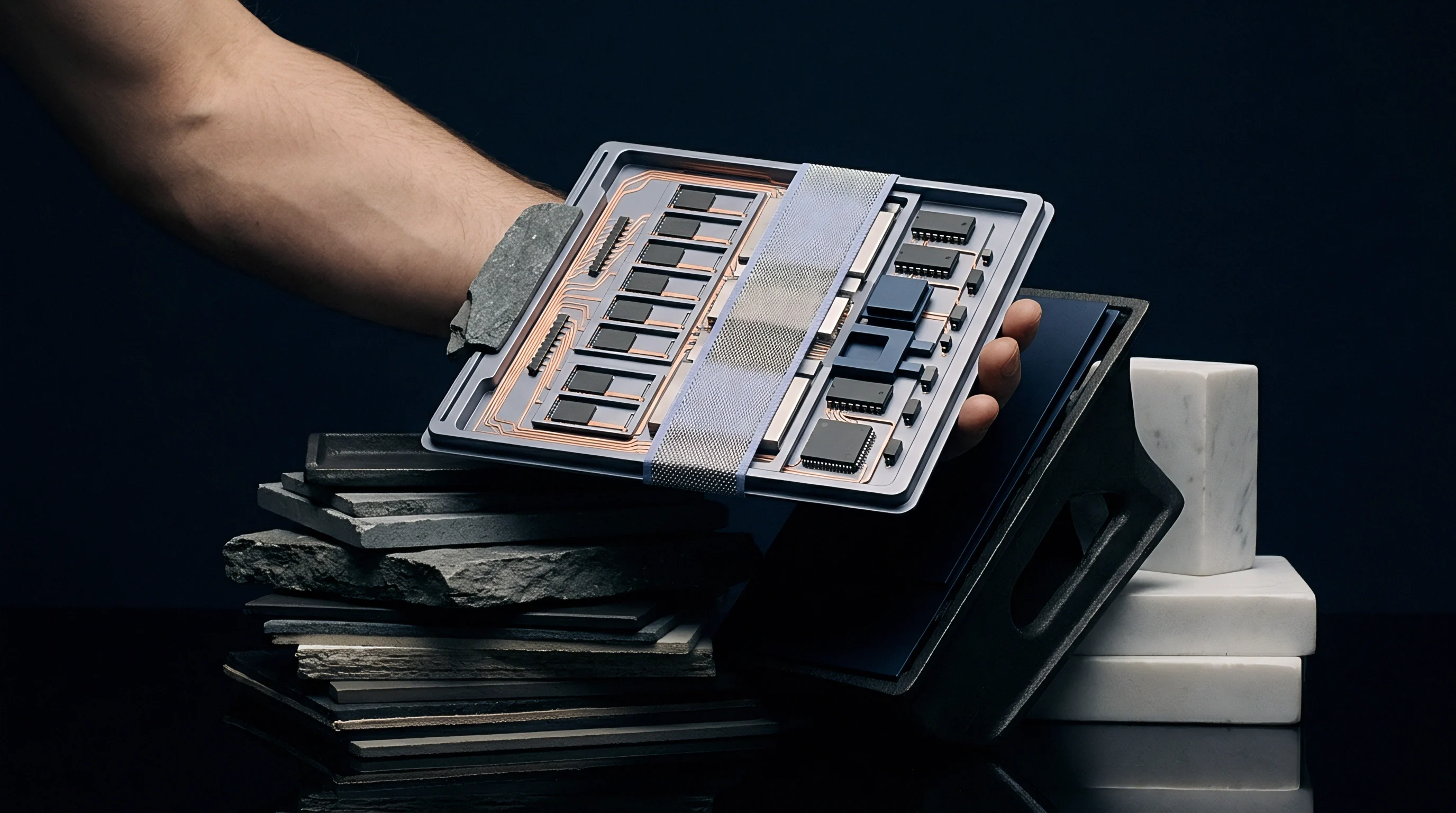
When a radio host exceeds mathematical exclusion boundaries, test labs rely on physical phantoms to quantify absorption directly. These hollow fiberglass forms ~ shaped like human heads or flat torsos ~ are filled with liters of viscous, dielectric tissue simulant. An automated robotic arm guides an isotropic E-field probe through the liquid along a calibrated grid, reading localized voltage gradients to calculate the spatial SAR distribution.
Physical SAR testing imposes rigid mechanical constraints on the hardware. Devices tested for zero-millimeter contact sit flush against the flat phantom shell, while body-worn configurations use calibrated spacers set to five millimeters, ten millimeters, or fifteen millimeters. The hardware must remain completely rigid across area and zoom scans that often run forty-five minutes per channel.
The tissue simulant itself is sensitive to environmental drift. Recipes rely on deionized water, sugar, salt, bactericides, and cellulose for lower frequencies, switching to diethylene glycol butyl ether solutions in higher microwave bands. Because conductivity and relative permittivity shift with temperature and evaporation, lab engineers verify the liquid with an open-ended coaxial probe before each run.
A drift beyond five percent from target values requires aborting the test.
Chamber Measurement Complexities
Physical probe scans often expose localized hotspots that simple point-source calculations miss. RF currents traversing battery contacts, PCB shield cans, and display flex cables can couple energy directly into the simulant. An antenna that radiates omnidirectionally in free space may concentrate near-field energy when placed against high-permittivity fluid, shifting the peak SAR location from the antenna element to an unexpected ground return path.
Preparing hardware for chamber runs requires specialized engineering deliverables. Test houses require custom firmware that locks the radio into continuous transmission across low, mid, and high channels at full duty cycle, disabling any thermal throttling or dynamic backoff. If battery-management software automatically scales down RF output under sustained load, engineers must override those routines so the lab can measure worst-case exposure.
Hardware must also be modified to accept steady DC power from an external source. Internal lithium-ion cells deplete during lengthy multi-channel scans, causing output drops that ruin measurement consistency. Technicians solder battery-eliminator leads directly to the motherboard rails, dressing the wires away from the antenna to prevent parasitic RF coupling and field distortion.
Chamber testing adds friction that goes well beyond lab fees. Accredited test facilities often face lead times of three to six weeks during peak product launch cycles. Completing a multi-band portable host assessment takes twenty to forty hours of chamber time, producing extensive test reports filled with liquid logs, probe calibration sheets, and volumetric contour plots.
The list below outlines critical physical test artifacts that a compliance laboratory requires when a portable host fails mathematical exclusion thresholds:
- Conducted power verification samples fitted with calibrated coaxial pigtails at the antenna feed point to enable direct instrumentation power validation.
- Dedicated continuous-transmission firmware binaries allowing manual selection of modulation schemes, channel frequencies, and power levels without over-the-air handshaking.
- Battery eliminator hardware attachments wired directly into primary power rails to guarantee constant voltage across multi-hour measurement scans.
- Identical production mechanical enclosures complete with final internal metal shielding, battery cells, printed circuit boards, and acoustic transducers.
Missing any of these deliverables halts the evaluation before it starts. A module vendor that delivers bare hardware without raw transmission control utilities leaves the host integrator with the entire firmware integration burden.
Once testing concludes, the certified power listed on the equipment authorization grant defines the legal operating envelope for all subsequent production batches.
Formula
Domestic exclusion rules follow specific algebraic formulas published in regulatory knowledge databases. The Federal Communications Commission divides standalone portable exclusion into three practical tiers. The baseline tier offers a blanket exemption for devices transmitting at one milliwatt or less time-averaged power up to six gigahertz, regardless of separation.
A low-power sensor or medical implant emitting under one milliwatt (factoring in tolerances) qualifies immediately at zero millimeters.
Above one milliwatt, engineers apply a frequency-dependent, distance-scaled formula for devices operating between one hundred megahertz and six gigahertz at gaps up to fifty millimeters. The equation scales the fundamental SAR limit against the inverse square root of the frequency in gigahertz, determining the maximum allowable power from the separation distance in millimeters normalized to the operational band.
For one-gram tissue averaging, the source-based time-averaged output power divided by the separation distance, multiplied by the square root of the frequency in gigahertz, must remain at or below three point zero. For ten-gram extremity use ~ such as wrist wearables or handheld industrial gear ~ the limit relaxes to seven point five. The core formula is structured as:
Threshold Index = (P / d) sqrt(f)
Here, P is the maximum time-averaged conducted or radiated power in milliwatts, rounded to the nearest integer. The variable d represents the minimum separation distance in millimeters (values under five millimeters round up to five millimeters), and f is the channel frequency in gigahertz.
A twenty-four milliwatt Bluetooth transmitter evaluated at ten millimeters separation distance yields a threshold index of three point seven six, exceeding the one-gram limit and mandating full chamber evaluation.
Consider a dual-mode wireless handheld operating in the two point four gigahertz ISM band. The transceiver has a nominal conducted output of eight milliwatts with a plus one decibel tolerance, reaching ten point零七 milliwatts peak. Its internal antenna provides two point zero dBi gain, giving an EIRP of fifteen point nine six milliwatts.
Because the rule evaluates the higher of conducted power or EIRP, the calculation starts at sixteen milliwatts.
Assuming the device operates at a fifty percent source-based duty cycle over any continuous six-minute window, the effective time-averaged power drops to eight milliwatts. At a five-millimeter user separation distance and a frequency of two point four five gigahertz, the threshold index evaluates to:
Threshold Index = (8 mW / 5 mm) sqrt(2.45 GHz) = 1.6 1.565 = 2.50
Since two point five zero is below the three point zero limit, the device qualifies for standalone exclusion without SAR testing. But if the duty cycle increased to eighty percent, time-averaged power would hit twelve point eight milliwatts, pushing the index to four point零一 and making chamber measurements mandatory.
The table below provides a detailed lookup matrix of calculated maximum allowable time-averaged power limits in milliwatts across varying separation distances and frequency bands under standard one-gram head and body rules.
| Separation (mm) | 915 MHz | 2450 MHz | 5250 MHz | 5800 MHz |
|---|---|---|---|---|
| 5 | 16 | 10 | 7 | 6 |
| 10 | 31 | 19 | 13 | 12 |
| 15 | 47 | 29 | 20 | 19 |
| 20 | 63 | 38 | 26 | 25 |
| 25 | 78 | 48 | 33 | 31 |
| 30 | 94 | 57 | 39 | 37 |
| 35 | 110 | 67 | 46 | 44 |
| 40 | 125 | 77 | 52 | 50 |
| 45 | 141 | 86 | 59 | 56 |
| 50 | 157 | 96 | 65 | 62 |
| Values calculated in accordance with KDB 447498 general RF exposure guidance; power values rounded to nearest milliwatt. | ||||
Beyond fifty millimeters, near-field absorption assumptions give way to plane-wave power density models. The formulas transition to linear power offsets based on distance increments, allowing power limits to scale into hundreds of milliwatts and exempting most cellular or wide-area modems operating at these larger spacings.
Filing exhibits must clearly justify any claimed source-based time averaging. User-accessible configuration options that alter duty cycles cannot be used to claim averaging; the limit must be enforced by protocol design, hardware timers, or locked factory firmware.
Entering antenna gain in decibels rather than linear ratios during power averaging is a common mistake that invalidates test documentation and delays equipment authorization grants.
Dispute
RF exposure rules remain unaligned across international borders, creating friction for worldwide product rollouts. A portable device that qualifies for an SAR exclusion under United States guidelines may require laboratory testing in Canada, Europe, or Japan. Each regulatory body applies its own formulas, tissue geometries, and power baselines.
In Canada, ISED enforces RSS-102. Although Canada shares the US one-gram limit of one point six watts per kilogram, its exemption math is considerably stricter. RSS-102 Issue 6 uses frequency-segmented tables with linear interpolation between points.
At two point four gigahertz and five millimeters, the Canadian exemption ceiling is four milliwatts time-averaged EIRP. An eight-milliwatt device that is exempt under FCC rules must undergo SAR testing or nerve stimulation assessments to enter Canada.
Are Exclusion Thresholds Applicable across Border Regimes?
Navigating global compliance requires balancing competing technical mandates across target regions. Under the European Union’s Radio Equipment Directive 2014/53/EU, Article 3.1a health and safety requirements reference CENELEC standards such as EN 50663 and EN 62479. The baseline European threshold permits up to twenty milliwatts of time-averaged available or radiated power for general public exposure.
While twenty milliwatts seems lenient on paper, it applies against a ten-gram tissue mass and a two point zero watts per kilogram limit. Devices exceeding this threshold, or those falling under dedicated product standards, default to EN 50566 testing. Meanwhile, Japan’s Ministry of Internal Affairs and Communications enforces separate technical criteria under the Radio Law, mandating physical absorption evaluations for higher-power wireless devices while providing distinct paths for low-power stations.
Because of these discrepancies, hardware teams typically design for the strictest target territory. A single product shipping to North America, Europe, and Asia must satisfy the lowest common power and spacing thresholds, unless the manufacturer is willing to maintain region-specific firmware builds that throttle transmitter power locally.
The following numbered sequence outlines the analytical workflow that engineering teams execute to arbitrate cross-border SAR exemption compliance:
- Determine worst-case time-averaged source power by taking the higher of maximum rated conducted output and EIRP, incorporating the highest factory tune-up tolerance limit.
- Map physical antenna geometry inside the final enclosure to establish the absolute minimum user contact distance in millimeters during all foreseeable operational postures.
- Calculate jurisdiction-specific exemption thresholds across FCC KDB 447498, ISED RSS-102, and CENELEC EN 50663 mathematical formulas for every operational frequency band.
- Evaluate multi-market laboratory testing trade-offs between setting regional firmware power reductions or funding physical chamber scans to support uniform global hardware configurations.
Procurement teams frequently assume that purchasing a pre-certified modular transmitter exempts the final product from further SAR reviews. However, an FCC grant issued for mobile use with a twenty-centimeter warning provides no coverage when installed in a handheld host. The host integrator is legally responsible for certifying the portable exposure configuration.
The table below highlights critical differences in standalone exclusion limits, tissue averaging masses, and reference power metrics across major international regulatory frameworks.
| Regulatory Body | Primary Standard | Tissue Averaging Mass | Exemption Limit at 2.4 GHz (5 mm) | Reference Power Metric |
|---|---|---|---|---|
| United States (FCC) | KDB 447498 D04 | 1-g Body/Head | 9.5 mW | Conducted or Radiated |
| Canada (ISED) | RSS-102 Issue 6 | 1-g Body/Head | 4.0 mW | Maximum EIRP |
| European Union (RED) | EN 50663 / EN 62479 | 10-g Body/Head | 20.0 mW | Available or Radiated |
| Australia (ACMA) | ARPANSA RPS S-1 | 10-g Body/Head | 20.0 mW | Mean Power |
| Japan (MIC) | Radio Law Article 14-2 | 10-g Body/Head | 20.0 mW | Average Radiated |
Surveillance authorities routinely sample retail hardware to verify compliance. If an audit reveals that an exemption was claimed using incorrect separation distance assumptions, agencies will issue sales stops and recall notices.
A non-compliant filing leaves the importer responsible for impoundment costs, regulatory fines, and the expense of modifying or replacing field inventory.
Schedule
RF exposure compliance must be factored into product launch milestones early. Shifting unexpectedly from a calculation-based exemption to physical testing causes major schedule slippage. While a documentary report takes three business days of engineering review, a full lab test campaign generally consumes four to six weeks once queue times, sample logistics, firmware setup, chamber runs, and report authoring are tallied.
Timelines stretch further if the hardware fails initial testing. If early scans return one point eight watts per kilogram against the one point six watts per kilogram ceiling, the board must be reworked. Engineers face PCB redesigns, antenna repositioning, adding RF absorbers, or integrating proximity sensors to throttle power when a user touches the casing.
Permissive Change Mechanics
Using a pre-certified radio module in a portable host triggers formal change requirements. If the original modular grant was approved for mobile conditions at twenty centimeters, placing that module five millimeters from a user invalidates the authorization. This cannot be resolved with simple administrative paperwork; the manufacturer must file a Class II Permissive Change or apply for a completely new FCC ID.
A Class II filing requires engineering data proving the host enclosure and antenna layout meet portable limits. If module output stays below the standalone threshold at the given distance, the applicant submits an evaluation report with the calculations. A Telecommunication Certification Body reviews the numbers, checks tolerances and antenna gains, and typically issues the updated grant within ten to fifteen business days.
When transmitter output exceeds the exemption threshold, the Class II filing must include a full physical SAR test report. The TCB will inspect liquid recipes, probe calibrations, scan step sizes, and drift logs, adding two to three weeks of administrative review beyond the chamber testing window.
Unplanned SAR testing carries substantial financial overhead. A multi-band compliance campaign costs between six thousand and eighteen thousand dollars per hardware revision. On complex devices featuring multiple cellular bands, Wi-Fi MIMO, and Bluetooth, laboratory invoices routinely exceed thirty-five thousand dollars ~ excluding prototype shipping, on-site engineering support, and certification filing fees.
To mitigate these risks, sourcing teams write RF compliance milestones into master service agreements and component purchase orders, placing financial and technical accountability on suppliers for unannounced hardware changes.
A standard procurement compliance clause defines performance obligations, documentation deliverables, and economic remedies in the text below:
The module supplier warrants that all delivered transceivers maintain total conducted output power, including manufacturing and thermal tune-up tolerances, strictly within the limits specified in the integration documentation, and agrees to reimburse all laboratory testing fees resulting from unannounced silicon power revisions.
Treating exposure limits as firm mechanical and electrical design boundaries from day one avoids late-stage redesigns. Industrial designers must preserve required separation gaps, firmware engineers need locked time-averaging mechanisms, and antenna teams must address ground return currents before cutting tooling for injection molds.
Addressing these variables early turns regulatory clearance into a predictable milestone rather than a launch risk. A properly structured filing withstands post-market audits, secures equipment grants, and prevents costly shipping delays across target markets.