Mitigating Co-Located Multi-Radio SAR Exposure Regulatory Liabilities across Cross-Border Hardware Supply Chains
Mitigating co-located multi-radio SAR liabilities requires mandatory Class II permissive changes, dynamic power back-off firmware, and strict factory calibration.
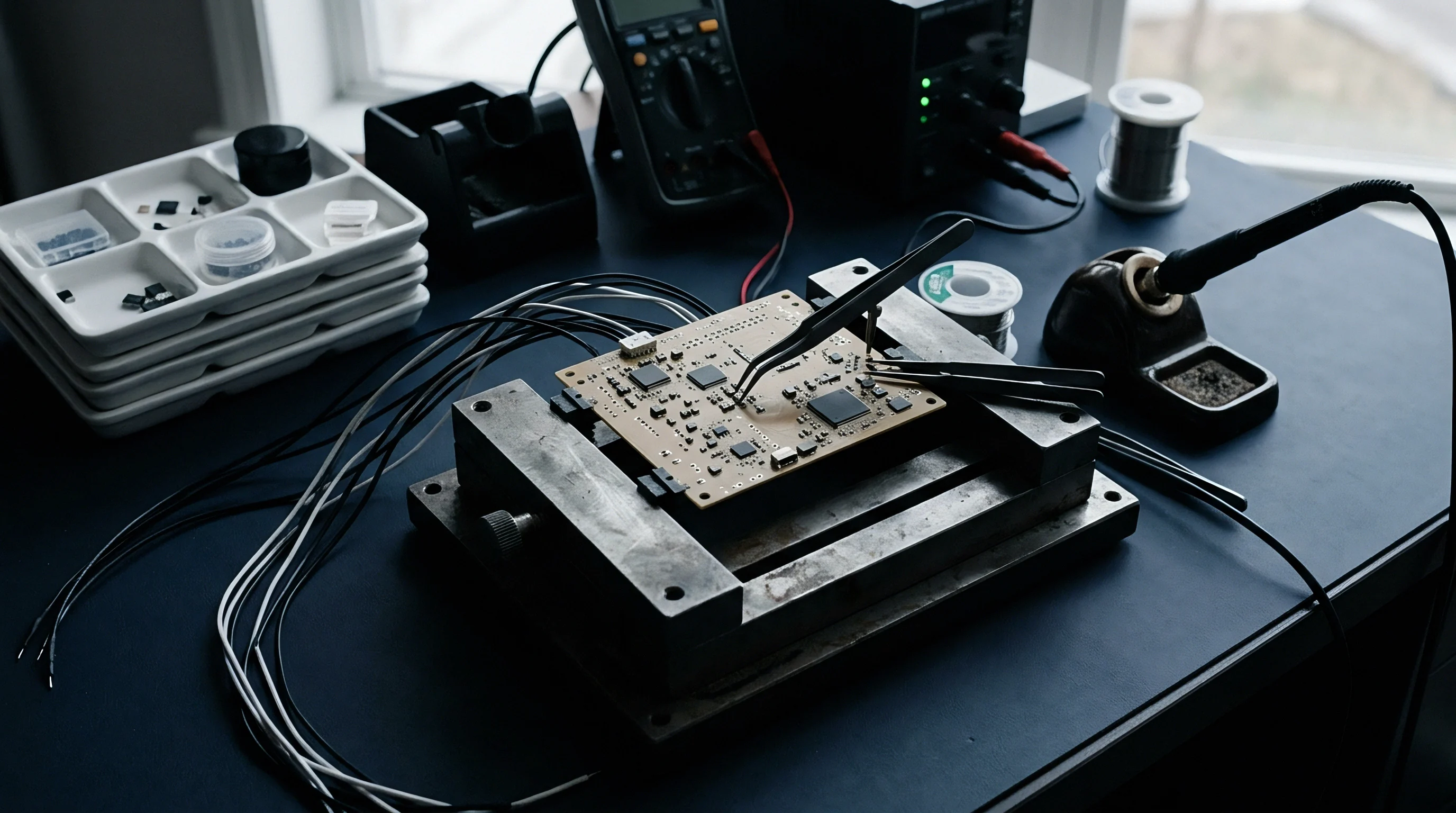

Exposure
A dipole probe measures electric field gradients inside a tissue-equivalent liquid phantom set two millimeters from a handheld transceiver enclosure. Radio frequency energy absorbs into human muscle and fat tissue at rates governed by carrier frequency, antenna near-field coupling, and instantaneous conducted output. When a device operates a cellular transceiver alongside five-gigahertz Wi-Fi and Bluetooth radiating elements inside the same enclosure, thermal absorption fields overlap.
The Federal Communications Commission under Title 47 Part 2.1093, Innovation, Science and Economic Development Canada under RSS-102, and the European Union under the Radio Equipment Directive impose strict Specific Absorption Rate boundaries on these combined emissions.
Modular certifications do not protect the host product. Radio module vendors market prefabricated hardware under grant authorizations that strictly apply to standalone conditions at separation distances exceeding twenty centimeters. Solder that module onto a custom mainboard inside a handheld housing and the standalone grant becomes void for human body contact.
Importers and brand owners assume full legal status as manufacturers under international statutes, bearing civil and criminal responsibility for non-compliant radiation.

Simultaneous Transmission Thresholds and Summed Ratios
Evaluation protocols require mathematical summation of individual radio contributions whenever transmitting antennas sit within twenty centimeters of a user. The laboratory calculates the exposure ratio by dividing the measured one-gram or ten-gram peak spatial average value of each standalone transmitter by its regulatory threshold. A cellular modem radiating at 1.1 watts per kilogram against a 1.6 watt per kilogram threshold produces a ratio of 0.6875.
A concurrently operating wireless local area interface delivering 0.7 watts per kilogram adds a ratio of 0.4375. Summing these figures yields 1.125.
Because the total exposure ratio exceeds 1.0, the test laboratory cannot declare compliance through simple addition. Engineering teams then face two choices: redesign the hardware to lower conducted power or execute SAR to Peak Location Separation Ratio assessments under KDB 447498. This secondary evaluation computes spatial distance between the highest absorption coordinates of the two transmitting antennas.
An equation divides the sum of the individual absorption values raised to the 1.5 power by the physical separation distance in millimeters. If the resulting metric remains below 0.04, the equipment passes without simultaneous volume scanning.
A calculated SAR ratio summation exceeding 1.0 at five millimeters separation forces two hundred hours of laboratory volume scanning.
Exceeding that 0.04 boundary triggers full simultaneous volume testing. The lab mounts the device inside an automated robot chamber, scanning both transmitters across identical phantom coordinates. Phase drift alters SAR, so test runs multiply across every supported cellular band, transmission channel, and data mode alongside every Wi-Fi modulation profile.
A certification campaign that initially budgeted ten days can expand to seven weeks of bench operation.

Cross Border Limit Variations
Discrepancies between international bodies complicate hardware architecture for global distribution. North America enforces a localized peak limit of 1.6 watts per kilogram averaged over one gram of contiguous cubical tissue for the head and torso. The European Union, following International Commission on Non-Ionizing Radiation Protection guidelines reflected in EN 50566, enforces a limit of 2.0 watts per kilogram averaged over ten grams of contiguous tissue.
Devices held in the hand or strapped to extremities encounter a 4.0 watts per kilogram ceiling across ten grams in both jurisdictions, yet measurement probes and phantom geometries diverge.
| Regulatory Regime | Head and Torso Limit | Extremity Limit | Averaging Mass | Summation Metric |
|---|---|---|---|---|
| United States FCC Part 2.1093 | 1.6 W/kg | 4.0 W/kg | 1.0 g cube | Sum of ratios or SPLSR below 0.04 |
| Canada ISED RSS-102 Issue 6 | 1.6 W/kg | 4.0 W/kg | 1.0 g cube | Total exposure ratio below 1.0 |
| European Union RED EN 50566 | 2.0 W/kg | 4.0 W/kg | 10.0 g contiguous | Simultaneous sum below 1.0 |
| Japan MIC Ordinance 35 | 2.0 W/kg | 4.0 W/kg | 10.0 g contiguous | Combined exposure ratio below 1.0 |
A design passing European ten-gram volume scans can fail North American one-gram peak assessments. Energy concentrated in a tight hot spot disperses across a ten-gram volume, depressing the European metric while spiking the localized one-gram American evaluation. Sourcing an off-the-shelf Asian reference design built solely around CE documentation exposes Western importers to market withdrawal actions when audited under United States laboratory conditions.
Ignoring simultaneous transmission arithmetic leaves the importer vulnerable to immediate border seizures, mandatory national retail recalls, public regulatory enforcement notices, and statutory fines that wipe out gross product line profits.


Arbitration
Firmware coordination between separate RF sub-systems prevents unconstrained simultaneous radiation. Hardware platforms integrate distinct chipsets for baseband cellular communication and local connectivity, often sourced from competing silicon vendors. Without physical interconnects and real-time control routines, both transmitters emit maximum rated power simultaneously whenever background data synchronization overlaps with voice calls or tethering sessions.
Physical interface lines bridge the modem and connectivity silicon. A high-speed three-wire or four-wire coexistence bus links the baseband processor directly to the wireless local network controller. These lines transmit time-division multiplexing signals, asserting priority frames before high-power packet bursts begin.
If the cellular transceiver schedules an uplink slot in an LTE band adjacent to industrial, scientific, and medical allocations, the coexistence controller forces the local wireless chip to hold back its transmission envelope or drop power output.
Dynamic Power Reduction Mechanics
Modern transceivers utilize internal non-volatile tables to store power back-off offsets. Capacitive sensors detect proximity to human skin, feeding interrupt signals into an application processor or the baseband directly. When an object approaches within ten millimeters, the sensing circuit trips and loads back-off values from memory.
Maximum conducted output drops from twenty-four decibel-milliwatts down to twelve decibel-milliwatts within fifty milliseconds.
Sensor design carries acute manufacturing dependencies. Trace inductance, stray capacitance on the printed circuit board, and enclosure paint conductivity shift the sensor baseline, while tooling wear alters internal antenna clearance. A production batch using housing resin with a slightly altered dielectric constant can desensitize the sensor so it fails to trigger power back-off during proximity trials, prompting the lab to reject the host.

What Triggers Simultaneous Transmission Exposure Evaluation?
Regulatory scrutiny activates when two conditions align: spatial proximity under twenty centimeters and concurrent transmission capability across independent RF paths. Even when transmissions occupy different frequency bands, thermal loading within shared human tissue remains additive. Baseband processors operating time-averaged SAR algorithms actively compute transmission duty cycles to maintain rolling averages below regulatory ceilings.
- Proximity Detection Assertion occurs when capacitive electrodes sense dielectric loading from human tissue and transmit an interrupt over an I2C bus to the host controller.
- Lookup Table Execution forces the power management unit to write back-off registers across both baseband and connectivity transceivers within ten milliseconds, risking non-compliant peak bursts if latency exceeds timing limits.
- Coexistence State Verification checks hardware contention lines between Wi-Fi and cellular chipsets to block simultaneous peak transmissions on overlapping antennas.
- Conducted Power Clamping sets final power amplification limits at the RF front-end, where uncalibrated factory lookup tables cause either regulatory non-compliance or broken wireless range.
Time-averaged exposure tracking relies on software daemons executing inside the baseband operating system. Sourcing teams frequently license turnkey wireless modules without obtaining root access or source rights to this proprietary baseband firmware. The buyer cannot alter the power calculation algorithms, leaving the host system incapable of passing combined testing when custom antennas differ from the module vendor evaluation board layout.
Section 2.1043 of Title 47 invalidates existing modular approvals whenever an enclosure positions co-located radiators within twenty centimeters of human tissue.
Whether closed-source baseband algorithms from tier-one modem fabricators can be certified cleanly on open-source Linux kernels without transferring full source repositories remains unresolved between testing bodies and chipset vendors.


Chassis
Physical placement of radiating elements inside an enclosure determines spatial absorption distribution. Isolating antennas on opposite ends of a device housing separates their thermal absorption hot spots in human tissue. Ground plane return paths dictate how fields circulate through the assembly.
Plastics alter dielectric loading across ground planes. ABS enclosures exhibit a relative permittivity near 2.8, whereas polycarbonate approaches 3.2. Injecting glass fiber into structural frame plastics elevates dielectric losses and distorts antenna resonance.
Return currents create secondary radiation maxima. When ground currents from a cellular main antenna flow across an internal display shield toward a top-mounted connectivity antenna, coupling increases dramatically.

Antenna Placement and Ground Currents
Coupling shifts peak SAR locations. Two radiators separated by fifty millimeters on a common printed circuit board can still couple electromagnetically through shared ground planes. High frequency currents induce secondary fields in battery casings, camera brackets, and flexible printed circuits.
The highest SAR reading often appears over a floating metallic bracket thirty millimeters away rather than directly beneath the driven antenna element.
Ground plane geometry requires deliberate slotting and decoupling components. Inserting discrete ferrite beads or quarter-wavelength ground slots isolates return currents, preventing the cellular transmission envelope from driving the Wi-Fi antenna ground. Shielding cans over baseband circuitry must bond continuously to ground layers with via stitching pitched closer than one-twentieth of the operational wavelength.

Spatial Separation and Peak Ratios
Physical distance governs the SAR to Peak Location Separation Ratio calculation. Expanding the distance between maximum absorption points reduces the numerator in the cross-exposure equation. If an engineering team increases 3D antenna separation from twenty millimeters to forty-five millimeters, the calculated SPLSR value drops substantially, bypassing the requirement for simultaneous volume scanning.
- Ground Plane Resonance occurs when cellular currents circulate across chassis metal, turning passive internal brackets into secondary radiating structures that distort calculated absorption coordinates.
- Dielectric Housing Variation shifts antenna resonance frequencies across production batches, changing near-field phase distributions and invalidating original laboratory scans.
- Flex Cable Coupling routes high-power RF currents along internal display interconnects directly into proximity sensors, causing intermittent false triggers or dead transmit bands.
- Thermal Dissipation Spreads pull conductive heat sinks across antenna clearance areas, degrading passive antenna efficiency and forcing transceivers to transmit at higher power levels.
| Separation Distance | Primary Transmitters | Ground Decoupling State | Spatial Peak Overlap | Evaluation Outcome |
|---|---|---|---|---|
| 15 mm | LTE Band 7 + 2.4 GHz Wi-Fi | Continuous ground plane | Severe spatial overlap | Mandatory volume scan failure |
| 30 mm | LTE Band 7 + 2.4 GHz Wi-Fi | Continuous ground plane | Moderate spatial overlap | SPLSR 0.058 (Fails threshold) |
| 30 mm | LTE Band 7 + 2.4 GHz Wi-Fi | Slotted ground with ferrite isolation | Distinct absorption peaks | SPLSR 0.034 (Compliant bypass) |
| 65 mm | 5G NR n78 + 5 GHz Wi-Fi | Isolated ground plane islands | No spatial peak overlap | Arithmetic sum pass below 1.0 |
Chassis miniaturization forces antennas into compromised proximity. Wearable devices, handheld barcode terminals, and ruggedized vehicle tablets demand compact forms that compress radio modules against human skin. When physical isolation cannot be expanded, engineering teams must reduce conducted RF power to remain within legal boundaries, sacrificing link budget and operational range.
Antenna separation along the chassis diagonal suppresses spatial peak overlap more effectively than lateral displacement.


Dossier
Technical filings submitted to regulatory bodies must document every facet of co-located operation. Sourcing managers often assume that buying pre-certified modules eliminates paperwork expenses, but cross-border certification regimes do not work on assumptions. When a host product integrates multiple transmitters, the original modular grant must be updated through formal regulatory filings.
In the United States, an integrator files a Class II Permissive Change under FCC rules to add co-located portable conditions to an existing modular grant. This process requires authorization from the original module grantee via a formal letter of permission. If a tier-two module vendor in Shenzhen refuses to execute this letter or dissolves as a legal entity, the importer cannot file a permissive change.
The importer must then execute a complete Change in Identification under FCC Section 2.933, creating a new equipment authorization record from scratch.

Permissive Change Paths across Jurisdictions
Filing structures diverge internationally. ISED Canada enforces Class 4 Permissive Changes for co-located portable installations, demanding dedicated test reports showing SAR compliance within the specific host enclosure. The European Union requires no permissive change filings because it does not maintain a central equipment authorization database like the FCC.
Instead, the importer signs an official Declaration of Conformity under Radio Equipment Directive 2014/53/EU.
Signing a European Declaration of Conformity without an exhaustive technical construction file creates serious legal exposure. National market surveillance authorities in Germany, France, and Sweden routinely pull wireless hardware from retail shelves for independent laboratory audits. The French Agence Nationale des Fréquences actively tests handheld devices at zero-millimeter separation, issuing immediate sales bans and demanding public software patches when absorption values exceed statutory thresholds.

Which Deliverables Prove Cross Border Dossier Equivalence?
An auditable technical construction file bridges distinct national requirements through specific engineering deliverables. Importers cannot rely on generic datasheets or component-level inspection certificates. Verification bodies demand traceable, laboratory-stamped data packages detailing exact physical host conditions.
- Accredited Laboratory Reports bearing ISO/IEC 17025 seals containing liquid dielectric recipes, probe calibration dipoles, and three-dimensional field plots for all simultaneous states.
- Signed Grantee Permission Documents releasing original module test records for host integration filings under FCC Form 731 and Canadian equivalent procedures.
- Attestation Statements of Architecture signed by the chief technical officer verifying that dynamic power reduction tables cannot be modified by end users via standard operating system controls.
- Factory Conformance Logs detailing conducted power calibration limits on every production serial number to verify alignment with certification dossier thresholds.
Turnkey white-label factories refuse radiated field liabilities once conducted power leaves the factory floor inside specified calibration windows.
Laboratories located in different international hubs display subtle measurement variances. A laboratory in Taipei might record an absorption reading of 1.48 watts per kilogram on a specific cellular channel, while an audit facility in North America records 1.65 watts per kilogram on the identical hardware due to differences in robot grid resolution and liquid phantom recipes. Delta testing costs twenty thousand dollars.
Assuming that standalone modular approvals allow multiple transceivers to be combined in a single enclosure without additional evaluation remains one of the most common mistakes in hardware integration.

Indemnity
Commercial contracts must define which supply chain entity absorbs financial fallout from regulatory failures. Turnkey original design manufacturers routinely include clauses disclaiming all liability for host-level compliance. When customs authorities halt a shipping container at a port of entry, the importer absorbs detention charges, storage fees, and broken delivery contracts with retail clients.
Production lines measure only conducted RF power. A high-speed surface-mount assembly line cannot place devices inside robot liquid phantom tanks to verify radiated absorption. Factory automated test stations measure conducted power into a coaxial socket for thirty seconds.
If conductive paint inside the housing pools unevenly, near-field radiation spikes while conducted power appears completely normal.

Integration Boundaries and Factory Calibrations
Calibration tolerances compound across manufacturing steps. A cellular modem chipset carries a factory power tolerance of plus or minus one decibel, and an external power amplifier adds another half decibel of thermal drift. A device tuned at the top of its allowable conducted window emits nearly forty percent more RF power than a unit tuned at the nominal center, causing factory calibration shifts that violate filing limits.
Tooling and housing wear generate subtle mechanical shifts over production cycles, making continuous statistical process control on internal antenna clearances essential in sourcing contracts. A displacement of zero point five millimeters between an antenna trace and an internal lithium battery casing alters ground current return loops, pushing a compliant pre-production design into immediate violation during subsequent production runs.
| Sourcing Model | Firmware Control | Dossier Ownership | Regulatory Risk Bearer | Average Transfer NRE |
|---|---|---|---|---|
| Turnkey White-Label | Factory proprietary / Locked | Factory or ODM | Brand Importer | $5,000 – $15,000 |
| Semi-Custom Platform | Shared HAL / Configurable | Split ownership | Split under contract | $35,000 – $80,000 |
| Custom Host Integration | Full source / In-house | Brand Owner | Brand Owner | $120,000 – $250,000 |
| Reference Design Clone | Silicon vendor reference | Third-party lab | Brand Importer | $20,000 – $50,000 |
Customs impounds uncertified wireless shipments. Recovering from an import hold requires immediate legal intervention, accelerated re-testing at domestic accredited facilities, and expedited filing fees that regularly surpass the original profit margin of the production run. Supply contracts must assign clear indemnification obligations to the manufacturing partner for design defects that produce uncertified radiation levels.

Commercial Allocation of Market Surveillance Penalties
Contracts that omit explicit technical representations for co-located exposure leave buyers without legal recourse. If an original design manufacturer alters the passive antenna component supplier without notification, SAR distributions shift. Sourcing agreements must explicitly categorize passive antenna components, proximity sensors, and internal grounding clips as critical components subject to strict engineering change order authorizations.
The importer signs legal conformity documents. When regulatory authorities issue a market withdrawal order, the brand whose logo appears on the exterior plastic faces the legal consequences. Litigation against an overseas manufacturing partner rarely recovers recall expenses, lost retail shelf space, or destroyed inventory.
Section 8.4 of the Master Manufacturing Agreement assigns absolute financial liability to the manufacturer for all market withdrawal expenses, inventory write-downs, and regulatory fines resulting directly from unnotified engineering changes to RF shielding, antenna geometry, or factory power calibration firmware.