Fixed-Point Polynomial Calculation Strategies for Microcontroller Sleep Timer Calibration
Fixed-point Horner polynomial evaluation compensates 32.768 kHz crystal parabolic drift, preserving microamp sleep budgets and tight radio wake guard bands.
Coefficient
Uncompensated low-power real-time clock sources drift rapidly as thermal conditions shift away from twenty-five degrees Celsius. A standard 32.768 kHz quartz tuning-fork crystal attached to a wireless microcontroller displays parabolic frequency deviation across ambient temperature changes. At room temperature, the crystal holds nominal oscillation frequency within specified factory tolerances, typically plus or minus twenty parts per million.
But as the operating environment approaches industrial boundaries like minus forty degrees Celsius or plus eighty-five degrees Celsius, oscillator frequency drops significantly. This uncorrected timing drift degrades real-time clock accuracy, causing microcontroller sleep timers to wake early or late relative to target system schedules.
Temperature Coefficients in Low Power Oscillators
A standard 32.768 kHz tuning-fork crystal exhibits a parabolic frequency shift governed by a negative second-order thermal constant. Cutting the quartz at a twenty-five-degree angle creates a characteristic parabolic curve centered at its turnover point. Mathematically, frequency deviation is calculated as the product of this quadratic thermal constant ~ typically minus 0.034 parts per million per degree Celsius squared ~ and the squared difference between measured temperature and turnover temperature.
At a turnover temperature of twenty-five degrees Celsius, the second-order offset remains zero. If the ambient sensor reads sixty-five degrees Celsius, that forty-degree differential yields a frequency shift of minus 54.4 parts per million.
In low-power battery-operated endpoints, sleep intervals extend across hundreds of seconds to preserve cell energy. Over a ten-minute sleep period, an uncompensated minus 54.4 parts per million drift delays the wake counter by 32.6 milliseconds. Wireless transceivers operating on strict time-synchronized listening schedules ~ such as Bluetooth Low Energy connection events or LoRaWAN Class B beacon receptions ~ fail to establish link synchronization when timing offsets exceed allocated receiver guard bands.
Expanding receiver listen windows to absorb this drift increases active current consumption, draining energy reserves intended for multi-year field service.
A 32.768 kHz tuning-fork crystal at 60 degrees Celsius deviates by minus 145 parts per million from nominal frequency without parabolic polynomial compensation.
Parabola Fitting for Crystal Frequency Deviation
Measuring frequency deviation across an industrial thermal chamber generates a curve centered at the turnover point. Second-order polynomial models approximate quartz crystal drift with high accuracy across standard commercial temperature spans, mapping temperature input counts from an internal analog sensor to a frequency offset correction factor. These polynomial calculations output a dimensionless ratio in parts per million deviation, which firmware converts into clock cycle tick adjustments for the underlying hardware sleep counter register.
Extended industrial operating conditions ranging from minus forty degrees Celsius to plus one hundred twenty-five degrees Celsius expose non-linear deviations that exceed second-order parabolic predictions. Third-order polynomial terms incorporate cubic coefficients to account for thermal stress variations within ceramic crystal packages. Evaluating these third-order equations on resource-constrained microcontrollers introduces floating-point calculation demands that exceed microampere power budgets if executed using software emulation libraries.

Arithmetic
Executing floating-point operations on low-power microcontrollers without hardware floating-point units consumes excessive energy and clock cycles during wakeup sequences. Embedded processors like ARM Cortex-M0+ and RISC-V RV32EC cores require hundreds of software instruction cycles to evaluate floating-point polynomial expressions. Fixed-point arithmetic converts continuous decimal coefficients into scaled integer values, enabling native 32-bit hardware ALU registers to process temperature compensation math in minimal clock cycles while preserving mathematical accuracy during low-power timer interrupt routines.
ETSI EN 300 220-1 limits frequency error to 100 parts per million for sub-gigahertz transmitters operating in the 868 MHz band.

Q Format Selection for Truncation Error Control
Representing fractional values in fixed-point arithmetic allocates specific bit fields to signed integers and fractional remainders. Selecting the optimal Q format requires balancing maximum numeric range against fractional bit resolution. A Q15.16 format dedicates fifteen bits to integer values and sixteen bits to fractional parts, providing a resolution of approximately 1.525 x 10^-5.
However, second-order parabolic coefficients derived from crystal thermal curves require higher fractional precision, as values such as minus 0.034 parts per million reside below Q15.16 LSB resolution thresholds.
Q8.24 fixed-point representation assigns twenty-four bits to the fractional portion, delivering a fine resolution of 5.96 x 10^-8 per LSB count. Storing scaled coefficients in Q8.24 format prevents lower-order thermal terms from rounding down to zero during register bit-shift sequences. Maintaining this fractional precision across intermediate multiplication operations prevents systematic drift accumulation over repeated sleep-wake cycles.
| Fixed-Point Format | Integer Bits | Fractional Bits | Resolution Precision | Cortex-M0+ Execution Cycles | Maximum Dynamic Range |
|---|---|---|---|---|---|
| Q15.16 | 15 | 16 | 15.25 micro-units | 14 cycles | -32768 to +32767 |
| Q8.24 | 7 | 24 | 0.0596 micro-units | 18 cycles | -128 to +127 |
| Q24.8 | 23 | 8 | 3.906 milli-units | 12 cycles | -8388608 to +8388607 |
| Q32.32 | 31 | 32 | 0.00023 nano-units | 48 cycles | -2147483648 to +2147483647 |
Horner Method Pipeline Optimization on ARM Cortex M0
Calculating second- and third-order polynomials requires factoring operational terms to minimize register reloads and hardware multiplication calls. Standard polynomial forms demand exponentiation operations, generating redundant multiplication loops that inflate processor cycle counts. The Horner method restructures polynomial expressions into nested monomial additions and multiplications, reducing an nth-degree polynomial to exactly n multiplications and n additions.
Factoring a second-order parabolic equation into Horner form eliminates squared variable multiplications. This nested structure allows an ARM Cortex-M0+ core to execute fixed-point calculations using single-cycle 32-bit hardware multiply instructions. Right-shifting intermediate 64-bit accumulator results realigns fractional binary points, maintaining bit-width boundaries without triggering integer register overflow errors.
- Fractional Register Overflow occurs when intermediate multiply results exceed the 32-bit register width before right-shifting.
- Coefficient Truncation Underflow happens when small negative thermal terms round down to zero in low fractional bit formats.
- Sign Bit Corruption emerges during arithmetic right shifts on signed variables if uncorrected multi-word operations are used.
- Turnover Temperature Offset Drift occurs when factory calibration points fail to store individual crystal inflection coordinates.
Executing fixed-point timer adjustment calculations follows a defined arithmetic routine to write updated compare values into hardware real-time clock counter registers before sleep entry.
- Read raw temperature counts from internal analog digital converter registers during wake sequence.
- Subtract the stored turnover temperature baseline to compute integer temperature delta.
- Multiply highest order fixed-point coefficient by thermal delta within a 64-bit accumulator.
- Arithmetic shift right by fractional bit count to re-align binary radix position.
- Add lower order coefficient and repeat multiplication step iteratively down to constant term.
- Scale output ticks to sleep counter reload register and write new value before power down.
Selecting fixed-point bit shifts that align fractional binary points with native processor bus widths yields faster execution than maximizing theoretical numeric range.

Scale
A drift in sleep timing alters the exact instant a battery-powered receiver opens its listening aperture for incoming beacon signals. In asynchronous and semi-synchronous wireless networks, node receivers must wake slightly ahead of anticipated transmitter packet arrivals. Expanding receiver listen windows absorbs timing uncertainty but forces radio transceivers to spend valuable energy in high-power active states, scaling total current draw directly against real-time clock stability.
Higher polynomial degrees reduce fitting residue until fixed-point bit truncation error exceeds the higher order mathematical gain.
Wake Window Alignment across Variable Temperature Gradients
When ambient temperatures change by ten degrees Celsius per minute, sleep timer registers experience cumulative count mismatches against real wall-clock elapsed time. Outdoor wireless nodes experience rapid crystal frequency shifts during sunrise and sunset transitions. Uncompensated sleep counters drifting by one hundred parts per million generate a ten-millisecond offset over a one-hundred-second sleep window, forcing receiver guard bands to expand symmetrically to cover both positive and negative drift bounds to guarantee packet reception.
Implementing fixed-point polynomial compensation restricts sleep timer drift to within five parts per million across identical thermal gradients. This reduced drift bound allows firmware to shrink receiver wake guard bands from twenty milliseconds down to one millisecond, holding node energy usage close to theoretical sleep baselines.
| Compensation Mode | Frequency Drift Span | Sleep Duration | Required Receiver Guard Band | Active RX Current at 3.3V | Energy Spent Per Wake Event |
|---|---|---|---|---|---|
| Uncompensated Quartz | 125 parts per million | 600 seconds | 150.0 milliseconds | 12.5 milliamperes | 6.18 millijoules |
| Linear Lookup Table | 35 parts per million | 600 seconds | 42.0 milliseconds | 12.5 milliamperes | 1.73 millijoules |
| Q15.16 Quadratic Polynomial | 8 parts per million | 600 seconds | 9.6 milliseconds | 12.5 milliamperes | 0.39 millijoules |
| Q8.24 Horner Polynomial | 2 parts per million | 600 seconds | 2.4 milliseconds | 12.5 milliamperes | 0.09 millijoules |
Radio Listen Duration Impact on Battery Lifetime
Extending the active receiver period to compensate for timing uncertainty increases baseline current consumption from microamperes to milliamperes. A lithium thionyl chloride CR2032 coin cell provides approximately 225 milliampere-hours of usable capacity. In deep sleep mode, a low-power microcontroller draws 1.5 microamperes, consuming 13.14 milliampere-hours per year.
Waking every ten minutes with an uncompensated 150-millisecond guard band consumes an additional 27.37 milliampere-hours annually, exhausting cell capacity within five years.
Applying Q8.24 Horner polynomial compensation reduces required guard bands to 2.4 milliseconds. Active radio listen charge per wake cycle drops from 1.875 millicoulombs to 0.03 millicoulombs, bringing annual active listen energy down to 0.438 milliampere-hours and extending total coin cell operating life beyond fifteen years. System developers systematically audit algorithm selection against microampere baseline goals before locking firmware designs.
- Evaluate Hardware Multiplier Capabilities to confirm whether the target core executes 32-bit by 32-bit single-cycle operations or multi-cycle software emulation.
- Determine Thermal Gradient Dynamics to select between second-order parabolic models and third-order polynomial expansions.
- Calculate Minimum Guard Band Margins based on target packet preamble duration and radio receiver phase locked loop lock times.
- Verify Analog Converter Resolution to match temperature sensor tick precision with fractional fixed-point variable ranges.
Failing to account for non-linear oscillator drift in sleep timer calibration causes premature battery exhaustion and lost data transmissions across outdoor deployment fields.

Latency
Calculating mathematical corrections inside low-power wake interrupts adds timing jitter to the underlying sleep timer schedule. Microcontroller wake execution delays stem from internal oscillator startup times, register restoration overhead, and compensation calculation delays. Fixed-point calculation strategies minimize execution latency, returning the microcontroller core to low-power sleep mode within microseconds of an interrupt trigger.
Wake window guard bands expanded to absorb timer drift directly convert microamperes of sleep current into milliamperes of active radio listening.
Execution Cycles and Real Time Clock Compensation Intercepts
Hardware counter registers in low-power microcontrollers require interrupt service handlers to inject drift values before timer reload events occur. Running an ARM Cortex-M0+ at 16 MHz, a fixed-point Q8.24 Horner polynomial calculation executes in 18 clock cycles, taking 1.125 microseconds. An active core current draw of 3 milliamperes during this period consumes 3.375 nanocoulombs of electric charge per calculation event.
Software floating-point libraries performing identical polynomial evaluations require over 1,200 clock cycles, holding the core active for 75 microseconds and consuming 225 nanocoulombs per event. Fixed-point processing saves over 98 percent of calculation energy during each sleep compensation intercept. These lower execution delays reduce software timing jitter, keeping hardware timer capture registers accurately aligned with real wall-clock time.

Dynamic Drift Adjustment in Asynchronous Wireless Schedules
Periodic synchronization frames sent by a gateway establish absolute master clock timestamps for field devices. Asynchronous wireless networks, including LoRaWAN Class B beacons and cellular LTE-M extended discontinuous reception schedules, enforce strict paging window timing. Extended sleep intervals reaching several hours amplify uncompensated crystal frequency errors into multi-second drift offsets.
Cellular modules operating under 3GPP extended discontinuous reception mode rely on internal real-time clock timers during sleep states lasting up to 2.91 hours. Uncompensated crystal drift causes field endpoints to wake outside network paging frames, triggering costly network re-attach procedures that consume hundreds of milliamperes for several seconds. Fixed-point real-time clock polynomial adjustments hold timer offsets within tight window boundaries, preventing link detachment.
- Oscillator Parabolic Coefficient Datasheets documenting turnover temperature tolerances and quadratic thermal constants across manufacturing lots.
- Fixed Point Shift Proof Dossiers displaying bit-level register truncation bounds and worst-case mathematical rounding limits.
- Temperature Sensor Accuracy Logs verifying onboard sensor linearity and thermal coupling response time relative to quartz crystal housing mass.
- Current Trace Calibration Records capturing microamp sleep profiles and active wake interrupt compute durations under calibrated thermal chambers.
3GPP Release 13 Clause 8.2 defines eDRX paging cycle periodicities that force field devices to re-synchronize network timers upon exceeding a twenty-millisecond wake window offset.


Precision
Rounding intermediate products within fixed-point registers introduces systematic offset accumulation over millions of sleep cycles. Bit truncation drops low-order fractional bits following right-shift operations, systematically underestimating target sleep count additions. Incorporating rounding biases into fixed-point polynomial evaluation routines cancels these systematic truncation offsets, holding long-term timing error within theoretical bounds.
Quantization Noise Bounds in Fixed Point Polynomial Evaluation
Truncating binary fractional parts at sixteen bits drops fine granular thermal delta measurements before exponent multiplication. Arithmetic right-shifts round positive values down toward negative infinity, shifting calculated sleep counter reload values systematically low. Accumulated negative bias causes sleep timers to trigger early, slowly drifting node wake schedules relative to absolute system time.
Adding a half-LSB rounding constant, represented as 2^(N-1) where N represents the right-shift count, transforms directional truncation bias into zero-mean symmetric quantization noise. Symmetric noise cancels accumulation errors across thousands of successive sleep periods, keeping long-term real-time clock drift bounded within calculated crystal stability limits.
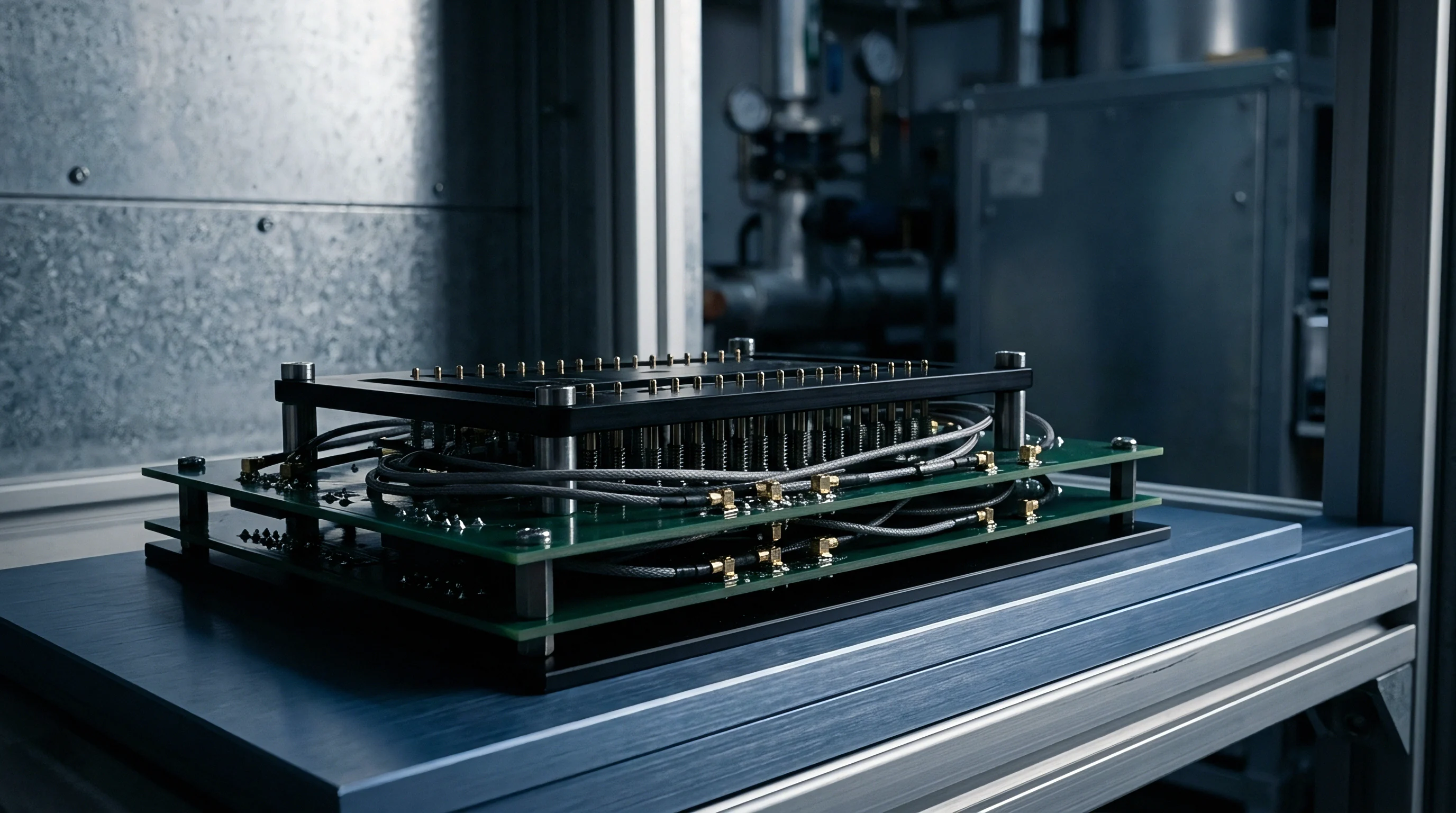
Bench Verification of Real Time Clock Compensation Cycles
Connecting a high-speed digital storage oscilloscope to the low-power wake pin captures real-time timing drift across simulated temperature ramps. High-precision current probes measure microampere sleep baselines and active wake current spikes during compensation calculation execution. Automated test scripts ramp thermal chambers from minus twenty degrees Celsius to plus seventy degrees Celsius while logging pulse-per-second output pins against atomic time references.
Empirical laboratory measurements confirm that fixed-point Q8.24 Horner polynomial compensation holds sleep timer deviation within plus or minus 1.8 parts per million across seventy-degree thermal swings. Tight timing control enables wireless node receivers to maintain 2.5-millisecond guard bands, securing multi-year battery life for remote industrial endpoints.
Calibrating the low-power sleep counter with temperature-indexed polynomial evaluation maintains tight guard bands while holding total sleep current within original energy budgets.