Quantifying Non-Terrestrial Network Protocol Conformance Overhead on Embedded Power Budgets
Non-terrestrial protocol conformance increases embedded wake energy up to fifteenfold through pre-RACH GNSS synchronization and Doppler compensation.

Orbit

Exo-Atmospheric Link Dynamics and Synchronization Mechanics
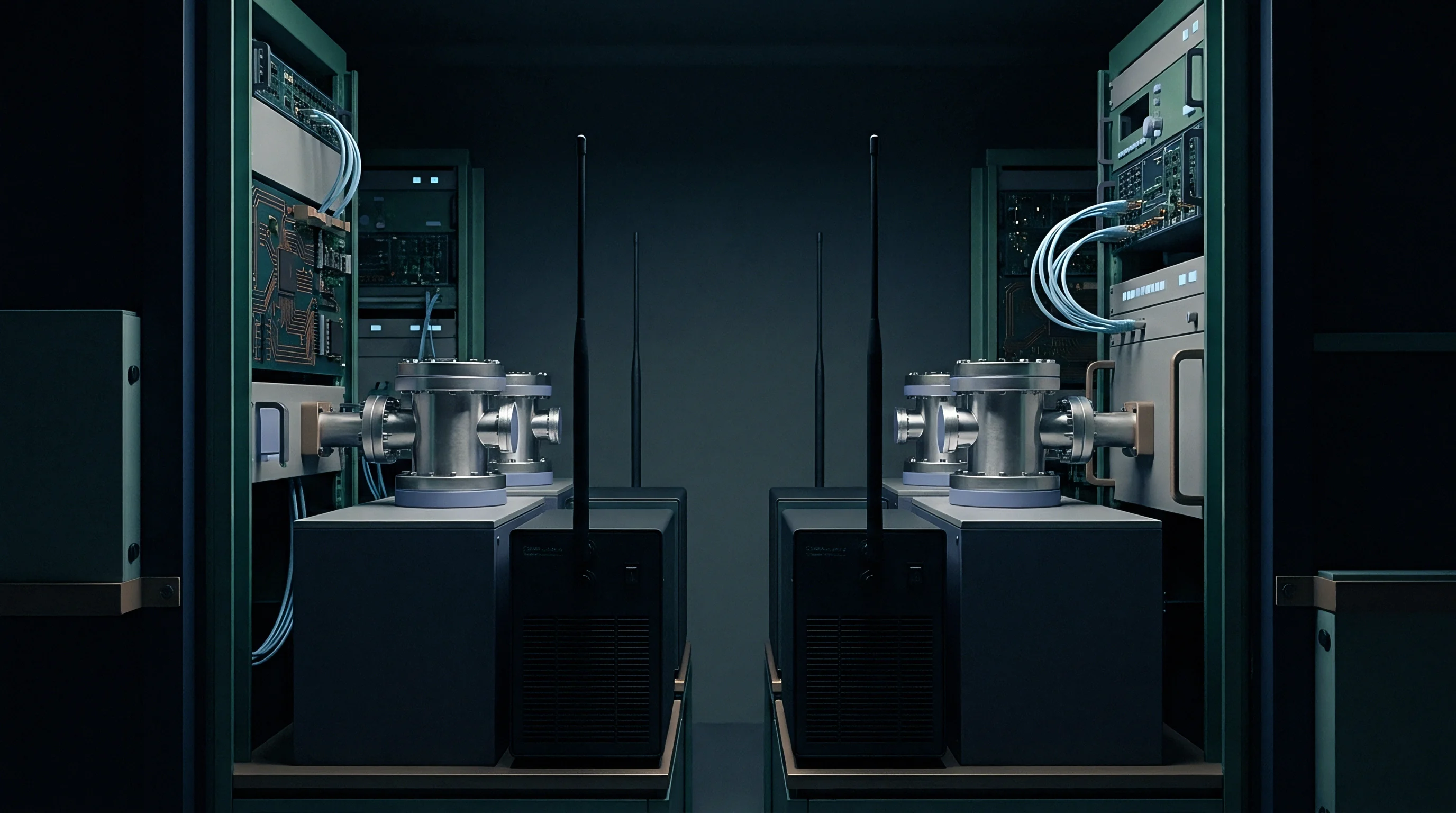
A digital storage oscilloscope connected across a ten-milliohm shunt resistor captures the current transient as an orbital transceiver wakes from ultra-low-power sleep. Path loss over non-terrestrial channels varies continuously with changing slant range. A Low-Earth Orbit platform at 600 kilometers altitude exhibits a slant range of 600 kilometers at zenith, expanding to over 1,500 kilometers at a ten-degree elevation angle ~ a geometry that increases free-space path loss by more than 8 decibels.
High relative velocity between orbital nodes and ground terminals creates Doppler shifts reaching plus or minus 35 kilohertz in the 2 GHz S-band allocation.
Because Doppler shifts distort the preamble over space links, 3GPP Release 17 non-terrestrial link specifications mandate pre-compensation of both frequency and time offsets at the user terminal before preamble transmission. Physical layer synchronization overheads include extended Random Access Channel preambles, preamble repetition factors up to 64 or 128 times, and timing advance pre-compensation. Standard terrestrial NB-IoT devices transmit random access preambles with minimal timing offset estimation, whereas spaceborne transceivers require continuous position and velocity calculations before enabling the RF power amplifier.
A 10-decibel increase in preamble repetition density expands transmission energy consumption by 840 millijoules per uplink attempt at 23 dBm output power.
Unsynchronized transmission attempts fail completely when propagation delay variations exceed the cyclic prefix duration. At a 1,500-kilometer slant range, one-way signal transit time reaches 5 milliseconds, introducing a 10-millisecond round-trip delay. Embedded baseband firmware compensates for this propagation delay by advancing preamble timing relative to the frame boundary.
This calculation forces the host microcontroller to remain in active clock modes longer, drawing extra microampere-hours before RF generation begins.
- Ephemeris staleness widens frequency search windows during initial synchronization, raising receiver energy consumption before packet arrival.
- Crystal oscillator drift skews timer accuracy over temperature variations, risking missed transmission windows during brief orbital passes.
- Excessive preamble repetition runs power amplifiers longer during low elevation angles, wasting energy against atmospheric attenuation.
- Frequent tracking update cycles consume power whenever fast-moving orbital beams cross stationary field devices.
Sensitivity degradation over long propagation paths forces the use of aggressive preamble repetitions. While a single Random Access Channel preamble burst in terrestrial configurations spans 5.6 milliseconds, a non-terrestrial preamble configuration with 32 repetitions spans over 180 milliseconds. Operating a 23 dBm power amplifier for 180 milliseconds draws peak currents of 120 to 180 milliamperes from the embedded power rail ~ an energy expenditure paid long before application payload data bits pass to the modulator.
The exact point where dynamic beam-forming on spaceborne platforms renders device-side Doppler pre-correction redundant remains a point of active debate among transceiver designers.


Grid

Embedded Power Accounting across Conformance States
Electrical energy stored in primary lithium-thionyl chloride cells depletes through discrete protocol state transitions rather than steady standby draw. Conformance with non-terrestrial specifications introduces mandatory pre-transmission steps absent in standard land-based cellular operations. The embedded modem cannot simply scan a frequency raster and issue an attach request; because uncalibrated local clocks drift quickly, obtaining a location fix consumes substantial energy.
A positioning receiver must acquire valid orbital ephemeris and determine local device coordinates before the baseband controller calculates Doppler pre-compensation values.
GNSS receiver operation forms the largest single power overhead during initial link setup. Cold-start GNSS acquisition consumes 15 to 30 milliamperes over 25 to 45 seconds when antenna placement or ambient cover degrades sky visibility. This pre-RACH positioning step expends between 1.35 and 4.86 joules of energy before a single radio frequency symbol reaches the antenna port.
Terrestrial modems bypass this stage entirely by leveraging cell-site tracking and fixed timing advance values stored during prior attach sequences.
| Parameter | Terrestrial Cellular NB-IoT | 3GPP Rel-17 NTN NB-IoT | Proprietary LEO Direct-to-Device |
|---|---|---|---|
| GNSS Fix Requirement | Optional / Intermittent | Mandatory Pre-RACH | Mandatory Periodic |
| Doppler Pre-Compensation | None | Device-Side PHY Layer | Baseband Firmware Interpolation |
| Max Preamble Repetitions | 128 | 512 | 64 |
| Typical Sync Overhead per Uplink | 15 – 45 mAs | 180 – 450 mAs | 90 – 220 mAs |
Tracking Area Updates pose an additional energy drain unique to moving satellite beam layouts. Spaceborne platforms moving at 7.5 kilometers per second sweep sub-satellite beam footprints across ground geography rapidly, changing a stationary field node’s serving cell every 45 to 90 seconds. If protocol stack parameters permit automatic Tracking Area Updates upon beam boundary crossing, the modem wakes continually to perform handover procedures.
System integrators typically adjust core timer values to suppress unnecessary update messaging.
- Connect a high-speed current probe across the primary battery terminal and configure logging at 100 kilosamples per second.
- Force a cold-start attachment sequence under controlled Doppler shift simulation of 35 kilohertz.
- Capture total charge consumption in milliampere-seconds from initial receiver wake-up through random access preamble transmission to final power-save idle transition.
- Measure the precise duration of GNSS signal acquisition preceding the uplink frame.
Tracking area updates triggered by moving beam footprints drain battery reserves faster than raw payload transmissions.
Power Saving Mode (PSM) and extended Discontinuous Reception (eDRX) timers require careful alignment with orbital pass schedules. Standard PSM parameters designed for fixed terrestrial infrastructure leave modems sleeping while spaceborne transceivers pass overhead, or wake modems when no orbital node resides above the horizon. Failed connection attempts into empty sky consume maximum RF transmit power as baseband logic escalates repetition counts searching for nonexistent downlinks.
Setting power-saving mode timers longer than the orbital pass period prevents fruitless attachment attempts while spaceborne transceivers sit below the horizon.


Sink

Worked Energy Budget and Field Trace Analysis
Evaluating power dissipation during non-terrestrial protocol conformance requires separating baseline modem operation from overhead induced by orbital mechanics. Consider an industrial remote monitoring terminal equipped with a 3.6-volt primary lithium-thionyl chloride battery rated at 2,400 milliampere-hours. The terminal reports a 50-byte telemetry packet once per hour over an S-band direct-to-space link.
Ambient operating temperatures average 20 degrees Celsius, yielding a baseline cell self-discharge rate below one percent annually.
Calculating energy per packet phase highlights where battery capacity vanishes during standard operation:
Step 1: Positioning Receiver Fix. The GNSS engine executes a warm start, drawing 12 milliamperes for 12 seconds to achieve sub-50-meter accuracy and lock time reference. Charge spent: 144 milliampere-seconds (518.4 millijoules).
Step 2: Microcontroller Doppler Pre-Computation. The host ARM Cortex-M4 core executes floating-point orbital calculations using cached ephemeris data, running for 40 milliseconds at 8 milliamperes. Charge spent: 0.32 milliampere-seconds (1.15 millijoules).
Step 3: Downlink Sync Search. The RF transceiver wakes to search for orbital beam synchronization signals, operating its receiver for 350 milliseconds at 26 milliamperes. Charge spent: 9.1 milliampere-seconds (32.76 millijoules).
Step 4: RACH Preamble Execution. The modem transmits an extended Random Access Channel preamble with 32 repetitions at 23 dBm output power, drawing 130 milliamperes for 1.6 seconds. Charge spent: 208 milliampere-seconds (748.8 millijoules).
Step 5: Payload Transmission and Acknowledgment. The terminal transfers the 50-byte payload and receives RLC acknowledgment, drawing 130 milliamperes during transmission and 26 milliamperes during reception over a combined duration of 300 milliseconds. Charge spent: 39 milliampere-seconds (140.4 millijoules).
| Execution Phase | Current Draw | Duration | Charge (mAs) | Energy Percentage |
|---|---|---|---|---|
| GNSS Timing & Position Fix | 12.0 mA | 12.0 s | 144.0 | 36.0% |
| Baseband Pre-Compensation | 8.0 mA | 0.04 s | 0.32 | 0.1% |
| Downlink Beacon Acquisition | 26.0 mA | 0.35 s | 9.1 | 2.3% |
| RACH Repetitions (32x) | 130.0 mA | 1.60 s | 208.0 | 51.9% |
| Payload & Acknowledgment | 130.0 mA | 0.30 s | 39.0 | 9.7% |
| Total Per Uplink Cycle | 400.42 | 100.0% | ||
Summing these execution phases yields a total charge consumption of 400.42 milliampere-seconds (1.441 joules) per uplink event. Payload transmission accounts for under ten percent of total energy expenditure. Pre-transmission protocol conformance requirements, comprising positioning fix and extended preamble repetition, consume nearly 88 percent of the overall energy budget.
In comparison, a terrestrial NB-IoT module transmitting the same 50-byte payload consumes 22 milliampere-seconds total charge, representing an eighteenfold energy penalty for non-terrestrial connectivity conformance.
- Disable HARQ retransmissions when channel conditions introduce propagation delays exceeding 25 milliseconds to prevent buffer memory holding current.
- Enforce extended sleep timers between tracking updates to decouple device wake-up schedules from fast-moving footprint boundaries.
- Implement coarse ephemeris caching on persistent storage to eliminate full constellation cold fixes prior to scheduled orbital contacts.
Underestimating preamble repetition power during low-elevation orbital passes leads to early battery passivation and unrecoverable node failure in remote field deployments.


Margin

Protocol Stack Tuning and Frequency Band Constraints
Maintaining radio link stability across exo-atmospheric paths requires error correction configurations that directly multiply transmitter airtime. System engineers adjust physical layer and radio link control parameters to preserve connectivity while controlling battery depletion. Disabling specific retransmission mechanisms yields measurable power savings when operating over channels characterized by high round-trip latency.

How Much Power Does Doppler Pre-Compensation Consume?
Baseband processors calculating Doppler frequency offsets and timing advances consume negligible current compared to RF power amplifier operation. Processing algorithmic corrections on a 32-bit ARM Cortex core draws microamperes over fractional milliseconds, whereas operating the power amplifier for a single extra preamble repetition consumes tens of milliamperes.
Hybrid Automatic Repeat Request (HARQ) retransmissions, designed for terrestrial channels with millisecond-level feedback loops, perform poorly across long non-terrestrial propagation paths. Holding baseband buffers active while waiting 30 to 50 milliseconds for HARQ feedback forces the modem to remain in intermediate power states instead of dropping into deep sleep. Disabling HARQ retransmissions and shifting Radio Link Control (RLC) to Unacknowledged Mode (UM) removes receiver window waiting times, dropping energy consumption per message by up to 28 percent.
| Frequency Band | Uplink Spectrum | Regulatory Region | Duty Cycle Ceiling | Max Power Output |
|---|---|---|---|---|
| Sub-GHz ISM | 868.0 – 868.6 MHz | Europe (ETSI) | 1.0% per hour | 14 dBm ERP |
| Sub-GHz ISM | 902.0 – 928.0 MHz | Americas (FCC) | FHSS Channel Ceilings | 30 dBm EIRP |
| L-Band MSS | 1610.0 – 1626.5 MHz | Global (ITU) | Continuous / Uncapped | 23 dBm Conducted |
| S-Band MSS | 1980.0 – 2010.0 MHz | Global (ITU) | Continuous / Uncapped | 23 dBm Conducted |
Regional band plans constrain transmit duration and output levels. Operating in sub-GHz Unlicensed Industrial, Scientific, and Medical allocations subjects terminal nodes to strict duty cycle ceilings. European ETSI regulations enforce a one percent hourly duty cycle ceiling across standard sub-GHz channels, limiting cumulative transmission time to 36 seconds per hour.
High preamble repetition factors quickly exhaust this regulatory transmission budget, blocking subsequent status messages or emergency alarms until the duty cycle window resets.
- Timing sync validation logs verifying frequency pre-correction within 50 hertz tolerances across temperature sweeps.
- Power amplifier duty records confirming conformance with sub-GHz duty cycle ceilings under maximum repetition configurations.
- Coexistence emission profiles demonstrating adjacent band attenuation during high-power S-band uplink bursts.
Standard 3GPP Release 17 clause 7.3 mandates GNSS location assistance before initial random access when Doppler uncertainty exceeds 1.5 kilohertz.
Discrepancies between datasheet power figures and measured field consumption typically stem from test conditions that assume ideal zenith pass trajectories with zero oscillator drift.


Tariff

Silicon Architecture, Memory Overhead, and Sourcing Strategy
Procurement specifications for exo-atmospheric telemetry modules balance initial hardware unit costs against lifetime battery replacement expenses driven by protocol compliance. Selecting silicon with integrated non-terrestrial protocol stacks alters system architecture. Microcontrollers executing dual-stack cellular and spaceborne protocols demand larger internal memory arrays and higher clock speeds to handle complex radio resource control state machines.
Microcontrollers equipped with external QSPI flash chips draw additional supply current during firmware execution. Executing protocol stack code from external memory increases energy consumption per clock cycle compared to running directly from embedded flash memory. Modern integrated baseband chipsets incorporate dedicated hardware accelerators for preamble generation and FFT-based Doppler search engines, reducing active compute time and preserving system power reserves.
Firmware image size scales exponentially when dual-stack terrestrial and non-terrestrial protocol drivers inhabit the same microcontroller flash memory.
Airtime subscription structures interact directly with embedded energy budgets. Service providers billing on a per-kilobyte tier incentivize message consolidation. However, accumulating application data over several hours to send larger single packets increases RF power amplifier burst durations.
System designers calculate the inflection point where long continuous transmit bursts trigger cell thermal throttling or primary battery voltage drops, balancing commercial airtime rates against hardware operating limits.
Engineering teams selecting integrated transceivers for long-life remote deployments evaluate both silicon unit prices and the total joules consumed per delivered application byte across five years of orbital passes.