Harmonized Standard Test Procedures for Machine Learning Driven Array Backoff Power Control Tables
Harmonized machine learning array power backoff testing requires deterministic safety clamp auditing and multi-dimensional spatial near-field scanning across all operating states.
Mask
Beam-steering radio equipment relies on dynamic phased array backoff control to stay within specific absorption rate limits and total radiated power caps across operating bands. Older wireless systems used fixed look-up tables burned into non-volatile memory during factory calibration. In contrast, current millimeter-wave and sub-6 gigahertz active arrays run inference engines that trim per-element phase and attenuation on the fly according to active channel loading, enclosure temperatures, and proximity sensor feeds.
Because this control loop continuously alters the spatial distribution of radio frequency energy, formal laboratory qualification becomes far more complicated.
Static power tables lock spatial performance to predetermined boundaries.
When an adaptive machine learning model governs array gain and power backoff, standard compliance routines built around static beam configurations miss the worst-case spatial energy density. Regulatory frameworks ~ including the Federal Communications Commission under KDB 447498 D04 and European harmonized standards under ETSI EN 303 687 ~ require peak electromagnetic field exposure to remain below statutory thresholds in every achievable operating state. Proving this requires reconciling the deterministic boundaries of the software model with physical radiated measurements taken inside an accredited anechoic chamber.

Deterministic Power Boundaries for Adaptive Array Controllers
Array control software built on neural networks or regression trees maps real-time host telemetry to discrete backoff values across individual power amplifier channels. For regulatory certification, the central hazard is unconstrained inference. If the model hits an out-of-distribution state ~ an unusual mix of ambient temperature, load impedance mismatch, and proximity readings ~ it can fail to apply sufficient backoff, pushing radiated emissions past statutory ceilings.
To satisfy type approval standards, manufacturers implement deterministic clamping software that caps the model’s output. This envelope ensures that no combination of neural weights or input vectors can drive the active array front-end beyond the maximum equivalent isotropically radiated power verified during testing. Compliance assessments review both the inference engine and the hardware clamping logic beneath it.
Safety software envelopes cap maximum array output regardless of algorithmic state inputs.

Radio Frequency Exposure Limits across Phased Array States
Assessing energy absorption from adaptive phased arrays requires measuring power density across both space and time. Standard planar phantom sweeps designed for fixed antennas cannot track peak energy density when beam profiles shift under trained inference parameters. Test procedures therefore call for spatial grid scans across the near-field plane while sweeping the full state space of the backoff table.
Engineers run synthetic stimulus sequences to force the control table through its operational states. For equipment operating above 6 GHz, compliance centers on absorbed power density averaged over a 4 square centimeters area, per IEC/IEEE 62209-1528. Scans capture spatial profiles at maximum broadside, at extreme steering angles, and at intermediate backoff steps commanded by the algorithm.
| Evaluation Parameter | Static Look-Up Table System | Machine Learning Adaptive Array Control |
|---|---|---|
| State Matrix Verification | Single sweep across fixed channel index values | Multivariate state sweep including sensor and thermal inputs |
| Near-Field Surface Mapping | Fixed grid scan over peak spatial location | Dynamic spatial tracking scan across variable beam locations |
| Software Attestation File | Static firmware build hash and table binary | Model weight validation, input bounds documentation, safety clamp logic |
| Spurious Emissions Profile | Measured across static power amplifier bias points | Evaluated across dynamic transition states and state table switching |
Failing to establish the boundary conditions of an adaptive backoff table invalidates the electromagnetic compatibility test dossier. The consequences are immediate: rejected type applications, distributor recalls, and suspended equipment grants.

Bench
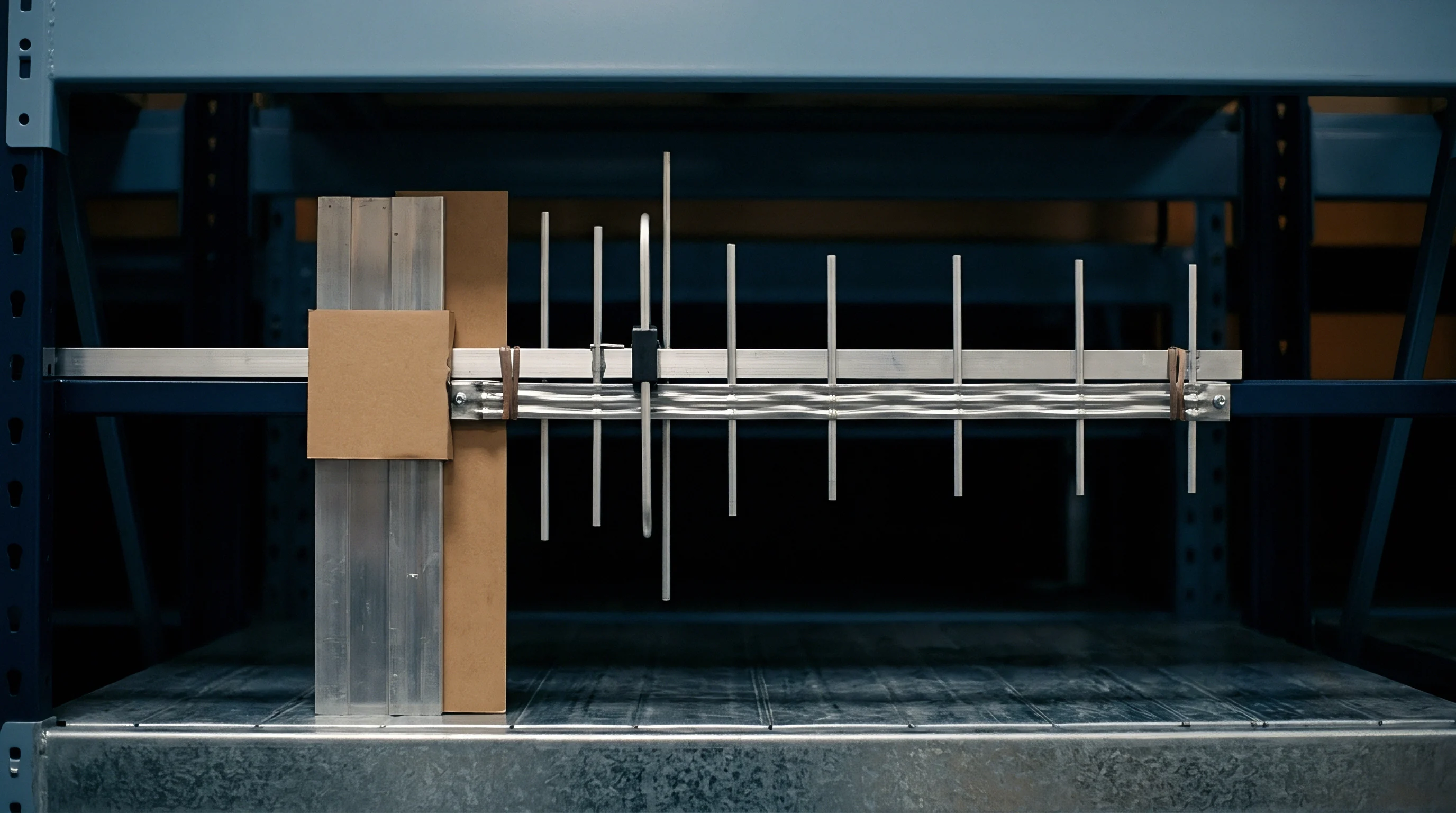
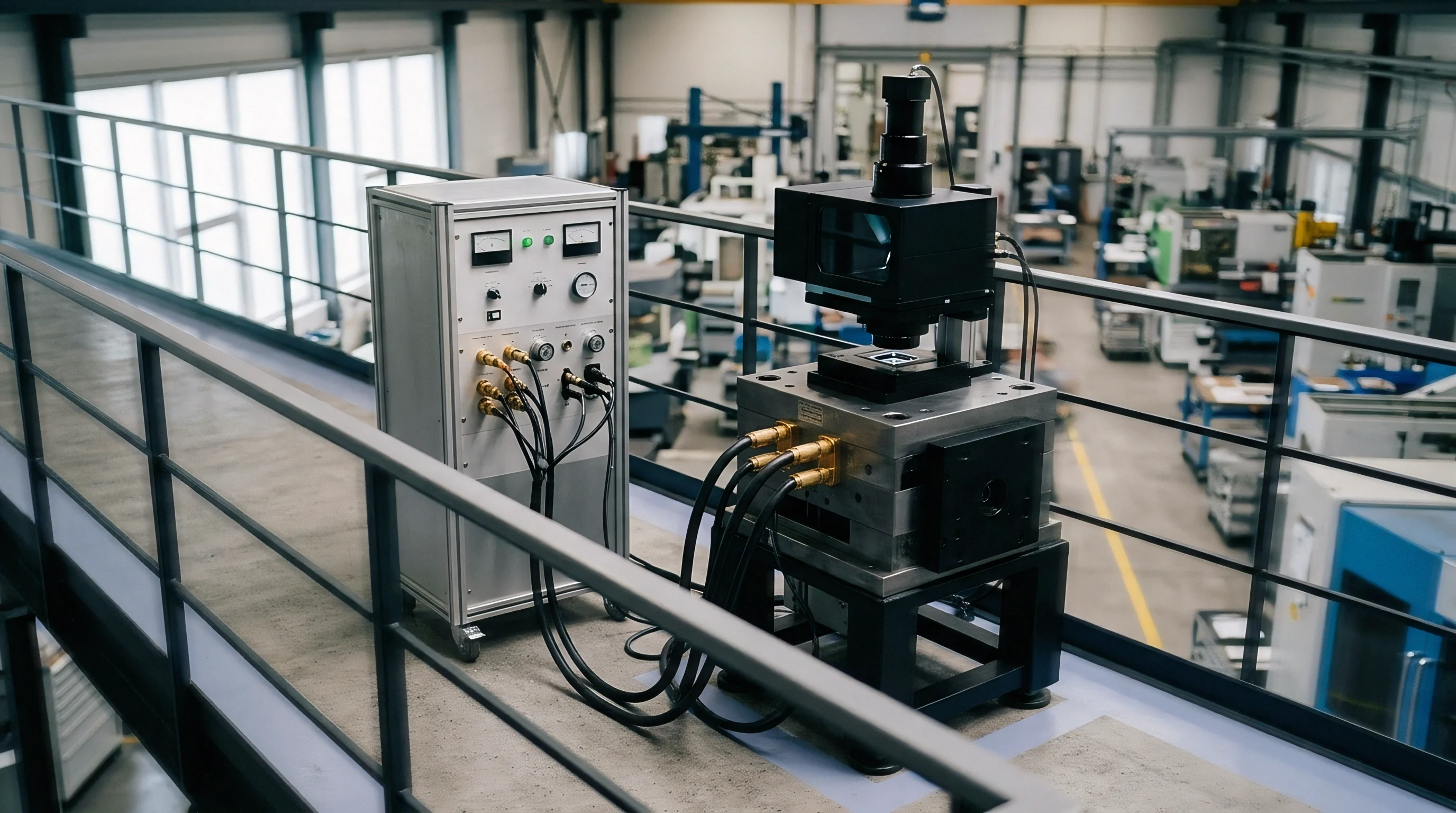
Testing machine-learning power tables requires physical benches linked directly to telemetry ports on the device under test. A complete setup pairs an automated scanning gantry with high-speed isotropic electric field probes, synthetic channel emulators, and temperature-controlled enclosures. Routines feed synthesized sensor signals into the host while instrumentation samples the resulting radio frequency exposure in the near field.
Phased arrays produce intricate, multi-lobed radiation fields.
Anechoic chambers capture actual radiated energy rather than projected estimates.
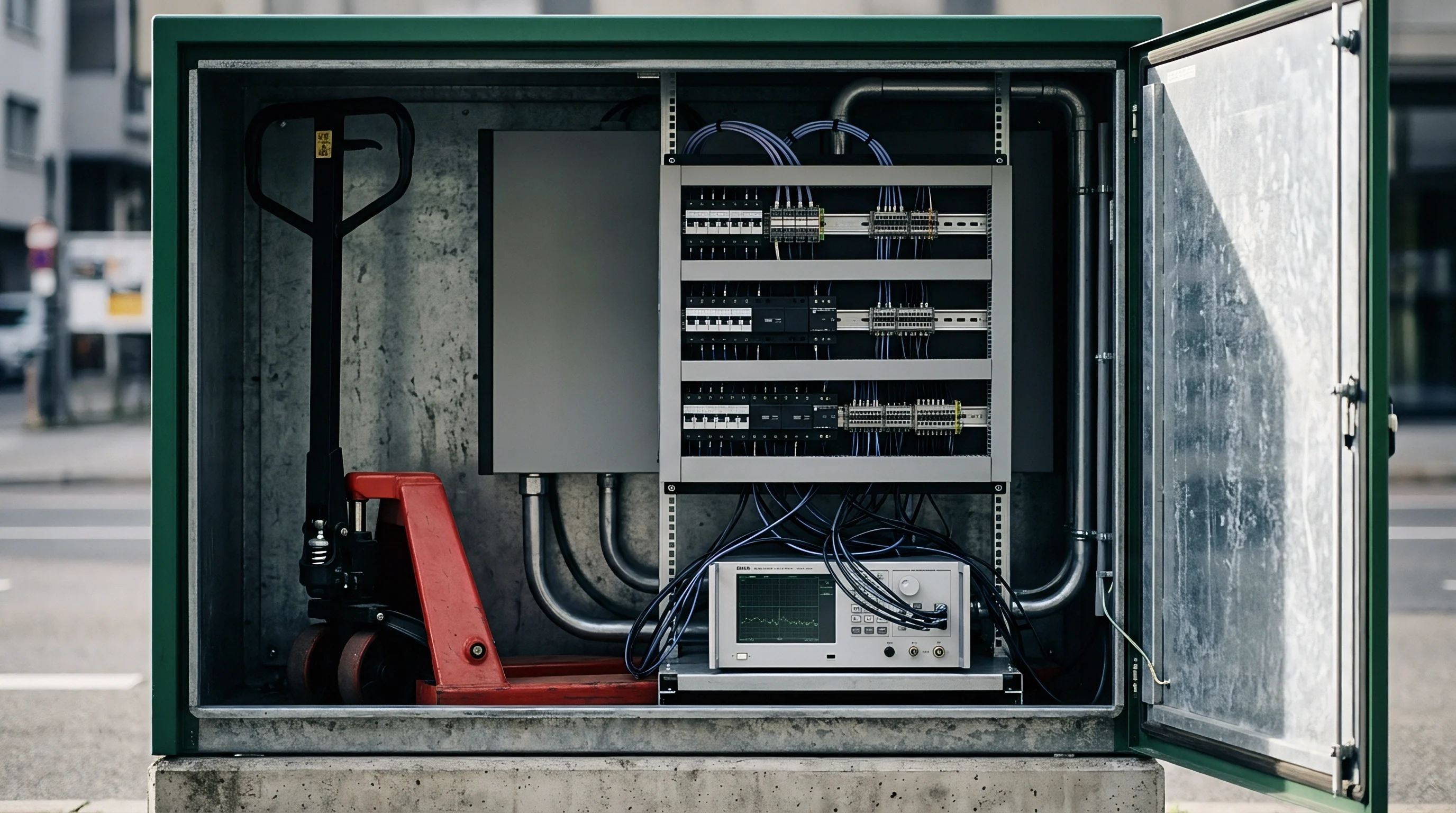
Automation software synchronizes signal generation with field probe acquisition. Mounted on a low-permittivity dielectric turntable inside a fully anechoic chamber, the device receives simulated ambient telemetry over serial or Ethernet test buses, stepping the model through its input states while probes log radiated fields.
Automated Test Setup for Spatial Power Sweeps
The bench ties high-bandwidth power meters and vector signal analyzers to specialized near-field scanners. Positioners move isotropic sensors across a three-dimensional grid around the enclosure, taking steps smaller than one-tenth of a wavelength at the highest operating frequency. Because the algorithm switches states rapidly, the acquisition system relies on temporal sampling loops fast enough to catch microsecond power spikes.
Stable array calibration requires clean, uncorrupted DC power delivery.
Test scripts sweep three operational axes simultaneously: pointing angle, sensor stimulus, and channel frequency. As the bench cycles through operating channels, it steps the simulated thermal and proximity telemetry. Measured power is checked against the table backoff value at each position, flagging any discrepancy greater than the 0.5 decibels tolerance limit.
Simulated User Proximity and Beam Steering Modulation
Evaluating proximity backoff requires physical phantoms near the radiating array. Capacitive plates, optical targets, or synthetic tissue phantoms stimulate the onboard proximity sensors that feed the machine learning model. Operators vary phantom distance to assess both response latency and the backoff depth applied by the controller.
Beam steering introduces directional complexity into proximity testing. When the controller alters phase weights to track a simulated base station, the backoff table recalculates spatial overlap between the main beam and the adjacent phantom. Test benches record power density every 5-degree in azimuth and elevation to verify that backoff engages whenever the beam points toward tissue.
What Triggers Algorithmic State Transitions during Radiated Scans?
State transitions during chamber tests follow the telemetry fed to the inference processor. Scripts trigger these shifts by systematically altering parameters during active transmission runs:
- Thermal threshold crossing prompts the model to lower total array power to avoid junction overheating, balancing individual element gains to level temperature gradients across the substrate.
- Proximity sensor triggers force power reductions across elements closest to the dielectric target, reshaping the beam envelope to stay below exposure limits.
- Base station power control requests demand maximum permitted total radiated power, overriding efficiency modes while hardware clamping enforces the hard exposure ceiling.
- Impedance mismatch variations caused by dielectric loading prompt the ML engine to adjust drive currents, preserving radiation efficiency without breaching spurious emission masks.
Unexpected radiated power spikes during state transitions stem from non-deterministic neural network interpolation across uncalibrated telemetry states inside active test chambers.

Matrix
Validating algorithmic backoff tables requires structured state-space mapping. With thousands or millions of model weight interactions, measuring every possible operating state inside a chamber is impossible within commercial schedules. Certification bodies therefore rely on a hybrid model: empirical spot measurements in an anechoic chamber matched against audited computational reconstructions.
The matrix indexes thermal telemetry, proximity flags, RF channels, and steering angles against expected output power. Test engineers pick evaluation points with multi-dimensional boundary sampling to stress edge conditions. This framework separates empirical points reserved for chamber sweeps from intermediate conditions checked via software audit.
Deterministic Envelope Bounds for Neural Power Approximators
Because neural networks function as non-linear approximators, regulatory approval requires isolating inference behind a hard-coded deterministic envelope. In this dual-layer setup, proposed backoff figures pass through a secondary logic gate that verifies them against hard safety limits before altering control voltages on the phase shifters and power amplifiers.
Audits confirm that firmware routines or runtime exceptions cannot bypass this secondary check. The firmware must default to maximum backoff whenever sensors disconnect, model execution stalls, or memory faults occur. In addition, independent watchdog timers force array drive down if the inference engine crashes or produces illegal instructions.
Hard-coded safety envelope logic must override neural model inference outputs during invalid telemetry events.

Worked Reconstruction of Interpolated Array Backoff State Space
Regulatory procedures can be illustrated through an active 8×8 dual-polarized millimeter-wave phased array module operating at 28 GHz. Here, a trained model manages thermal throttling and proximity backoff across four input variables: substrate temperature, proximity sensor capacitance, channel index, and beam elevation angle.
With an unattenuated total radiated power of 33 dBm, the module must respect an exposure ceiling of 1.0 milliwatts per square centimeter at a 50 millimeters reference distance. The model defines backoff across 1,024 operating states. Chamber sweeps measure 64 selected boundary conditions, leaving the remaining 960 states to automated computational verification.
- Initialize the anechoic test bench and calibrate isotropic field probes across 27.5 GHz to 28.35 GHz.
- Mount the array on a low-permittivity fixture and connect serial telemetry control buses.
- Force telemetry to State Index 001: broadside steering, 25 degrees Celsius substrate temperature, clear proximity flag, and mid-band channel.
- Measure total radiated power and peak spatial power density in the near field, verifying results fall within 0.3 dB of nominal predictions.
- Step through the 64 physical test states, driving thermal inputs to maximum, steering out to 60 degrees deflection, and tripping proximity sensors.
- Import the 64 empirical datasets into the validation engine to establish the interpolated envelope curve.
- Screen all 960 unmeasured computational states against the safety ceiling to confirm zero boundary violations.
Spurious emissions often surge during abrupt backoff state shifts.
Interpolation errors between empirical points cannot exceed the facility’s certified measurement uncertainty budget. Whenever a modeled state comes within 0.2 decibels of the statutory limit, that exact telemetry configuration must be pulled into the chamber and measured directly.
| Test State Category | Input Combination Matrix | Required Measurement Method | Compliance Acceptance Threshold |
|---|---|---|---|
| Baseline Nominal | 25°C, No Proximity, Broadside Beam | Physical Anechoic Chamber Scan | EIRP within ±0.5 dB of target table value |
| Thermal Boundary | 85°C Substrate, Broadside Beam | Physical Anechoic Chamber Scan | Power backoff ≥ 3.0 dB below maximum rating |
| Proximity Trigger | 25°C, Active Proximity Flag | Physical Anechoic Chamber Scan | Power density ≤ 1.0 mW/cm² at phantom interface |
| Steered Extreme | 50°C, ±60° Azimuth / Elevation | Physical Chamber + Interpolation Audit | Spatial peak exposure below statutory limits |
| Fault Interpolation | Sensor Signal Disruption / Out-of-Bounds | Automated Test Bench Verification | Fallback to absolute maximum backoff state |
Under Clause 6.4 of ETSI EN 303 687, dynamic power schemes that adjust output based on runtime metrics must provide complete state verification logs within the technical documentation file submitted for EU Type Examination.


Audit
Securing market clearance for adaptive backoff systems depends heavily on documentation and configuration management. Certifying bodies do not examine compiled code in a vacuum; they audit development controls, attestation logs, safety hardware architectures, and lifecycle update protocols.
The certificate grant scope defines the outer legal boundaries for the equipment.
Distributing unapproved firmware updates invalidates existing market grants.
Classifying firmware updates is a routine stumbling block in international approvals. Manufacturers routinely roll out patches to refine inference efficiency, conserve power, or tweak thermal profiles. Rules determine whether those changes require an administrative notification, a formal permissive change filing, or a completely new equipment authorization.
Filing Requirements for Algorithmic Radio Control Firmware
Technical filings for adaptive transceivers must satisfy regional software security rules. In the United States, the Federal Communications Commission enforces KDB 594280 guidance for U-NII and active transmitters. Applicants must show that third parties cannot modify neural weights, bypass sensor processing, or override safety clamps to drive output power beyond granted limits.
Dossiers must draw a strict boundary between user-facing code and compliance-critical radio controls. Neural weight sets, model topologies, and clamping algorithms sit firmly on the compliance side. Modifying any of these components automatically triggers regulatory re-evaluation.
Documentation files must prove that host operating systems cannot alter verified power backoff weights.

Host Integration Boundaries and Software Attestation Protocols
Integrating an approved adaptive radio module shifts regulatory responsibility to the host manufacturer. Grant certificates stipulate strict thermal, structural, and software limits. Integrators must prove that the final chassis neither detunes proximity sensors nor distorts array radiation beyond certified tolerances.
Attestation letters accompanying the filing must detail how the model pipeline is protected. Regulators require documentation of cryptographic signing for firmware builds, root-of-trust validation during boot sequences, and memory protections preventing injection attacks against active weight arrays.
- Model Architecture Dossier covering layer configurations, matrix dimensions, telemetry scaling factors, and fixed output clamping limits.
- Software Security Attestation detailing cryptographic signing, secure boot processes, and memory isolation protecting radio control parameters.
- State Verification Report logging chamber sweep results across designated physical test points and interpolated boundaries.
- Host Integration Guide defining mechanical clearance, sensor layout rules, thermal limits, and host-level verification procedures.
Host integrators face distinct procedural hurdles when attempting to reuse original modular test data after updating array backoff weights in post-launch firmware.


Yield
Managing global approvals for adaptive array products requires careful capital allocation and calendar management. Multi-state arrays consume far more anechoic chamber time than fixed-power designs. Chamber availability, multi-country filing schedules, and retest reserves govern both product rollout dates and certification spend.
Chamber availability routinely sets the hard schedule for commercial shipping.
In-country agents shepherd submissions through local regulatory queues.
Unplanned retests can easily double total certification timelines.
Projecting total regulatory expense means factoring in chamber day rates, support engineering hours, agency fees, and statutory filing tariffs in each jurisdiction. Budgets must also reserve funds for chamber re-runs if algorithmic instability surfaces during baseline sweeps.

Laboratory Chamber Hour Allocation and Test Campaign Scheduling
An 8-element static array typically ties up an anechoic chamber for 16 to 24 hours to cover spatial patterns, occupied bandwidth, and spurious emissions. An equivalent adaptive array running machine-learning backoff requires 60 to 120 hours of automated chamber time to map its mandated state space. Program managers must book these extended chamber windows months ahead of launch.
Staging test runs controls laboratory costs. Screening designs on internal or regional pre-compliance benches before booking commercial test houses helps isolate peak emission states early and confirms that safety clamping kicks in during telemetry faults.
Cross Border Approval Cost Comparison
Certification costs and filing requirements diverge across jurisdictions. Total expenditure covers accredited lab time, local filing fees, in-country representative retainers, and translation costs. Lowering entry friction depends on sequencing submissions so a single primary test report supports multiple regional dossiers.
Under the EU Radio Equipment Directive, manufacturers can self-declare conformity against harmonized standards if accredited test data covers the full scope. When dynamic backoff involves non-harmonized evaluation procedures, however, an EU Notified Body must assess the file. In the United States, FCC rules require routing through a Telecommunications Certification Body, which adds direct filing and administrative review charges.
| Target Market Region | Primary Approval Route | Estimated Chamber Time Required | Average Total Regulatory Filing Cost | Standard Regulatory Lead Time |
|---|---|---|---|---|
| United States (FCC) | TCB Grant submission via Part 15 / Part 30 | 80 to 120 Hours | $35,000 to $55,000 | 6 to 8 Weeks |
| European Union (CE RED) | Notified Body Type Examination Certificate | 60 to 90 Hours | $28,000 to $45,000 | 4 to 6 Weeks |
| Japan (Giteki / MIC) | Registered Certification Body Approval | 50 to 80 Hours | $22,000 to $38,000 | 5 to 7 Weeks |
| China (SRRC) | In-Country Radio Regulation Approval | 70 to 100 Hours | $30,000 to $50,000 | 8 to 12 Weeks |
| Brazil (ANATEL) | Designated Certification Body (OCD) | 60 to 90 Hours | $25,000 to $42,000 | 10 to 14 Weeks |
A single compliance failure halts shipments immediately.
Spending extra pre-compliance hours early in hardware development prevents full campaign restarts when edge-case backoff failures appear in commercial test facilities.