Decoupling Non Recurring Engineering Costs from Production Bill of Materials Unit Pricing
Decouple non recurring engineering into milestone payments to preserve design ownership, eliminate inflated bill of materials markups, and secure transfer rights.


Ledger
Quotations for custom RF and microcontroller builds routinely hide non recurring engineering fees inside piece-part prices. A plant might quote forty thousand wireless sensor nodes at twelve dollars and eighty cents apiece with zero upfront design costs. Itemized under an unbundled scope, however, that same build reflects seven dollars and forty cents in raw materials, two dollars and ten cents in factory conversion, and a standalone engineering invoice for one hundred and thirty-two thousand dollars.
Rolling development hours into unit pricing locks the buyer into an artificially high cost curve over the full lifespan of the assembly.
Amortizing engineering overhead across piece pricing keeps early shipments looking manageable by pushing cash outlays past initial validation gates. But that balance turns once volumes surpass the opening forecast. At one hundred thousand units, the per-unit surcharge collects three hundred and thirty thousand dollars in nominal development fees ~ an overpayment of nearly two hundred thousand dollars beyond the true non recurring cost.
The factory pockets the surplus and keeps design documentation locked down, arguing that development was funded on its own ledger.
Amortized engineering fees turn volume growth into compounding factory profit while masking baseline raw material costs.
A sound procurement specification establishes clear commercial boundaries before vendor selection begins. Labor, design validation, functional test fixtures, and regulatory filings are structured as distinct milestones invoiced only upon deliverable acceptance. Material tracking then runs on standard component costs alongside an agreed assembly conversion margin, isolating supply chain volatility from technical service fees.
| Cost Component Category | Embedded Unit Amortization Model | Decoupled Engineering Milestone Model | Variance at Forecast Baseline | Variance at Double Baseline Volume |
|---|---|---|---|---|
| Initial Non Recurring Engineering | 0 USD upfront fee | 95,000 USD milestone invoice | -95,000 USD immediate cash | -95,000 USD immediate cash |
| Base Bill of Materials Unit Cost | 14.80 USD per assembled module | 10.20 USD direct material baseline | +4.60 USD per produced unit | +4.60 USD per produced unit |
| Manufacturing Conversion Margin | Embedded in unit quote | 1.90 USD per module | Included in base comparison | Included in base comparison |
| Total Spend at 50,000 Units | 740,000 USD total billing | 700,000 USD aggregated billing | +40,000 USD excess expense | Not applicable |
| Total Spend at 100,000 Units | 1,480,000 USD total billing | 1,305,000 USD aggregated billing | Not applicable | +175,000 USD excess expense |
Decoupling development from production pricing keeps baseline margins visible on both sides of the table. When technical milestones remain speculative, contract manufacturers often pad component lines to hedge against yield loss. Setting engineering into a dedicated statement of work strips that ambiguity out of subsequent purchasing audits and replenishment runs.
- Direct material tracking separates raw vendor quotes from factory handling markups against verified distributor invoices.
- Milestone acceptance criteria anchor developmental payouts to documented test logs rather than arbitrary calendar dates.
- Tooling amortization clauses trigger an automatic drop in unit price the moment production volume crosses the agreed amortization threshold.
- Fabrication file ownership assigns full copyright over layout databases to the buyer once developmental balances are cleared.
Manufacturers operating under unbundled engineering models run their lines against realistic operational margins. Contracts hold up better over time when unit pricing reflects actual assembly work instead of lingering development debt.
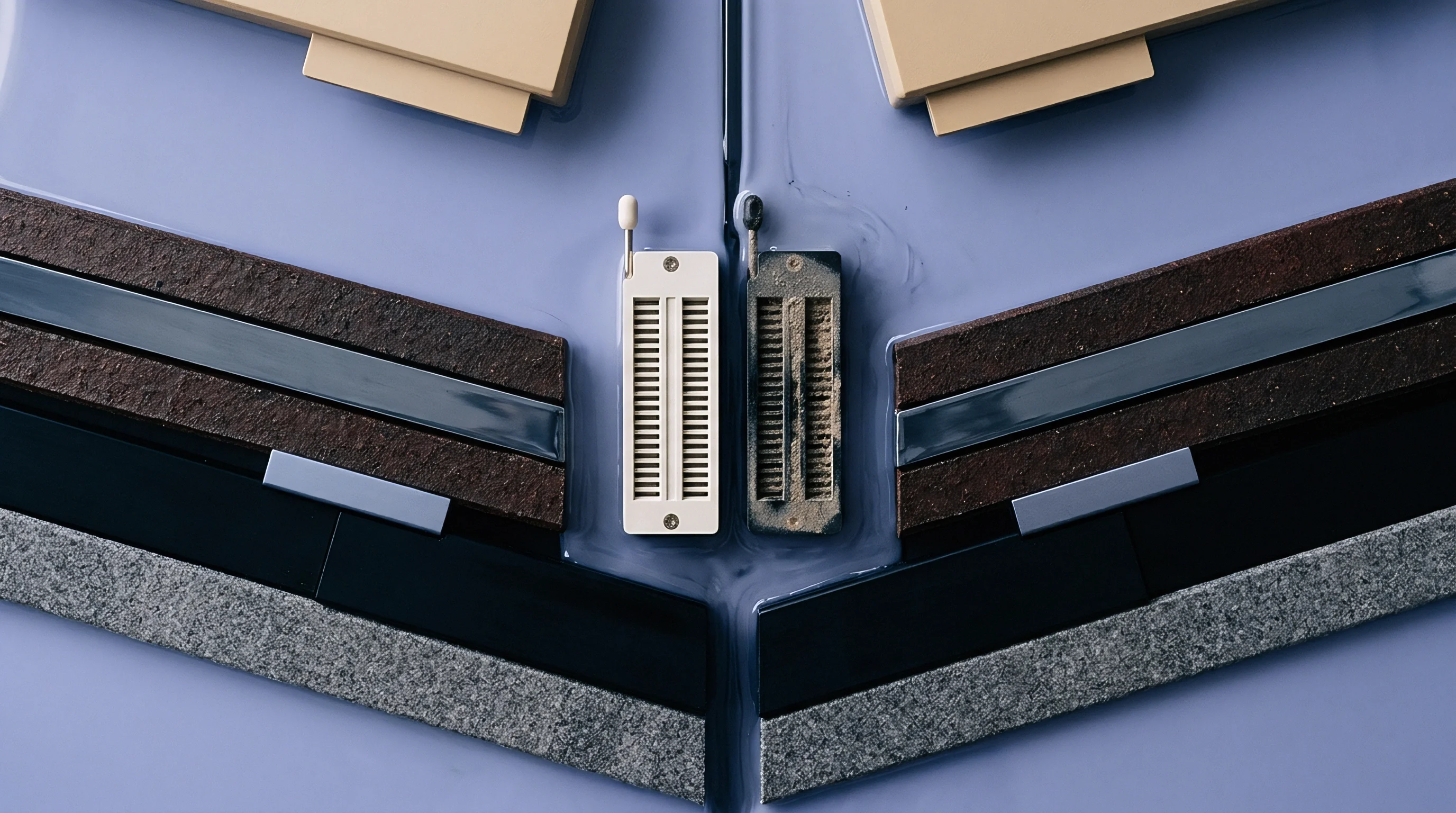

Jig
Production testing marks the clear boundary between product engineering and daily assembly line operations. Building high-density wireless assemblies requires custom bed-of-nails fixtures, RF shielding enclosures, and automated flashing racks. If these systems are rolled into general piece pricing, legal title stays with the assembler.
When a contract ends, the customer leaves empty-handed, unable to bring up an alternate facility without paying to replicate the entire test line from scratch.

What Dictates Physical Fixture Transfer Rights?
Ownership of production equipment comes down to how line items are defined in the original non recurring engineering agreement. Contracts must state plainly that every test bench, calibration standard, bed-of-nails rig, and programming interface funded by the customer remains buyer-owned tooling. Because fixtures degrade across operating cycles and demand routine servicing, clear ownership terms prevent disputes over maintenance responsibilities.
Explicit buyer-owned tooling clauses turn factory test fixtures into portable assets that can be extracted on sixty days written notice.
Physical hardware is useless without its accompanying documentation. A functional fixture delivered without electrical schematics, pin-wiring maps, and test executive source code cannot be maintained or adapted. Complete handover terms require calibration certificates, diagnostic routines, and automated self-test scripts alongside the steel and acrylic frames.
- Fixture schematic sign-off requires complete Altium or Eagle design files covering interposer boards, current-sense shunts, and pogo-pin wiring looms before metal machining starts.
- Calibration procedure verification establishes traceable guidelines to confirm spectrum analyzer and power meter offsets inside RF isolation chambers.
- Test sequence script deposition commits Python or LabVIEW test routines into a version-controlled repository accessible to buyer engineers.
- Line qualification acceptance verifies measurement repeatability across fifty consecutive cycles on golden boards before releasing the final tooling invoice.
Line transfers inevitably expose the friction built into captive factory tooling. When engineering deliverables are properly unbundled, the customer pays for fixture design time, receives the fabrication packages, and holds unambiguous legal rights to pull the physical hardware. Teams that skip unbundled fixture agreements routinely see dual-sourcing schedules slip by six to nine months while replacement rigs are fabricated and qualified.
Under standard terms such as Master Manufacturing Agreement Section 8.4, specialized test fixtures, tooling, and programming molds funded through dedicated invoices remain the exclusive property of the purchaser, deliverable within fifteen business days of written demand.

Markup
Component surcharges mask true assembly economics whenever non recurring costs go unseparated. Assemblers routinely attach administrative handling margins to bare circuit boards, microcontrollers, passives, and packaging. In standard contracts, those markups hover between three and eight percent.
But when development costs lack an explicit invoice, factories inflate pass-through fees to fifteen, twenty, or twenty-five percent across the entire bill of materials.
Procurement audits expose these inflated spreads through open-book reviews that demand original distributor invoices, rebate terms, and landed freight costs. Without unbundled development billing, the assembler defends elevated component markups as a buffer against unbilled engineering changes, firmware fixes, and early yield fallouts on the line.
| Component Category and Part | Actual Distributor Net Price | Authorized 5 Percent Markup | Factory Quoted Unit Price | Hidden Engineering Recovery Margin |
|---|---|---|---|---|
| Multi-Band Cellular Transceiver | 4.20 USD | 4.41 USD | 5.85 USD | +1.44 USD per unit |
| Cortex-M4 Host Controller | 1.85 USD | 1.94 USD | 2.60 USD | +0.66 USD per unit |
| Multi-Layer HDI Printed Circuit Board | 0.92 USD | 0.97 USD | 1.45 USD | +0.48 USD per unit |
| Power Management Integrated Circuit | 0.68 USD | 0.71 USD | 1.05 USD | +0.34 USD per unit |
| Precision RF Passives and Crystal | 0.45 USD | 0.47 USD | 0.70 USD | +0.23 USD per unit |
The arithmetic shows how an assembly carrying eight dollars and ten cents in raw components ends up billed at eleven dollars and sixty-five cents under an embedded model. That three-dollar-and-fifty-five-cent spread far exceeds standard handling overhead. Paying upfront engineering invoices strips out this hidden multiplier, pulling material markups back in line with actual freight and logistics costs.
Market volatility further complicates embedded cost structures. When silicon lead times blow out and spot-market buys inflate component lines, the plant passes cost hikes directly to the customer without adjusting the embedded engineering premium downward. Sourcing teams end up absorbing higher unit costs with zero accounting credit for engineering expenses already amortized.
- Open-book audit clauses grant the right to inspect factory purchase orders against distributor invoices twice per calendar year.
- Yield fallout allocations benchmark scrap and rework rates independently of component pricing to prevent padded material buffers.
- Distributor rebate assignment channels volume discounts and backend supplier rebates back to the brand instead of leaving them with the plant.
Failing to decouple engineering fees from component lines blinds purchasing teams to bill-of-materials inflation, surrenders volume discounts, and leaves programs exposed to escalating material margins over the life of the product.


Escrow
Firmware, PCB layouts, and system schematics require clear procedural separation from contract manufacturing runs. In joint development setups, the factory often writes low-level hardware abstraction layers and flash drivers while the client team writes higher-level application code. Rolling these engineering assets into per-unit billing clouds IP ownership.
Title over bootloaders, pin mappings, and bill of materials source documentation defaults to the factory, reducing the physical board to a closed proprietary module.

Who Retains Custody over Uncompiled Firmware?
Uncompiled source code lingers in legal ambiguity whenever milestones lack clear deliverable definitions. Assemblers maintain dedicated build environments with proprietary toolchains, board support packages, and internal signing keys. Because manufacturing Gerbers omit netlist topologies, second-source transfers fall apart without access to native schematics and build files.
An escrow repository secures the collateral needed to stand up production independently.
Pairing IPC-2581 manufacturing packages with complete source trees lets an alternate plant bring up lines within forty-eight hours of an operational stoppage.
Software and design escrows rely on objective, predefined release triggers. Third-party agents hold native ECAD databases, manufacturing Gerbers, pick-and-place centroid files, and uncompiled C source code. Release conditions trigger automatically upon supplier insolvency, price increases exceeding indexed material benchmarks, or missed purchase order deliveries beyond contracted grace periods.
Releasing low-level microcontroller drivers, automated test routines, and native layout databases threatens proprietary factory processes and exposes internal intellectual property to market rivals, while withholding them leaves the buyer without operational redundancy.

Severance
Separating engineering expenses from manufacturing invoices creates the legal runway for moving production elsewhere. Brands frequently run into irreconcilable friction with initial assembly partners over factory capacity, slipping first-pass yields, unauthorized component swaps, or credit disputes. When development debt remains tied to per-unit billing, walking away halts production entirely, and unitemized tooling deposits disappear without recourse.
An orderly exit requires an explicit asset register drawn up at the start of the engagement. Itemized invoices document that the buyer funded board designs, injection tooling, programming fixtures, and certification filings in full. With no unpaid development balances remaining on the books, the buyer retains clear authority to pull tooling and transfer files without financial dispute.
Regulatory filings highlight why discrete capitalization matters. FCC grants, RED certificates, and regional telecom approvals tie directly to documented board revisions, trace layouts, and shielding designs. When compliance testing is billed as an unbundled engineering deliverable, all formal test reports and regulatory authorizations designate the buyer as the official grantee.
Transferring manufacturing simply requires updating facility addresses with regulators rather than running months of redundant chamber tests.
Pulling physical tooling marks the final step in decoupling from a supplier. Enclosure molds, stamped RF shields, and carrier-tape dies require months of lead time to replace. Properly unbundled contracts assign unique asset tags, serial numbers, and maintenance histories to every tool on the floor.
Freight handlers can then collect company-owned assets directly from the loading dock without getting bogged down in commercial arbitration.
Even with unbundled deliverables in hand, replacement assembly houses rarely replicate initial surface-mount yields immediately from existing placement programs without a round of process tuning on their own lines.