Hybrid Dual-Radio Protocol State Machines for Edge-Triggered Burst Buffering Applications
Edge-triggered dual-radio buffer architecture staging fast edge interrupts into local non-volatile RAM prevents data loss during link state handoffs.


Trigger
Edge-triggered architecture demands immediate ingestion when an external event pulls an interrupt pin low. High-frequency acoustic emission sensors, piezo vibration monitors, and rapid transient flow meters generate data peaks within microseconds. The primary controller cannot wait for a high-power cellular modem or a multi-hop mesh radio to complete a network join handshake before accepting incoming bytes.
Data collection starts on hardware edge detection, storing high-rate samples directly into a dedicated low-power staging area while the communication subsystem wakes up.
Dual-radio architectures separate the operational concerns of immediate local notification from bulk asynchronous data upload. A ultra-low-power radio running a short-range protocol maintains continuous or low-latency beaconing for local proximity alerts and peer synchronization. Concurrently, a secondary long-range or high-throughput interface sits in a deep sleep state drawing under two microamps until an edge event crosses a hardware comparator threshold.
Once activated, the system state machine manages the handoff between local memory staging and backhaul transmission without dropping intermediate sampling frames.
| Sensor Interface Type | Interrupt Latency | Peak Sample Rate | Staging Buffer Target | Radio Wake Trigger |
|---|---|---|---|---|
| SPI Direct Memory Access | 1.2 microseconds | 10 megasamples per second | SRAM Direct Circular Queue | Hardware Threshold Counter |
| I2C High-Speed Mode | 14.5 microseconds | 3.4 megabits per second | SRAM Ping-Pong Buffer | GPIO Level Interrupt |
| ADC Autonomous Sampling | 0.8 microseconds | 2 megasamples per second | Internal Dual-Bank RAM | DMA Half-Full Interrupt |
| UART Burst Framing | 8.0 microseconds | 1.8 megabits per second | FIFO Ring Memory | Pattern Match Detector |
State machine design determines whether edge-triggered buffers survive radio startup delays. When a high-amplitude transient triggers the system, the ingestion controller immediately routes incoming serial frames into primary fast memory. The main radio subsystem takes anywhere from fifteen milliseconds for a 2.4 GHz short-range transceiver to seven seconds for an LTE-M module establishing an RRC connection.
The local staging state machine handles this latency gap by tracking memory fill pointers, managing overflow conditions, and initiating backhaul negotiation before memory bus exhaustion occurs.
Failure modes in dual-radio state transitions cluster around concurrent resource contention and power bus voltage drops. The system must prevent data corruption during high current surges when both transceivers temporarily overlap operational windows.
- Bus Contention Lockup occurs when the primary processor attempts simultaneous SPI writes to local burst memory and the high-speed radio chip select line without hardware arbitration.
- Brownout State Inversion triggers when the sudden current peak of the secondary radio power amplifier drops the supply rail below the operating limit of the fast volatile staging memory, resetting write pointers.
- Buffer Pacing Overrun manifests when high-rate edge sampling fills the primary staging queue faster than the state machine can transition the long-range radio from cold boot into active transmission mode.
- Asynchronous Clock Drift creates frame alignment failures between the real-time clock driving timestamp capture and the asynchronous packet timers of the primary transport protocol.
A fast staging buffer absorbs sensor shock loads while slow long-range link state machines complete network joins.
Firmware architects frequently encounter race conditions during simultaneous edge interrupt generation and radio stack re-initialization. Silicon vendors often explain unexpected packet drop during edge bursts by claiming the host microcontroller failed to clear the interrupt flag prior to entering the radio service routine.

Spool
Memory selection dictates how edge-buffered payloads survive unexpected power interruptions or long radio link acquisition cycles. Static RAM offers microsecond access times and zero write endurance penalties, but its volatility presents catastrophic data loss risks if battery voltage droops during secondary radio power amplifier engagement. Non-volatile alternatives like NOR Flash, Ferroelectric RAM, and Serial EEPROM introduce strict trade-offs between write current, block erase overhead, and byte-level endurance.

Buffering Media Architecture
Ferroelectric RAM provides instantaneous non-volatile writes with ultra-low power consumption, making it ideal for edge burst staging. Standard SPI NOR flash requires block-level sector erasing, creating write latency spikes that disrupt continuous sensor sampling during an active edge event. High-density designs employ a hybrid spooling structure using internal SRAM for immediate sensor intake, transferring complete fixed-length blocks into FRAM or low-power NOR flash while the radio state machine establishes link sync.
| Memory Technology | Write Bus Current | Byte Write Latency | Erase Cycle Requirement | Data Retention at 85C |
|---|---|---|---|---|
| Internal SRAM | 0.4 milliamperes | 12 nanoseconds | None | Volatile (Power Dependent) |
| Serial FRAM | 0.6 milliamperes | 70 nanoseconds | None | 100 Years |
| SPI NOR Flash | 12.0 milliamperes | 40 microseconds | 4 Kilobyte Block Erase | 20 Years |
| Ultra-Low Power EEPROM | 1.5 milliamperes | 3 milliseconds | Page Write Cycle | 100 Years |
The state machine tracks memory allocation through a double-ended ring buffer. Primary head pointers advance on every DMA sensor interrupt, while tail pointers lag behind, advancing only as the active radio acknowledges successful packet arrival over the air. If the long-range radio link degrades due to path loss or interference, the tail pointer freezes while the head pointer continues wrapping around the ring buffer.
System firmware classifies incoming events into critical priority levels, allowing historical routine readings to drop while preserving safety-critical edge burst frames when memory capacity reaches maximum fill thresholds.
Buffer Handover Validation Procedure
Validating memory integrity across radio transition boundaries requires precise bench test sequencing under simulated power sag conditions.
- Connect a dual-channel pulse generator to the external sensor interrupt pin and the primary system power monitor input.
- Inject continuous 100-kilobit-per-second sensor burst streams while asserting an edge trigger command.
- Induce a controlled supply voltage drop from 3.3 volts to 2.1 volts precisely when the secondary radio initiates its power amplifier bias setup.
- Read the non-volatile memory spool addresses using a secondary direct probe to verify CRC checksum continuity across all recorded event pages.
A miscalculated buffer head pointer during a burst transition leads to permanent payload corruption, silent packet drops on the long-range interface, and complete loss of high-frequency transient history.


Transit
Combining two radios on a single compact edge device forces complex RF co-existence choices. A typical hybrid deployment pairs a 2.4 GHz IEEE 802.15.4 or Bluetooth Low Energy transceiver with a sub-GHz LoRaWAN or cellular LTE-M interface. The short-range protocol provides low-latency local command channels and diagnostic access, while the long-range link delivers edge-buffered event payloads to remote network infrastructure.
Which Dual-Radio Architecture Prevents Edge Burst Drops?
Simultaneous dual-radio operation introduces severe near-field desensitization when transmit energy from one radio swamps the low-noise amplifier of the second radio. An edge device transmitting a +20 dBm sub-GHz pulse while attempting to receive a 2.4 GHz acknowledgment frame risks internal front-end overload unless receiver selectivity exceeds 45 dB isolation. Hardware designers solve this by employing pin-diode RF switches, dedicated bandpass filters, or strict time-division multiplexing managed directly inside the protocol state machine.
| Protocol Pair | Active Band Width | Peak Output Power | Air Interface Data Rate | Link Margin at 1 Kilometer |
|---|---|---|---|---|
| BLE 5.2 + Sub-GHz LoRaWAN | 2.4 GHz / 915 MHz | +4 dBm / +22 dBm | 2 Mbps / 5.4 kbps | 12 dB / 28 dB |
| Sub-GHz Proprietary + LTE-M | 868 MHz / Band 20 | +14 dBm / +23 dBm | 100 kbps / 375 kbps | 18 dB / 32 dB |
| Wi-Fi 6 (2.4 GHz) + Sub-GHz FSK | 2.4 GHz / 915 MHz | +18 dBm / +14 dBm | 72 Mbps / 50 kbps | 6 dB / 22 dB |
| Zigbee 3.0 + NB-IoT | 2.4 GHz / Band 8 | +8 dBm / +23 dBm | 250 kbps / 62 kbps | 10 dB / 35 dB |
Link budget calculations dictate protocol state transitions when edge buffers fill up. A sub-GHz interface running at 915 MHz with +22 dBm transmit power into a 0 dBi chip antenna achieves an effective isotropic radiated power of +22 dBm. Paired with a receiver sensitivity of -126 dBm at spreading factor 7, the calculated link budget stands at 148 dB.
In an industrial facility with heavy concrete shielding, path loss exponents approach 4.2, reducing the reliable transmission distance to less than 350 meters. The protocol state machine must adjust packet length and data rate before dumping large edge-buffered spools to avoid high packet error rates.
Handoff logic manages protocol state transitions based on channel quality metrics, buffer occupancy, and power limits.
- Channel Quality Thresholds force the state machine to drop packet size when the Received Signal Strength Indicator falls below -105 dBm or Signal-to-Noise Ratio drops under -6 dB.
- Buffer Overflow Override triggers an immediate state shift to the highest-throughput active radio interface when local staging memory exceeds 80 percent capacity.
- Duty Cycle Rate Limiting forces long-range sub-GHz transfers to pause, switching transport duties to a secondary cellular pipe when regional airtime limits are reached.
- RF Co-Existence Arbitration disables short-range advertising packets during active long-range high-power burst transmissions to prevent front-end receiver saturation.
A sub-GHz long-range radio operating at maximum output power saturates adjacent 2.4 GHz low-noise amplifiers unless board-level isolation exceeds 40 dB.
Antenna placement directly governs actual radiated performance versus theoretical datasheet figures. Placing dual antennas closer than one-quarter wavelength of the lowest operating frequency degrades antenna efficiency by up to 6 dB due to mutual coupling effects. Designing a shared antenna network using an integrated diplexer eliminates the spatial separation issue, but introduces 1.2 dB of insertion loss across both path channels, reducing net link margin.
Radios transmitting across heavy industrial structures always require a minimum 15 dB fade margin above theoretical sensitivity calculations.

Current
Energy accounting for edge-triggered dual-radio systems requires measuring dynamic microamp currents across rapid state transitions. A sensor node spending 99 percent of its operational lifetime in a low-power sleep mode draws between 1.2 and 2.5 microamps at 3.3 volts. When an edge event triggers high-speed sampling, current draw rises instantly to 8 milliamperes for host controller processing, followed by a spike to 120 milliamperes when the sub-GHz radio power amplifier ramps up to +22 dBm output power.
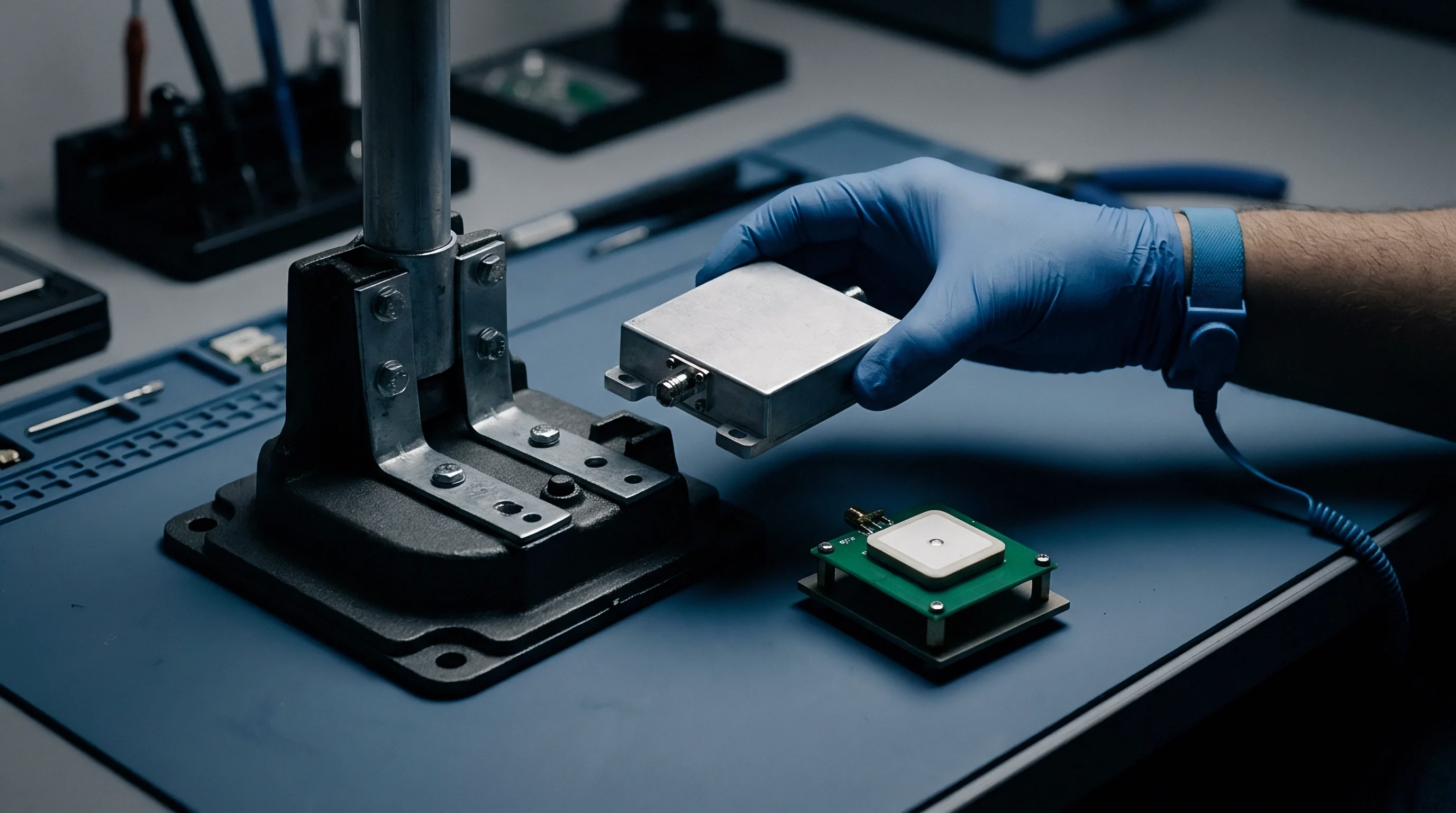
Power Profile during Burst Offload
The energy cost per delivered edge frame depends on airtime duration and power amplifier efficiency. Consider an edge event generating a 512-byte payload spooled in local FRAM. Transmitting this payload over a sub-GHz LoRa link at spreading factor 7 (125 kHz bandwidth, coding rate 4/5) results in an airtime of 71.9 milliseconds.
At 120 milliamperes transmit current from a 3.3 volt source, a single frame consumption equals 28.4 millijoules. The same payload transmitted over an LTE-M link requires an RRC connection setup phase consuming 450 milliamperes for 1.8 seconds, yielding a connection setup energy cost of 2.67 joules before payload byte transmission even begins.
Primary lithium thionyl chloride (LiSOCl2) batteries excel at low continuous drain but suffer from severe voltage delay and high internal impedance under sudden pulse loads. A 100-milliampere pulse drawn directly from a bobbin-type LiSOCl2 cell can drop terminal voltage below the 2.8 volt reset threshold of the edge processor. System designers bypass this limitation by placing a hybrid layer capacitor or a bank of low-ESR tantalum capacitors in parallel with the battery, supplying transient peak current while the battery replenishes the capacitor charge during sleep periods.
Single-cell lithium batteries require parallel hybrid layer capacitors to survive peak 120 milliampere radio PA surges without brownout resets.

Power Verification Documentation Requirements
Supply chain dossiers for battery-operated burst buffering hardware require explicit laboratory measurements before volume production sign-off.
- Current Waveform Trace files recorded at a minimum of 1 megasample per second capturing the complete sequence from initial edge interrupt to sleep entry.
- Capacitor Voltage Sag Curves documenting minimum rail voltage reached during maximum power amplifier transmit pulses at -20 degrees Celsius.
- Sleep Current Distribution Plots verified across fifty discrete production modules to establish upper statistical bounds for standby drain.
- Calculated Energy Per Byte metrics established for each available radio interface under varying payload sizes and modulation rates.
How does the state machine handle power budget allocation when continuous edge interrupts prevent the node from returning to deep sleep state?

Spectrum
Operating dual-radio edge devices globally requires navigating conflicting regional spectrum regulations. Unlicensed sub-GHz bands offer exceptional range and penetration, but strict regulatory bodies impose rigid duty cycle ceilings, maximum power limits, and channel access mechanisms. A protocol state machine optimized for the North American 915 MHz band fails compliance testing in Europe under 868 MHz rules unless firmware dynamically alters transmission parameters based on regional configuration flags.

Regulatory Framework Comparisons
European standards under ETSI EN 300 220 mandate tight duty cycle limits on sub-GHz bands, typically restricting airtime to 1.0 percent or 0.1 percent per hour depending on the specific sub-band segment. In a 1.0 percent channel, a radio can transmit for a total of 36 seconds within any rolling one-hour window. An edge-triggered application experiencing an acute sensor anomaly that attempts continuous burst dumping exhausts its hourly airtime allowance in minutes.
The state machine must respond by buffering subsequent events locally, stepping down transmission frequency, or failing over to a secondary licensed spectrum pipe like LTE-M or NB-IoT.
| Regulatory Region | Frequency Allocation | Max Radiated Power | Duty Cycle Limit | Channel Access Rules |
|---|---|---|---|---|
| Europe (ETSI) | 863.0 to 870.0 MHz | +14 dBm ERP | 0.1% or 1.0% per hour | Listen Before Talk or Duty Cycle |
| North America (FCC) | 902.0 to 928.0 MHz | +30 dBm Peak Conducted | No strict duty cycle limit | Frequency Hopping (FHSS) >50 Ch |
| Japan (ARIB) | 915.0 to 928.0 MHz | +13 dBm EIRP | Continuous Limit < 400ms | Listen Before Talk (LBT) Mandatory |
| Australia (ACMA) | 915.0 to 928.0 MHz | +30 dBm EIRP | No strict duty cycle limit | Frequency Hopping or Digital Mod |
FCC Part 15.247 regulations for North America do not impose hourly duty cycle ceilings, but require specific channel hopping schemes or minimum 6 dB bandwidths exceeding 500 kHz for digitally modulated systems operating up to +30 dBm transmit power. Japan’s ARIB STD-T108 standard enforces mandatory Listen Before Talk time windows of at least 128 microseconds, forcing the state machine to verify channel clearance prior to every edge burst frame transmission. Failure to detect ambient RF energy above -80 dBm requires the state machine to back off for a randomized interval, increasing edge buffer retention times.
Commercial sourcing contracts for dual-radio modules must account for regional compliance certification costs and module variant SKU management. A single worldwide hardware layout using a multi-band radio transceiver reduces inventory complexity, but requires region-specific antenna tuning circuits and firmware firmware images locked to destination country codes.
Standard procurement agreements for wireless modules specify that any unannounced change to internal silicon steppings or RF front-end component vendors voids existing regulatory approval files, transferring full re-certification financial liabilities directly to the module manufacturer.