Quantifying Power Consumption Spikes during Global eUICC Profile Steering Events
Global eUICC profile steering events consume up to twenty milliampere-hours across multi-minute sessions, requiring hybrid pulse buffering to prevent brownouts.

Surge
Field current traces recorded during an embedded universal integrated circuit card (eUICC) remote profile switch reveal electrical draw patterns that dwarf normal cellular telemetry bursts. When an asset tracker or smart meter initiates a subscription swap, the cellular transceiver leaves its low-power sleep state to negotiate an extended data session across local base stations. The radio frequency frontend activates power amplifiers to exchange cryptographic keys with the Subscription Manager Discovery Server and Subscription Manager Data Preparation platform, driving current drain from microampere baselines to sustained operational peaks reaching two amperes.
Current consumption during these steering events splits across two distinct hardware domains: the cellular baseband radio processor and the secure element running the eUICC operating system. While typical cellular transmission bursts last between twenty and five hundred milliseconds, an over-the-air profile steering sequence involves bidirectional packet transfers, authentication cycles, and local flash memory programming. The cellular transmitter operates at maximum target output power to maintain connectivity with distant cell towers during roaming handshakes.
A Cat-M1 transceiver pulling twenty-three dBm into a mismatched antenna consumes five hundred milliamperes while the eUICC secure element draws an additional thirty-five milliamperes during cryptographic verification.
Battery capacity calculations that rely purely on standardized periodic reporting models fail to account for the multi-minute energy penalty of an unexpected profile steering sequence. A profile change commanded by a cellular broker shifts the device into an active radio state that persists across multiple minutes. When radio conditions deteriorate, retransmissions multiply total power consumption by an order of magnitude.
Baseband Transients during Remote SIM Provisioning
Radio frequency power amplifiers generate steep load transients as the cellular modem switches through synchronization, random access, and bearer negotiation sequences. During LTE Cat-M1 attachments, transmit pulses draw instantaneous currents between three hundred and five hundred milliamperes at 3.6 volts under a matched fifty-ohm antenna load. If the antenna voltage standing wave ratio degrades to 3:1 due to proximity to metal enclosures or damp ground planes, the internal power amplifier increases current demand to compensate for reflected power, pushing supply line peaks beyond 750 milliamperes before decoupling capacitors can buffer the demand.
Baseband transceivers executing profile steering remain locked in active receive and transmit cycles for duration windows spanning 60 to 240 seconds. The radio must maintain continuous channel state information, process multiple Bearer Independent Protocol frames, and exchange transport layer security records with the remote subscription server.

Cryptographic Engine Current on the Secure Element
The secure silicon hosting the eUICC architecture introduces a secondary, highly concentrated current demand directly on the SIM interface rail. Operating under ISO/IEC 7816-3 or Single Wire Protocol electrical specifications, the secure element operates at Class B (3.0 volts) or Class C (1.8 volts) supplied directly through the cellular baseband power management unit. Asymmetric key operations, specifically elliptic curve cryptography curve calculations executing during mutual authentication, trigger internal charge pumps within the smart card chip.
Writing a newly downloaded operational profile into the secure element requires non-volatile memory block erasures and programming cycles. Modern eUICC integrated circuits utilize embedded flash or advanced ferroelectric memory that requires localized voltage elevation up to twelve volts via on-chip charge pumps. Writing a typical profile container ranging from forty to eighty kilobytes generates sustained current spikes between twenty and forty milliamperes directly on the SIM supply line for ten to twenty-five seconds.
Depleted cells drop output voltage below the power management threshold, forcing permanent baseband shutdown and stranding field assets prematurely.

Handshake
Subscription steering sequences begin when the home cellular operator or mobile virtual network enabler forces an over-the-air profile switch to minimize roaming fees or reassert billing control. The baseband processor receives an application protocol data unit command triggering the local profile assistant to establish an external data pipe through the active cellular connection. This action prevents the modem from entering discontinuous reception modes or entering power-saving states.
Negotiation sessions proceed through standardized GSMA SGP.02 (machine-to-machine) or SGP.22 (consumer and industrial) remote SIM provisioning flows. The terminal connects to the Subscription Manager Data Preparation node, verifies server identity through X.509 certificate chains, and streams an encrypted profile bundle containing file system tables, international mobile subscriber identity credentials, and security keys. Packet loss on marginal cellular edges forces transport-layer retransmissions, ballooning RF transmission time and total watt-hours consumed.
| Operational Phase | Voltage Rail (V) | Peak Current (mA) | Average Current (mA) | Duration (s) | Energy (mWh) |
|---|---|---|---|---|---|
| Cellular Grid Scan and PLMN Re-Attach | 3.6 | 620 | 185 | 28.4 | 5.25 |
| TLS Tunnel Establishment | 3.6 | 410 | 140 | 8.6 | 1.20 |
| Encrypted Profile Download (65 kB) | 3.6 | 480 | 165 | 42.1 | 6.95 |
| eUICC Flash Erase and Decryption | 3.6 (eUICC 1.8) | 95 | 42 | 16.8 | 0.71 |
| SIM Warm Reset and Execution | 3.6 | 210 | 68 | 3.2 | 0.22 |
| New Carrier Registration and Attach | 3.6 | 680 | 210 | 34.5 | 7.24 |
| Data measured at twenty-five degrees Celsius with nominal 3.6V supply, antenna VSWR under 1.5:1, and LTE Cat-M1 coverage at -92 dBm RSRP. | |||||
Following profile write completion, the eUICC issues a proactive command signaling a refresh event to the baseband modem. The modem drops its current registration, re-initializes the physical SIM interface via an explicit Answer To Reset cycle, and reloads subscriber files. A full cellular frequency scan follows, probing local spectrum allocations to attach to the newly authorized Public Land Mobile Network.
GSMA SGP.02 clause 5.3.4 permits cellular operators to throttle SIM toolkit polling intervals, extending OTA execution times beyond three minutes during hostile radio conditions.
Each profile transition subjects the host power distribution line to an unbuffered energy drain. The following failure patterns routinely surface during unmanaged remote steering execution across remote cellular assets:
- Secure Session Expiry happens when high packet jitter stalls the TLS handshake, causing the remote provisioning server to drop the socket and forcing the device to restart the download script from scratch.
- Channel Scanning Thrashing arises when the newly activated profile specifies radio access technologies unsupported by regional base stations, compelling the modem to search alternate frequency bands continuously.
- SIM Interface Brownout occurs during flash programming operations if the supply rail dips below 1.62 volts, creating corrupted file structures and locking the secure chip permanently.
- Baseband Watchdog Trip strikes when prolonged carrier re-registration scripts block host microcontroller communication, causing autonomous supervisory circuits to trigger a hardware reset.
Carrier steering logic can lock modems into persistent execution loops if roaming agreements between multi-national mobile network operators alter profile permissions while the unit remains transit-bound. If an activated profile gets rejected by local cell towers with specific cause codes, such as PLMN Not Allowed, the profile assistant attempts fallback routines. These routines reactivate bootstrap credentials, reconnect to the discovery engine, and download alternate subscriptions.
Incorporating GSMA PRD IR.73 section 4.1 into wholesale SIM access contracts penalizes excessive steering refreshes by transferring subscriber re-attachment fees directly back to the MVNO.

Droop
Primary battery chemistries deployed in field telemetry hardware react severely to the sustained pulse trains demanded by profile steering events. Lithium thionyl chloride (LiSOCl2) and lithium manganese dioxide (LiMnO2) systems exhibit internal impedance values that rise as chemical cells discharge or encounter sub-zero temperatures. High instantaneous current pulses drawn by the cellular power amplifier pull terminal voltage downward through simple ohmic resistance.
Lithium thionyl chloride cells passivate during prolonged sleep, dropping usable terminal voltage below the baseband shutdown threshold when hit by instantaneous radio transmit pulses.
When terminal voltage sags below the minimum operating threshold of the cellular modem, internal supervisory circuits initiate an emergency power cut. Most cellular baseband chipsets require a solid 3.1 to 3.3 volt input to maintain linear power amplifier operation; falling below 2.8 volts trips the low-voltage lockout circuit and risks latching the unit into repeated reboot sequences.
Can Profile Steering Trigger Autonomous Battery Cutoff?
Direct battery cutoff occurs routinely when an eUICC profile swap coincides with deep chemical passivation. Lithium thionyl chloride cells develop an insulating lithium chloride crystalline layer across their lithium anodes during storage or prolonged microampere sleep modes. This passivation film preserves cell capacity over multi-year operational horizons, behaving much like the passive oxide layers that protect structural alloys from chemical degradation.
Under sudden load, this protective film acts as a high series resistance, choking current output and dropping cell output voltage below baseline parameters until physical current flow dissolves the crystals.
A standard sensor wake-up drawing thirty milliamperes for two hundred milliseconds generates minimal voltage depression and safely clears light passivation films. A profile steering event, however, demands four hundred to eight hundred milliamperes within the first three seconds of network reconnection. If heavy passivation remains present on the anode, terminal voltage collapses almost instantaneously to less than two volts.
The baseband processor browns out, restarts, attempts to read the SIM card again, and drops the battery into a cyclical reset loop that permanently drains remaining cell capacity.
| Chemistry | Open Circuit (V) | Loaded Rail at 25°C (V) | Loaded Rail at -20°C (V) | Internal Resistance (Ω) | Passivation Risk |
|---|---|---|---|---|---|
| LiSOCl2 Spiral Wound (D-Cell) | 3.67 | 3.32 | 2.88 | 0.45 | Moderate |
| LiSOCl2 Bobbin Type (AA-Cell) | 3.65 | 2.45 | 1.75 | 3.80 | Severe |
| LiMnO2 High Rate (CR123A) | 3.15 | 2.85 | 2.42 | 0.35 | Negligible |
| LiSOCl2 with Hybrid Pulse Cap (HPC) | 3.65 | 3.48 | 3.18 | 0.12 | Suppressed |
The internal resistance parameters documented above illustrate why standard bobbin-type lithium thionyl chloride cells cannot natively support remote SIM provisioning operations without secondary energy storage. An internal resistance of nearly four ohms produces an immediate 1.6-volt drop under a modest four-hundred-milliampere transmit pulse, terminating baseband execution instantly.

Passivation Layers in Lithium Thionyl Chloride
Overcoming anode resistance requires sequential, staged current steps before initiating wireless eUICC steering routines. The system must activate resistive dummy loads or schedule minor receive-only RF sequences to peel back the lithium chloride crystal barrier gradually. Depassivation cycles consume measurable capacity without advancing data transfer, adding to the hidden overhead of carrier profile re-assignments.
- Pre-Activation Stage engages a controlled ten-milliampere internal current sink for five hundred milliseconds to evaluate baseline voltage depression under low load.
- Secondary Step Sequence draws fifty milliamperes through periodic transceiver listening sweeps, monitoring the internal battery rail via the analog-to-digital converter until voltage stabilizes above 3.2 volts.
- High Current Qualification pulses the transmitter at one hundred milliwatts conducted power for ten milliseconds to confirm that internal cell resistance has dropped below critical operational limits.
- Execution Authorization releases the profile management firmware to open data sockets with the remote subscription server and proceed with the download phase.
Bypassing this staged depassivation sequence guarantees brownout failures on assets deployed in northern latitudes or temperature-controlled cold-chain shipping containers. Battery discharge curves steepen rapidly when continuous RF transmit cycles collide with cold ambient operational boundaries.


Rig
Accurate verification of eUICC steering current spikes requires specialized bench instrumentation capable of capturing microampere-level sleep currents alongside high-frequency, multi-ampere transmit peaks. Standard digital multimeters rely on integrating auto-ranging circuitry that dampens or misses transient spikes lasting tens of microseconds. A wideband current measurement system or high-speed precision power analyzer connected in series with the device under test captures the true shape of the transient profile.
To quantify the true energy consumption of a profile swap, test configurations must isolate the eUICC supply pins from the main cellular modem voltage rail. By placing an isolated current shunt on the ISO 7816-3 VCC line and another on the primary battery supply, the engineer separates baseband RF radiation consumption from the energy required to execute internal eUICC cryptographic verification and non-volatile memory programming.

Do Unacknowledged OTA Retries Explain Energy Spikes?
Retransmissions driven by degraded link margins explain why field deployments burn ten times the calculated energy budget during profile updates. During an engineered bench test, an attenuator bank inserted between the module antenna port and a base station simulator demonstrates the steep energy non-linearity. At an optimal Reference Signal Received Power (RSRP) of -75 dBm, a complete profile switch consumes approximately 21.5 milliampere-hours of capacity over 130 seconds.
When the programmable attenuator degrades the signal to -115 dBm, forcing lower modulation coding schemes and heavy Hybrid Automatic Repeat Request retries, the required energy skyrockets to 184 milliampere-hours across 680 seconds.
Carrier policies dictate retry limits. If the profile download pipeline encounters an unacknowledged frame during the APDU sequence, the modem holds its transmit power at maximum output while awaiting TCP socket recovery. In low-coverage regions, the module frequently reaches its maximum transmission power limit of +23 dBm on Band 20 (800 MHz) or Band 28 (700 MHz), draining the primary battery cell at over 450 milliamperes for the entire recovery window.
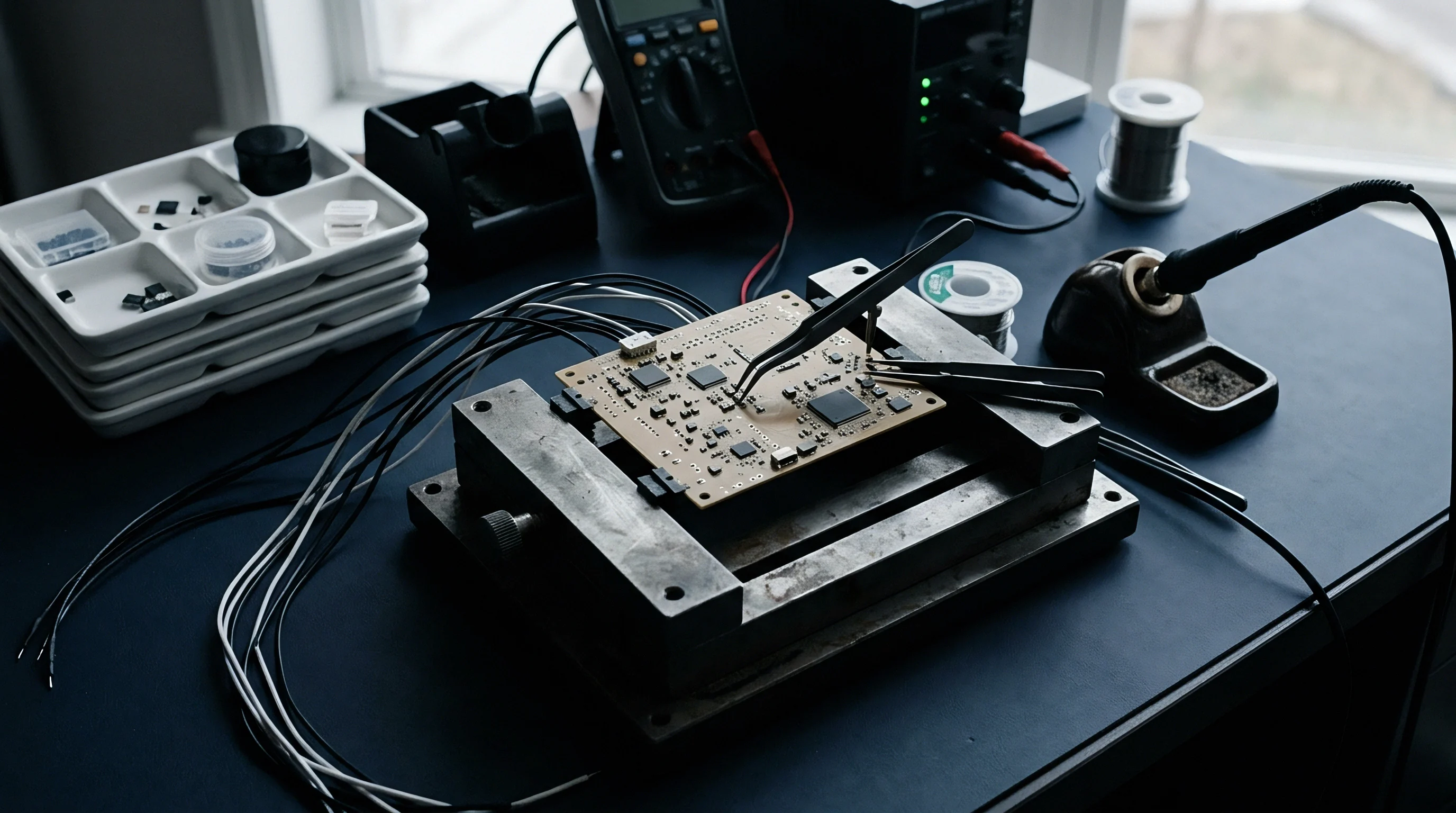
Bench Instruments for Millisecond Transients
Capturing the full profile steering signature demands an instrumentation stack with high sampling rates and dynamic range spanning at least six decades of current magnitude. Evaluating hardware performance prior to volume manufacturing runs relies on a strict verification checklist:
- Sampling Bandwidth demands a minimum digitization rate of one hundred kilosamples per second to resolve discrete TDMA transmit bursts and charge pump activation transients.
- Buried Shunt Calibration validates that voltage burden introduced across current sensing resistors does not artificially force the module into premature low-voltage cutoffs during multi-ampere pulses.
- Multi-Channel Acquisition measures the primary system rail, the eUICC VCC pin, and digital control lines simultaneously to correlate current peaks with specific APDU command packets.
- Shielded RF Coupling isolates the device under test inside a solid copper anechoic box to eliminate external interference from nearby commercial base stations during protocol traces.
Data gathered through this test methodology reveals that software estimates generated by cellular profile brokers systematically under-report field energy dissipation by ignoring physical layer retransmissions.

Safeguard
Protecting remote field hardware against the catastrophic effects of profile steering transients demands hardware-level energy buffering coupled with protective firmware policies. Adding a hybrid pulse capacitor or supercapacitor in parallel with a primary lithium cell decouples the electrochemical energy source from millisecond power amplifier peaks. The primary cell trickle-charges the capacitor during extended low-power sleep cycles, while the low-ESR capacitor discharges directly into the power amplifier during profile negotiation bursts.
Firmware architecture must establish strict boundaries around over-the-air management operations. Autonomous subscription management agents embedded in device application code must actively audit battery state of charge, ambient temperature, and prevailing RF signal strength before clearing the cellular modem to process an incoming profile steering command. If the primary supply rail exhibits high internal impedance or if the received cellular signal drops below -105 dBm RSRP, the device must defer profile execution to preserve operational survival.
| Buffering Topology | Added BOM Cost ($) | Quiescent Leakage (µA) | Peak Current Capacity (A) | Operating Temperature (°C) | PCB Footprint (mm²) |
|---|---|---|---|---|---|
| Hybrid Pulse Capacitor (HPC) | 2.45 | 0.8 | 5.0 | -40 to +85 | 140 |
| Electric Double-Layer (Supercap) | 1.15 | 4.5 | 2.5 | -20 to +65 | 95 |
| Solid Tantalum Array (4x 470µF) | 0.85 | 2.2 | 1.2 | -55 to +105 | 180 |
| Oversized Spiral LiSOCl2 Cell | 3.10 | 0.2 | 2.0 | -55 to +85 | 520 |
Selecting an energy buffer involves balancing component bill of materials costs against operational life expectancies. While standard electric double-layer capacitors offer an economical solution for mild industrial environments, their elevated leakage current at high ambient temperatures can consume more cumulative energy over ten years than the profile steering events they were added to mitigate. Hybrid pulse capacitors combine the low self-discharge of lithium primary cells with the pulse delivery of electrolytic systems, maintaining minimal quiescent leakage across automotive operating ranges.
Firmware engineers often size device power budgets for steady-state cellular telemetry while overlooking the multi-minute energy penalty of remote profile swaps.
Assume a typical deployment scenario: a battery-powered asset tracker operates on a single AA-sized lithium thionyl chloride cell rated at 2,400 milliampere-hours at twenty-five degrees Celsius. Assume an operational baseline where the device transmits one hundred bytes once per day via LTE-M, consuming twenty-five microampere-hours per daily transmission cycle alongside a sleep current of 3.5 microamperes. Under this baseline, the theoretical cell longevity exceeds ten years.
Now introduce a carrier profile steering event that executes under suboptimal radio conditions, drawing an average current of 280 milliamperes for three minutes. This single steering operation burns fourteen milliampere-hours, wiping out 560 days of regular telemetry budget in 180 seconds. If an unstable carrier platform triggers four automated steering retries within a single week, the device expends fifty-six milliampere-hours, permanently degrading cell terminal voltage and shaving years off operational deployment lifetime.
Mitigating these exposure profiles requires explicit technical service level agreements with MVNOs and cellular airtime brokers. Sourcing engineers must write definitive operational clauses into data contracts, prohibiting cellular core systems from issuing over-the-air SIM toolkit refresh scripts without explicit, device-initiated authorization. Limiting profile steering routines to scheduled maintenance intervals when the hardware connects to external power sources eliminates unexpected brownout events entirely.
Whether future non-terrestrial cellular standards can negotiate multi-carrier credential swaps without quadrupling localized energy expenditure remains fundamentally unproven across mass silicon deployments.